Where to Put the Boards in a Fanless Box
This is a companion to our heat-sink study, A Hundred Solves for One Heat Sink. That one optimized the fins of a single sink. This one steps back to the box: a sealed, fanless enclosure — a roadside telecom cabinet, a fanless edge server, a potted controller — where you cannot add a fan and cannot add fins to the air, because the air never leaves. All you can do is decide which board goes where.
We built a generic sealed aluminum enclosure, 260 × 180 × 140 mm, holding 5 heat-generating boards in a vertical stack of slots, dissipating 114 W in total into 25 °C surroundings. The boards have fixed, distinct powers — a hot processor, a power module, and lesser cards — and the design question is the assignment: which board in which slot. There are more than a hundred ways to arrange five boards; the script sampled 23 of them and let Icepak resolve the buoyant airflow inside each.
Fanless is not a niche choice. Fans are the least reliable part in most electronics — they clog, seize, and wear out long before the silicon does — so anything that has to run untended for years in a dusty, wet, or sealed setting tends to do without one: outdoor telecom and traffic cabinets, industrial controllers, medical and defense boxes, potted power supplies. The price of that reliability is that every watt has to conduct to the walls and drift out by natural convection and radiation alone. When the total dissipation is fixed and there is no fan to add, the engineer's remaining degrees of freedom are the enclosure and the layout — and the layout costs nothing to change.
A buried hot board cooks
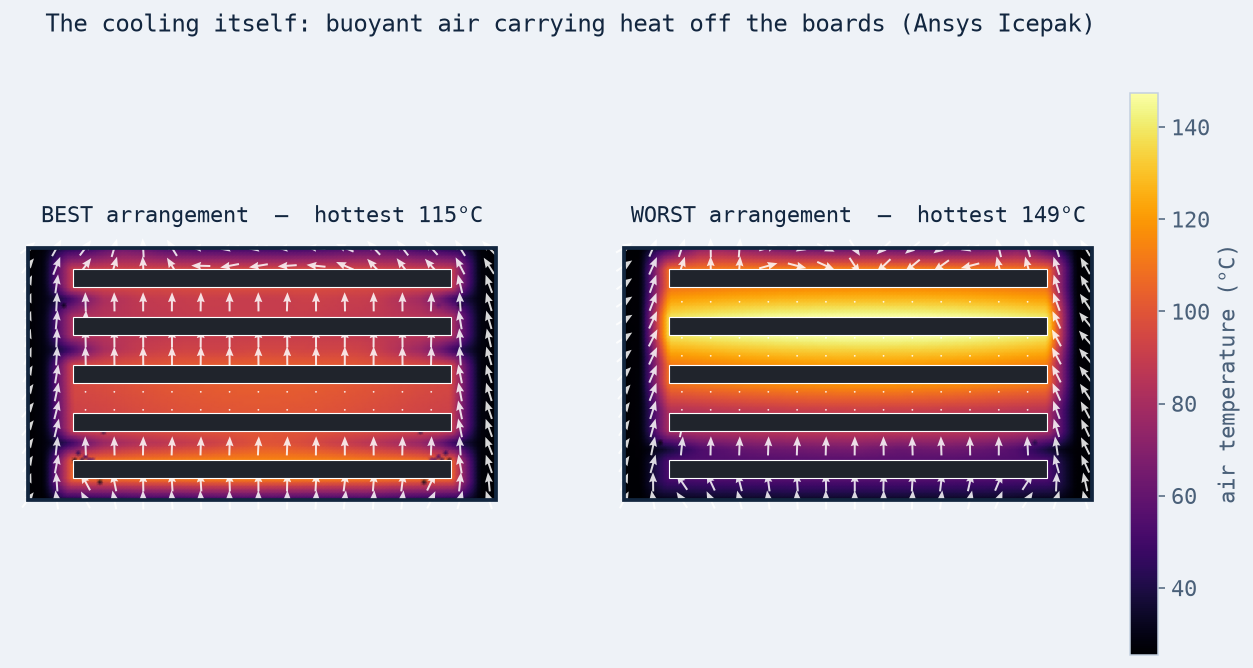
With no fan, the only thing moving the heat is buoyancy: warm air rises off each board, pools under the lid, and sinks along the cool walls. That sets up a simple rule the simulation makes vivid — the worst place for a high-power board is the middle of the stack. There it heats the air passing up to the boards above it, and it sits under the warm blanket they in turn create; its own plume has nowhere clean to go. Put that same board low, near the floor and the cool inflow, and its heat rises away past everything instead of soaking the neighbors.
The leaderboard
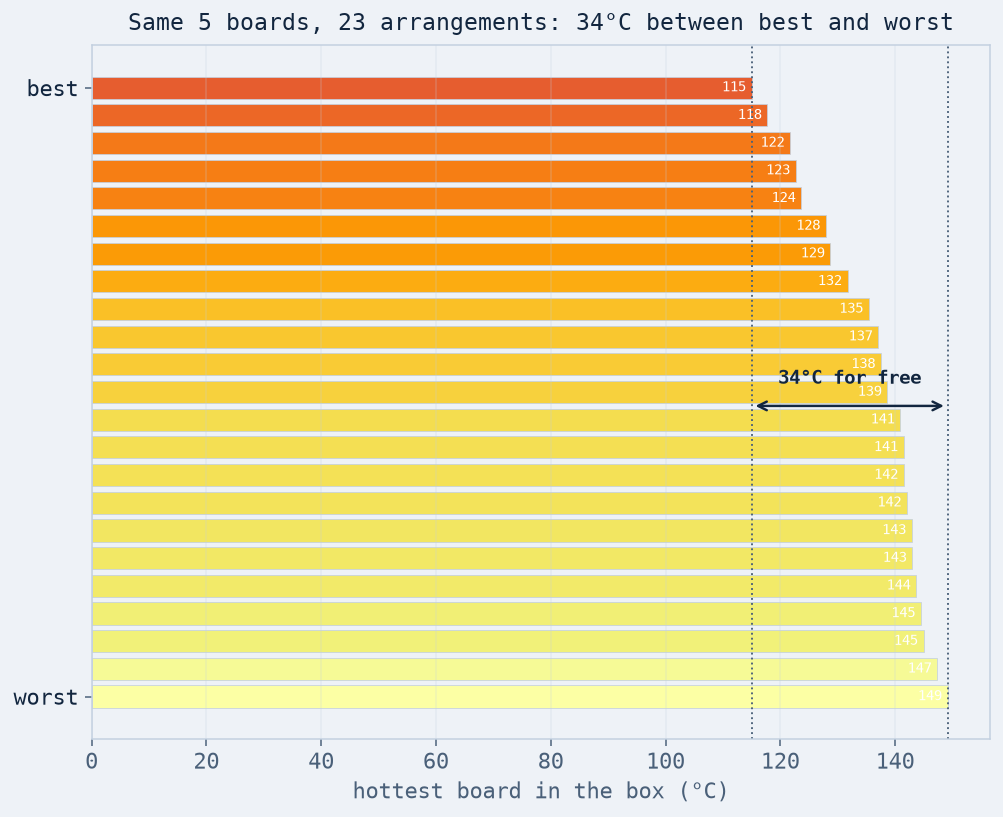
Ranking every arrangement by its hottest board turns a vague intuition into a design curve. The spread is not subtle: 34 °C separates the best layout from the worst, and for a component whose life halves roughly every 10 °C, that is the difference between a design that lasts and one that fails in the field — bought with nothing but a bill of materials that was already fixed.
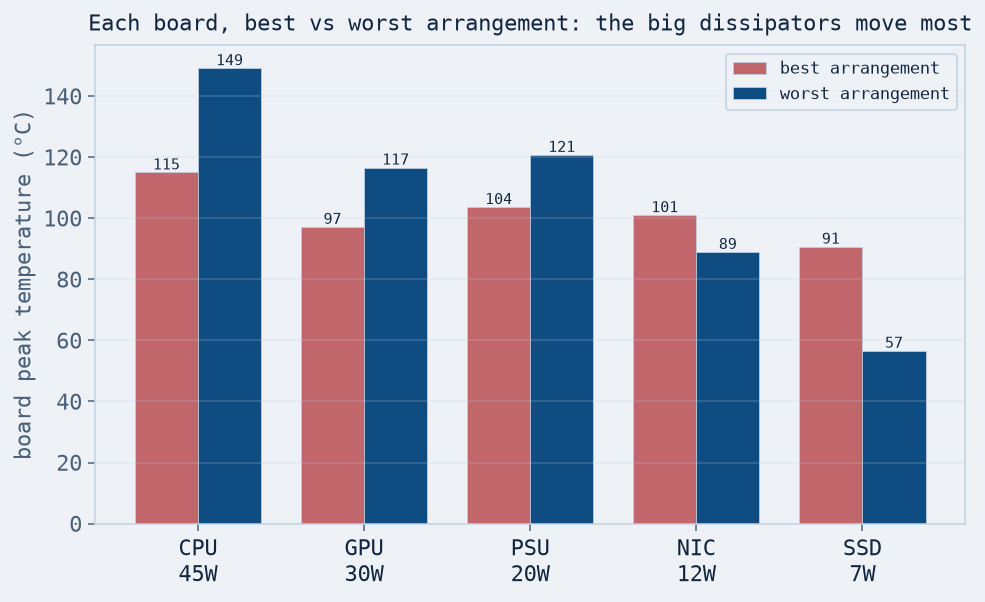
Breaking the two extreme layouts down board by board shows where the swing lives: it is the high-power boards that move, while the small ones barely notice. The biggest dissipator is the whole story — it is the board that gets buried or freed — and the low-power cards ride along close to their surroundings wherever they sit. That is the practical takeaway: you do not have to place every board perfectly, only keep the one or two biggest heat sources out of the trap.
Why natural convection makes it non-obvious
The intuitive move — spread the hot parts out evenly, or put the hottest on top where heat “wants” to go — is not what wins. Because the hot air itself collects at the top of a sealed box, a high-power board placed high sits in the warmest air in the enclosure and has little headroom to shed into. The winning layouts keep the biggest dissipators low, where the air is coolest and their plumes can rise clear, and reserve the top slots for the low-power boards that can tolerate the warm ceiling. It is the kind of coupled, buoyancy-driven trade that you cannot read off a spreadsheet — it takes resolving the actual flow in the box, which is exactly what a conjugate heat-transfer solve does.
The rule that falls out is short enough to design by: put the biggest heat sources low and near a wall, give them clear air above, and let the small stuff take the warm top slots. But the ranking matters more than the rule, because the penalty for getting it wrong is not gentle — most arrangements cluster in a broad middle band, and it is the few genuinely bad ones, the layouts that bury the processor, that fall off a cliff. A sweep finds those cliffs; intuition walks off them.
Is the number trustworthy?
The physics carries its own check. At steady state a sealed box must reject exactly the power put into it — 114 W in, 114 W out through the walls to ambient — and that global balance holds for every layout, because rearranging the boards moves heat around inside the box but cannot change how much the box has to shed. What the layout changes is the internal distribution: the temperature the hottest board is forced to reach to drive its share of that 114 W out through the shared, still air. That is why the identical total power lands anywhere from 115 to 149 °C on the worst-off board, and why the arrangement — not the wattage — is the free variable worth sweeping.
What the automation did
One enclosure was built parametrically, and a script stamped out 23 board arrangements, solved each in Ansys Icepak as a steady natural-convection conjugate heat-transfer problem — buoyant air, conduction through the boards, surface-to-surface radiation — read back every board's peak temperature, and ranked them, one solve at a time with no one at the keyboard. The deliverable is not a single run; it is the leaderboard, and the rule it exposes: in a fanless box, layout is a free thermal-design variable that most teams leave on the table.
What this model does and does not cover
Have a sealed or fanless box that runs hotter than you would like? The cheapest degrees are often in the arrangement, not the hardware — and the only way to find them is to resolve the flow. We do this in Ansys Icepak, Fluent and Mechanical. Rand Simulation — innovation through insight.