Why a Flat Camera Lens Sees in Only One Color
A camera lens has one job: take every ray leaving a point in the world and bring it back to a single point on the sensor, for every color at once. A glass lens does it with curvature and thickness. A metalens does it with a flat surface: a dense field of pillars, each a tiny antenna whose width sets how much it delays the light passing through. Choose each pillar's width to reproduce the phase a curved lens would have imposed, and a sheet a micron thick bends light like a lens millimeters thick. The question that decides whether it can be a camera lens is not whether it focuses — it is whether it focuses all colors to the same plane. That is a solve, not a formula, and it is the question here.
This study is the visible-light companion to our thermal-camera metalens, Can a Flat Lens Made of Data Focus Heat? That one showed a silicon metalens focusing long-wave infrared and the focus sliding with color; this one asks the same question for a visible camera — and answers it with a picture, not just a focal curve.
Building the lens from measured pillars
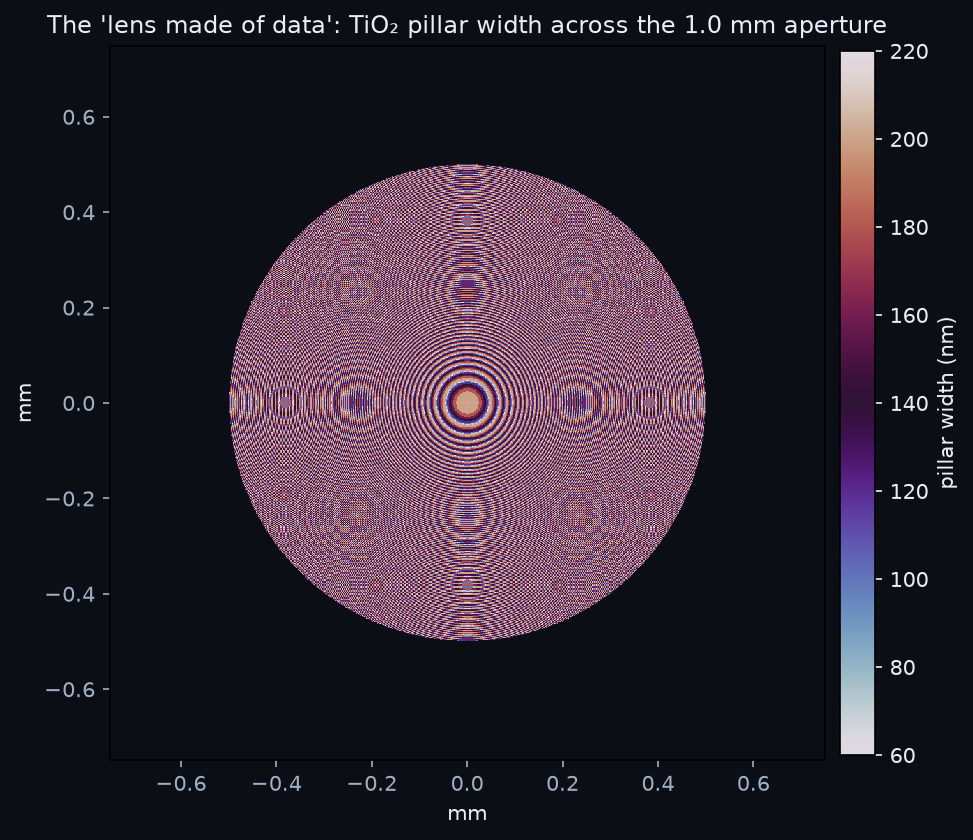
You cannot guess how a pillar delays light — you have to measure it. Ansys Lumerical FDTD solves Maxwell's equations for one TiO₂ pillar in its lattice, returning the phase and transmission it imposes at each color; sweeping the width builds a library of “atoms” to choose from. That library is the honest core of the study: the built atoms span a full 2π of phase at 550 nm with near-unity transmission and a clean energy balance, gated before a single pillar was placed. With the library in hand, the green-design phase at every point of the aperture picks the pillar that fits, and the lens falls out: about 8,724,901 pillars, each width a number, on a stack 1.1 µm thick.
It focuses — then the color walks off
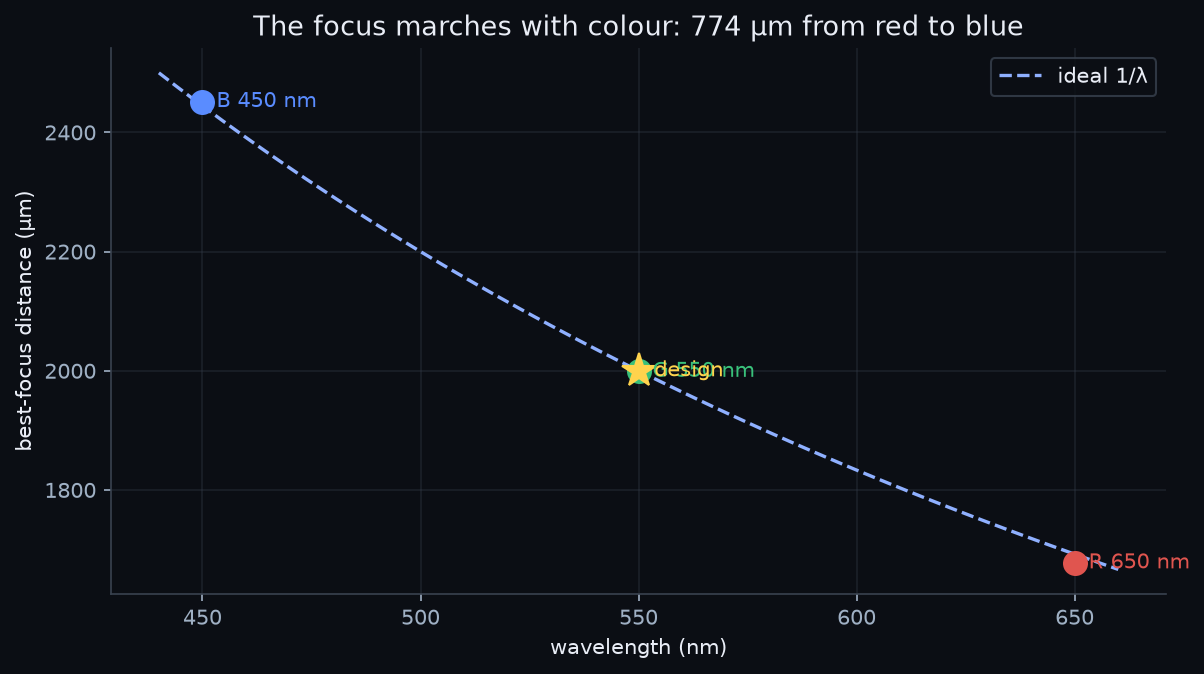
Handed the measured pupil — each cell carrying the transmission and phase its pillar was solved to have — an exact angular-spectrum propagation shows where each color comes to a point. Green lands on the 1999 µm design plane; red and blue do not. They focus at 1678 and 2452 µm, a 774 µm spread across the visible band, because the pillars deliver the right phase at exactly one wavelength and the wrong one everywhere else. This is chromatic aberration, and on a metalens it is severe and backwards from glass: the focal length falls as 1/λ, so blue (short wavelength) focuses farthest, red nearest. A single flat surface simply cannot hold all three colors to one plane.
What the sensor sees
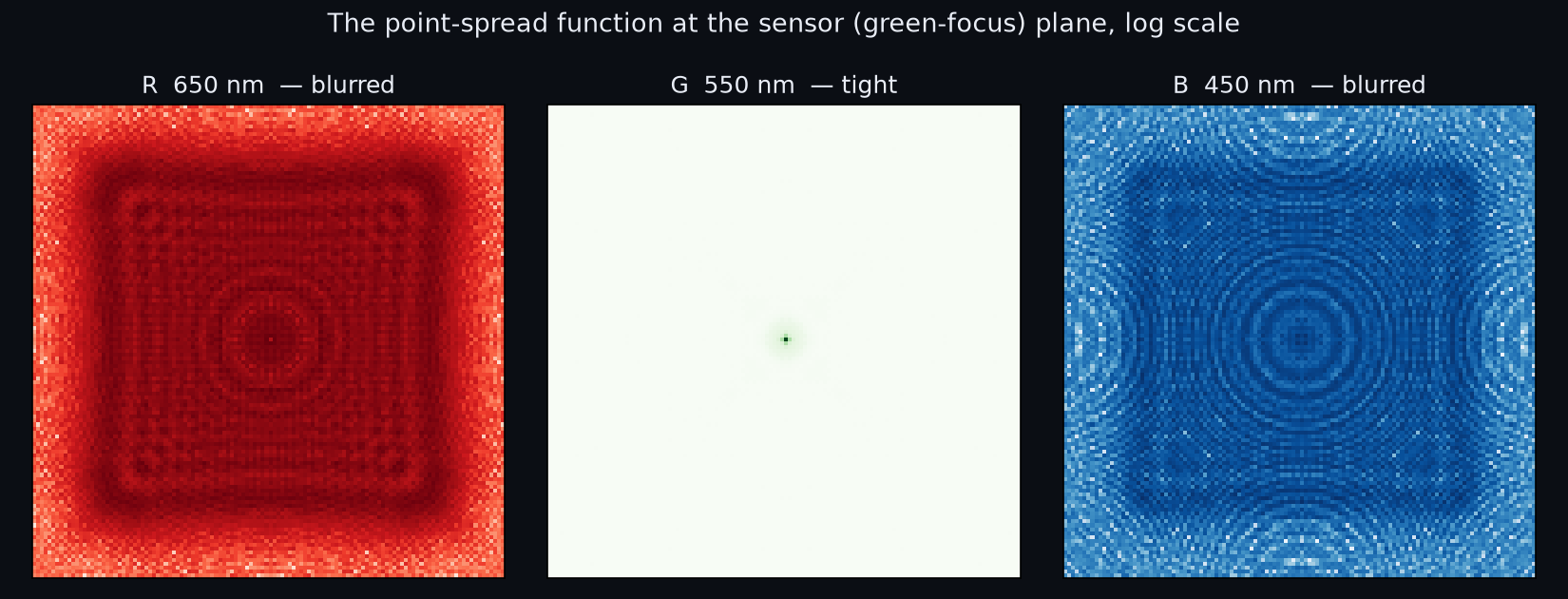
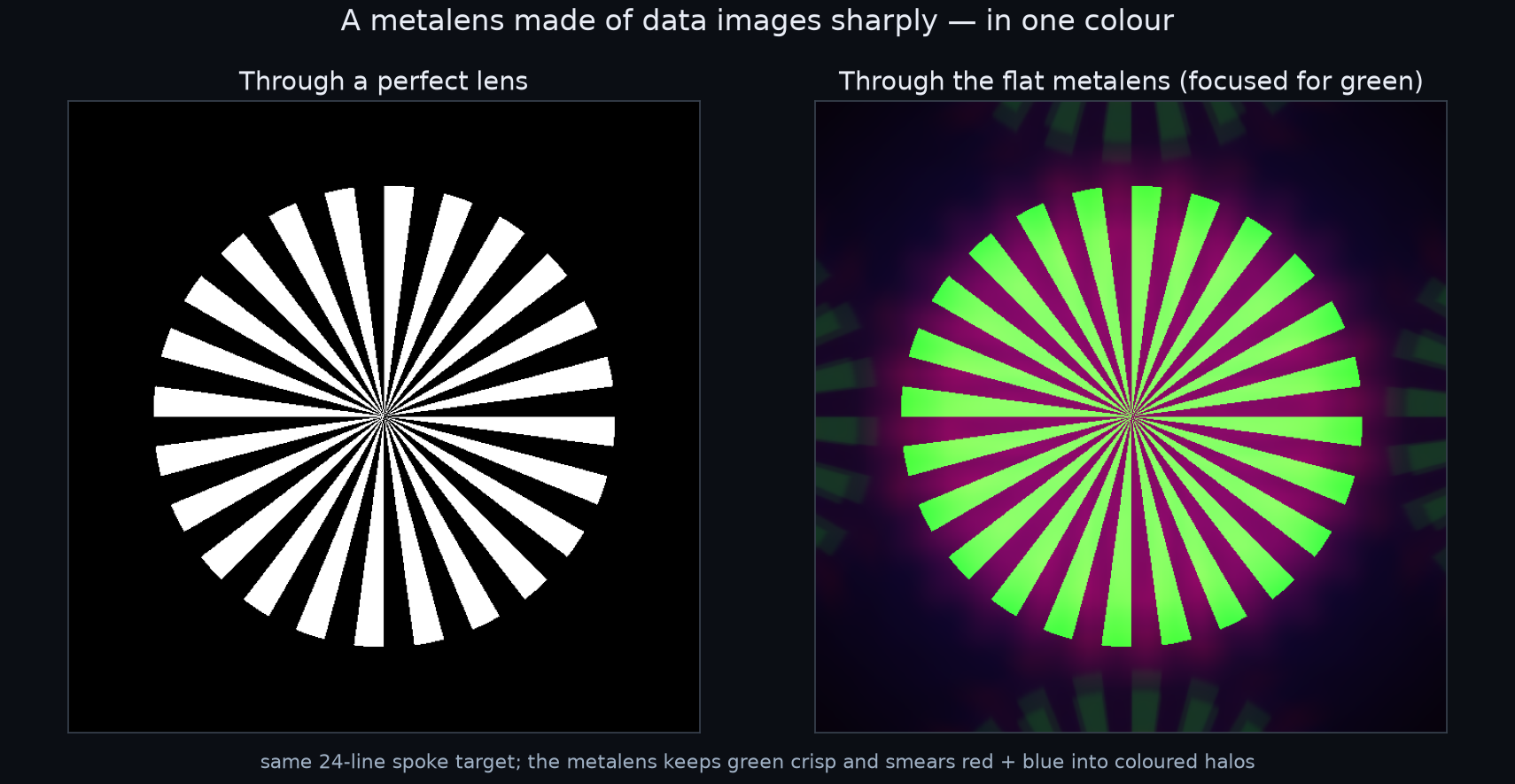
Fix the sensor at the green focus, where a camera would put it, and propagate a resolution target through the lens color by color. Green comes through crisp — a point images to a spot 5385x tighter than red and 9532x tighter than blue at that same plane. Red and blue, focusing hundreds of microns away, land on the sensor as broad discs, so every bright feature wears a magenta-and-blue halo. That is the hero image above: the lens is genuinely, sharply imaging — in green — and fringing everything else. Stop the target down to green light alone and a flat metalens is a superb, hair-thin camera lens; hand it white light and it is a one-color camera.
That is not a modeling artifact — it is the honest state of the art, and the reason single-layer metalenses are not yet in your phone's main camera. A flat metalens buys astonishing thinness and a fabrication that is lithography rather than grinding, at the cost of a chromatic spread a curved lens does not have. Beating it — stacking dispersion-engineered atoms, or splitting the color channels — is the open research problem the field is built around. Seeing both halves in one solved image, the crisp green and the colored halos, is exactly what tells a camera designer whether a metalens belongs in a given system.
What this model does and does not cover
Designing a metalens, a diffractive optic, or any structured surface where the pattern is the component? The design wavelength is the easy part; imaging across a band is where the physics lives, and it is a solve — unit-cell library plus propagation — not a formula. We do metasurface and diffractive-optics work in Ansys Lumerical. Rand Simulation — innovation through insight.