How Much a Foil Wrap Blocks a Car Key Fob's Signal
A Modern Car Key Is Two Radios, and Foil Only Answers One
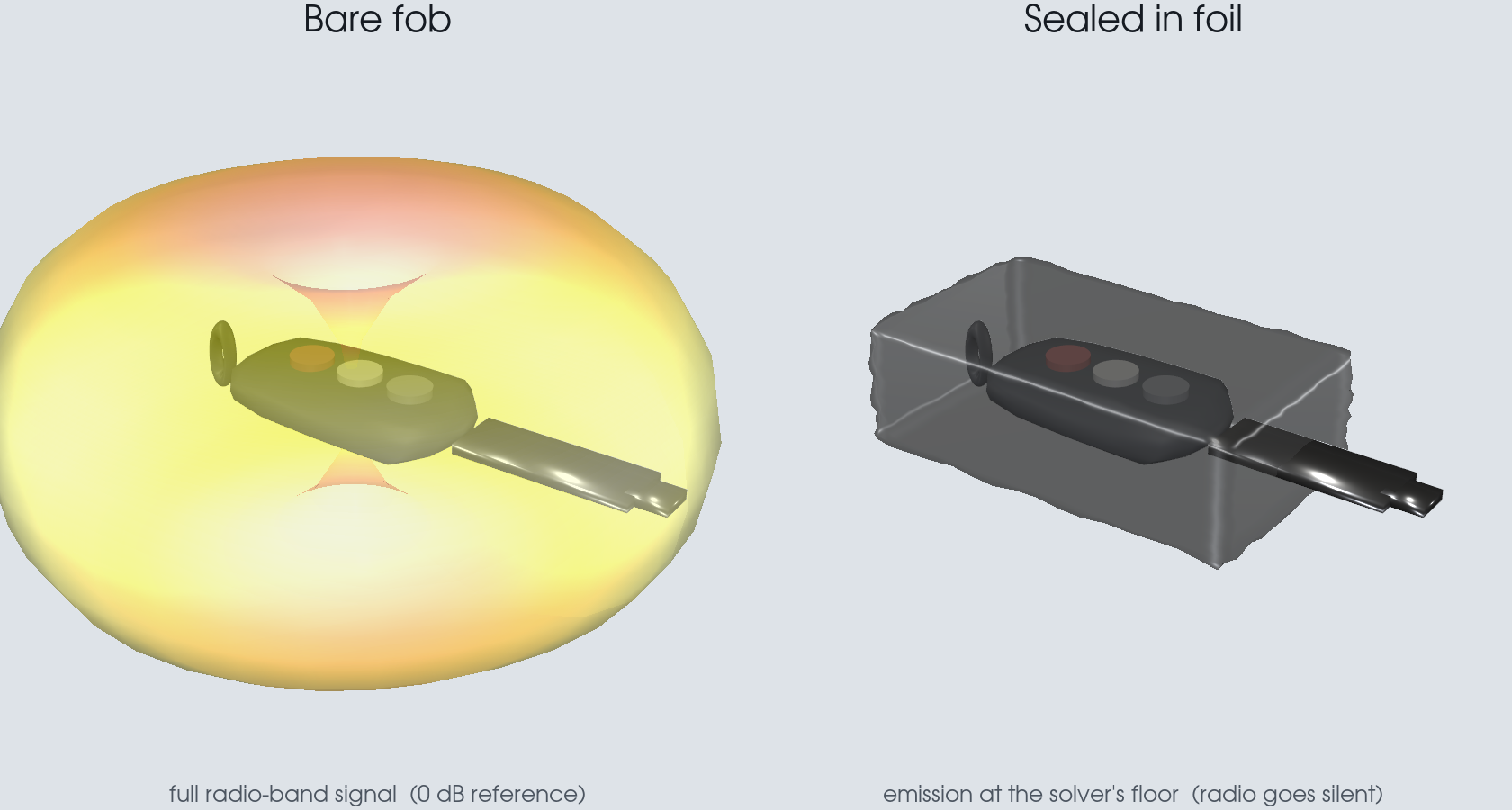
A keyless-entry attack is a relay: two thieves, two boxes, one link between them. One box stands by your car and impersonates the fob; the other stands by your house and impersonates the car, waking your key and passing its reply back down the line. That handshake runs on two very different radios. The car wakes the fob with a 125 kHz low-frequency magnetic pulse, and the fob answers with a 315 or 433 MHz radio chirp. A foil wrap, a tin, or a pouch is specified against that second link — the UHF reply — and that is the link a full-wave solver like HFSS is built to price. So lead with the nuance: this study shows what a wrap does to the fob's radio reply, and at that band a sealed wrap is genuinely strong. It does far less to the 125 kHz wake-up pulse, which is a different kind of physics entirely — and, as the scope box below works out, thin non-magnetic foil is a poor shield there. Foil quiets the echo; it barely touches the shout that starts the whole exchange.
What Shielding Effectiveness Means Here
Shielding effectiveness (SE) is the honest number the enclosure-shielding literature uses: solve the field radiated by the bare fob, solve it again with the wrap in place, and take the ratio in decibels. Higher is better — 20 dB means the escaping field is one-tenth as strong, 40 dB one-hundredth, and so on. It is a ratio, so the exact antenna does not matter as long as it is the same in every run; ours is a small strip dipole about 17 mm tip to tip, which at 433 MHz is only about a fortieth of a wavelength — electrically tiny, exactly like a real fob antenna. Each wrap is a thin conductive shell around it: aluminum for the foil, a mild-steel box for the tin, a good conductive fabric for the pouch. At these frequencies the metal itself is never the leak — aluminum's skin depth at 433 MHz is under four microns against a wall thousands of times thicker — so a perfectly sealed shell blocks essentially everything, and the whole story lives in the openings: the fold in a foil wrap, the seam under a tin lid, the overlap of a pouch flap.
A Gap in the Foil: Does It Really Ruin the Protection?
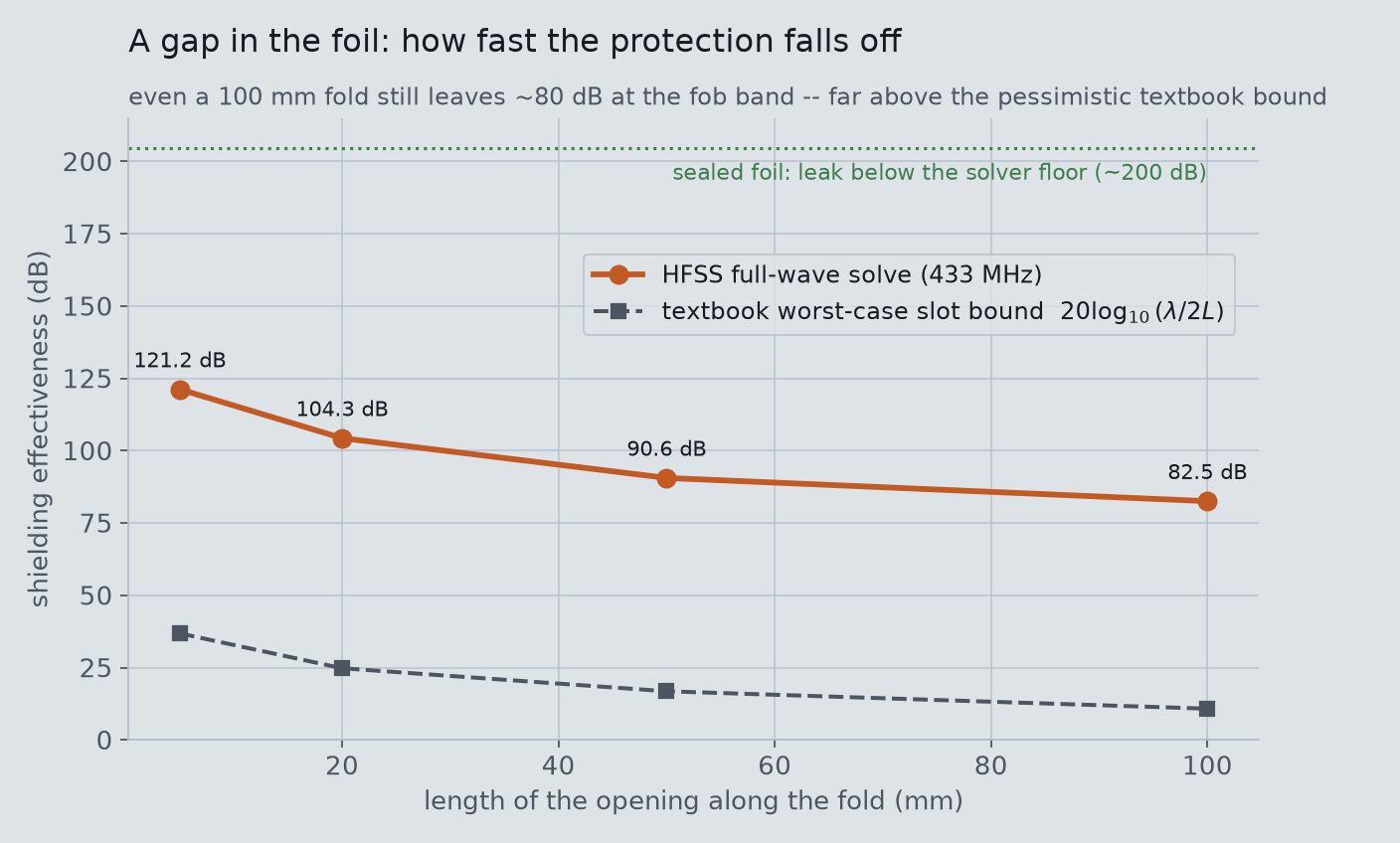
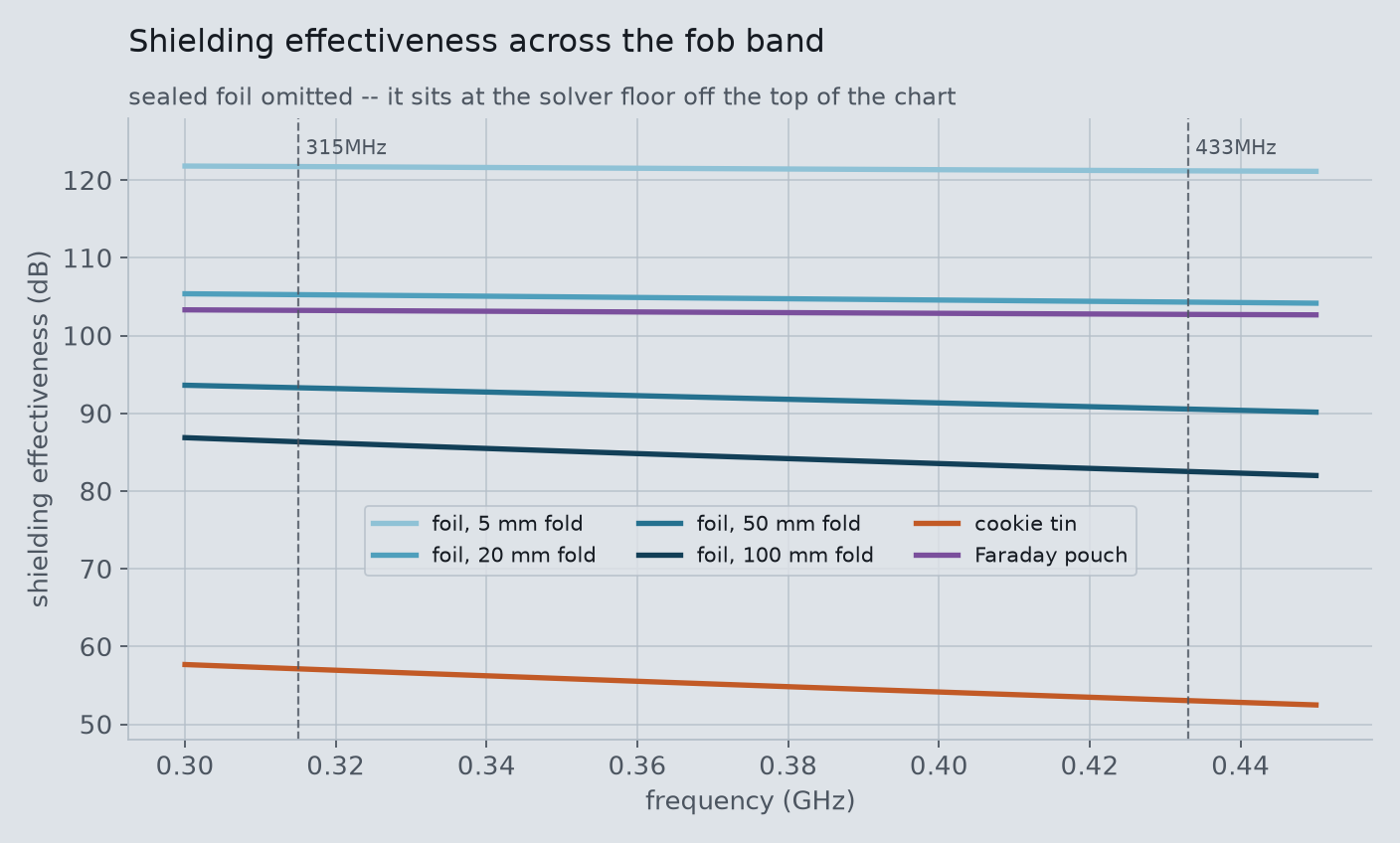
This is the question the request really turned on, and the folklore answer is “yes, the smallest gap wrecks it.” The solves say something more interesting. We took the sealed foil wrap and cut a single opening along the top fold — 3 mm wide, and swept its length from 5 mm out to a hand-wide 100 mm — then solved SE at each size. The protection does fall as the opening grows, monotonically: from about 121 dB at a 5 mm nick down to about 82 dB at the 100 mm fold. But look at the numbers — even the worst case, a fold as long as the fob itself, still leaves more than 80 dB at the radio band. That is not a shield that has been “ruined.” It has been dented.
Why so much better than the back-of-the-envelope rule predicts? The textbook worst-case estimate for a slot, SE ≈ 20 log10(λ/2L), treats the opening as an efficient antenna and puts the 100 mm fold at only about 11 dB. Our full-wave solve sits 70 dB above that line. The reason is physical and worth keeping: that formula is a pessimistic bound for a slot near its half-wave resonance, and our openings are nowhere near it — a half-wave slot at 433 MHz would be 346 mm long. A narrow, sub-resonant fold, with the fob's electrically-tiny antenna sitting right under it where the coupling field is weakest, is a genuinely poor leak. The gap costs real decibels, and the trend is exactly what aperture theory predicts, but at the fob band the failure is graceful, not the sudden collapse the folklore promises.
Where the Gap Sits Beats How Big It Is
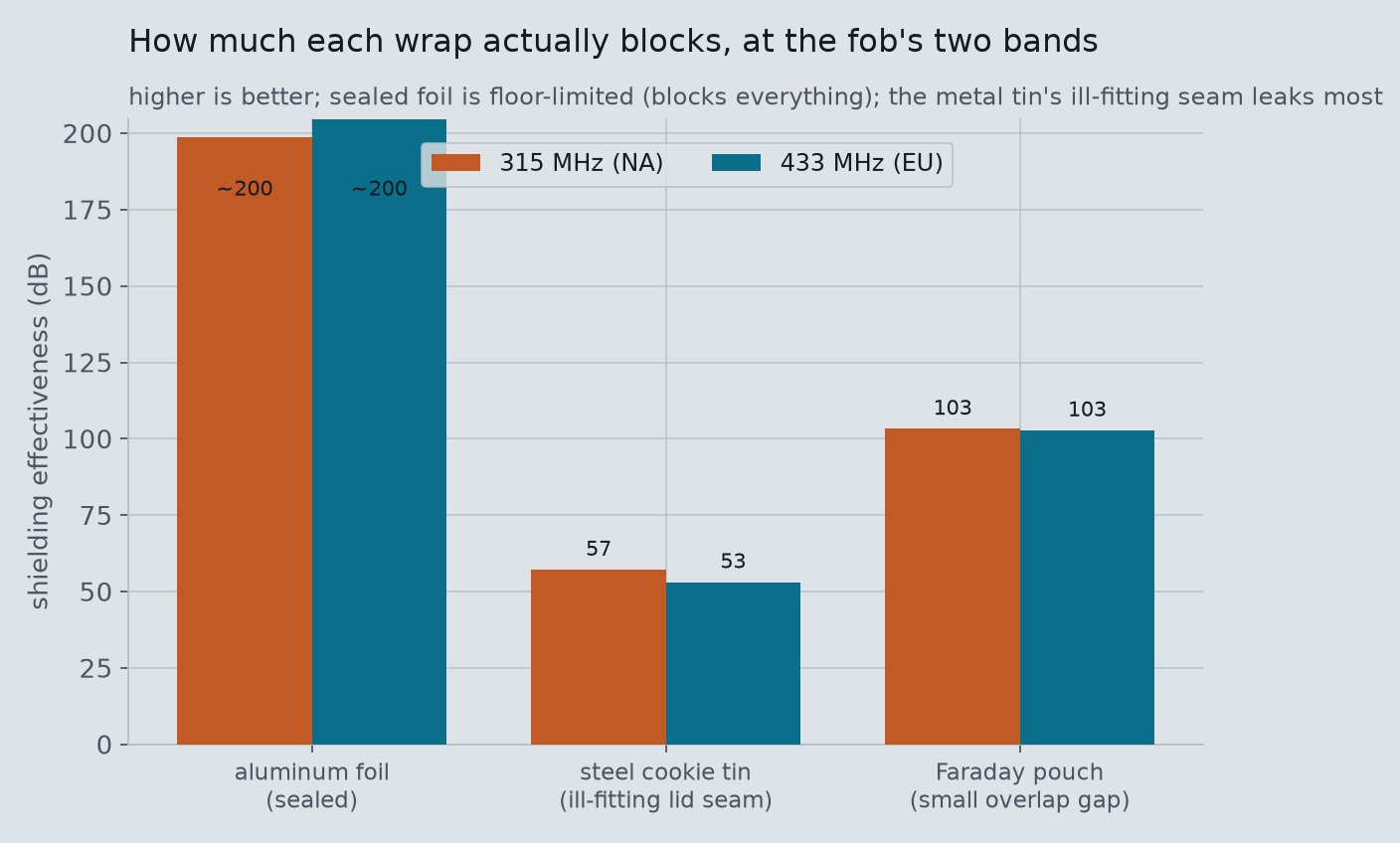
The tin is the tell. Its leak — a 0.5 mm seam under an ill-fitting lid, on the side wall — is far narrower than the 3 mm foil fold, yet it shields the least of everything we ran, about 53 dB at 433 MHz against the folded foil's 82. A thinner opening that leaks more sounds backwards until you notice where each one sits. The foil fold runs across the top, directly over the fob's antenna, where a small vertical antenna radiates least. The tin's seam runs along the side, broadside to the antenna, where the field it couples to is strongest. Position, not size, sets which opening actually leaks — the same lesson that makes real enclosure design about seam placement and gasket lines rather than raw wall thickness. It is also the honest caveat on the graceful-failure result above: a clean fold centered over the antenna is close to a best case, and a gap in the wrong place would cost more.
So — Does Foil Stop Relay Theft?
At the fob's radio band, a wrap that actually stays closed is a strong shield, and even an imperfect one blocks a great deal — so the part of relay theft that reads the fob's reply is genuinely hard to do through foil. But two honest qualifiers decide whether that translates into a safe car. First, a loose kitchen-foil fold is not a purpose-built pouch. Our numbers assume the wrap holds a clean, closed shape around the fob; a scrap of foil that springs open in your pocket, or a tin whose lid rides up, is a different object than the sealed shell that scores ~200 dB at the solver's floor. A Faraday pouch or a well-latched tin earns its dB because it stays closed. Second, and more important, foil answers the wrong radio. The 125 kHz wake-up pulse that starts a relay attack is a low-frequency magnetic field, and — as the scope box shows — thin non-magnetic aluminum barely attenuates it. A ferromagnetic steel tin does better there, one of the few places its material actually helps. If you want a car key silenced, the reliable move is the purpose-built pouch or a snug metal tin, closed every time — not a loose square of foil.
Designing a shield, an enclosure, or an antenna that has to keep a signal in — or out? The decibels are decided by geometry: where the seams sit, how narrow the gaps are, whether the wrap actually closes. A full-wave solve prices every one of those before you cut metal or fabric. We run electromagnetic shielding and antenna studies in Ansys HFSS, geometry through validated results. Rand Simulation — innovation through insight.