Where the Steam Goes in a Commercial Kitchen Hood
What happens the moment the fan switches on
A bucket and a half, spread through a room of steam
Everyone has watched steam vanish into a restaurant hood, and it looks like a lot of water disappearing. It isn’t. Steam at 100 °C is roughly 1,600 times less dense than liquid water — about 0.6 kg per cubic meter of vapor versus 958 kg for the liquid. Fill the entire 26.5 m³ plenum of a 45 ft × 50 in × 60 in hood with saturated steam and you have on the order of 16 kg of water riding as vapor — which, fully condensed, is about 16 liters. That is the whole budget the hood ever has to deal with, and the question the owner actually asked is how it splits up: how much leaves as vapor, how much stays suspended, and how much turns back into water.
To answer it we ran the extraction as a time-accurate simulation rather than a steady snapshot, because the interesting part is the drain-down — how fast the column clears once the −0.07 psi (−483 Pa) suction is applied at the 30 in round duct. A sealed box can’t be evacuated, so the hood is modeled the way a real canopy hood works: open along its underside, with room-temperature makeup air drawn up from below as the steam is pulled out the top.
Where the trapped steam actually goes
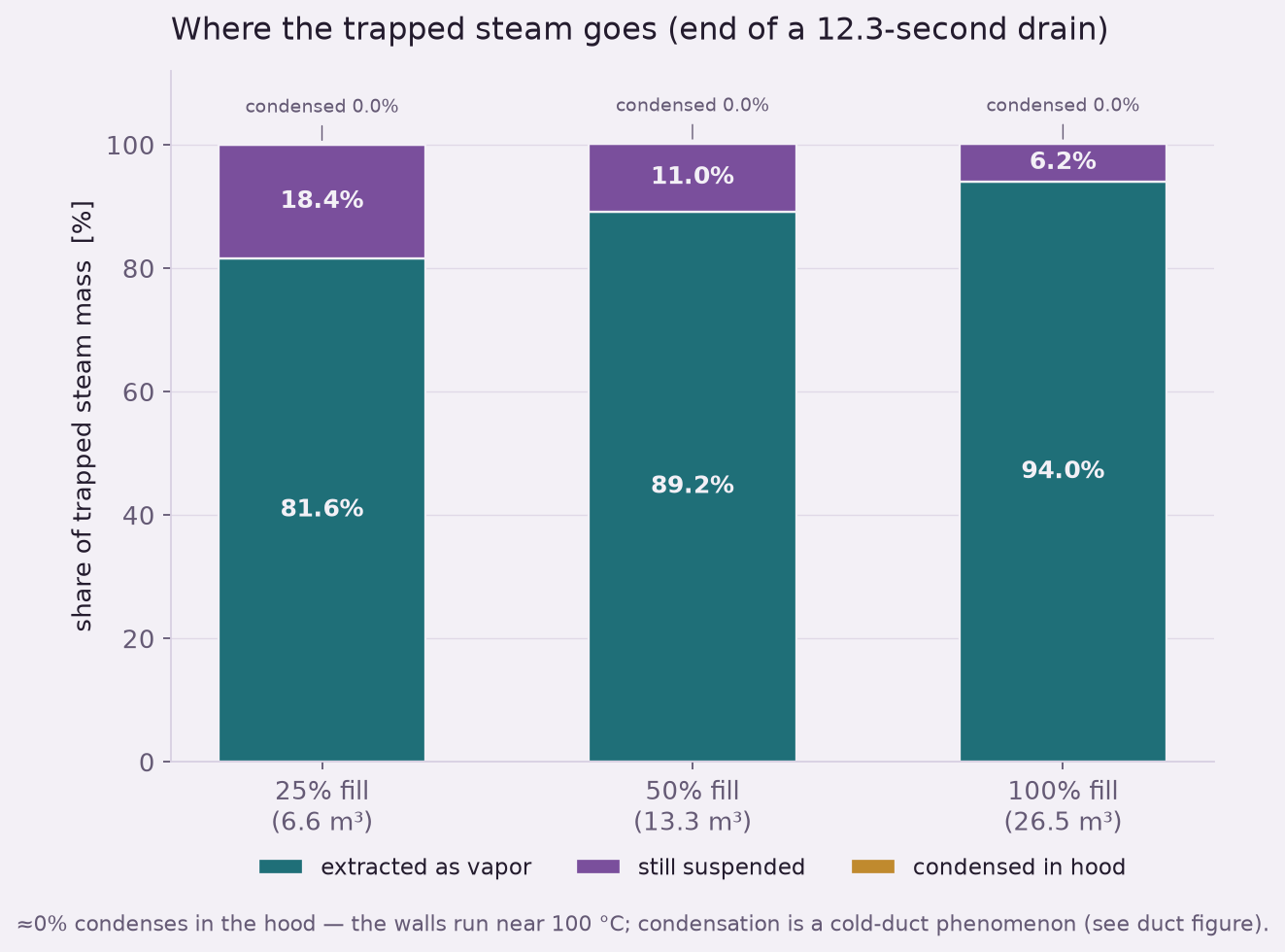
We explored three trapped volumes — a quarter-full, half-full, and completely full hood (6.6, 13.3, and 26.5 m³), each patched as a stratified layer of hot steam under the ceiling, since steam floats over cooler room air. The three drains are identical except for how much steam they start with.
The split is consistent and a little surprising. In the full-hood case, 94% of the trapped steam has left the duct as vapor within 12.3 seconds; the half- and quarter-full hoods reach 89% and 82% in the same window. The condensed fraction inside the hood is essentially zero in every case. The steam is not turning into water on its way out — it is being carried out as gas, fast.
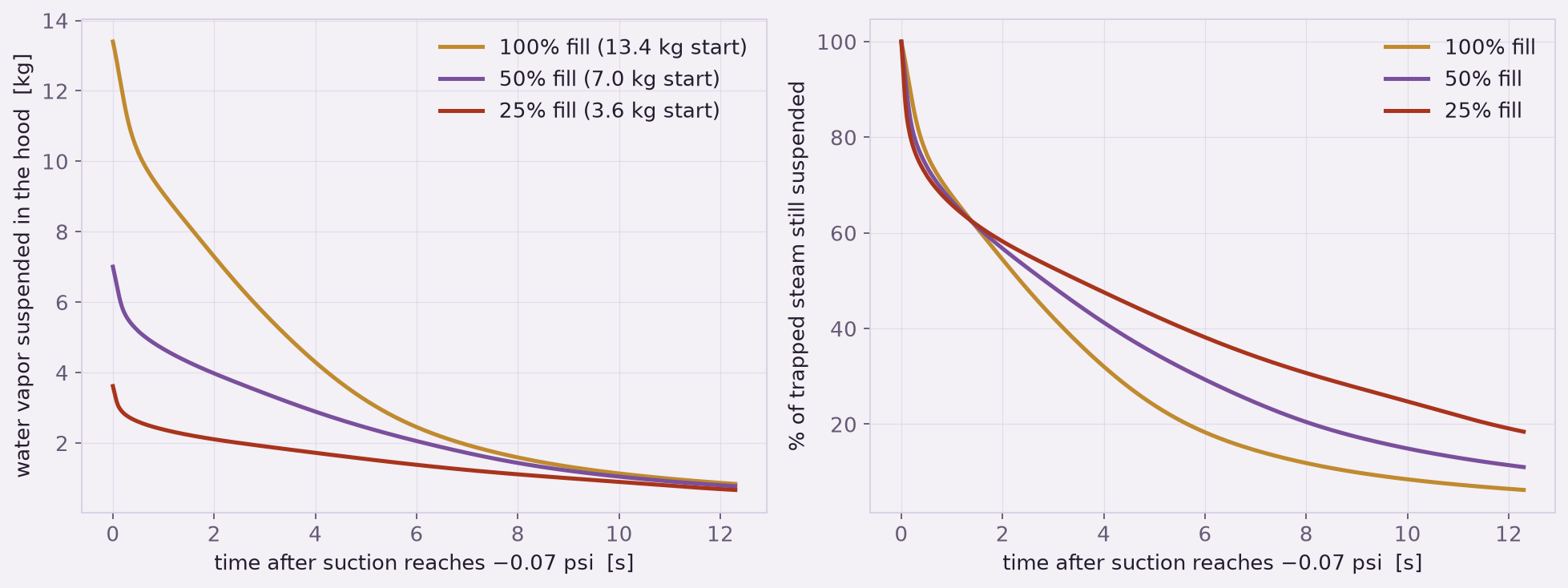
Why does a fuller hood clear a larger fraction? Because all three cases asymptote toward a similar small residue of vapor — the dilute, well-mixed steam that the through-flow can only remove slowly. Starting with more steam means that stubborn tail is a smaller share of the total. It is the last wisp that is hard to get, not the first roomful.
As a check on the extraction itself, the solved duct velocity settles at about 29 m/s (near 30,000 CFM through the 30 in duct). A loss-free Bernoulli estimate for −483 Pa of suction gives a ceiling of 28–31 m/s; the CFD sits right at, and correctly just below, that bound once duct friction is included — exactly where a trustworthy answer should land.
Why almost nothing condenses in the hood
The ask pinned the physics that matters here: the duct is near 212 °F inside and room temperature outside. Steam only turns back into water where a surface sits below the local dew point. Inside the hood, the walls are bathed in ~100 °C steam and stay hot, so there is almost no cold surface for condensation to form on — and the residence time is seconds. The condensation site is the long, uninsulated duct, where the steel finally has room-temperature air on the far side.
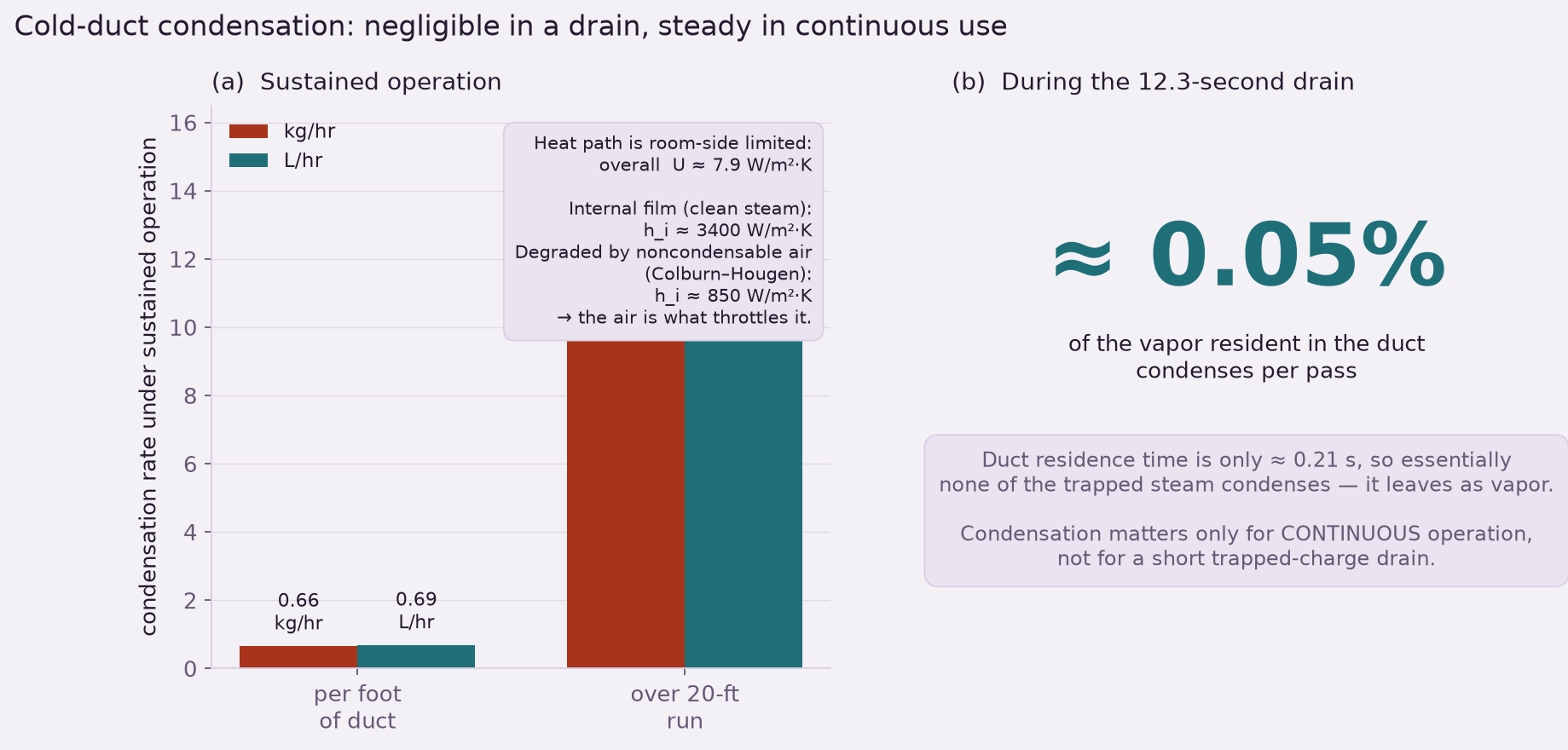
Even in the duct, the amount of condensation is limited by how fast heat can leave through the wall — and that rate is set by the slow natural convection on the room side, an overall coefficient of only about 8 W/m²·K. Working from the solved duct-inlet state (near-saturated steam, ~30 m/s), the Nusselt film-condensation bound gives an internal coefficient around 3,400 W/m²·K for clean steam; the air mixed into the steam throttles that by roughly four-fold, and the room-side convection dominates the rest. The result is a sustained-operation condensation rate of about 0.66 kg/hr (0.69 L/hr) per foot of duct, or roughly 13 kg/hr over a 20 ft run — a real, continuous drip a designer should size a drain for.
But during the one-time drain the ask describes, condensation is negligible: at 30 m/s the steam spends only about 0.2 seconds in a 20 ft duct, so only about 0.05% of the vapor in the duct at any moment condenses before it is gone. A trapped charge of steam leaves as vapor. Condensation is the price of running the line all night, not of clearing one cloud.
The grease question
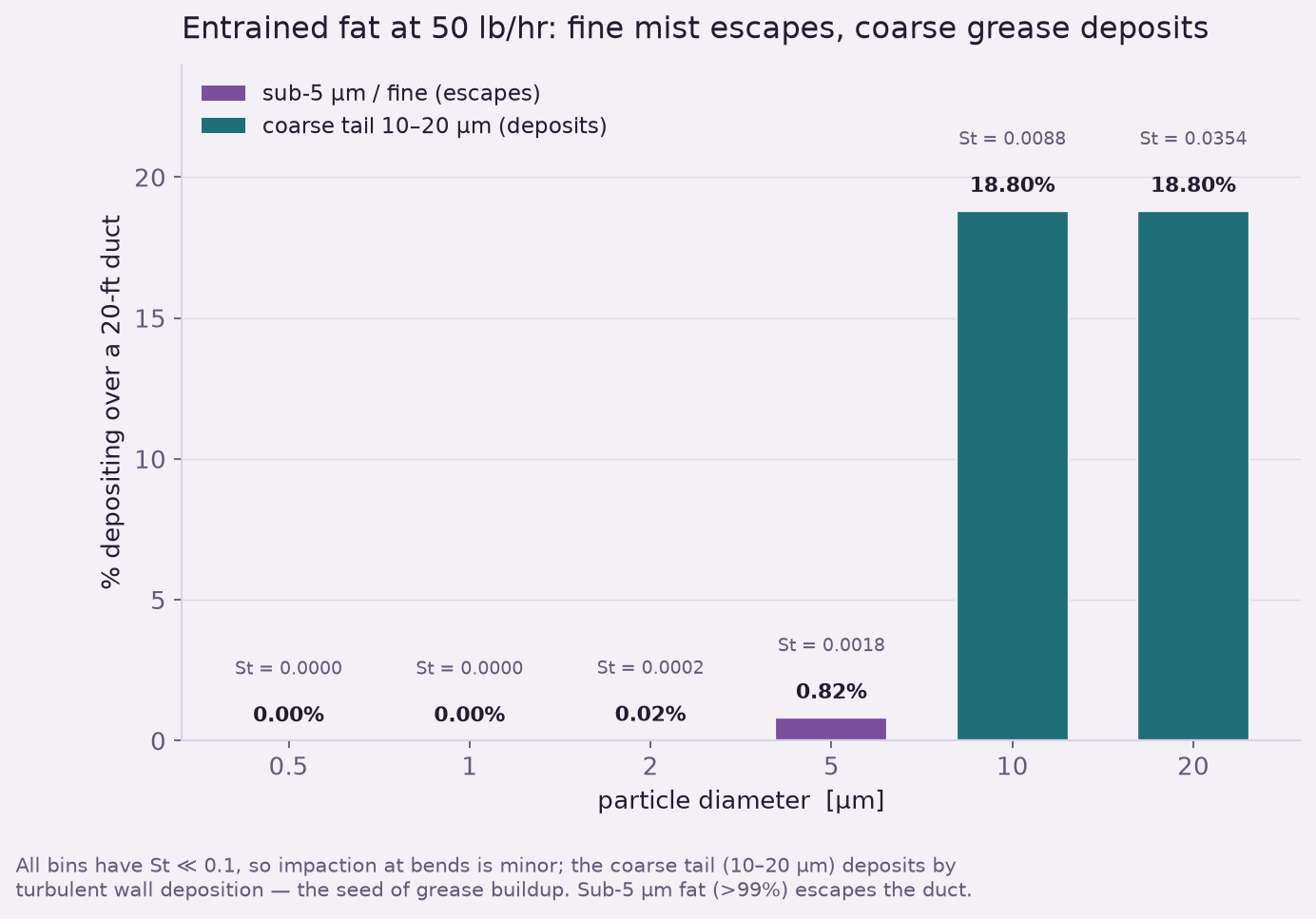
Grease in the duct is why kitchen exhaust is a fire-code item, so the entrained-fat number turns this from a curiosity into the operator’s real problem. At the stated 50 lb/hr, the fate of a fat droplet depends almost entirely on its size. Every size in the cooking-effluent range has a Stokes number well below 0.1, meaning the particles are light enough to follow the airflow rather than fly straight at bends — so impaction at elbows is minor. The fine mist under 5 µm escapes the duct almost completely (over 99%). The coarse tail, 10–20 µm, is different: those droplets are heavy enough to be flung onto the walls by turbulent eddies, depositing on the order of 15–20% over a 20 ft run. That coarse fraction is the grease that accumulates on the steel — the case for baffles and a cleaning schedule, neither of which is modeled here.
How the simulation was built
The hood is a self-authored fluid domain — a 45 ft × 50 in × 60 in stainless canopy plenum with a tapered collar into a 30 in round duct riser, open along the underside — meshed watertight in Ansys Fluent Meshing (about 183,000 polyhedra cells, all volumes positive, minimum orthogonal quality 0.40). The solve is a transient, buoyant, species-transport model: air plus water vapor with real thermal buoyancy (incompressible-ideal-gas density), energy on, gravity on, and k-ω SST turbulence. The trapped steam is introduced as a one-time patched charge of 100 °C water vapor filling the ceiling-down layer, then the −0.07 psi suction is applied and the column is allowed to drain, with about 20 inner iterations per time step and the continuity trajectory checked throughout.
Every headline number is anchored to a closed-form check: the duct extraction rate against a Bernoulli / duct-flow calculation, the condensation coefficient against the Nusselt film-condensation correlation with the noncondensable-air degradation named explicitly, and the fat fate against a Stokes-number and turbulent-deposition screen. The reported values are the CFD’s; the hand calculations are there to keep it honest.
Do you have a real ventilation or extraction question — a kitchen or lab hood, a stack plume, a drying oven, condensation dripping where it shouldn’t, or grease-laden air you need to capture? The same Ansys CFD workflow that traced this hood’s steam — geometry, mesh, transient solve, and post-processing, end to end — is how Rand Simulation predicts where the vapor goes, how much condenses, and where the residue lands, before it becomes a code violation or a callback. That is innovation through insight.