We Found the Note — Then We Shattered the Glass
Every wine glass has a note. Flick the rim and you hear it — a clean, ringing tone that is the bowl flexing back and forth between an oval and a circle. In an earlier demo we went looking for that note with a modal analysis. This time we did the reckless thing: we played the note back at the glass, loud and exactly on pitch, and watched the rim tear itself apart in an explicit LS-DYNA fracture run. Spoiler — it shatters. And the control that proves why it shatters is the best part.
The physics: resonance is a patient thief
The glass-shattering trick is not about brute force. It is about timing. A wine-glass bowl is a very lightly damped structure — once it starts ringing, it keeps ringing. Push it with a pressure that oscillates at its natural frequency, perfectly in step with the motion, and every push adds a little more amplitude than the last. The rim swings wider and wider. That run-away growth is resonance, and it is how a modest, sustained input becomes a catastrophic output.
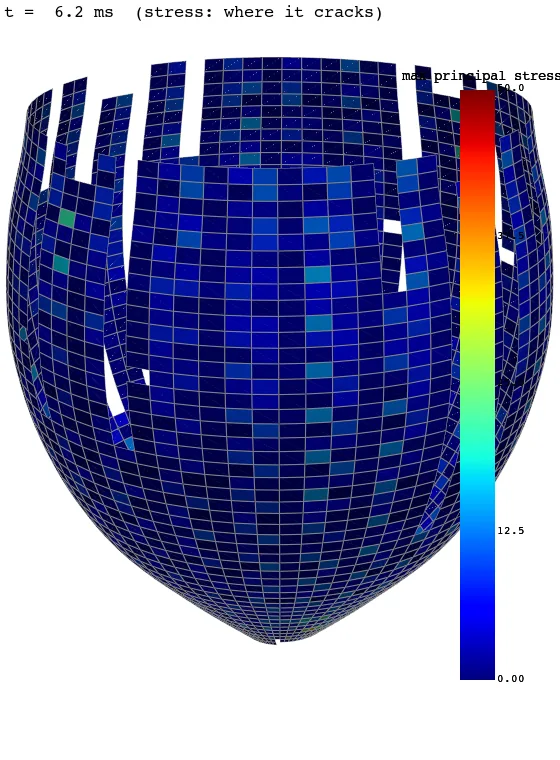
The specific mode that matters here is the (2,0) ovalling mode: two nodal diameters, so the circular rim pulses into an oval and back, four times per cycle. The bending is most severe at the tips of the oval — the antinodes — and that is where the tensile stress concentrates. Glass is strong in compression but brittle in tension; it does not yield, it cracks. So the question is simply: can the antinode tension outrun the ~50 MPa tensile strength of glass before the energy bleeds away? On resonance, yes.
It isn't the loudness that breaks the glass. It's the loudness arriving in perfect time, seven hundred times a second, exactly on the note.
Inside the model
Geometry and mesh
We modeled the bowl alone — a thin shell of revolution reusing the outer profile from our earlier wine-glass modal demo, offset to the mid-surface. The result is a clean shell mesh of 3,384 nodes and 3,312 fully-integrated shell elements (ELFORM=16, 5 integration points through the thickness), wall thickness 1.5 mm, sweeping from the base ring at y = 82 mm up to a rim radius of 41.2 mm at y = 178 mm. The base ring is fully clamped; the rim is free to ring.
Material and failure
Glass is *MAT_ELASTIC with E = 70 GPa, density 2500 kg/m³, and ν = 0.22. Brittle fracture is handled
with *MAT_ADD_EROSION set to a maximum-principal-stress threshold of SIGP1 = 50 MPa: when the
tensile stress in an element crosses that line, the element erodes and a crack is seeded. It is a deliberately simple
surrogate for glass failure — more on that in the scope box — but it captures exactly the thing we care about:
tension-driven cracking, where the tension is highest.
The load and the solver
This is the elegant bit. Rather than model a roaring loudspeaker, we applied a pressure on the bowl shaped like the
mode itself: P(θ,t) = P₀·cos(2θ)·sin(2πf·t). The cos(2θ) spatial shape is the (2,0) ovalling
pattern, so the forcing pours energy into only that one mode — a clean, surgical drive. We ran it explicitly
in LS-DYNA (lsdyna_dp, R16). To find the drive frequency in the first place, Stage A was an implicit eigenvalue
(modal) analysis that pulled the ovalling pair out at f* = 709.5 Hz. Stage B then drove the bowl at that exact
frequency.
Two decisions made the run honest and fast. First, drive amplitude: an undamped resonance grows roughly linearly, so we calibrated P₀ to fracture in a handful of cycles. Our first guess (0.02 MPa) shattered the glass in ~4 ms — too violent to be convincing — so we backed it down to P₀ = 0.005 MPa. Second, speed: we applied selective mass scaling to the small clamped base elements only. The rim and ovalling region were left untouched, which preserves f* exactly while buying roughly a 3× speedup on the time step.
Is it right?
A single shattering animation looks great but proves little on its own — maybe we just pushed hard enough to break anything. So we ran the experiment that scientists run: a control. Same glass, same mesh, same pressure amplitude, only the frequency changed — from the on-resonance 709.5 Hz down to an off-resonance 500 Hz.
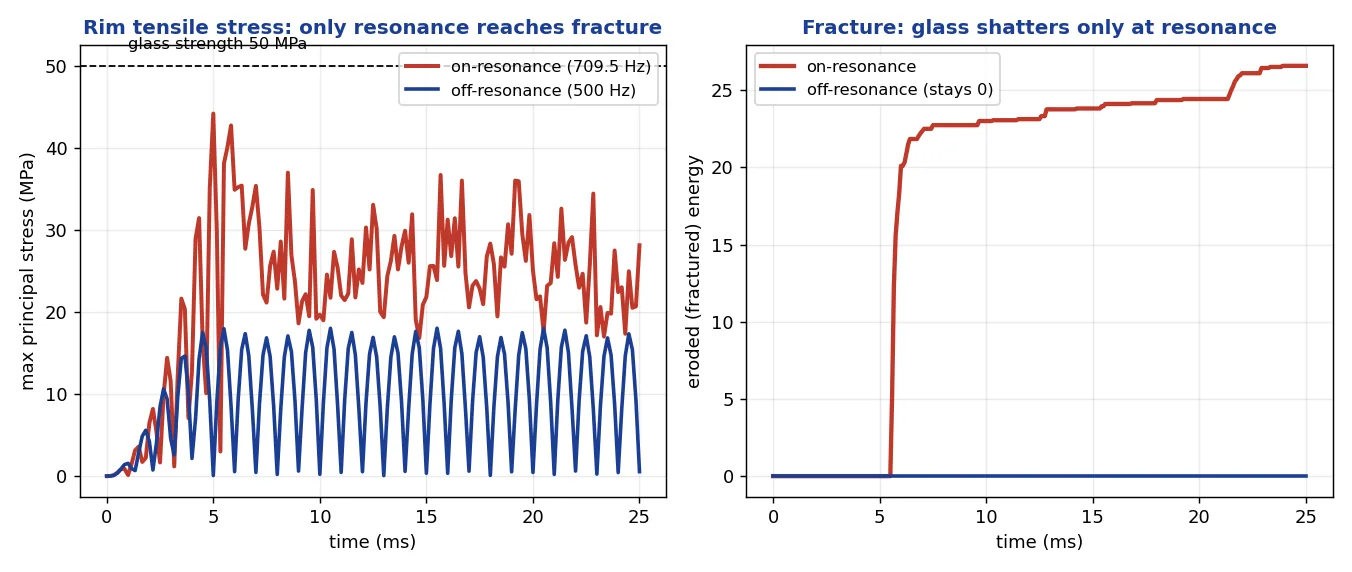
The on/off comparison is decisive on three counts. The location is correct: the crack starts at the (2,0) antinodes, where bending theory says tension is greatest — not somewhere random. The mechanism is correct: on resonance the stress accumulates and crosses strength; off resonance the same force merely sloshes the rim and the stress stays far below fracture (peaks ~18 MPa vs. 44+ MPa). And the frequency is grounded — it came straight out of the implicit modal analysis, not a number we picked. Together they isolate the cause: it is the resonance that breaks the glass, not the push.
The real-world connection
This is one of the most beloved "is it real?" myths in pop culture, and the answer is a satisfying yes. The legend goes back to the 1971 Memorex cassette commercials — Ella Fitzgerald hits a note, a wine glass shatters, and the tagline asks "Is it live, or is it Memorex?" The whole pitch was that the recording of her voice could break the glass just like the live note — resonance doesn't care whether the source is a larynx or a tape head, only whether the frequency is right.
Decades later, MythBusters put it to a real test. Adam Savage first broke a glass with an amplified voice, and then rock vocalist Jaime Vendera shattered a wine glass with his unaided voice — no microphone, no speakers — confirming the full myth. The key, exactly as our simulation shows, was finding the glass's own resonant note and holding it. Watch the iconic moment:
If you want the single unaided-voice break that sealed the episode, here is
Jaime Vendera's glass-shattering moment. A human can do in
one held note what we just did with a cos(2θ) pressure field and an erosion threshold: deliver energy on
the glass's own note until the antinodes give way.
*MAT_ELASTIC + *MAT_ADD_EROSION at a 50 MPa max-principal-stress threshold — a simple surrogate for
glass failure, not a fracture-mechanics flaw or crack-growth model, so it tells you where and when cracking
initiates rather than tracing a physically exact crack path. Selective mass scaling was applied only to the clamped
base elements (the rim/ovalling region is untouched, so f* is preserved) to keep the explicit run tractable. The
drive pressure amplitude was tuned to fracture in a handful of cycles, not derived from a real sound pressure level
— so this demonstrates the mechanism (resonance at the ovalling mode concentrates tension at the antinodes
and breaks the glass), proven by the on/off-resonance control, rather than predicting the exact decibel level a
singer would need.
Want resonance answers for hardware that can't shatter on stage? The same modal-then-transient workflow — find the mode, drive it, watch the stress concentrate — is the kind of workflow that helps teams keep brackets, enclosures, and rotating equipment off their resonances long before a prototype ever rings. That's innovation through insight.