Where a Diamond’s Fire Comes From — and Why Cubic Zirconia Has More
Hold a diamond under a lamp and it throws little darts of pure color — a flash of red here, a spark of blue there. Jewelers call it fire, and it is not sparkle (that’s brilliance, plain white flashes). Fire is the stone splitting white light into a spectrum, the same thing a prism does. We measured exactly how much fire three look-alike stones produce — a diamond, a cubic zirconia, and a piece of cut glass — by fanning a white beam through each in Ansys Speos. The surprising, and entirely real, result: the cubic zirconia out-fires the diamond.
1 · Fire is dispersion
A material’s refractive index isn’t one number — it changes with wavelength. Blue light bends a little more than red every time it crosses a surface. Send white light through at an angle and the colors come out fanned apart. How far they fan is the material’s dispersion, and it is the entire physical origin of a gem’s fire. Optical engineers summarize it with one number, the Abbe number (Vd): a low Abbe number means strong dispersion. Diamond sits around Vd = 55, cubic zirconia near 30 (so it disperses more), and ordinary crown glass around 64 (so it disperses much less).
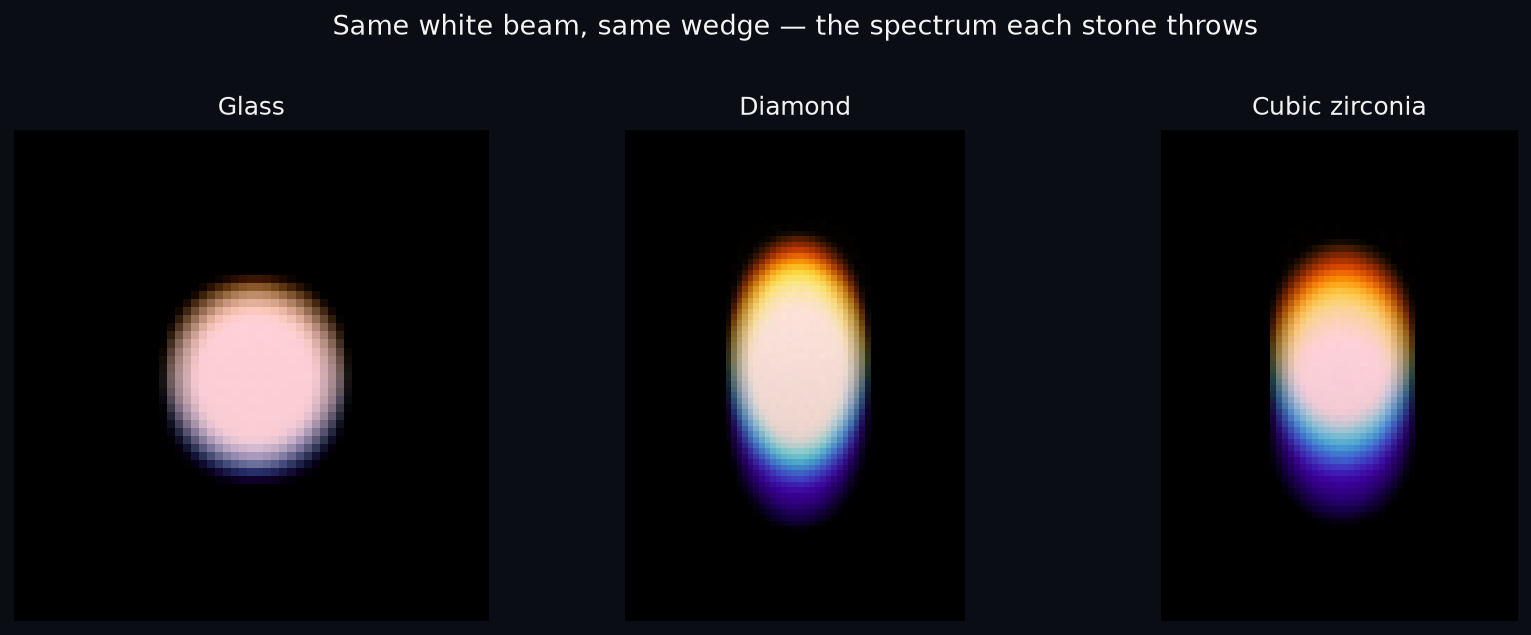
To see it directly, we sent a white beam through a shallow wedge of each material and let the fanned spectrum land on a screen. Everything but the material is held fixed, so the width of the rainbow is a clean, head-to-head measure of dispersion.
2 · Why not the schoolbook triangular prism?
Here’s a detail that trips people up: you can’t put a diamond’s light through a normal 60° prism. Diamond’s refractive index is so high (2.42) that a ray trying to leave a 60° face is asked to bend past 90° — the geometry has no solution (sin of the exit angle would need to exceed 1), so the light totally-internally-reflects and never gets out. That same trapping of light is exactly what makes a well-cut diamond so bright from the top. To isolate and measure just the dispersion, we used a shallow ˜19° wedge, which keeps the exit angle below diamond’s 24.4° critical angle so every color transmits.
3 · The measurement
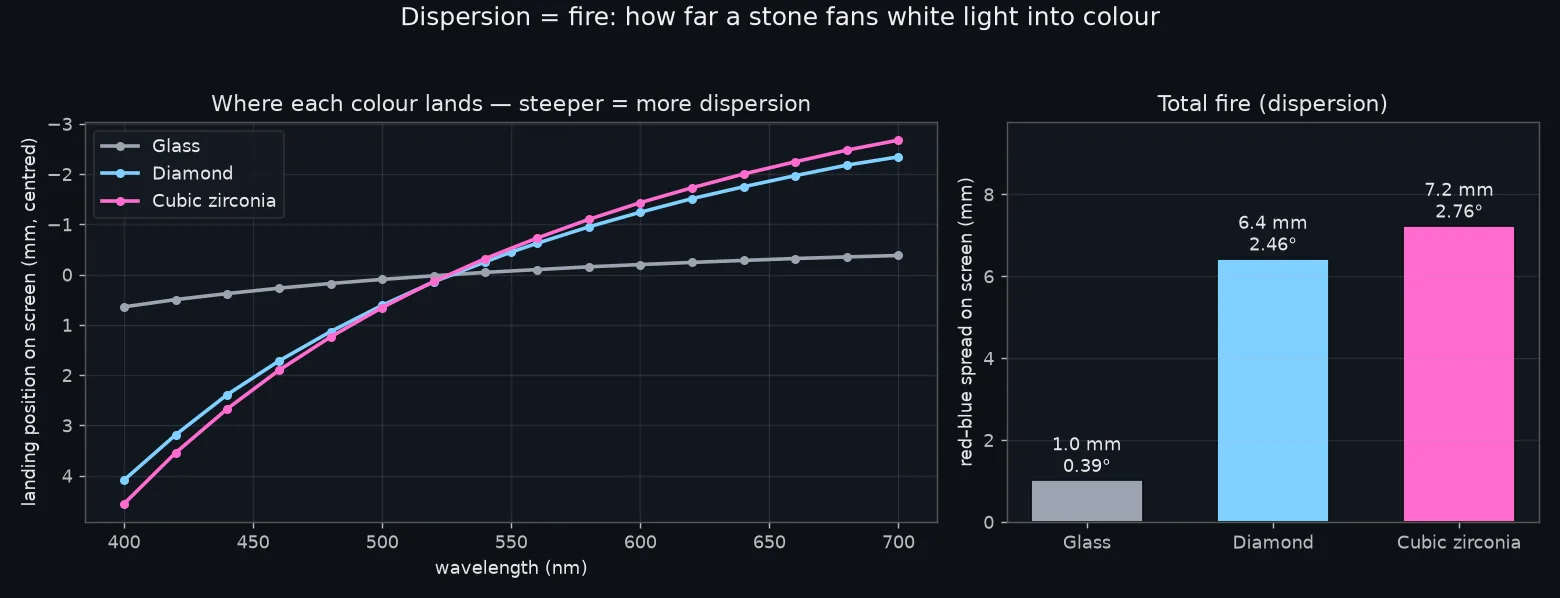
Reading it straight off the screen:
- Glass — 0.4° of spread. Almost no fire; the beam stays essentially white with the faintest colored edge. This is why a glass “diamond” looks lifeless.
- Diamond — 2.5° of spread, about 6× the glass. This is the fire everyone recognizes — enough color to be beautiful, balanced against high brilliance.
- Cubic zirconia — 2.8° of spread, more than the diamond. That extra dispersion is real, and jewelers use it as a tell: a stone that throws too much rainbow, too showily, is often not a diamond. More fire is not more valuable — it reads as fake.
4 · Material makes the fire; the cut decides whether you see it
Dispersion is only half the story. It sets how much color a material can produce, but you only see that fire if the stone’s geometry first catches the light, bounces it around inside, and sends it back out toward your eye. That is the job of the cut: the pavilion angle on the bottom of a round brilliant is tuned (around 40.75°) so that light entering the top hits the back facets steeper than the 24.4° critical angle and totally-internally-reflects back up, instead of leaking out the bottom. Cut a stone too shallow and the light passes straight through — a “window” — and even a real diamond goes dull and lifeless. So a great stone needs both: a high-dispersion, high-index material and a precise cut. Get either wrong and the fire never reaches your eye.
5 · Why an optical engineer cares about sparkle
Dispersion isn’t a jewelry curiosity — it’s a first-order effect in real optical design, and usually the enemy. The same splitting of colors that makes a diamond beautiful is chromatic aberration in a camera lens: red and blue focus at different depths and the image gets colored fringes, which is why good lenses stack low- and high-dispersion glasses to cancel it. It sets the resolving power of a spectrometer, the color error down a fiber, and the design of every prism and grating. Ray-tracing dispersion — wavelength by wavelength, through real geometry — is exactly what a tool like Ansys Speos is for; the diamond is just the most beautiful test case.
Fire is just dispersion you can hold in your hand. Measure it, and the diamond’s reputation turns out to be about balance — not the most color, but the right amount, wrapped in a cut that actually shows it off.
Physical-optics ray tracing in Ansys Speos (2026 R1).
6 · Honest caveats
- The index and Abbe numbers are representative textbook values for each material, not a measured specimen. The ranking (and the ˜6× glass-to-diamond spread) is robust; treat the absolute angles as indicative of this specific wedge geometry.
- We deliberately measured a shallow wedge, not a faceted stone, to isolate the material’s dispersion cleanly. Rendering the full sparkle of a cut brilliant — every facet flashing a different color — is a much heavier ray-trace and a separate study.
- The beam has a finite width, so the colors overlap into white through the middle and fringe at the edges — a faithful picture of a real dispersed beam, not an idealized separated rainbow.
Are red and blue refusing to focus at the same depth in your lens — colored fringes creeping into an image that should be sharp? Wavelength-by-wavelength ray tracing in Ansys Speos (2026 R1) — the same white beam through the same shallow wedge, reading 0.4° of spread for glass, 2.5° for diamond, and 2.8° for cubic zirconia, with the caveats stated plainly: textbook indices, a robust ranking, absolute angles indicative of this wedge — is how simulation quantifies chromatic error before you commit to a glass stack. That's innovation through insight.