The Egg-Drop Shootout: Putting a Number on “It Survived”
Everyone has done the egg-drop competition: wrap an egg so it survives a fall. The scoring is binary — it cracked, or it didn’t. But a packaging engineer can’t ship “it didn’t crack.” They ship a number: the peak deceleration, in g’s, that the fragile contents are allowed to feel. So we ran the schoolyard contest as a drop-test simulation and read that number straight off the egg — bare, then in bubble wrap, then in a foam case.
1 · The test, and the one number that matters
All three drops are identical except for the packaging. The egg is a brittle ellipsoidal shell — think of a thin ceramic — filled with a firm gel that stands in for the contents. It falls 1.5 m, which means it arrives at the floor doing 5.4 m/s, and it lands on a rigid, unforgiving surface. The only thing we change from run to run is what’s wrapped around it.
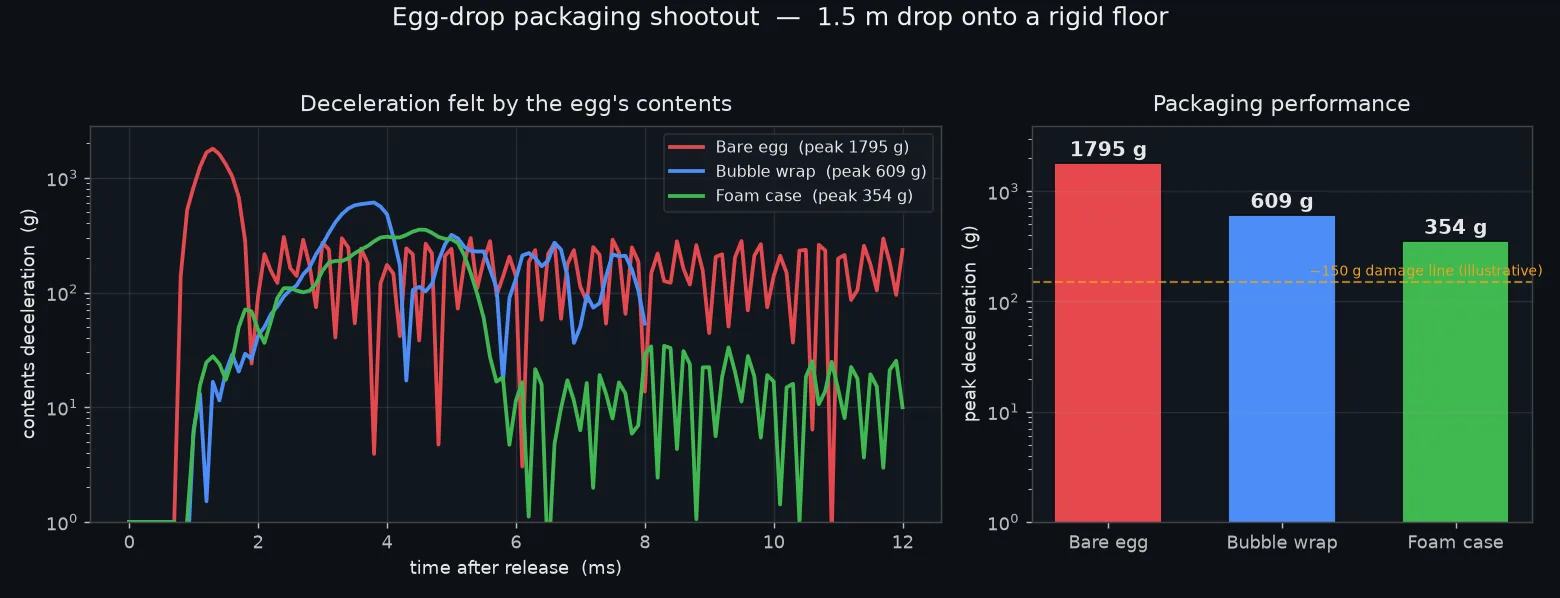
The scoreboard isn’t “cracked / didn’t crack.” It’s the peak deceleration felt by the contents at the center of the egg — exactly the quantity a real drop test measures with an accelerometer glued inside the product. That is the number that decides whether a hard drive’s heads stay parked, whether a vial of vaccine stays intact, whether a phone screen lives.
2 · The results
- Bare egg — 1795 g. With nothing to slow the stop, the shell overstresses on contact and the erosion criterion deletes the failed elements: it cracks and shatters. The contents take a brutal, needle-sharp deceleration spike.
- Bubble wrap — 609 g. A thin, soft crushable layer stretches the stop out over a few extra millimeters and knocks the peak down by about two-thirds. The shell survives.
- Foam case — 354 g. A thicker, firmer crushable layer soaks up more of the energy over a longer crush distance and cuts the peak by 80% versus bare. This is the winner, and it’s the same reason your electronics ship in dense molded foam and not in a bag of bubble wrap.
3 · Why cushioning works — it’s all stopping distance
The energy at impact is fixed the moment you pick the drop height; there’s no getting rid of it. What you get to choose is how far the egg travels while shedding that energy. Peak force scales roughly as energy divided by stopping distance, so a longer, softer stop means a lower peak. Bare, the egg stops in the fraction of a millimeter it takes the shell to fail. In the foam case, it stops over a couple of centimeters of crushing foam — and that extra distance is the whole game.
Crushable foam is the ideal tool for it because it collapses at a near-constant stress and stays collapsed, turning kinetic energy into permanent deformation instead of springing it back into the contents. Thicker and firmer means more energy absorbed before the foam bottoms out and the ride turns harsh again. That trade — enough crush travel, but firm enough not to bottom out — is exactly what a packaging engineer tunes.
4 · Why an engineer runs the toy version
Swap the egg for a hard drive, a camera, an implantable pump, or a bottle of reagent, and this is verbatim how drop-test and transport qualification is done: a brittle-or-fragile payload, a defined drop height and orientation, a crushable or molded cushion, and a peak-g budget the contents must stay under. The egg is just the friendliest possible stand-in for “something fragile, and the few milliseconds that decide its fate.” Getting the workflow — brittle failure, crushable-foam energy absorption, and a clean acceleration readout — right on an egg is what lets you trust it on the real product.
“It survived” is a story. 1795 g versus 354 g is an engineering result — and it’s the difference between a package that passes and one that just got lucky.
Impact / drop-test explicit dynamics in Ansys LS-DYNA (R16).
5 · Honest caveats
- The eggshell and foams use representative properties, not calibrated specimen data, and the contents are a uniform firm gel rather than a real yolk-and-white. The trend — and the roughly 5× spread from bare to foam — is robust; the absolute g-values are indicative, not certified.
- Each egg is dropped in a single orientation onto a flat rigid floor. A real qualification sweeps the worst-case corners and edges and repeats the drops.
- This is a single mesh density, not a convergence study, and there is no air, no membrane / shell-microstructure detail, and no adhesive between wrap and shell. It is a method demonstration of the drop-test workflow, reported as such.
Shipping something fragile — a hard drive, a camera, an implantable pump — against a peak-g budget the contents must stay under? The same Ansys LS-DYNA explicit drop-test workflow behind this shootout — brittle-shell failure decided by the stress field, crushable-foam energy absorption, and a clean deceleration readout of 1795 g bare versus 354 g in the foam case, with the representative-property and single-orientation caveats stated plainly — is how simulation puts a number on “it survived” before the physical drops break real hardware. That’s innovation through insight.