Can an Opera Singer Shatter a Wine Glass? Finding the Note
It is one of the most enduring images in physics folklore: a soprano holds a single, impossibly pure note, a wine glass on the table begins to shimmer, and then — crack — it bursts into a thousand pieces. Cartoon shorthand, party trick, MythBusters legend. But underneath the theatrics is a real, computable number: the one specific frequency a glass wants to vibrate at. We built a stemware glass in CAD, ran a modal analysis in Ansys Mechanical, and went looking for that note.
The physics: why a glass has a "note"
Run a wet finger around a wine glass rim and it sings. Tap it and it rings for a surprisingly long time. That sustained tone is the glass's bowl ovalling mode — the rim flexing back and forth between an oval and a circle. In modal terms it is the (2,0) mode: two nodal diameters, two regions pushing out while two pull in, ninety degrees apart. It is the lowest-energy way the thin bowl wall can ring, and it dominates the sound.
Glass rings so cleanly because it is almost undamped. Its quality factor (Q) is in the ~1000–2000 range, which is why the ping lasts seconds rather than dying instantly. That same low damping is the whole story of the shatter myth: drive a lightly damped structure at its exact resonant frequency and the response amplifies by roughly a factor of Q. Hit the note, hold it, and a modest sound pressure can build a surprisingly large strain in the rim. Miss the note — even slightly — and almost nothing happens.
The trick was never about being loud. It was about being exactly, relentlessly in tune.
Inside the model
Geometry
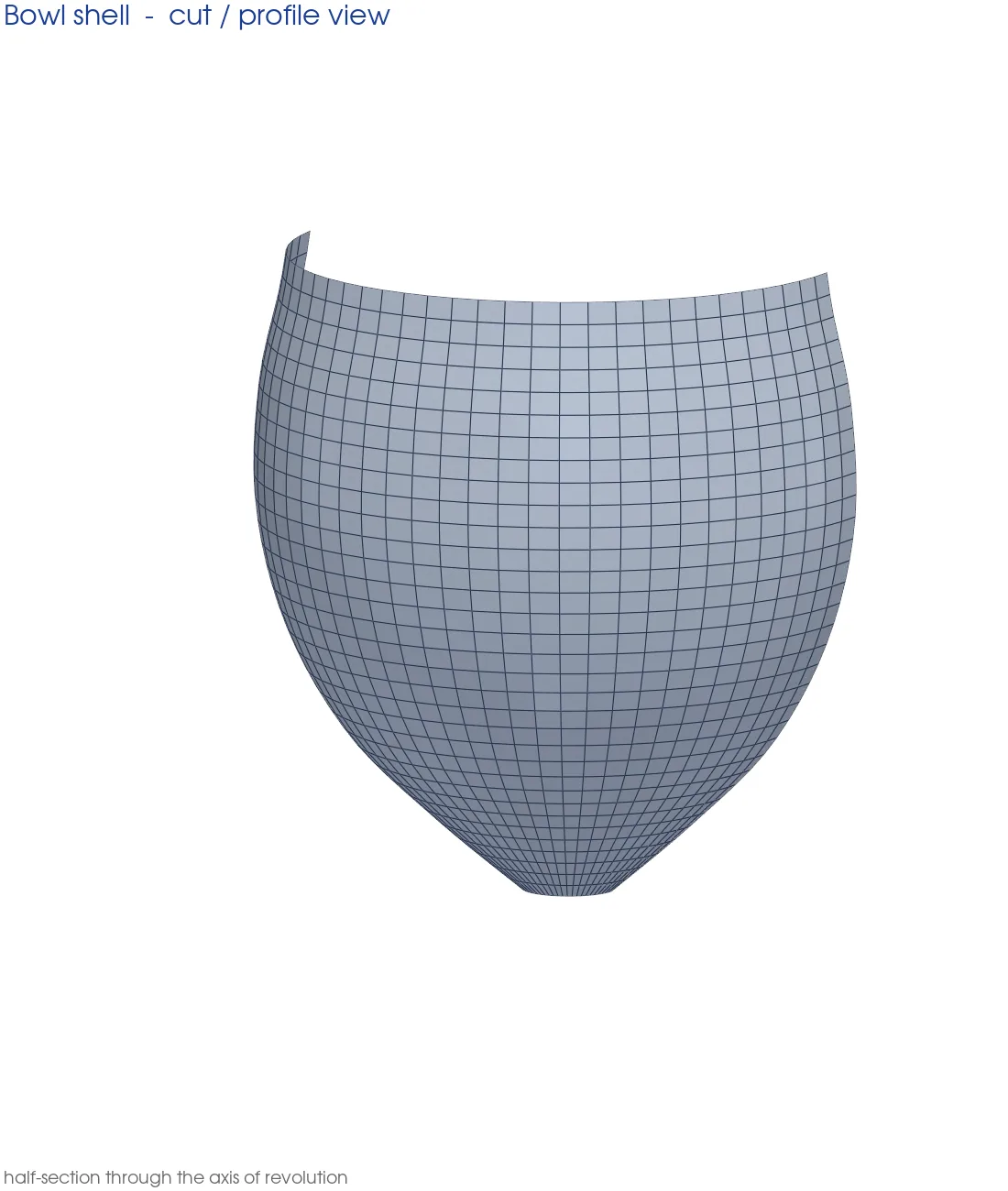
We built a realistic piece of stemware in CAD with cadquery: 178 mm tall, a 94 mm rim, a thin ~1.5 mm bowl wall, a solid stem and a flared foot — about 73 cc of glass, roughly 183 g. Getting there took three iterations. Unioning a separate bowl, stem and foot left two or three "touching" solids because the boolean kernel hated the near-point junction where the stem meets the bowl. The fix was to stop assembling parts and instead trace the entire glass as one closed cross-section and revolve it a single time — one fused body, no boolean seams. A spline-based profile also tripped the OpenCASCADE wire builder ("BRep_API command not done"), so we densified the outline into a Catmull-Rom polyline: smooth, robust, no spline-kernel calls.
Mesh
The action is all in the thin wall, so that is where the elements go. We meshed with 1.5 mm quadratic tets through the wall thickness, landing at 281,573 nodes / 155,924 quadratic elements. Quadratic elements matter here — a flexing rim is a bending problem, and bending is exactly where linear tets go stiff and lie to you.
Setup & solver
Material was ordinary glass — E = 70 GPa, ν = 0.22, ρ = 2500 kg/m³ — applied through an APDL command snippet (MP,EX/PRXY/DENS) on the body. The only boundary condition is a fixed support on the underside of the foot, mimicking a glass sitting on a table. We asked Ansys Mechanical for the first 16 modes. No load, no damping — a free-vibration modal solve just asks the structure which shapes it likes to ring in, and at what frequency. The solve ran on 6 cores in about 11 minutes.
The result
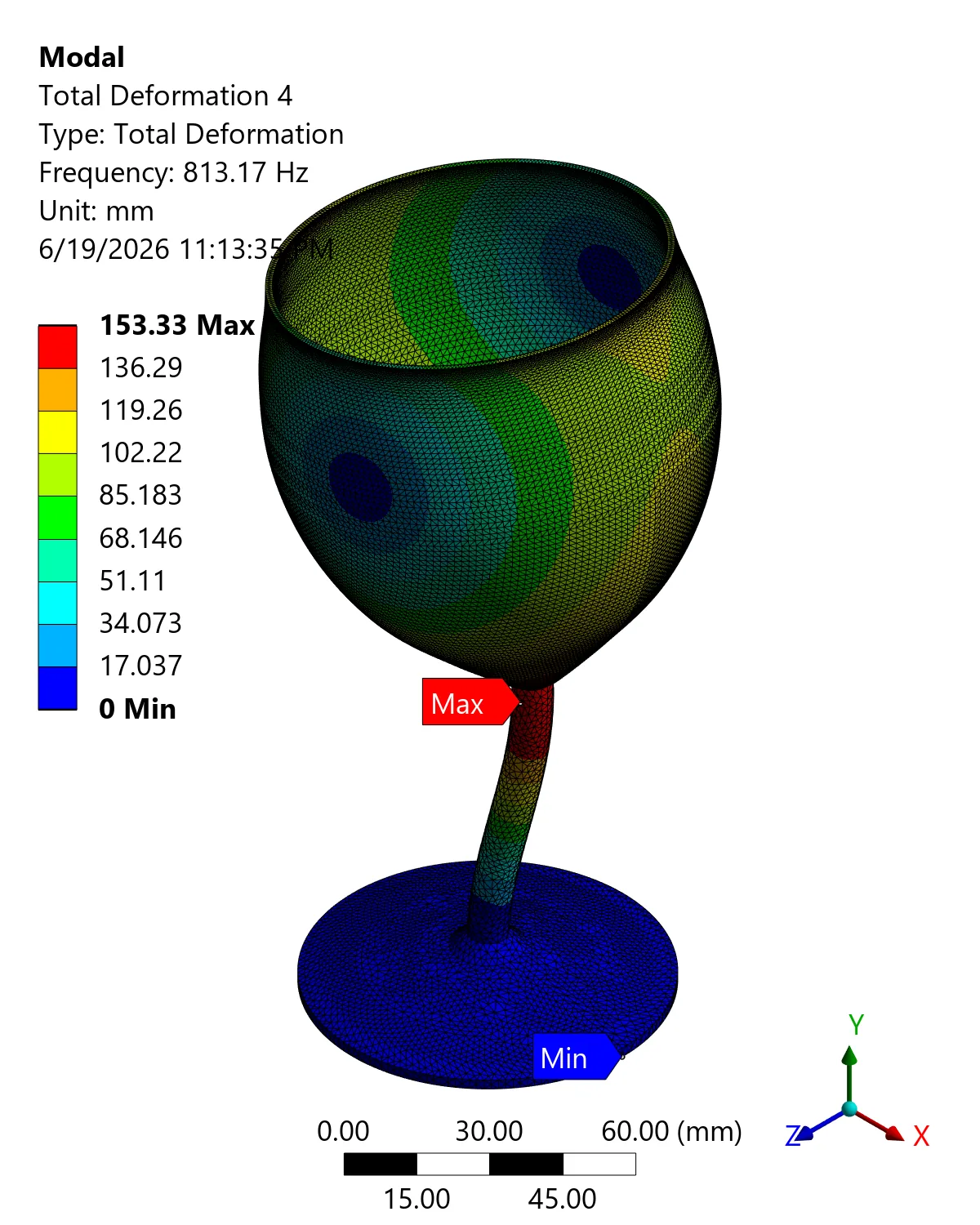
It is worth stressing what the model separates cleanly. People imagine the glass "wobbling," but the wobble (the 75.9 Hz sway on the stem) is not what makes the sound and not what a singer can break. The tone, and the target, is the 813 Hz ovalling of the rim. The modal solve tells those two apart for you.
Is it right?
Wine glasses tapped with a fingernail typically ring somewhere in the ~600–900 Hz band reported in the acoustics literature — it shifts with size and wall thickness, with delicate crystal ringing lower and breaking more easily. Our ovalling mode at 813 Hz sits squarely inside that reported band, and the (2,0) shape it produces is exactly the mode that radiates the audible tone. The near-degenerate pair (813.2 / 813.3 Hz) is also physically right: a real glass that is very slightly asymmetric will show that pair as a slowly rotating oval and a faint beat in the ring.
One honest qualifier: we did not tap this specific glass and record it. This is a comparison against the published ping band for stemware, not a measurement of the modeled glass — so call it a literature validation, which is the right level of rigor for this study.
So… could a singer actually break it?
The FEA gives the target — hit 813 Hz — but whether a voice then shatters the glass is an energy question. Ordinary glass fails in tension at roughly 50 MPa, which is a strain of only about 0.07% (ε = σ/E). With the rim's resonant amplification of ~Q (≈1000–2000), a sustained tone around 100–110 dB held exactly on the ovalling frequency can plausibly drive the rim past that fracture strain at a surface flaw. That is the entire mechanism: find the note, amplify it with the glass's own ringing, and let a microscopic scratch do the rest.
The real-world connection
And it has actually been done — without amplification. On MythBusters (2005), rock vocalist Jaime Vendera became the first documented person to shatter a wine glass with his unaided voice, hitting roughly 105 dB after painstakingly finding the glass's exact resonant pitch. Adam and Jamie first proved the easy version with a speaker and a strobe, then handed it to a human throat. The takeaway matches the model perfectly: brute loudness was not enough — the win came from nailing the note.
So the next time a cartoon soprano detonates the stemware, you can mutter the spoiler under your breath: it is the (2,0) ovalling mode, it rings near G#5 for a glass like this, and the magic is not the volume — it is the tuning. If you want to know the note your part rings at, that is a modal solve, and it takes about eleven minutes.
Does your part have to live beside a pump, a motor, or a blade-pass tone — and do you know the one frequency it wants to ring at? An eleven-minute free-vibration modal solve in Ansys Mechanical, with quadratic elements resolved through the ~1.5 mm bowl wall, the 813 Hz ovalling mode told cleanly apart from the harmless 75.9 Hz sway on the stem, and the answer held to the ~600–900 Hz ping band reported in the acoustics literature — is how simulation hands you every resonance a design owns before a shaker table, or the field, finds them the hard way. That's innovation through insight.