Why a Dropped Turkey Makes a Deep Fryer Boil Over
Every Thanksgiving, fire departments repeat the same warning: lower the turkey into the fryer slowly. Every year, someone drops it in anyway, and the internet gets another fireball video. We wanted the number the safety brochures never show: same pot, same oil, same frozen turkey — how much does the speed of entry alone change what comes over the rim? So we built the inside of the pot in Ansys Fluent and ran the drop, a 10-second lower, and the recommended slow lower as three transient multiphase solves.
One thing to set straight up front, because it frames everything below: the fireball is not an explosion of the oil, and we do not model the fire itself. The “explosive reaction” is a chain with a purely fluid-mechanical first link: water on the frozen bird flashes to steam in the 177 °C oil, the steam swells the oil into froth, and the froth carries hot oil over the rim — onto the open propane flame below. What burns is the oil the pot delivered to the burner. That delivery is a level-swell problem, it is exactly what a transient volume-of-fluid solve is for, and it is what we quantify here: liters of oil over the rim, per entry speed. The combustion that follows is deliberately out of scope; the fire-safety statistics on what happens once oil meets flame are grim enough without our help.
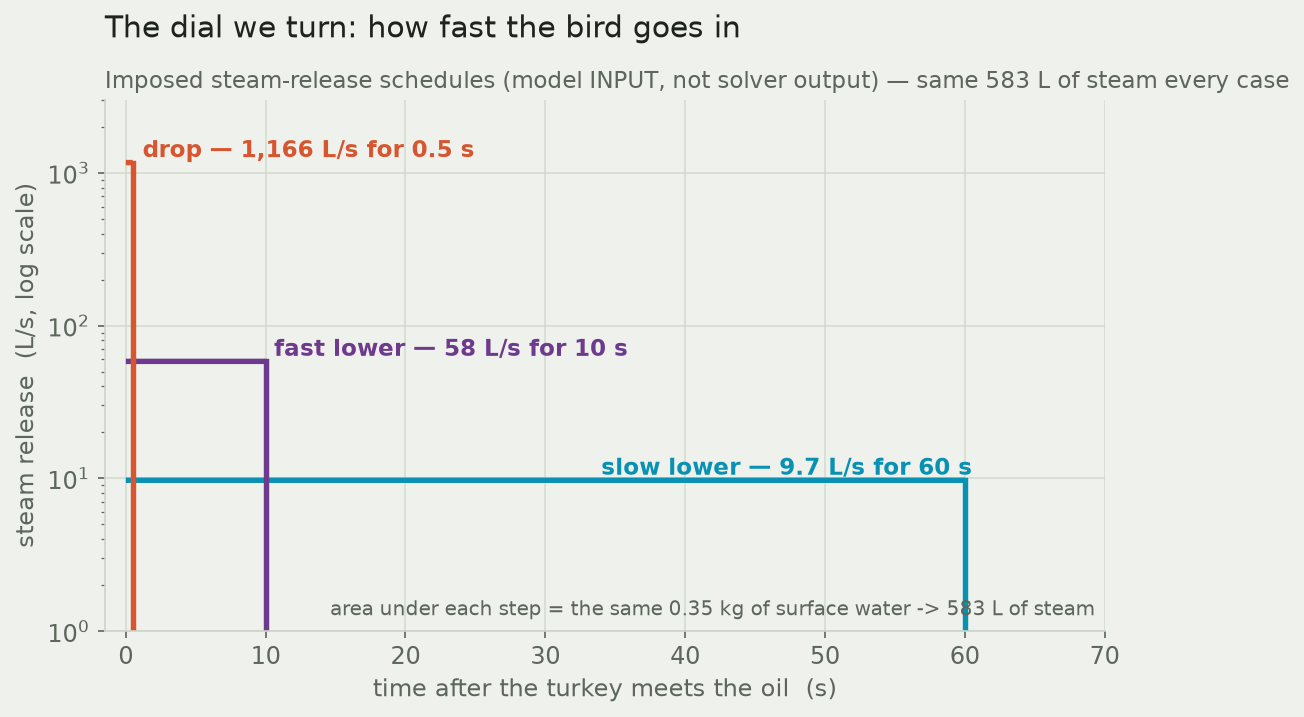
The same 583 liters of steam, released three ways
A 14-lb frozen turkey carries frost, glaze ice, and free water on and in its surface — call it 0.35 kg of quickly-flashable water for a properly thawed-then-refrozen-surface bird (we vary this number later, because it is the model’s honest uncertainty). At atmospheric pressure, 1 kg of water makes 1.67 m³ of steam: our 0.35 kg becomes 583 liters. The pot’s entire freeboard above the oil holds about 19 liters. The steam must leave — the only question is whether it leaves politely, bubbling up through the oil, or violently, taking the oil with it. And that is set by the rate of release, which is set by how fast the bird goes in.
We model the pot the way the manual says to fill it: a 30-quart pot, 3 gallons (11.4 L) of peanut oil at 350 °F, which sits at 14 cm depth and rises to 21.6 cm once the 6-liter bird is fully in — leaving 16 cm of freeboard to the rim. Properly filled, displacement alone never overflows the pot; every liter that leaves is steam’s doing. (Overfilling, the other classic mistake, would change that arithmetic — we hold fill fixed at the manual level and vary only the entry speed, because that is the question.) The solve is a 2D-axisymmetric transient volume-of-fluid model: oil as the liquid phase, the steam-froth as the gas phase, the turkey as a fixed submerged body whose surface releases the scheduled steam, and the domain extended past the rim so anything that goes over is caught, tallied, and never lost from the books.
What the drop does in a tenth of a second
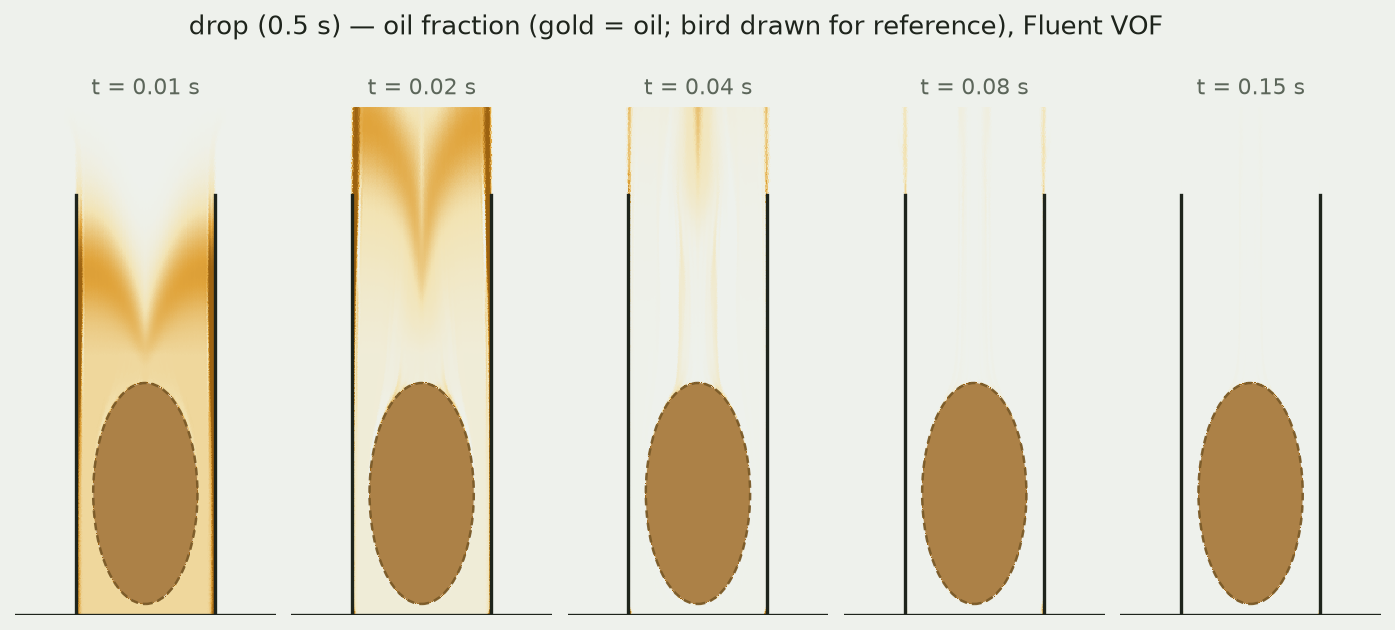
The drop releases steam at 1,166 liters per second. For scale: that fills the pot’s entire freeboard with new gas roughly every 16 milliseconds. The solved oil field responds the only way it can — the oil charge turns to froth and is ejected over the rim almost in bulk. In the solve, 94% of the oil has left the pot by 50 milliseconds; by a tenth of a second the pot holds barely a tenth of a liter of the original 11.35 — over 99% of the charge is over the rim.
The middle case is not safe either
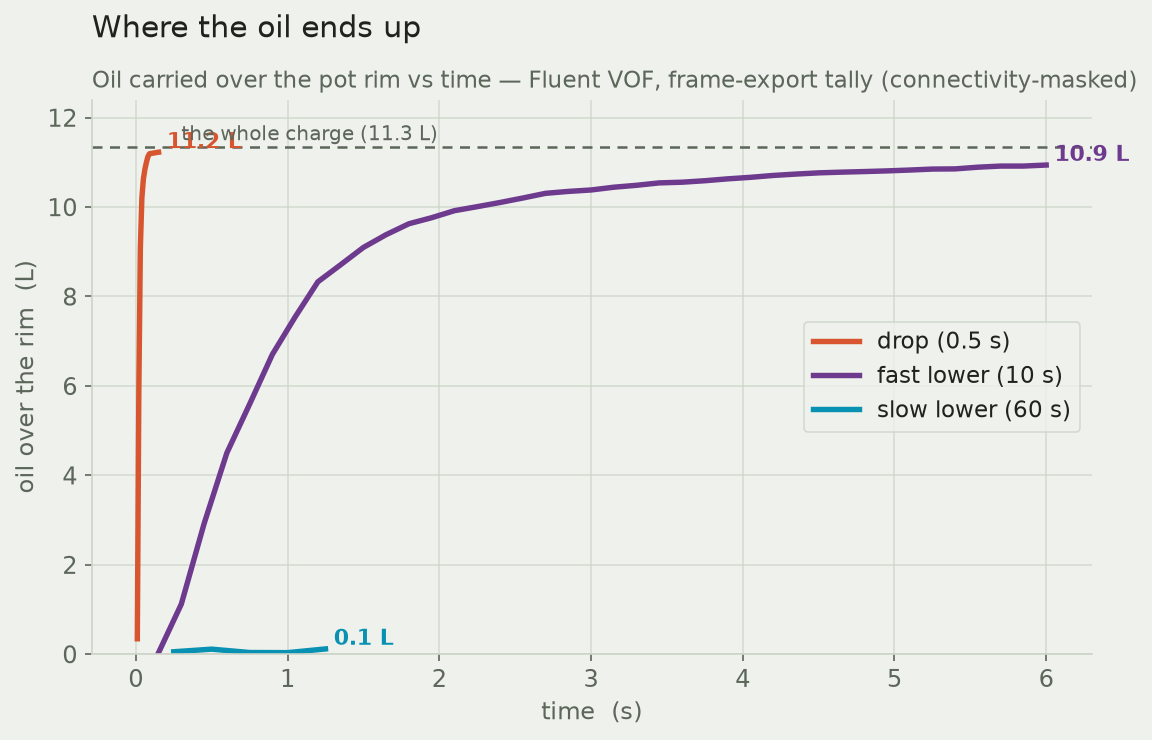
Maybe the drop is obviously reckless. What about lowering the bird over ten seconds — careful by the standards of an impatient cook? The release rate falls twenty-fold, to 58 L/s. The outcome barely improves: the froth never stops outrunning the venting, and the over-rim tally climbs until 10.9 liters — about 96% of the charge — has left the pot by five seconds. The eruption is slower and less cinematic than the drop, but the destination is the same: nearly the whole oil charge, delivered over the rim toward the burner.
Only the slow lower works
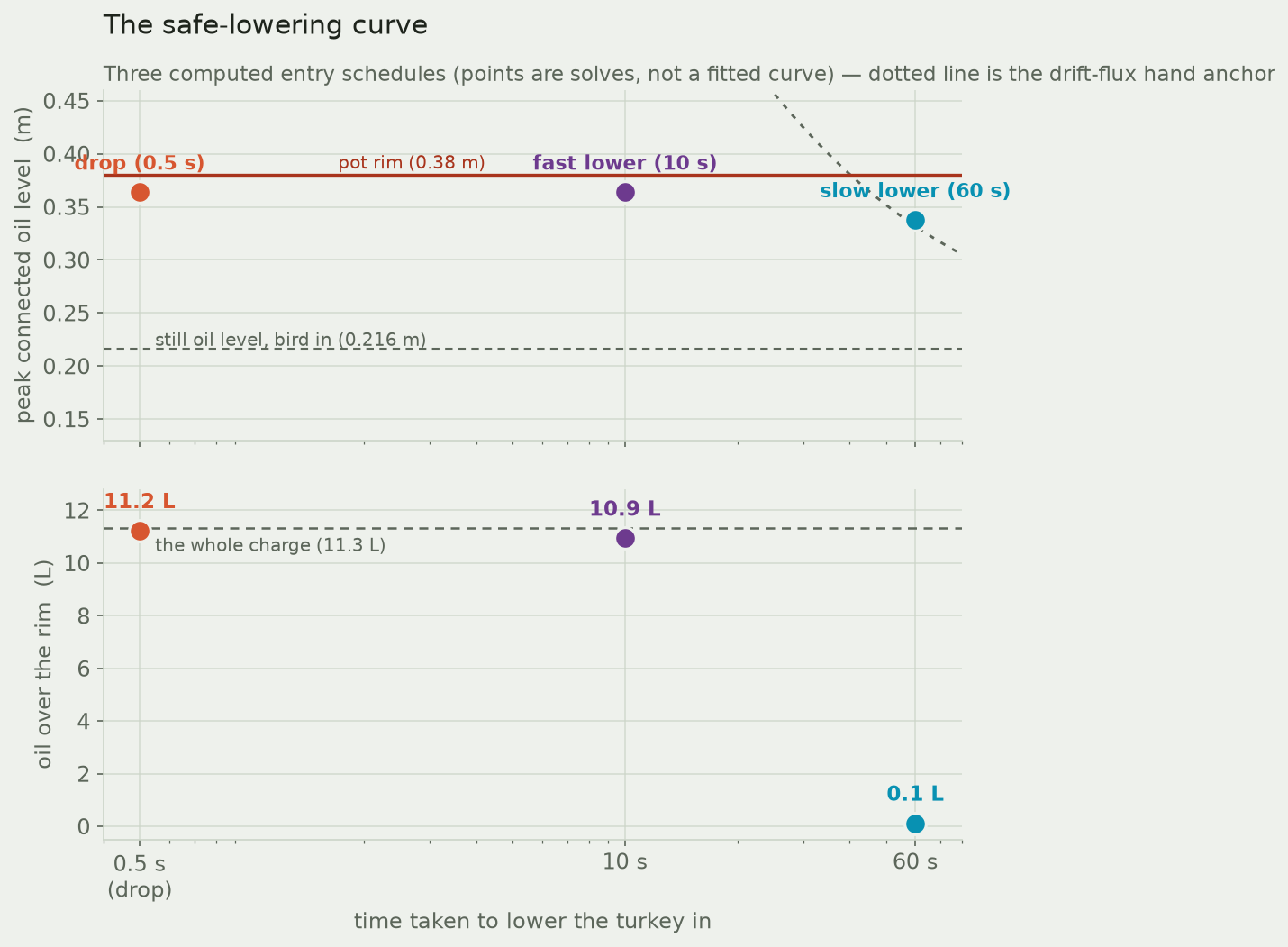
At the recommended 60-second lower, the release rate is down to 9.7 L/s — and the physics changes character. The froth still swells: the solved pool climbs from its still level of 21.6 cm to a seething 34 cm, about 4 cm below the rim, right up where the two faster cases were. But this time the steam bubbles through the oil and vents instead of carrying the charge with it. Over the solved window — long enough for more than the pot’s whole freeboard of steam to pass through — just 0.12 liters go over the rim, about 1% of the charge, against nearly the entire charge for the drop and the 10-second lower. Same height, opposite outcome: the pot seethes; it does not erupt.
Why the cliff is where it is
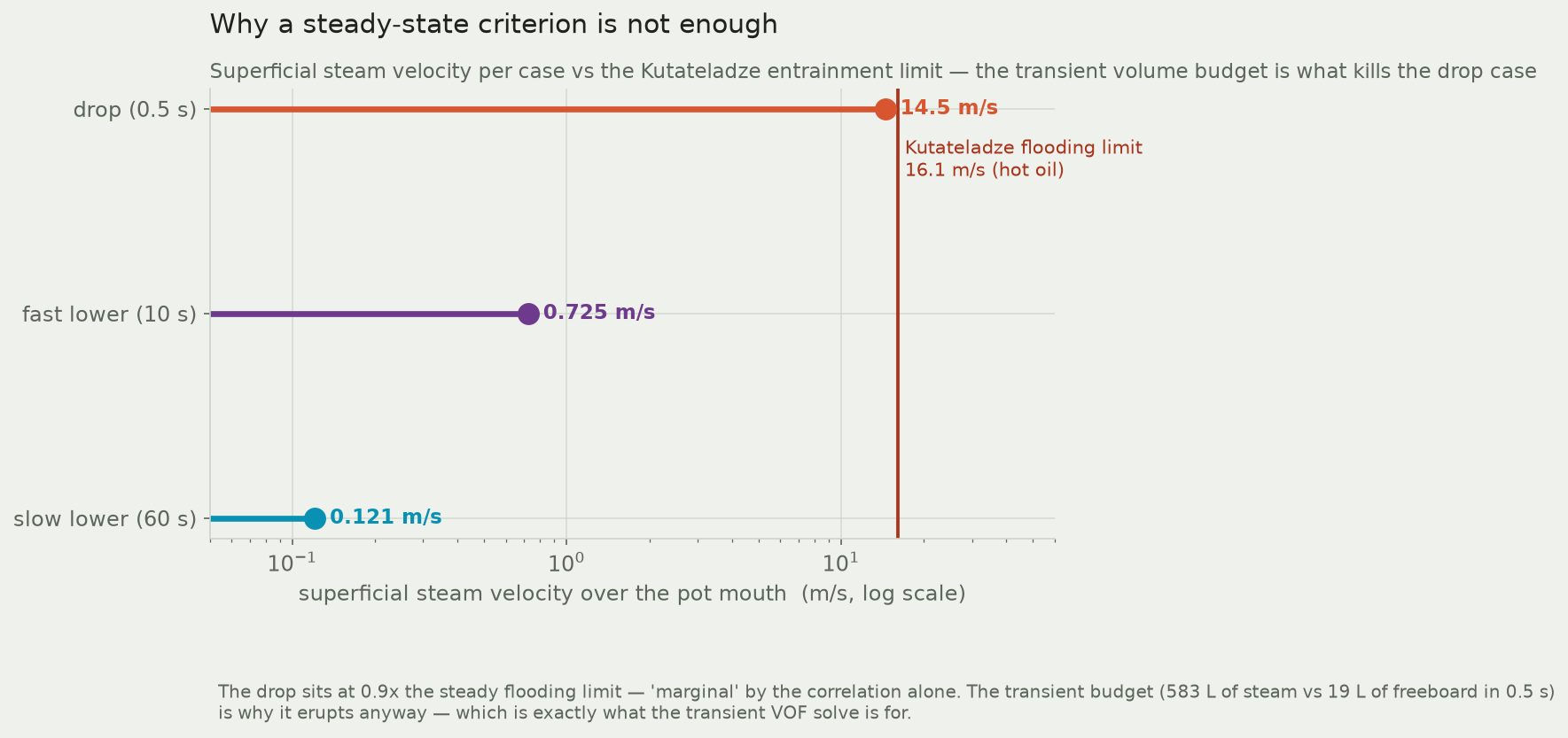
There is a classical way to see the boundary. For steam rising through oil, the Kutateladze flooding criterion puts the churn-to-entrainment limit — where rising gas starts carrying the liquid with it wholesale — at a superficial gas velocity of about 16 m/s for hot peanut oil. Our three schedules put the pot mouth at 0.12, 0.73 and 14.5 m/s. By that steady criterion alone the drop is “marginal” and both lowers are “fine.” The transient solves say otherwise for the 10-second case — and that disagreement is the point. A steady correlation asks whether a settled column can carry the flow; it has no way to see 583 liters of steam arriving against 19 liters of freeboard before venting can establish itself. Level swell is a transient volume budget, which is exactly why we solved it as one, and why the drift-flux swell estimate (the dotted line in the safe-lowering figure) tracks the solved points at the gentle end and underpredicts the violence at the fast end.
How much does the answer depend on our water estimate?
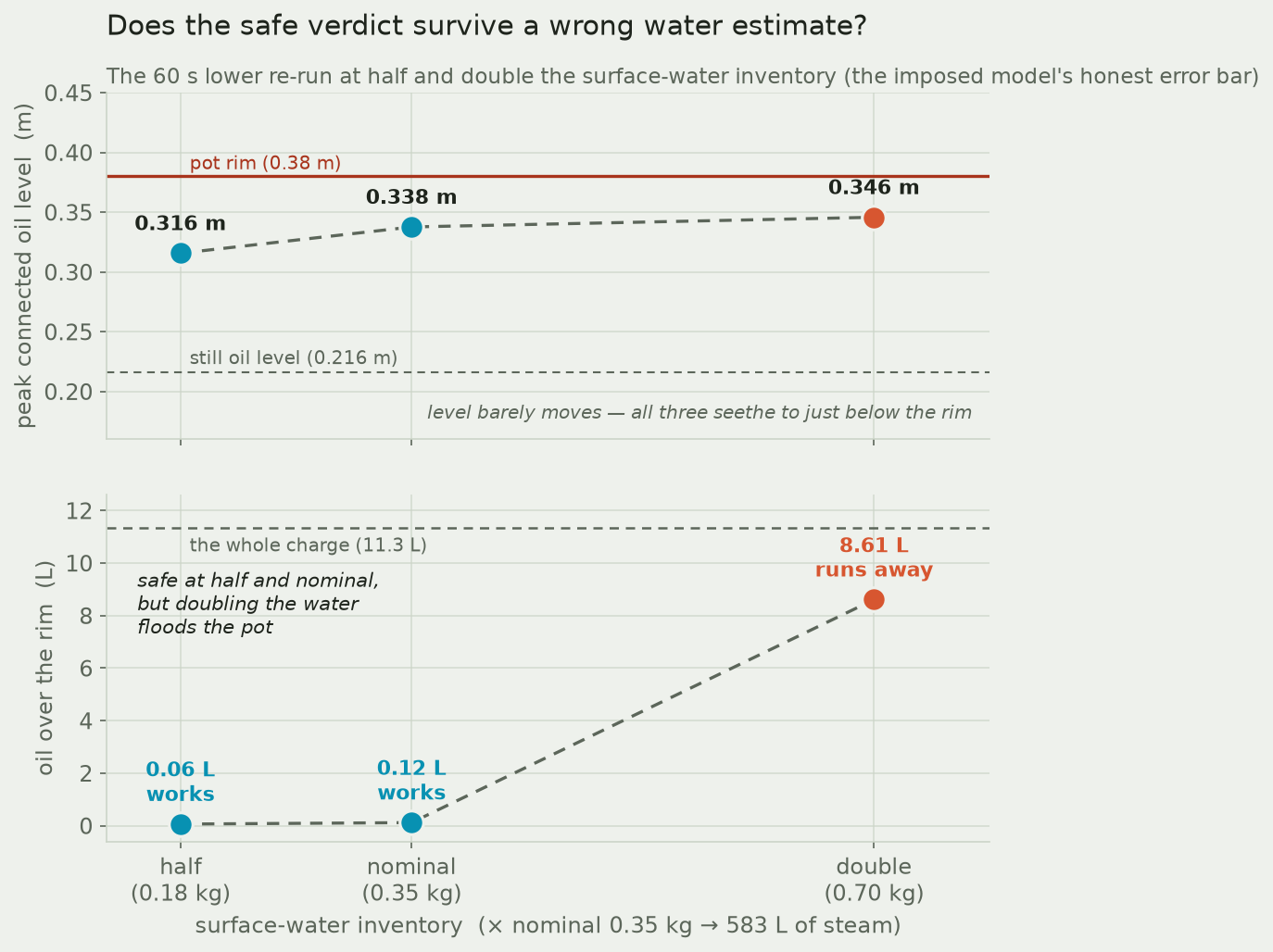
The 0.35 kg of flashable surface water is an estimate, and the honest move is to show what happens when it is wrong. We re-ran the deciding 60-second case at half and double the inventory. Halving it changes nothing that matters — 0.06 L over the rim, still safely contained. But doubling it flips the verdict: the same slow lower now sends 8.6 liters — three-quarters of the charge — over the rim. Notice what does not decide it: the peak froth level barely moves across the band (0.32, 0.34, 0.35 m — all a few centimeters below the rim). What changes is whether that froth vents its steam or carries the oil over with it, and at double the water it carries. Two things keep this an honest finding rather than an alarm. First, double the nominal water is 0.70 kg — right at the 0.68 kg the hot oil can physically flash before it cools (the thermal cap below), so this is the worst case the pot can actually produce. Second, the safe 60-second rate assumes a nominally-thawed bird; a heavier ice-and-frost load erodes the margin quickly, which is exactly why the same guidance that says “lower slowly” also says “thaw it completely and pat it dry.”
The receipts
Every claim above traces to a checked number. The initialized oil charge integrates to 11.35 L against the 11.4 L hand target (0.4%), and the no-injection reference solve holds the 21.6 cm displacement level without drift. The oil charge’s sensible heat above 100 °C caps flashable water at 0.68 kg — our 0.35 kg nominal sits comfortably inside it, and the ×2 sensitivity case (0.70 kg) sits right at that ceiling, so the doubled-water runaway is the worst case the pot can physically produce before the oil cools. Mass closes throughout the healthy solves: oil-in-pot plus oil-over-rim stays at the initial charge to better than 0.1 L, and the frame-export tallies agree with the in-solver volume integrals to ~0.2 L. The mesh-independence check on the 10-second case (the 59k-cell base mesh against a 30k-cell coarsening) holds the peak level and over-rim to within 4.4%.
| Entry schedule | Steam release | Peak level vs 38 cm rim | Oil over the rim | Verdict |
|---|---|---|---|---|
| Drop (0.5 s) | 1,166 L/s | ~36 cm, then ejects | 11.2 L (99%) | runs away |
| Fast lower (10 s) | 58 L/s | ~36 cm, froth outruns venting | 10.9 L (96%) | runs away |
| Slow lower (60 s) | 9.7 L/s | 34 cm — holds below rim | 0.12 L (1%) | works |
Have a boil-over, flooding, or level-swell risk in your own vessels — reboilers, kettles, quench tanks, storage under pressure relief? The same transient multiphase workflow that separated a seethe from an eruption here is how Rand Simulation quantifies carry-over, venting margins, and liquid-entrainment limits before hardware finds them the hard way. That is innovation through insight.