Why a Tuning Fork Has Two Prongs
Tap a tuning fork against your knee and it sings — a clean, pure note that hangs in the air for seconds, even while your fingers are clamped tight around the stem. A single steel beam would ring too, but grab its base and the sound dies instantly. So why the fork shape? Why two prongs joined at a stem? We ran a modal analysis in Ansys Mechanical to find the answer hiding in the mode shapes, and it comes down to one beautiful trick of symmetry.
The fun part: a node you can hold
A vibrating object has special places — nodes — that stay perfectly still even while everything around them oscillates. If you can engineer a node exactly where a human hand needs to grip, that hand can't drain the vibration's energy. The note rings on. That is the entire secret of the tuning fork, and the fork shape exists to put a node precisely at the stem.
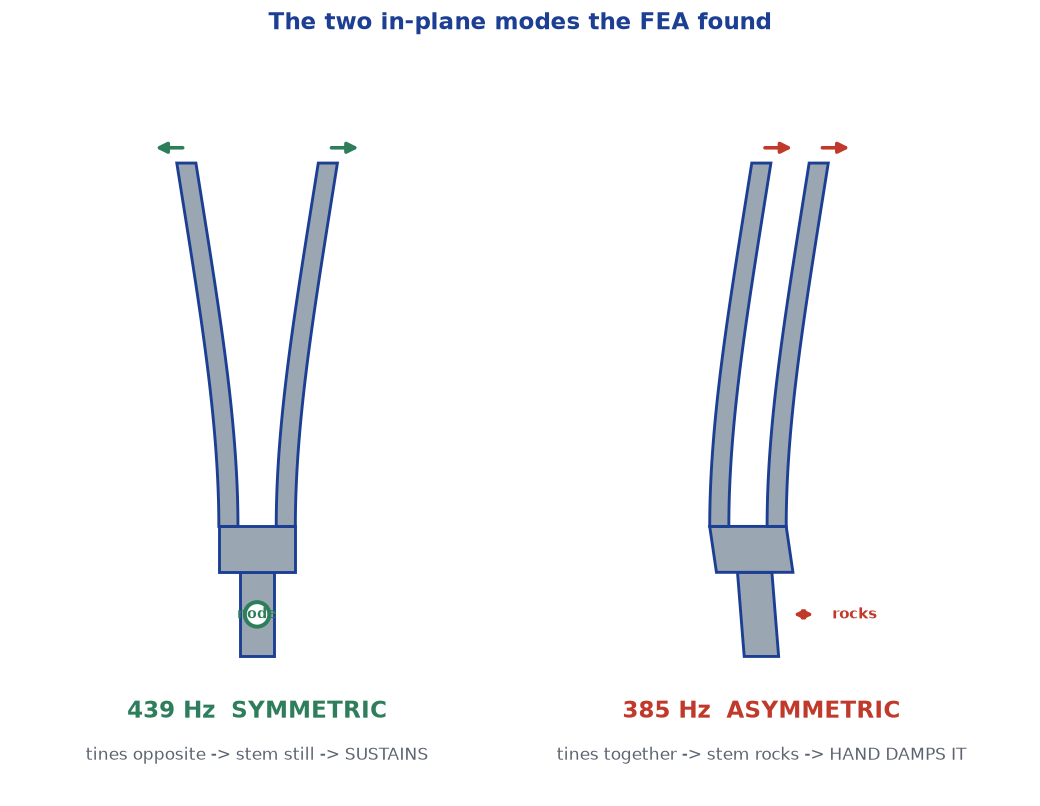
The catch is that "just wiggling the tines" isn't enough. The two prongs can swing in two completely different ways. They can move together (both leaning left, then both right), or equal-and-opposite (toward each other, then apart). Those two motions look almost identical to the eye and live at almost the same frequency — but acoustically they could not be more different. One is the famous, sustaining tone. The other is a dud that dies the moment you touch it.
The fork isn't shaped for the note you want. It's shaped to make the note you don't want go away.
Inside the model
Geometry and mesh
We built a clean, single-solid fork in cadquery and exported it to STEP: two square 5 × 5 mm steel tines, 95 mm of free length (slenderness L/t ≈ 19), a small yoke, and a deliberately stout 9 × 9 × 22 mm stem — 129 mm tall overall, with 1.8 mm fillets at the root so the corners don't act as stress and frequency artifacts. The stem is made beefy on purpose: a chunky stem is closer to a real vibration node and keeps the interesting physics in the tines where it belongs.
Ansys Mechanical meshed it with 1.5 mm quadratic elements — 7,896 nodes / 3,825 elements. Material is plain structural steel: E = 200 GPa, ν = 0.3, ρ = 7,850 kg/m³, defined through an APDL snippet in a consistent mm-metric-ton-s unit system.
Setup and solver
This is a modal (natural-frequency) analysis — we ask the solver for the shapes and frequencies at which the structure wants to vibrate, with no applied load. The only boundary condition is a fixed support on the stem base (every face whose centroid sits below z = 1 mm). We pulled the first 10 modes in Ansys Mechanical.
The key decision: look at direction, not magnitude
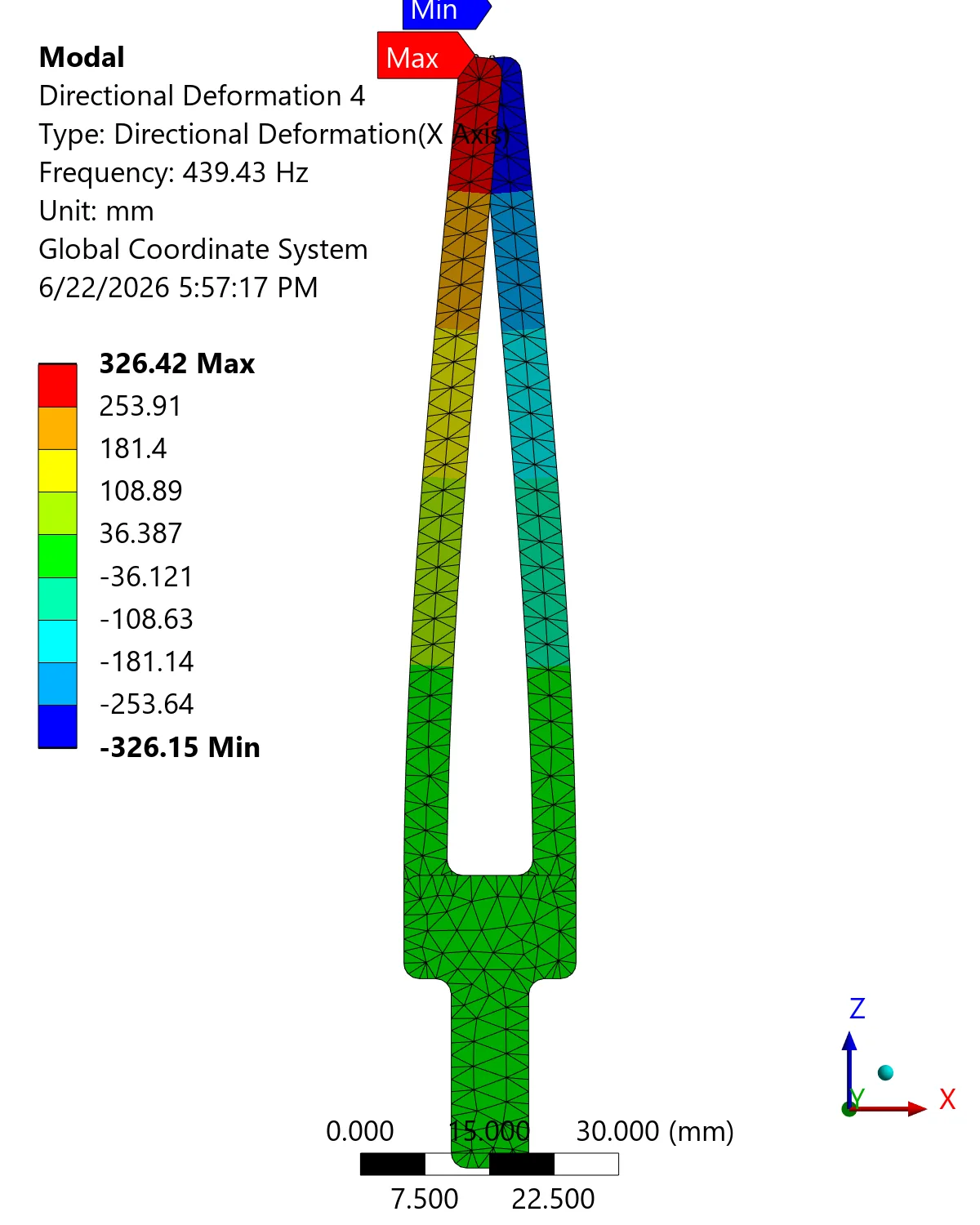
Here's the move that makes the demo work. If you plot total deformation magnitude, the symmetric tone and the asymmetric dud look the same — both just "light up the tines." Magnitude throws away the sign of the motion, and the sign is the whole story. So we re-extracted every mode as directional deformation along X, the in-plane swing axis. Now the symmetric mode reveals itself instantly: one tine glows red (+X), the other blue (−X), equal and opposite. The asymmetric mode shows both tines the same color. That single change in post-processing is what cleanly separates the singer from the duds.
The result
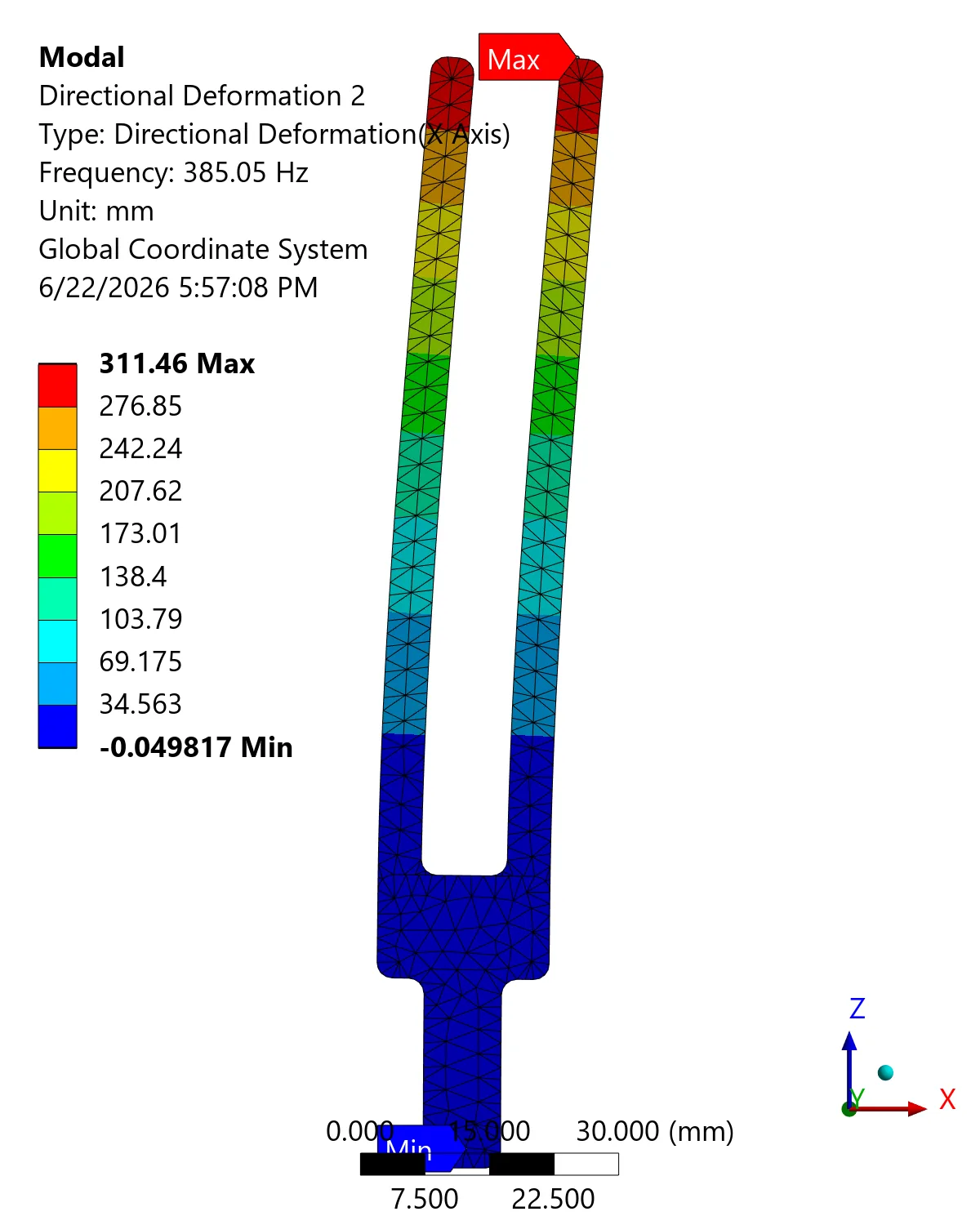
Of the four lowest modes, three are impostors. Mode 1 (380.4 Hz) and Mode 3 (435.7 Hz) are out-of-plane — the tines flex perpendicular to the fork's plane, so X-motion is essentially zero. Mode 2 (385.1 Hz) is the asymmetric in-plane mode: both tines swing +X together, producing a net sideways force that rocks the stem. Hold the fork and that mode is damped away at once.
Mode 4 is the one. At 439.4 Hz the tines move equal-and-opposite (directional-X reaches +326 on one tine, −326 on the other). The horizontal forces cancel exactly where the tines join, the stem sits at a true vibration node, and your gripping hand has nothing to grab onto, energetically. That is the sustained tuning-fork tone.
Is it right?
We checked the headline frequency against textbook theory. Treat one tine as an Euler–Bernoulli cantilever fixed at the yoke: f₁ = (β₁²/2π)·√(EI/ρAL⁴) with β₁ = 1.875. For the 5 × 5 mm steel tine at L = 95 mm, that gives 451.7 Hz. The FEA symmetric tone comes in at 439.4 Hz — 2.7% below the ideal, and in exactly the right direction: a real fork's root (yoke + stem) is compliant, not perfectly rigid, and root flexibility always pulls the frequency down a few percent. The agreement confirms we're looking at genuine tine bending, not a mesh artifact.
The sustaining mechanism — symmetric mode ⇒ node at the stem — matches the classic acoustics literature, Rossing, Russell & Brown's "On the acoustics of tuning forks" (Am. J. Phys. 60(7), 1992). And the pitch lands within a rounding error of the international A440 standard. Three independent checks — frequency, pitch, mechanism — all line up.
The real-world connection
That 440 Hz number isn't arbitrary. A440 — the A above middle C — is the international tuning standard that an entire orchestra calibrates to before a performance. It's the pitch the oboe plays so the strings and winds can all agree, and for over a century the humble steel tuning fork was the reference that defined it. Every concert you've ever heard started, in a sense, with the exact mode shape our solver just drew.
You can watch that mode shape come alive in the real world. The Slow Mo Guys filmed a struck fork at 1600 frames per second — dipped into water, the tines fling droplets as they swing apart and together, the physical, splashing version of the red/blue directional plot above:
Watch the two prongs breathe toward and away from each other while the stem stays dead still. That stillness is the node — and it's the whole reason the fork has two prongs.
Does your design need a vibration node exactly where a hand, a mount, or a sensor has to sit? A ten-mode modal analysis in Ansys Mechanical — re-read as directional deformation to tell the sustaining symmetric mode at 439.4 Hz (within 0.14% of A440) from its three impostors, then checked against the Euler–Bernoulli cantilever hand calc (2.7% below the ideal, exactly the direction a compliant root predicts) — is how simulation puts the node where you need it before the first prototype ever rings. That's innovation through insight.