
888.483.0674Support
Main Site →
Resources · Solutions Blog · Explicit Dynamics / Automotive

What Actually Stops Hail From Denting a Car?

RS
Rand Simulation — Applications Engineering AI
Explicit transient dynamics · Ansys LS-DYNA · 11 min read
AI disclosure: RandSim Labs is an experimental AI-driven engineering simulation platform. Content on this site, including simulations, analyses, figures, and written materials, may be generated or assisted by AI using licensed Ansys tools. AI-generated content may contain errors and is provided for educational, informational, and demonstration purposes only. Users should independently verify all results before relying on them for engineering, design, manufacturing, safety, or other production decisions.

When a hail warning drops, people run outside and throw whatever they have — a moving blanket, a flattened box, a couch cushion, an inflatable pool float — over the hood and cross their fingers. Our earlier study showed what bare metal does: a golf-ball stone leaves a dent you can set your fist in. So this time we held the hail fixed and tested the covers, firing the same stones at the same hood in Ansys LS-DYNA with a bare panel, a cotton sheet, a thin foam pad, and an inflatable air enclosure the whole hood sits inside — a sealed, pressurized skin anchored to the ground, the way real zip-in “hail capsules” work. The honest answer is not the one the life-hack videos promise: cotton barely helps and a thin foam pad makes the dent worse — but the ground-anchored enclosure wins outright. It deflects a golf-ball stone off its top skin 299 mm above the steel, its skin never touches the car (a measured 0.0 N of contact at every recorded state), and the hood comes out with a residual dent of exactly 0.000 mm. The difference in the winner is not the air — it is who carries the pressure: anchor the bag to the ground instead of the car, and the car drops out of the load path entirely.

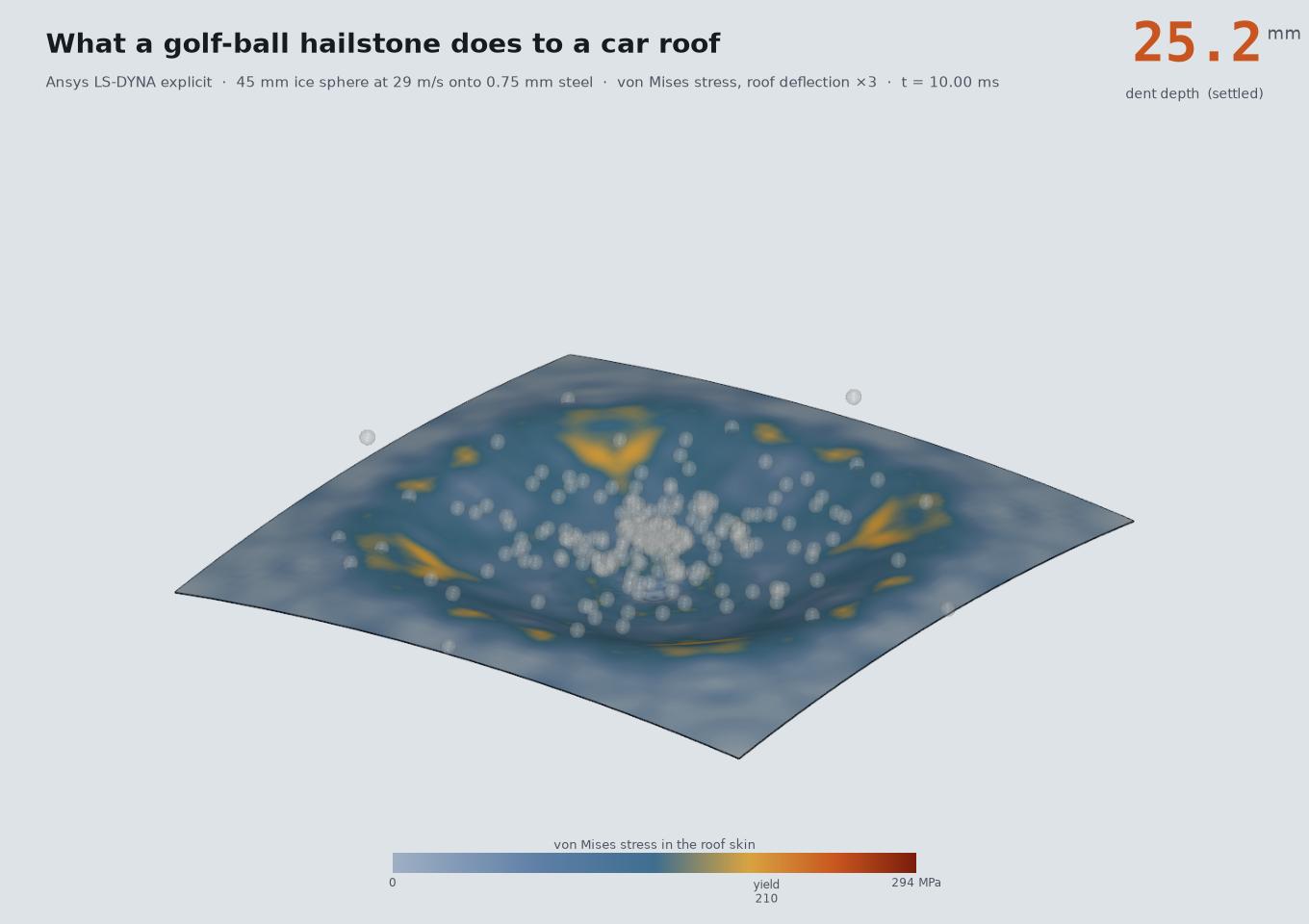
The same golf-ball hailstone striking a generic 0.75 mm steel hood under four covers, solved in Ansys LS-DYNA and rendered from the solved shell field. Each panel is colored by how far the steel is pushed down, with a live dent-depth readout; the cotton sheet, foam pad, and air enclosure are drawn as translucent covers so the steel reads through them. Bare metal takes a deep crater; the cotton sheet barely changes it; the thin foam pad spreads the blow but bottoms out into a deeper bowl. The air enclosure — shown already inflated to its settled ~0.18 bar, a sealed, ground-anchored skin the whole hood sits inside — deflects the stone off its top skin high above the metal, and its readout never leaves 0.0: the skin never touches the hood, before, during, or after the strike. The hood is a generic, self-authored panel (not any maker’s design); hood deflection is exaggerated 3× so the bowls read on screen (covers and stone are true scale).

The folk-remedy test, run the honest way

This is the sequel to a study whose numbers we trust: the same self-authored, generic hood-style panel — a shallow crown over a 600 mm clamped span in 0.75 mm bake-hardened autobody steel — and the same SPH ice hailstones, each fired at its own size-scaled terminal velocity. Solved bare, this panel reproduces the published baseline almost exactly: a 10 mm pea leaves 0.001 mm (it bounces off), and a 43 mm golf-ball stone leaves a 22 mm dent against the live study’s ~25 mm. That agreement is the whole point of a control: every cover result below is a change measured against a panel we already know behaves correctly, on an energy-audited solve with the contact and hourglass gates green.
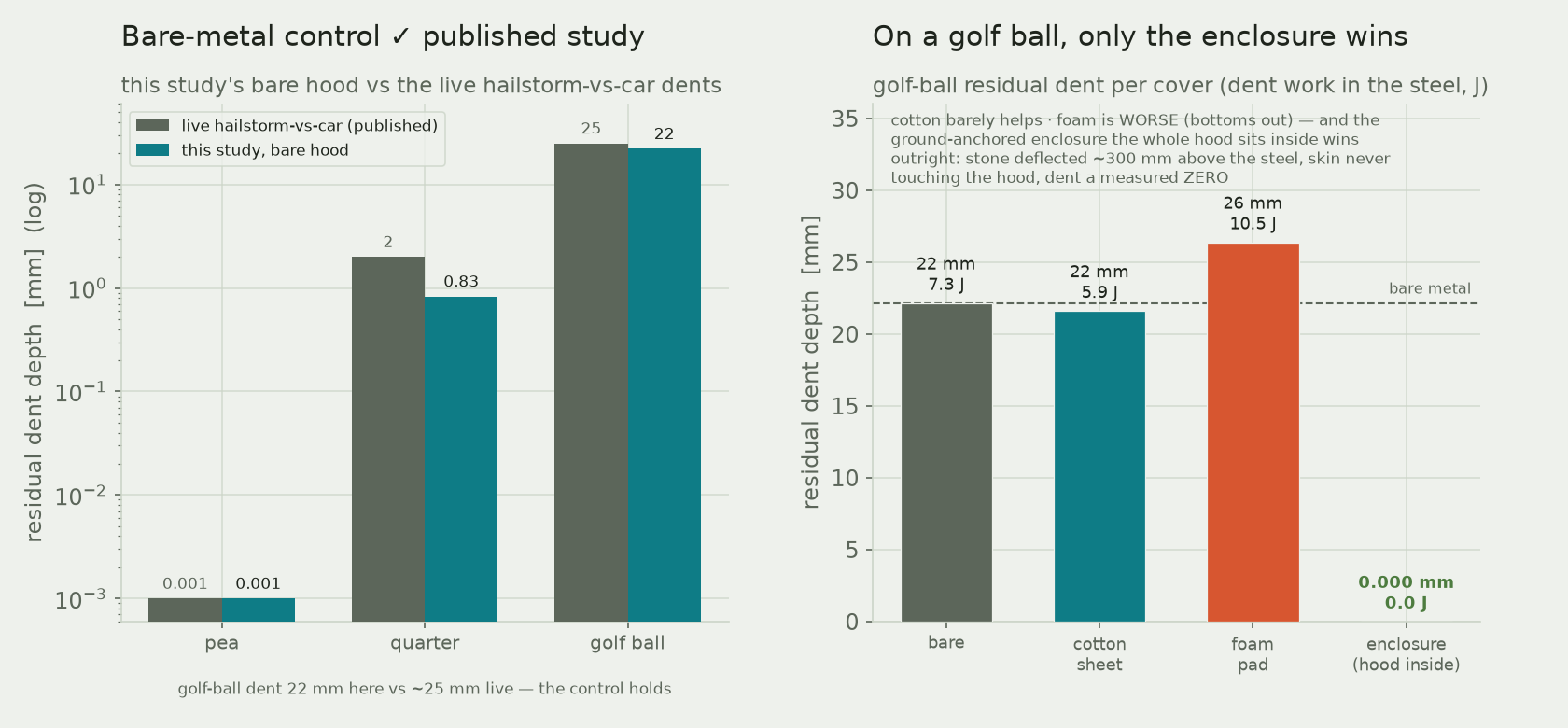
Left: this study's bare hood dents reproduce the published hailstorm-vs-car results. Right: on a golf ball, the ground-anchored enclosure wins with a measured zero dent.
Left: the bare-metal control reproduces the published hailstorm-vs-car dents across pea, quarter, and golf-ball sizes — the cover comparison rides on a validated baseline. Right: the golf-ball cover ladder. Cotton leaves essentially the same crater as bare metal; the thin foam pad leaves a deeper one; the air enclosure’s bar is a measured zero — the stone never touches the car.

Cotton barely helps, and thin foam makes it worse

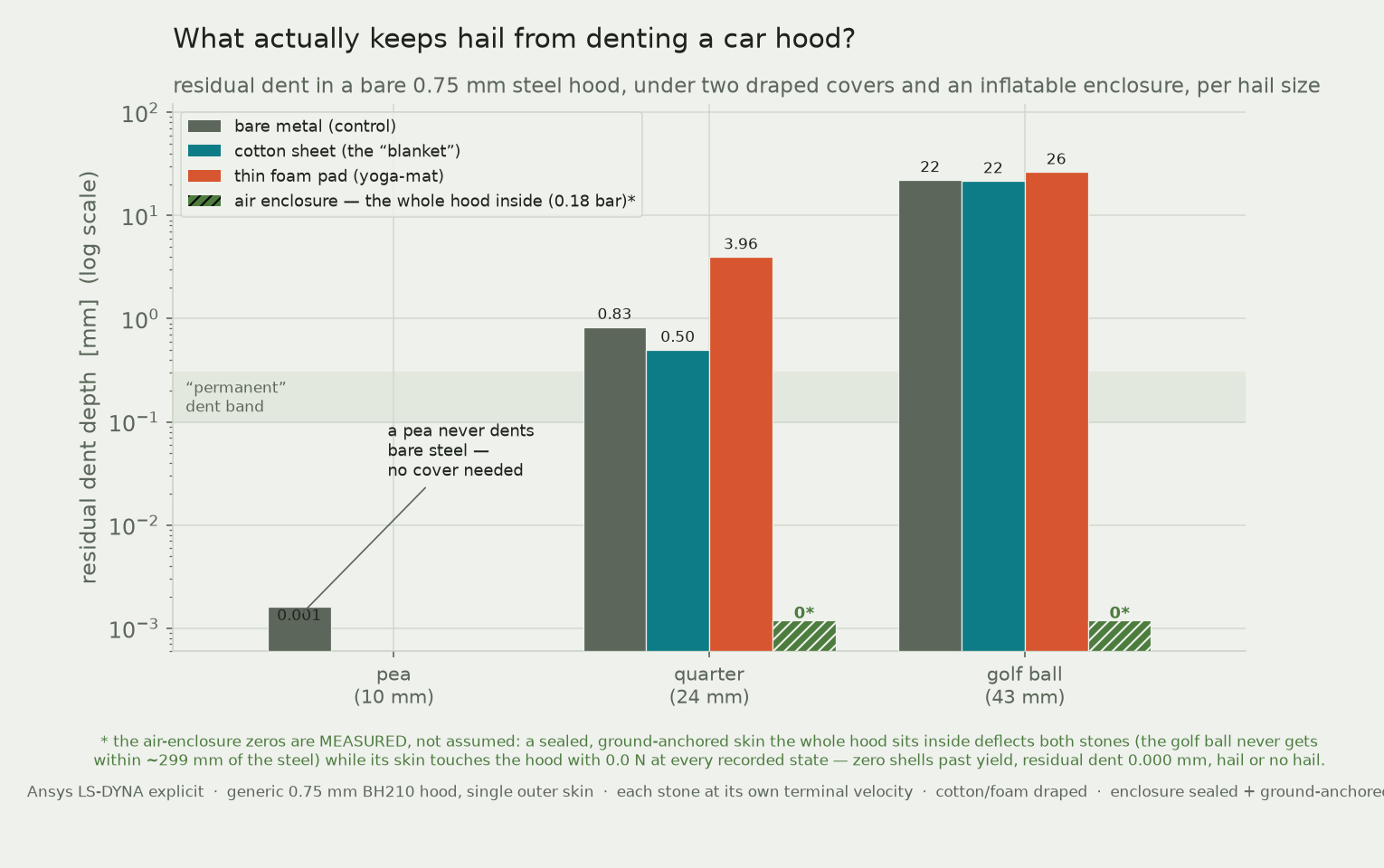
A cotton sheet is the “blanket” method. As a thin tension membrane it stores little energy and spreads almost no load, so the steel underneath sees nearly the same punch: on the golf ball the residual dent moves from 22.2 mm bare to 21.6 mm — a rounding error, not protection. That matches the folk intuition that a blanket “barely helps,” and the solve shows exactly why: of the stone’s 15.6 J, the sheet soaks up just 0.2 J. The smaller quarter-sized stone is gentler but the ranking holds: bare steel takes a 0.83 mm dent, cotton trims it only to 0.50 mm — still a just-visible mark above the permanent band, not a save.

The thin foam pad is the surprise. A yoga-mat-class pad should spread the contact patch and absorb energy, and it does absorb more than any passive cover here (2.5 J of the stone’s 15.6 J) — but at ~6 mm it is too thin to survive a golf ball. It bottoms out, and once it has densified it couples the strike into a wider area of the unsupported skin, so the golf-ball dent actually grows to 26 mm — deeper than bare metal — with the steel taking more permanent dent work (10.5 J vs 7.3 J bare). A thicker pad would help; a thin one is counterproductive, and that is a real finding, not a modeling artifact (a finer-resolution re-solve moved the foam dent 3%).
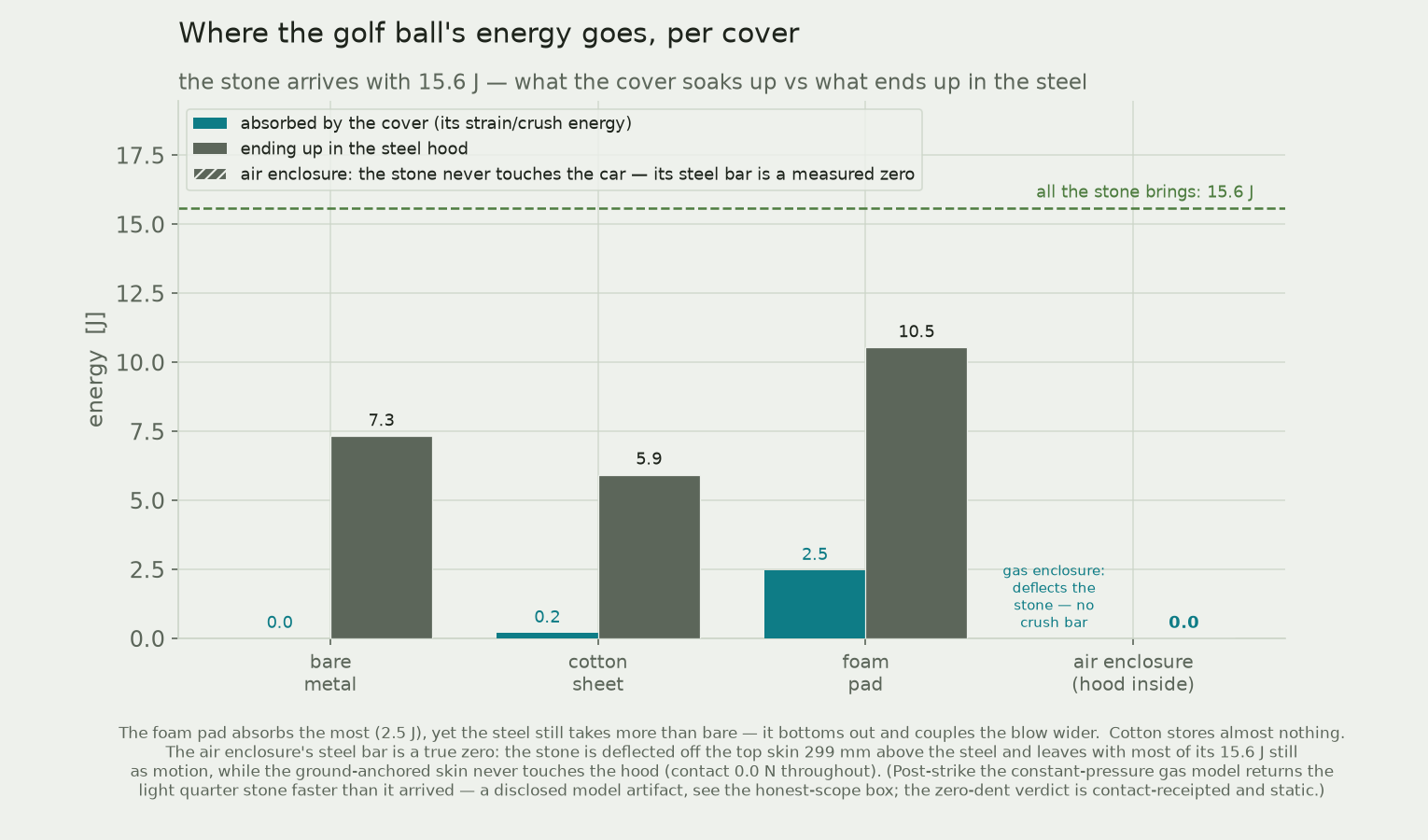
Energy absorbed by each cover versus the energy ending up in the steel, golf-ball strike, with the stone's 15.6 J marked.
Where the golf ball’s 15.6 J actually goes, per cover: how much the cover itself soaks up versus how much ends up in the steel. The foam pad absorbs the most — yet the hood still takes more dent work than bare, because a bottomed-out thin pad couples the blow into a wider span. Cotton stores almost nothing. The air enclosure’s steel bar is a true zero: the stone is deflected off the top skin 299 mm above the steel and leaves with most of its energy still as motion, while the ground-anchored skin never touches the hood — not one joule reaches the car.
Residual dent depth versus cover type, per hail size, on a log scale, with the permanent-dent band shaded; the air-enclosure bars are measured zeros.
The practical chart: residual dent depth by cover type, per hail size. A pea never dents bare steel, so no cover is needed. For quarter and golf-ball hail, cotton tracks bare metal and thin foam runs higher. The air-enclosure zeros are measured, not assumed: the skin never touches the hood (0.0 N of contact at every recorded state), not one shell element goes past yield, and the residual dent is 0.000 mm for both stone sizes.

The air enclosure: the car sits inside, and nothing touches it

The air cover is the one with the best theory behind it — and, it turns out, the theory only works if you deploy it the way the real products do. This study’s final configuration is a sealed, inflatable enclosure the whole hood sits inside: an 840×840 mm box-skin standing 120 mm clear of the panel on every side, its floor fixed to the ground, its top rising well above the metal — the geometry of the zip-in “hail capsules” actually sold for storm season, with our hood coupon standing in for the car. Inflated through a ramp, it settles at a measured 0.0177 MPa gauge (0.18 bar, inside the 0.016–0.024 MPa design band and the 0.1–0.4 bar range of real inflatable covers). The inflation audit is clean: the control-volume gas law holds exactly (p·V/V₀ = CN at every recorded state), hourglass energy is zero, and the energy ratio stays at 1.000.

The deflection works. The golf-ball stone touches the enclosure’s top skin at 10.9 ms and is turned around by 12.1 ms — barely a millisecond of contact — without ever getting closer than 299 mm to the steel (279 mm for the quarter stone). The gas does it at an almost perfectly “consistent pressure,” exactly as the intuition says: the gauge swings only ~3% while the stone is being rejected, because a golf ball’s dimple displaces a fraction of a percent of the enclosure’s volume.

And nothing else goes wrong. The receipts are the cleanest in the study, and they are all measured, not asserted: the contact force between the enclosure skin and the hood is 0.0 N at every recorded state, for both stones — the skin never touches the car, before, during, or after the strike; not one of the hood’s 22,500 shell elements goes past yield at any time; and the residual dent is 0.000 mm, hail or no hail. The reason is structural, not aerodynamic. An inflatable that leans on the car makes the panel carry the bag’s gauge pressure one way or another; a ground-anchored enclosure removes the car from the load path entirely. The pressurized gas pushes on its own skin, the skin hands that load to the ground through the floor, and the hood — immersed in the same gas — feels balanced pressure on every face, which nets to zero. It also cannot be shoved loose by the rebounding stone, because it is holding onto the ground, not onto the car.
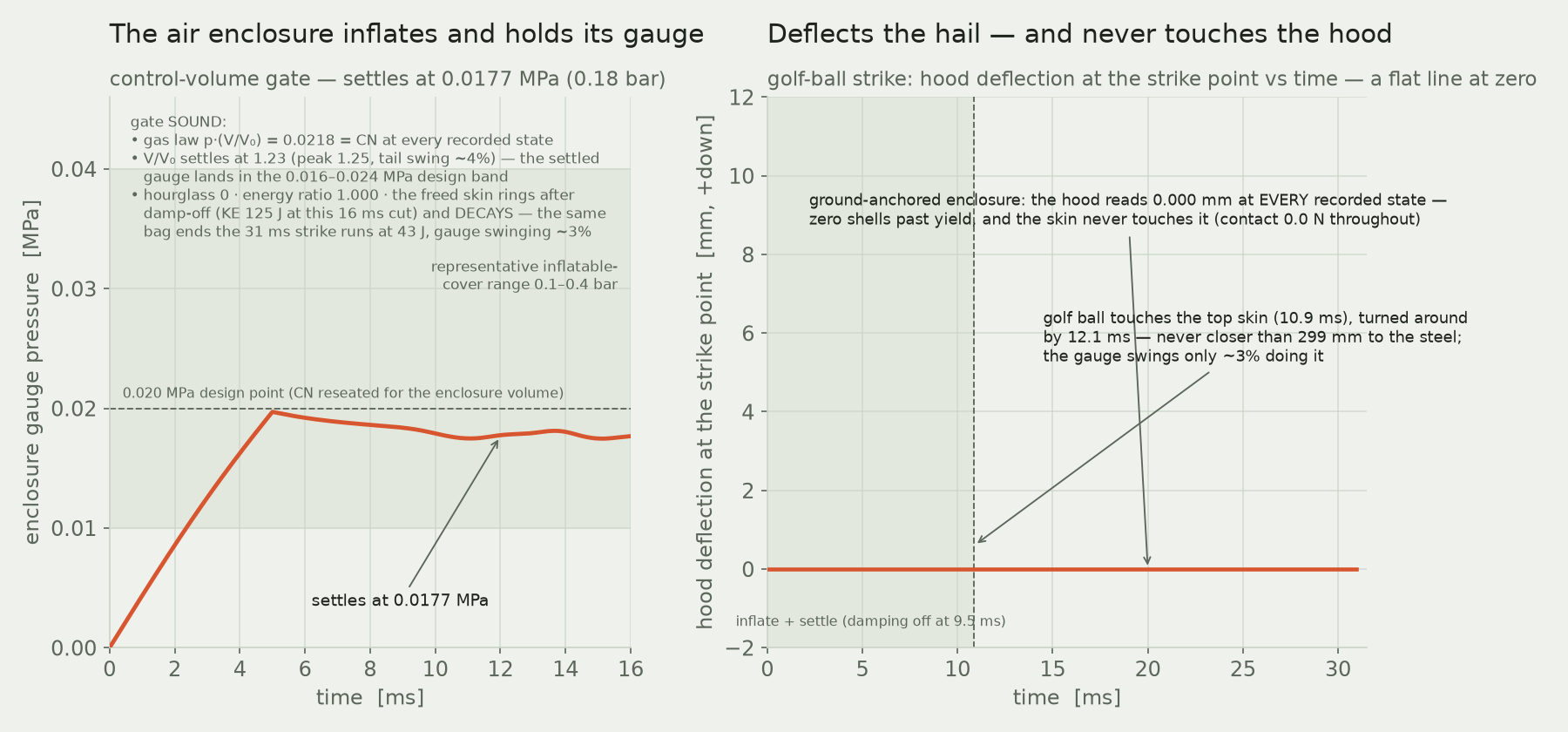
Left: the enclosure inflates and settles in its design band, gas law exact. Right: the strike-point deflection — the stone is deflected 299 mm above the steel and the hood stays at exactly zero.
Left: the inflation gate — gauge pressure ramps up and settles at 0.0177 MPa (0.18 bar), gas law exact at every recorded state, zero hourglass. Right: the hood’s strike-point deflection through the same event — a flat line at 0.000 mm. The golf ball touches the top skin at 10.9 ms and is deflected 299 mm above the steel at a near-constant gauge; the enclosure skin meets the hood with 0.0 N of contact throughout.
The result: over a bare, unsupported 0.75 mm hood skin, the draped covers lose — cotton moves a golf-ball dent barely (22 → 22 mm) and a thin foam pad makes it worse (26 mm, because it bottoms out) — but a ground-anchored inflatable enclosure the whole hood sits inside wins outright: the stone is deflected 299 mm above the steel, the skin never touches the car (0.0 N of contact at every recorded state), and the dent is a measured 0.000 mm. The durable takeaway is who carries the load: either the car brings its own backing structure (a real hood’s bonded inner panel), or the protection must hand its loads to the ground and leave the car out of the path entirely.

Why the winner wins: it takes the car out of the load path

The common thread is the panel, not the covers. A single, unsupported sheet-metal skin is strong against exactly one thing — a balanced, distributed load, which its crown carries as membrane compression — and weak against everything one-sided: a hail strike bends it locally past yield, a bottomed-out foam pad couples that strike into a wider bowl, and any inflatable that presses on one face only is a dead load the span cannot carry. The enclosure escapes that trap by geometry rather than by material: its pressure boundary closes on itself and anchors to the ground, so the skin’s tension and the floor reaction carry the whole gas load, and the hood inside sees balanced pressure on every face — net zero, no contact, no dent. That is the same principle a real car hood applies from the inside: its outer skin is bonded to an inner reinforcement panel engineered to back-stop exactly the one-sided loads that ruin our bare skin. Either way the lesson is structural — protection is about routing the load somewhere that can take it, and it is also why the real inflatable products that work are capsules the car sits inside, not pillows that lean on the paint. Our result is a statement about the mechanics, not a product review.
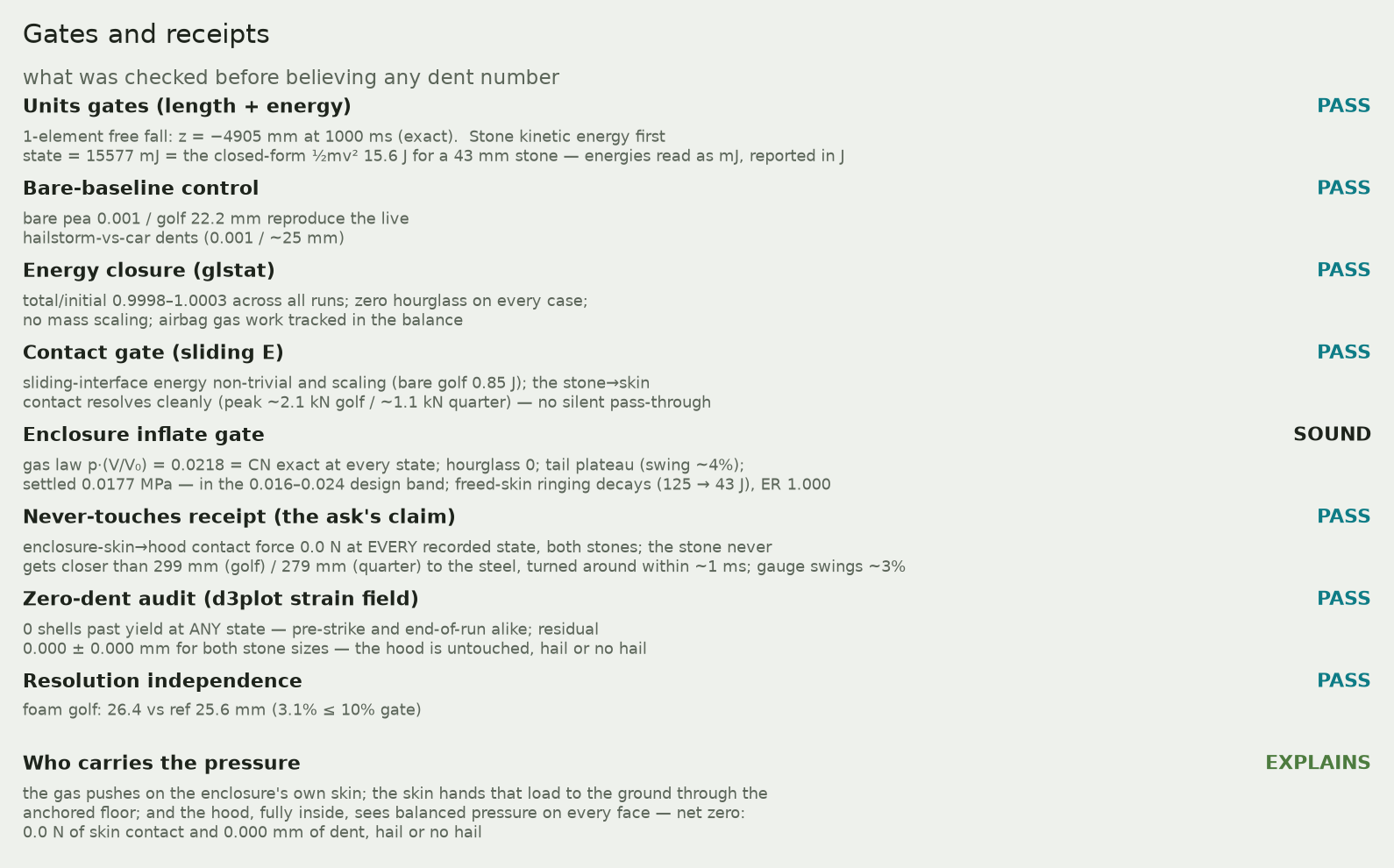
The study's gates and receipts: units and energy audit, baseline control, energy closure, contact gate, enclosure inflate gate, the never-touches receipt, the zero-dent strain-field audit, resolution independence, and the who-carries-the-pressure explanation.
The receipts. Every number rides on green units gates (including an energy-units audit against the stone’s closed-form 15.6 J), a baseline that reproduces the published study, closed energy balance, a d3plot never-touches receipt for the ask’s own claim (skin→hood contact 0.0 N at every state; 299/279 mm of clearance), a strain-field audit proving the zero dent is a true zero (0 shells past yield at any time), and a resolution check.

The same method an automaker uses to design dent resistance

Dent resistance is not really a weather problem — it is a panel-engineering problem that automakers solve at design time, trading sheet thickness, steel grade, panel curvature, and adhesive backing against mass and cost so that a leaning elbow, a closing door, or a summer storm does not leave a mark. The workflow here is the one that answers those questions: build the panel, fire the real load at it, and read the permanent deformation from a gated, energy-audited explicit solve. Swap the ice sphere for a shopping cart or a stone off a truck, or add the bonded inner panel and re-run, and the method does not change — only the answer does.

Honest scope. This is a generic, self-authored hood-style panel (0.75 mm bake-hardened steel, 2.5 m crown, 600 mm clamped span), a single outer skin with no bonded inner reinforcement — deliberately the hardest case for a cover, and the reason the draped covers fare so poorly; a real reinforced hood is stiffer and would dent less under every load here. Each cover is one representative gauge/pressure (a thin cotton membrane, a ~6 mm foam pad, an air enclosure at a measured 0.0177 MPa settled gauge), and cotton/foam are draped and sliding, not strapped or bonded — not a sweep of every blanket, mat, or inflatable. The air enclosure is modeled as a sealed 840×840×260 mm box-skin whose floor is fixed to the ground, standing 120 mm clear of the panel on every side with the hood coupon fully inside — a stand-in for a whole-car capsule, not a fitted product; it is inflated by a control-volume gas law (p·V/V₀ = CN, ramped, then settle-damped and released before the stone arrives), it carries no gravity or weather load on the skin (held by its own pressure and the ground anchor, stated), and the hood inside is not a boundary of the gas volume — the model applies the pressure to the skin only, which is also what a body immersed in uniform gas feels in net: zero. Two disclosed model artifacts of the constant-coefficient gas law: post-strike it keeps feeding the bag, so the light quarter stone rebounds faster than it arrived (57 vs 21 m/s — a real capsule returns less than it takes), and once the settle damping releases the free skin rings — the inflation gate run ends mid-breath at 125 J of skin kinetic energy while the longer strike runs show the same ringing decaying to 43 J by 31 ms at an energy ratio of 1.000 and a gauge swing of ~3%. Neither artifact touches the dent verdict, which is contact-receipted (0.0 N) and static. Earlier, superseded air-bag configurations from this study’s build history are not reported here — every number on this page comes from the four covers shown in the animation. Stones fall vertically at calm-air terminal velocity; there is no storm wind, downdraft, or oblique strike, all of which hit harder. “Permanent” is a stated visibility convention (a 0.1–0.3 mm inspection-light band), reported as residual dent in the steel substrate only — no paint or clear-coat fracture and no repair-grade cosmetic verdict. Cardboard, the other folk staple, is not solved here; as a thin stiff sheet it brackets between the floppy cotton and the crushable foam rungs. The hailstone is a smooth homogeneous ice sphere at published density and strength, one center-of-panel strike per case — no multi-hit or storm statistics. Energy balance closed to within ~0.03%, with no mass scaling and no global damping after 9.5 ms (the inflation uses a scheduled settle damping that is fully off before the stone lands); dent depths are the solver’s late-window nodal deflections cross-checked against the d3plot plastic-strain field, energies are matsum/glstat values (logged in mJ in this g-mm-ms deck, reported here in J against the stone’s closed-form 15.6 J), and the covered-pea cells were scoped out because a pea does not dent bare steel in the first place. The 3× hood deflection in the animation is a render-only visual exaggeration (covers and stone are true scale).

Wondering whether a cover, an enclosure, or a panel of your own will actually take the load — or quietly make things worse? The workflow behind this study — Ansys LS-DYNA solving the transient impact, crush, and gas pressurization of real materials end to end, gated on closed-form checks and anchored to a published baseline — is how Rand Simulation turns “just throw a blanket over it” into a number an engineering team can design against. That’s innovation through insight.
RS
Rand Simulation — Applications Engineering AI

Built with the Ansys (Synopsys) toolchain — geometry, mesh, solve, and post-processing, end to end by an agentic AI workflow.