What Size Hail Dents a Car Roof?
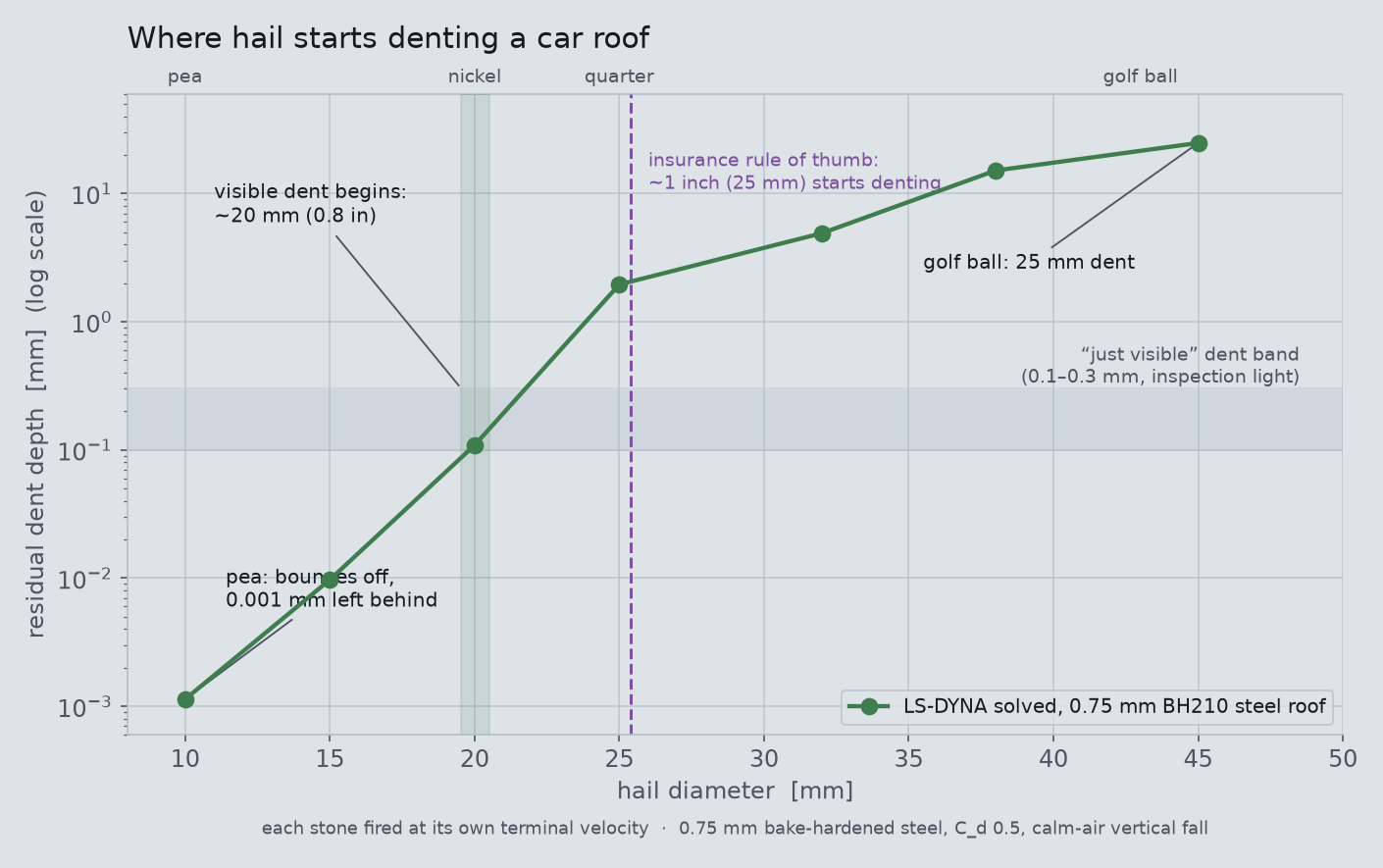
Every summer the same argument breaks out on driveways and in claims offices: was that hail big enough to do this? Everyone agrees a pea bounces off and a golf ball ruins a panel — the fight is over the line between them. So we fired the whole hail-size ladder at the same piece of car roof in Ansys LS-DYNA, each stone arriving at the speed physics actually delivers it, and watched where the steel stops springing back. A 10 mm pea leaves 0.001 mm behind — nothing; a 45 mm golf-ball stone leaves a 25 mm dent you can feel with your palm; and the crossover sits right around the one-inch line the insurance industry already uses.
Bigger hail falls faster, and that is the whole story
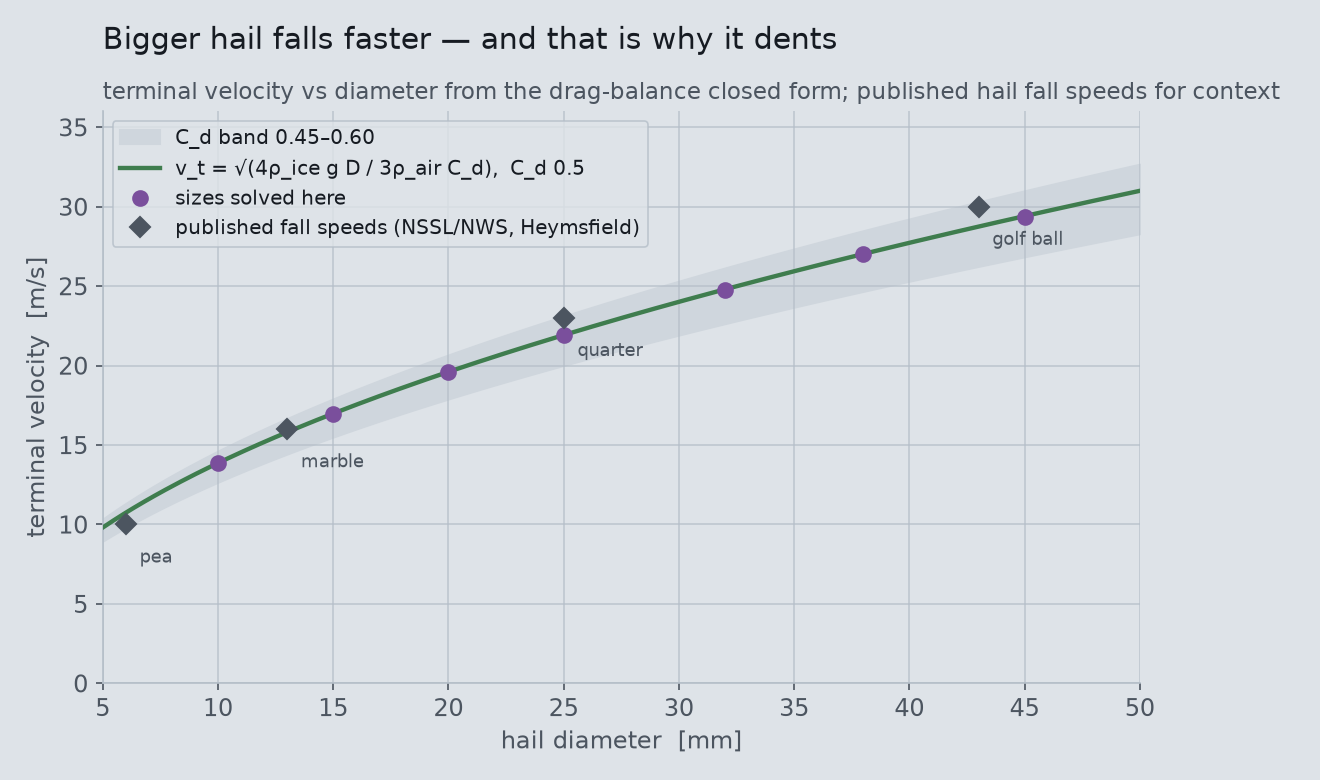
A hailstone is an ice sphere falling at terminal velocity, and terminal velocity scales with size. Drag balances weight when vt = √(4 ρice g D / 3 ρair Cd), so speed grows as the square root of diameter: a 10 mm pea arrives at about 14 m/s, a 25 mm quarter-sized stone at about 22 m/s, a 45 mm stone at about 29 m/s. That looks gentle until you count the energy. Kinetic energy is ½ m v²; mass grows as diameter cubed and vt² grows as diameter, so the punch a stone lands scales as diameter to the fourth power. Between the pea and the golf ball that is roughly 400× the energy — which is why the ladder has a knife-edge in it rather than a gentle ramp.
How the roof was modeled
The roof is a self-authored, generic sedan-style panel: a shallow spherical crown (2.5 m radius — the curvature you see reflected in a parking lot) over a 600 × 600 mm section held at its edges, meshed with 22,500 fully-integrated shell elements and made of 0.75 mm bake-hardened autobody steel with a real hardening curve. The hailstone is an SPH (smoothed-particle) ice sphere — the right tool for a body that shatters — using the standard ice material model, with failed particles kept as fluid-like debris so the splash you see in the animation is physical, not decoration. The two meet through a contact that we gate on every run: the sliding-interface energy has to be non-trivial, because an impact deck whose energy balance reads a suspiciously perfect 1.0000 is usually a contact that silently did nothing. There is no mass scaling (it would fabricate kinetic energy on a hard hit) and no global damping during the strike; the panel rings, and a light structural damping only afterward lets the permanent dent settle out so we can read it cleanly.
“Where dents start” needs a definition, so we picked a physical one: the residual dent depth — the deflection left at the impact point after the panel stops ringing and springs back — read from the solver’s own nodal output late in each run and cross-checked against the retained plastic work in the steel. A dent is plastic strain that stayed; if the panel gave back all its energy, there is no dent, and the plastic-work number says so.
Pea bounces, golf ball dents — shown, not asserted
The pea is the control the whole argument needs. Fired at its 14 m/s terminal velocity, the 10 mm stone dimples the panel by a tenth of a millimeter for an instant, the panel springs back 98.8% of the way, only about 2 joules of plastic work is dissipated, and 0.001 mm is left behind — the stone rebounds off an essentially unmarked roof. Step up the ladder and the panel holds its composure until, right around the one-inch mark, it doesn’t: the 45 mm golf-ball stone drives a plastic hinge ring, its own ice crushes, and a 25 mm dent remains after everything settles.
Why ice is gentler than a steel ball — and what moves the line
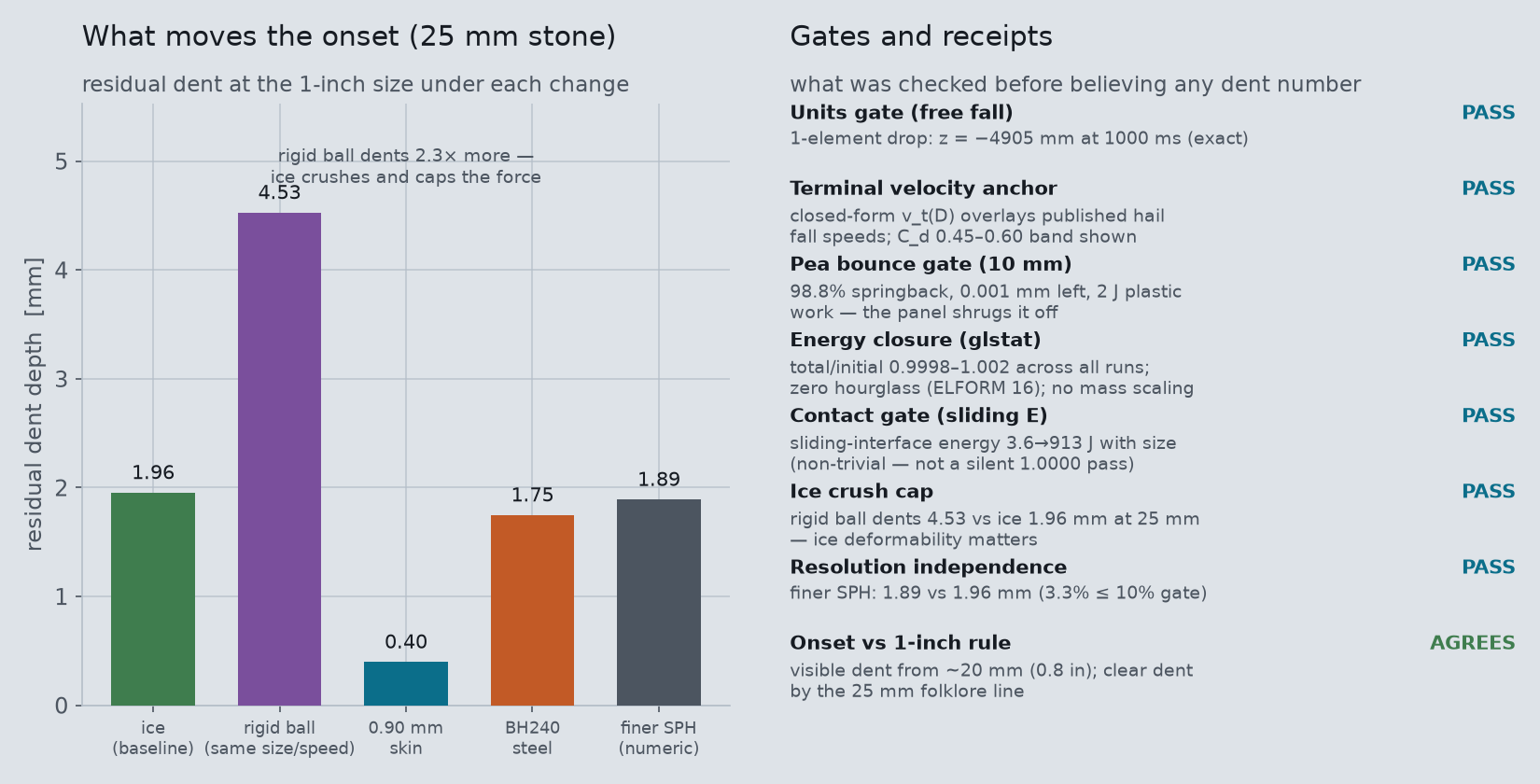
Here is the part the pamphlets miss: a hailstone is not a ball bearing. Because ice crushes on contact, it caps the force it can deliver, spreading the blow over a longer, softer push. Fire a rigid ball of the same 25 mm size at the same speed and the panel takes a 4.5 mm dent — 2.3× deeper than the 2.0 mm the deformable ice sphere leaves. That gap is why steel-ball impact tests (the FM 4473 / UL 2218 lineage) are a conservative stand-in for real hail, and why modeling the ice as ice, not as a hard sphere, matters if you want the real number.
The onset is a band, not a single number, because it moves with the panel. Thicken the skin from 0.75 to 0.90 mm and the 25 mm dent drops five-fold, to 0.4 mm — the difference between a totaled roof and a car wash. A higher-strength steel grade trims it modestly (1.75 vs 1.96 mm). And the drag coefficient sets the arrival speed, so the same stone in a stiffer or calmer air column hits a little harder or softer. We also refined the ice-particle resolution to make sure the dent is a result and not an artifact: the number moved 3.3%, well inside our 10% gate.
The same physics an automaker manages on purpose
Dent resistance is not a weather problem — it is a panel-engineering problem that automakers solve at design time, trading sheet thickness, steel grade, panel curvature, and adhesive support against mass and cost so a closing door, a leaning elbow, or a summer storm doesn’t leave a mark. The workflow here is the same one that answers those questions: build the panel, fire the real load at it, and read the permanent deformation from a gated, energy-audited explicit solve. Swap the ice sphere for a shopping cart, a stone off a truck, or a hand press, and the method does not change.
Wondering how much punishment your panel, enclosure, or product can take before it’s permanent? The workflow behind this study — Ansys LS-DYNA solving the transient impact, crush, and springback of real materials end to end, gated on closed-form checks and anchored to published data — is how Rand Simulation turns “everyone knows it dents” into a number an engineering team can design against. That’s innovation through insight.