How Fast a Champagne Cork Really Leaves the Bottle
Everyone has ducked a champagne cork, and everyone half-believes the shaken-bottle myth. The internet quotes an exit speed anywhere from 25 to 60 mph, and eye injuries from flying corks are a real emergency-room category every New Year. So we did the thing the folklore never does and actually computed it: a deformable cork seated in a glass neck, several atmospheres of gas behind it, friction holding it in place — and then we let it go. The number that controls everything is temperature, not agitation. Warm the bottle and the cork leaves fast; shake it and, for the launch itself, almost nothing changes.
A cork is a plug held by friction, launched by gas
The setup is simple to state. A champagne cork sits compressed inside the neck, its mushroom head outside; behind it, in the headspace, is dissolved-CO₂ gas at several atmospheres. The interference fit of the cork against the glass holds it there by friction. Take the cage off and the net force — gas pressure over the bore area, minus the friction grip — decides whether it stays or flies.
We built exactly that. The cork is a deformable solid with cork's real, unusual property: a near-zero Poisson ratio, so it can be squeezed radially into the bore without bulging along its length. Its density is smeared to the true mushroom-cork mass of about 8 grams. The neck is treated as rigid — we are launching a cork, not fracturing glass — with an 18 mm bore. The grip is not a number we typed in: the cork is built a hair smaller than the bore, then grown into the glass so that a genuine contact pressure develops, and the friction that holds the cork is whatever that contact pressure times the friction coefficient works out to be. As the compressed body slides up and out, the engaged length shrinks, so the grip ramps down on its own. The gas drive behind the cork base expands as the cork travels, so its pressure decays the way an adiabatic gas actually does rather than pushing at a constant value. The whole event is a few milliseconds of explicit transient dynamics, which is precisely LS-DYNA's lane.
Below about 4.75 bar, nothing happens
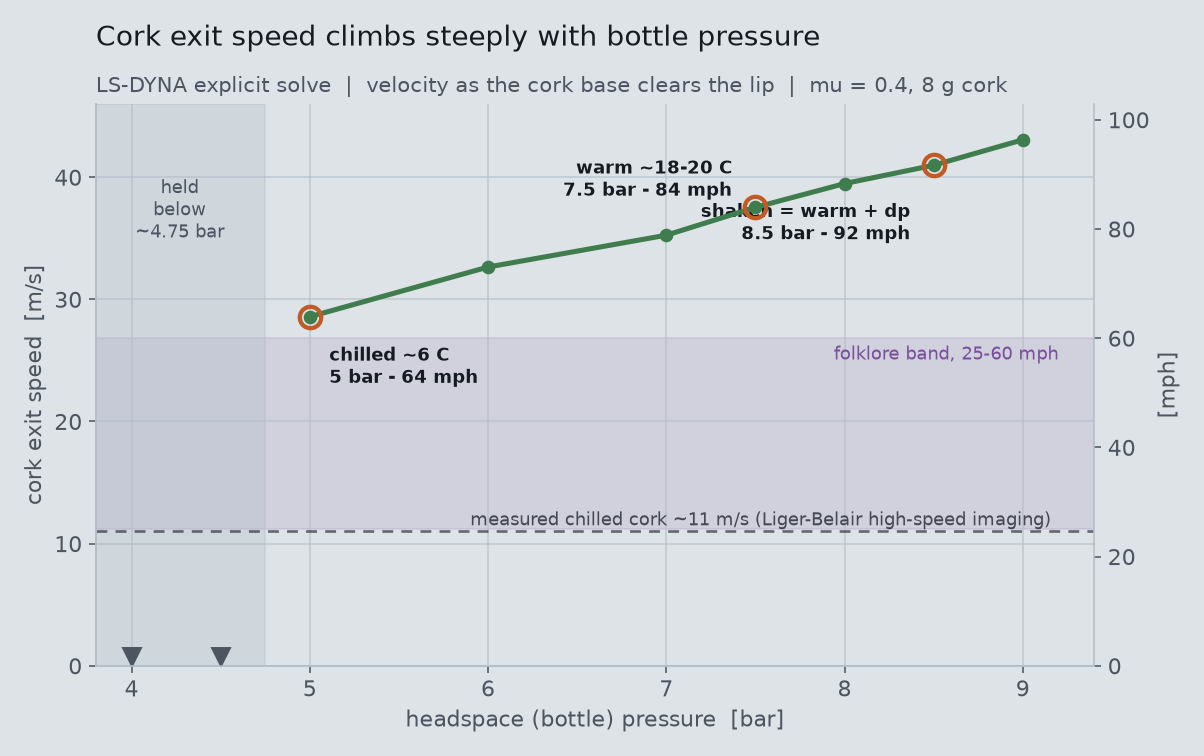
The first result is the one that explains why a cold bottle feels safe. Across the sweep, the cork does not move at all until the headspace pressure climbs past roughly 4.75 bar. At 4.0 and 4.5 bar the grip wins and the cork stays seated; at 5.0 bar it launches. There is a genuine threshold, and it is why chilling a bottle stabilizes it: cooling drops the equilibrium CO₂ pressure, and below the release point the friction simply holds. Above the threshold the model runs from 64 mph at 5 bar up to about 96 mph at an extreme 9 bar — the full idealized range the honest bracket later brings back to earth.
Above the threshold, the exit speed climbs steeply with pressure. This is the curve that "settles the number" — it maps the whole folklore band onto a physical axis and shows where each condition lands.
The launch is faster than you can flinch
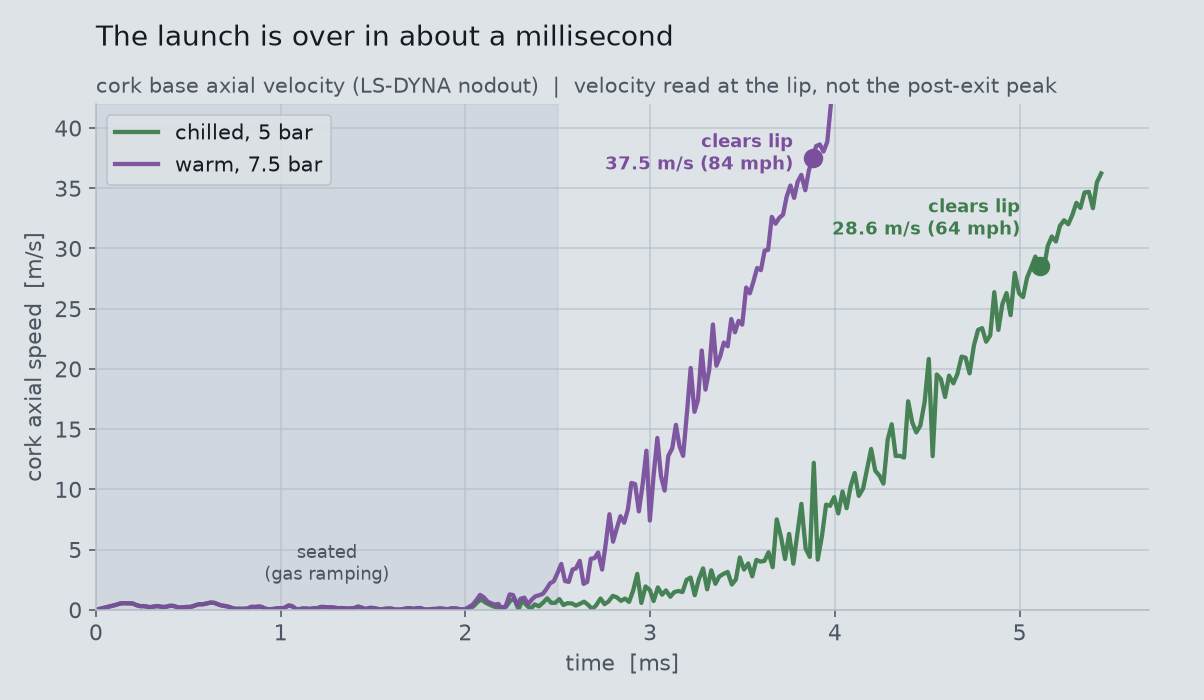
Reading the cork's velocity through the event shows how little time there is. After the gas ramps up and the grip releases, the cork goes from stationary to its exit speed inside the neck in a little over a millisecond. We report the speed at the moment the cork base clears the lip, not the peak — because the prescribed gas drive keeps pushing the now-free cork after it has left, which inflates the peak into an artifact. The honest number is the muzzle velocity at the lip.
Shaking is the myth; warming is the danger
Here is the part that overturns the party trick. Shaking a bottle does not change the equilibrium pressure in the headspace — that is set by temperature through how much CO₂ the wine holds, and shaking does not add any gas. What shaking changes is the foaming after the cork is out: the dramatic gush is dispersed bubbles, not a faster cork. So we modeled "shaken" the only honest way we could — as the warm bottle plus a small, bounded over-pressure — and the cork's launch speed barely moved.
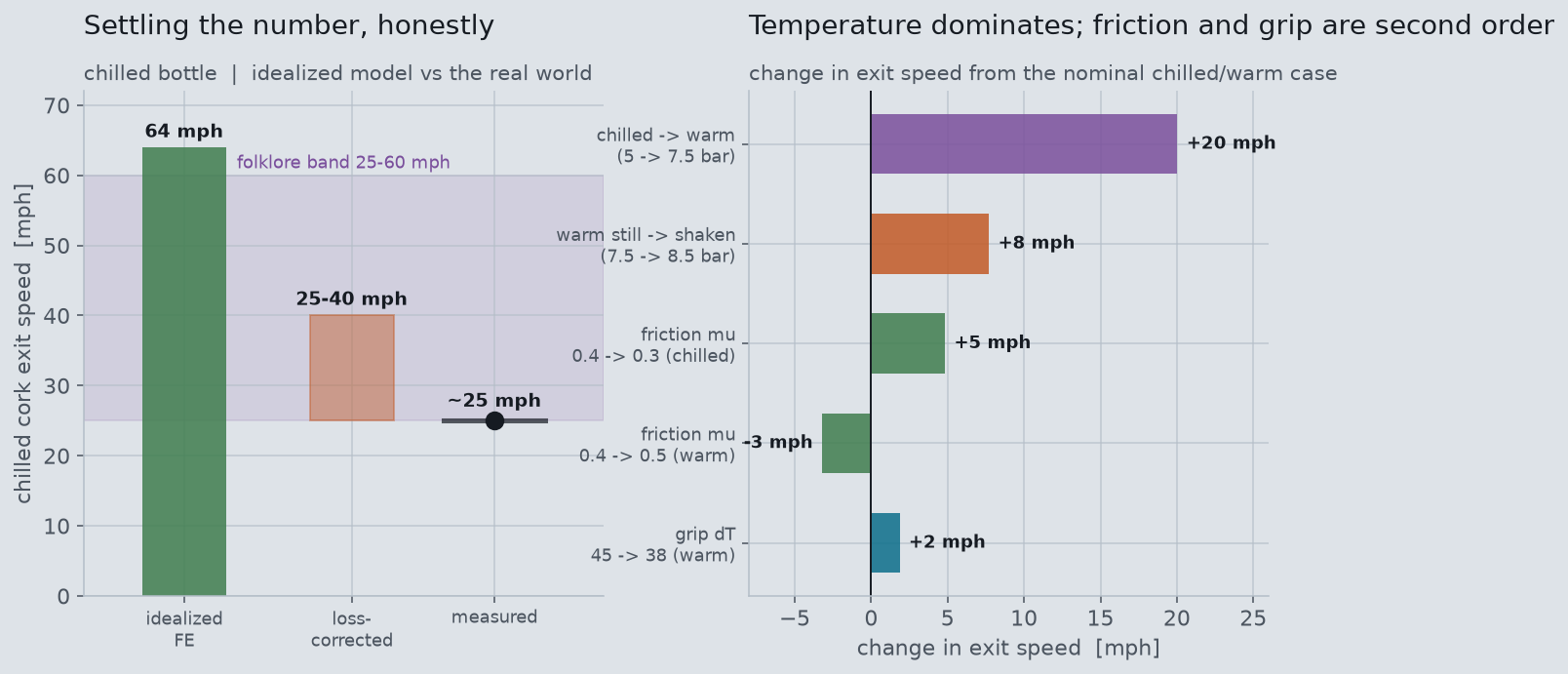
The comparison is stark. Going from chilled to warm — a swing you can create just by leaving the bottle on a table — adds about 20 mph to the exit speed. The bounded "shaken" bump on top of the warm case adds only about 8. Friction and the exact strength of the grip shift the answer by a few miles per hour either way, and above a certain grip the cold bottle simply stays corked. Temperature is the dial that matters; everything else is second order.
Settling the number, honestly
The model's exit speeds — 64 mph chilled, 84 warm — are faster than the folklore band and faster than the roughly 40 km/h (11 m/s) that high-speed imaging has measured for a real chilled cork. That gap is not something to hide; it is what an idealized launch model does. Our cork releases from a static friction latch and then slides with very little drag, and the model leaves out three things that all slow the real cork down: gas blow-by past the cork the instant it starts to move, which bleeds the driving pressure away fast; the cork's own viscoelastic absorption as it decompresses; and a gentler, less abrupt real-world release. Put a loss correction on the idealized number and it drops squarely into the 25–40 mph band and onto the measured anchor.
So the defensible answer is a bracket, not a single decimal: the idealized upper bound and a loss-corrected estimate that lands in the folklore band and on the measurement. What does not depend on that calibration — the robust, publishable physics — is the shape of the story: a hard release threshold, a steep climb with pressure, temperature as the dominant driver, and shaking as a near-non-event for the cork's speed.
Why the safety line is "keep it cold, point it away"
Turn the speed into energy and the safety point makes itself. Even the chilled cork in the idealized model carries a few joules of kinetic energy, and the warm one about 5.6 — and a cork does not need to be moving at its top speed to injure an eye. That is the whole reason flying corks are an ER category around the holidays. The physics-backed version of the standard advice is exact: cool the bottle to keep the pressure below the steep part of the curve, and never aim the neck at a face, because the launch is over before anyone in the room can react to it.
Have a product held in place by a grip that has to let go at exactly the right moment? The workflow behind this study — Ansys LS-DYNA solving the deformable cork, its emergent friction retention, the decaying gas drive and the exit kinematics, anchored to published measurements and reported with an honest error bracket — is how Rand Simulation turns a "how fast, really?" question into a number a team can defend. That's innovation through insight.