Where a Baseball Bat's Sweet Spot Really Is
Every hitter knows the two feelings without ever having seen an equation. Catch the ball out on the end of the barrel and your hands sting — a sharp, buzzing jolt that says you did something wrong even before you see where the ball went. Catch it on the sweet spot and you feel almost nothing, the ball just leaves, hot and fast, as if the bat were not even in your hands. Those are not two separate pieces of luck. They are the same graph, and this study draws it: the spot where the sting disappears is the exact spot where the ball comes off fastest.
The sweet spot is where the bat barely bends
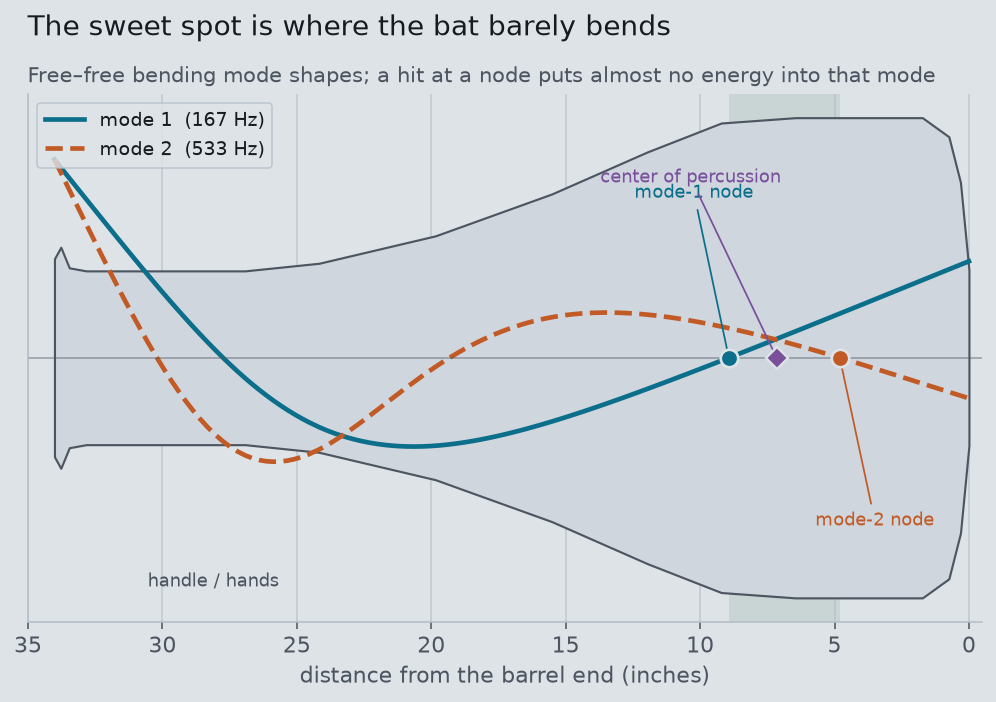
A bat is a slender elastic beam, and like any beam it has natural bending shapes it likes to vibrate in. Pluck one free in the air and it rings in its first two flexural modes: a low, slow bend and a faster double-bend. Each mode has nodes — points that stay still while the rest of the bat waves around them. Strike the bat at a node and you can barely get that mode moving; strike it at an antinode, like the far end of the barrel, and it rings like a struck bar.
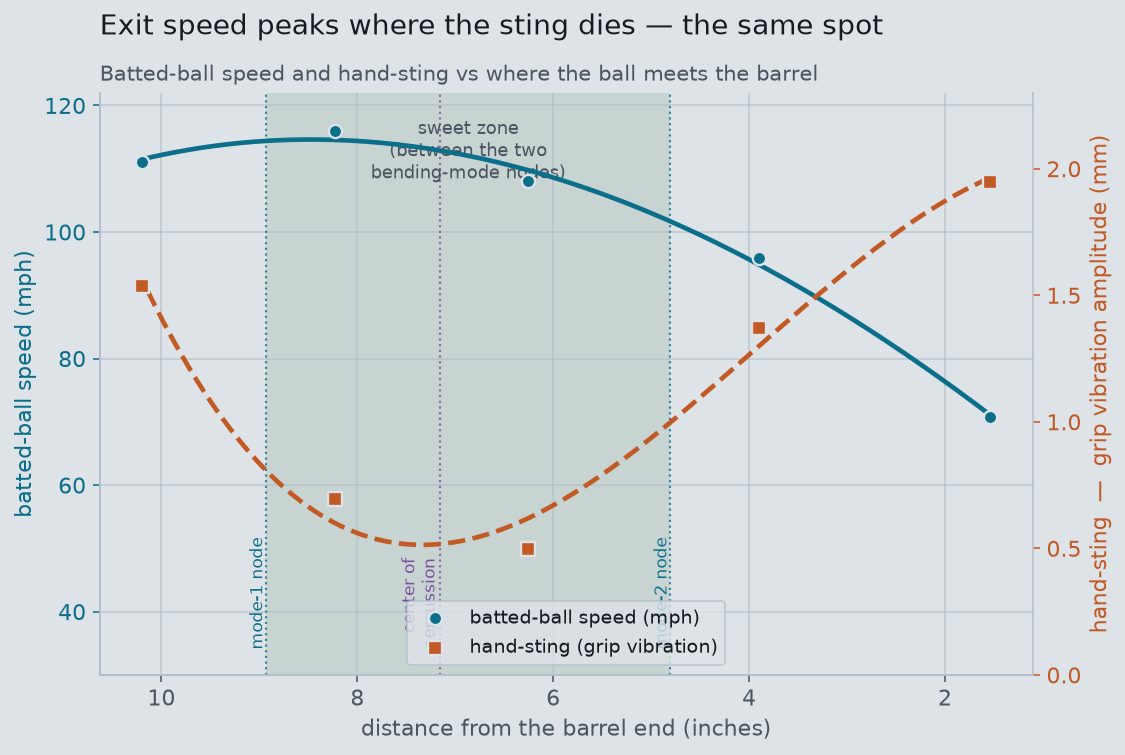
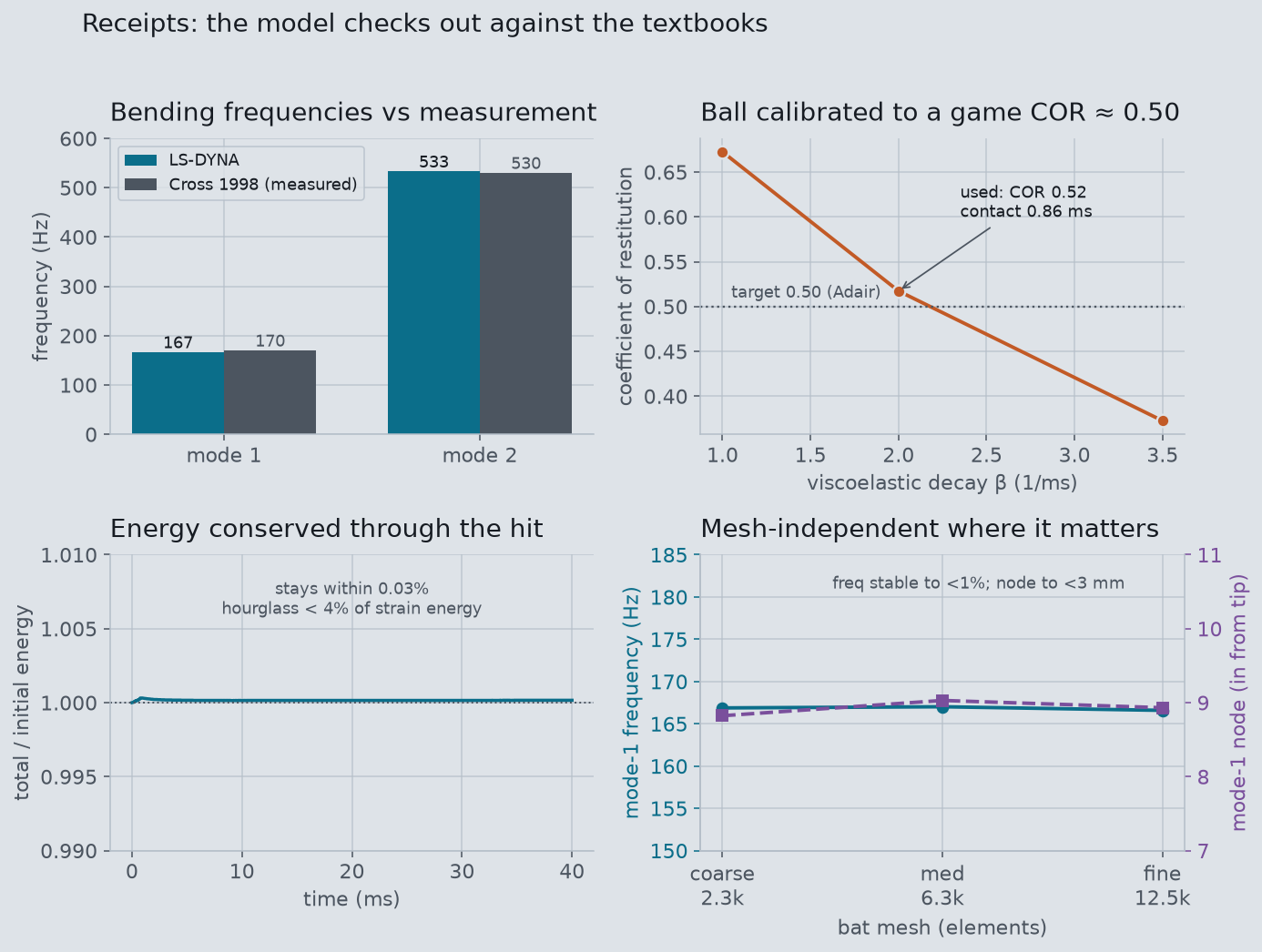
We extracted those modes directly from the solve by giving the free bat a sharp transverse tap and watching it ring, then reading the frequencies and mode shapes out of the motion. The first mode came out at 167 Hz and the second at 533 Hz — within about two percent of Rob Cross's classic laboratory measurements of a wood bat (170 and 530 Hz). The barrel-side node of the first mode sits about 8.9 in from the end of the barrel; the second mode's node is closer in, about 4.8 in. The region between them is where a strike excites neither mode strongly — and that is the felt sweet spot.
Hit it there and the ball agrees
Why should the quiet spot also be the fast spot? Because vibration is energy, and any energy that goes into ringing the bat is energy that did not go into the ball. When you hit a node, the bat cannot soak up much energy in bending, so more of it stays with the ball. The two effects — no sting, high exit speed — are two readings of the same thing.
We tested that by firing the ball at the free bat at five positions along the barrel, changing nothing but the strike location, and reading the ball's rebound. The directly solved quantity is the collision efficiency — how much of the ball's speed comes back — which is exactly what the NCAA/ASTM bench test measures. Converting to a real batted-ball speed with the standard collision formula (at a stated 90 mph pitch and 67 mph swing), the exit speed climbs from a feeble 71 mph off the very end to about 116 mph in the sweet zone, then falls off again as the impact moves down toward the taper. The peak of that curve and the minimum of the hand-sting curve land within an inch of each other — the whole thesis of the study in one figure.
The waves that reach your hands
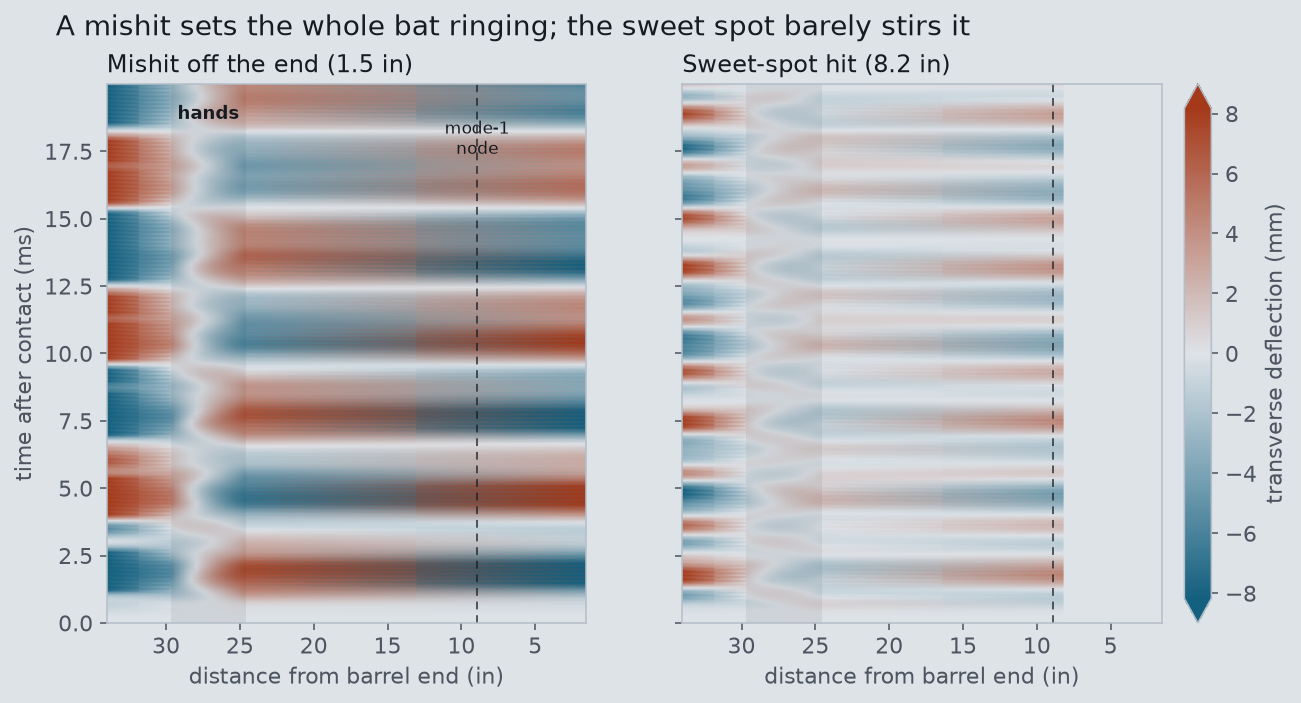
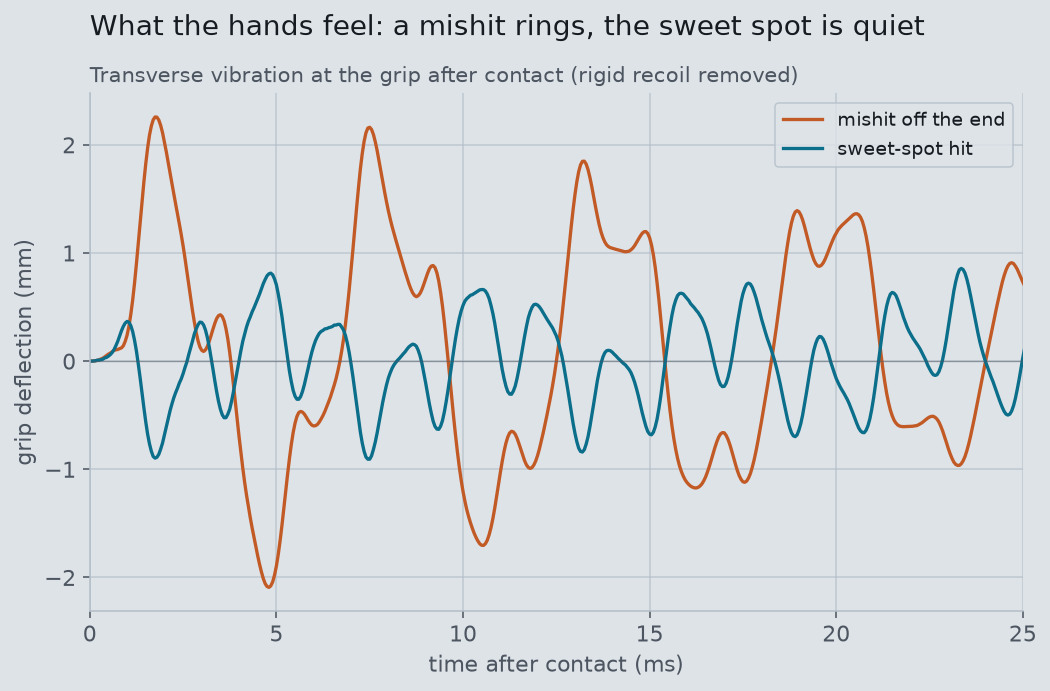
The sting itself is a traveling story. The instant the ball hits, it injects a transverse kink into the barrel that runs down the bat as a bending wave and arrives at the handle a fraction of a millisecond later — and then the whole bat settles into ringing at its bending frequencies. A mishit off the end launches a big wave and the handle whips through more than two millimeters of vibration; a sweet-spot hit puts almost nothing into the handle, and what little there is rings at the higher, gentler second mode.
Node, or center of percussion?
For decades the "sweet spot" was explained as the center of percussion — the point where, if you hit it, the bat does not jerk against a pivot at your hands. It is a real and useful idea, and it is easy to compute from the bat's mass distribution: for our bat it sits about 7.2 in from the end. But the center of percussion is a rigid-body idea; it says nothing about vibration, and it is vibration that stings. The honest answer the physics gives is that on a real bat these landmarks are neighbors: the vibration node zone (4.8–8.9 in) and the center of percussion (7.2 in) all fall within about two inches of the end, and the felt minimum-sting point (about 6.8 in) sits right among them. So the two explanations are not rivals so much as different mechanisms pointing at the same patch of wood — the nodes tell you why your hands stop buzzing, the center of percussion why the bat stops jarring. Both are why a barreled ball feels like nothing.
How we know the model is honest
A converged, self-consistent, wrong answer is the easiest thing in the world to produce, so every claim here is anchored to something we did not tune. The units were proved with a one-element free fall that dropped exactly 4905 mm in one second. The ball is not a perfect bouncy sphere: it is a viscoelastic model calibrated against a rigid wall to a coefficient of restitution of 0.52 and a 0.86 ms contact time — essentially the ~0.50 and 0.7–1.0 ms of a real game baseball. Every impact conserved energy to better than 0.03% with hourglass control kept to a few percent, and the whole result was checked on three mesh densities — the frequencies held to under one percent and the node location moved less than three millimeters. The sweet-spot location is the robust result; the absolute exit speed carries a band from the assumed ball stiffness and swing speed.
Want to know where your own product's sweet spot — or its weak spot — really is? The same explicit-dynamics workflow that located a bat's node from first principles will find the resonance, the impact response, or the fatigue-critical spot in your part, on Ansys tools, validated against physics you can check. Rand Simulation is an Ansys (Synopsys) Apex Channel Partner, and this study was built end to end by our applications-engineering AI. Let's turn your hardest "why does it do that?" into a picture — that is innovation through insight.