Why the Fastest Way to Cook Barbecue Beef Isn't the Best
Every pit has the same argument going at some point: low and slow, or crank the heat and get it done? A reader asked us to settle it — of all the ways to cook barbecue beef, which is fastest, how do they compare on energy, and does the meat come out juicy or greasy? So we took one beef brisket, built it in Ansys as a real transient heat-conduction problem, and cooked it five ways: a smoker, a convection oven, a direct grill, a sous-vide bath, and a pressure braise. Same cut, same 4 °C fridge start, same target. Only the way heat reaches the surface changes. The winner of the speed race turns out to be the worst thing you could do to the brisket.
Four cookers, one brisket, one clock
Barbecue beef means a brisket — the big, tapered, fatty cut with a thick "point" end and a thin "flat," a layer of fat cap on top. We modeled a representative one: about 35 cm long, tapering from 10 cm thick at the point to 4.5 cm at the flat, roughly 4.5 kg of lean beef under a 1 cm fat cap. It is a generic brisket, not any brand or product.
What makes this a clean simulation problem is that the meat itself does the same thing in every appliance. Beef is a poor conductor of heat, so however you heat the outside, the inside can only warm by slow diffusion inward. The entire difference between a smoker and a grill lives in one place: the surface — how hot the source is, and how fast it hands heat to the meat. So we solved one conduction problem five times, changing only the surface condition and the cook window each time, using heat-transfer coefficients and source temperatures taken from the food-engineering literature:
- Smoker — a gentle 121 °C (250 °F) with light airflow; the barbecue benchmark.
- Convection oven — 163 °C (325 °F) with forced air; the kitchen method.
- Direct grill — glowing coals near 650 °C radiating onto the surface; the hot-and-fast method.
- Sous vide — an 88 °C water bath; the precision method.
- Pressure braise — condensing steam at about 120 °C, which hands heat to the surface extremely fast.
The physics: a brisket is a slow conductor
Two textbook numbers decide everything here. The first is the Biot number — the ratio of how fast heat crosses the surface to how fast it can spread inside. When it is small, the whole piece warms together; when it is large, the surface races ahead and a steep gradient forms, cooking the outside long before the middle catches up. A smoker sits around 2; a grill around 6; a sous-vide bath and a pressure cooker are up near 20 to 90 — their surfaces are essentially pinned at the source temperature from the first minute, and everything after that is pure conduction inward. The second number is the ceiling: because heat only ever flows from hot to cold, the core can never get hotter than the source. That single fact is why a sous-vide bath at 88 °C cannot produce a 95 °C core, no matter how long you wait.
Inside the model
The solve is an Ansys Mechanical (MAPDL) transient thermal analysis on a structured mesh of about 99,000 nodes, built directly from the brisket geometry with the mesh packed tightest at both surfaces where the gradient is steep. The meat's properties are not held constant: thermal conductivity and specific heat follow the Choi–Okos composition model and change as the meat heats, including the well-known heat-capacity spike around 60–70 °C where muscle proteins denature — the non-evaporative part of the famous "stall" that slows a brisket's climb. The fat cap is a second material. Radiation from the coals and oven walls is folded into a temperature-dependent surface film so it is handled honestly alongside convection. We track the single coldest point deep inside the meat — the true thermal center, about 4.6 cm down — as the "done" signal, rather than an average that would read done while the middle lags.
The fast cooker wins the race and ruins the brisket
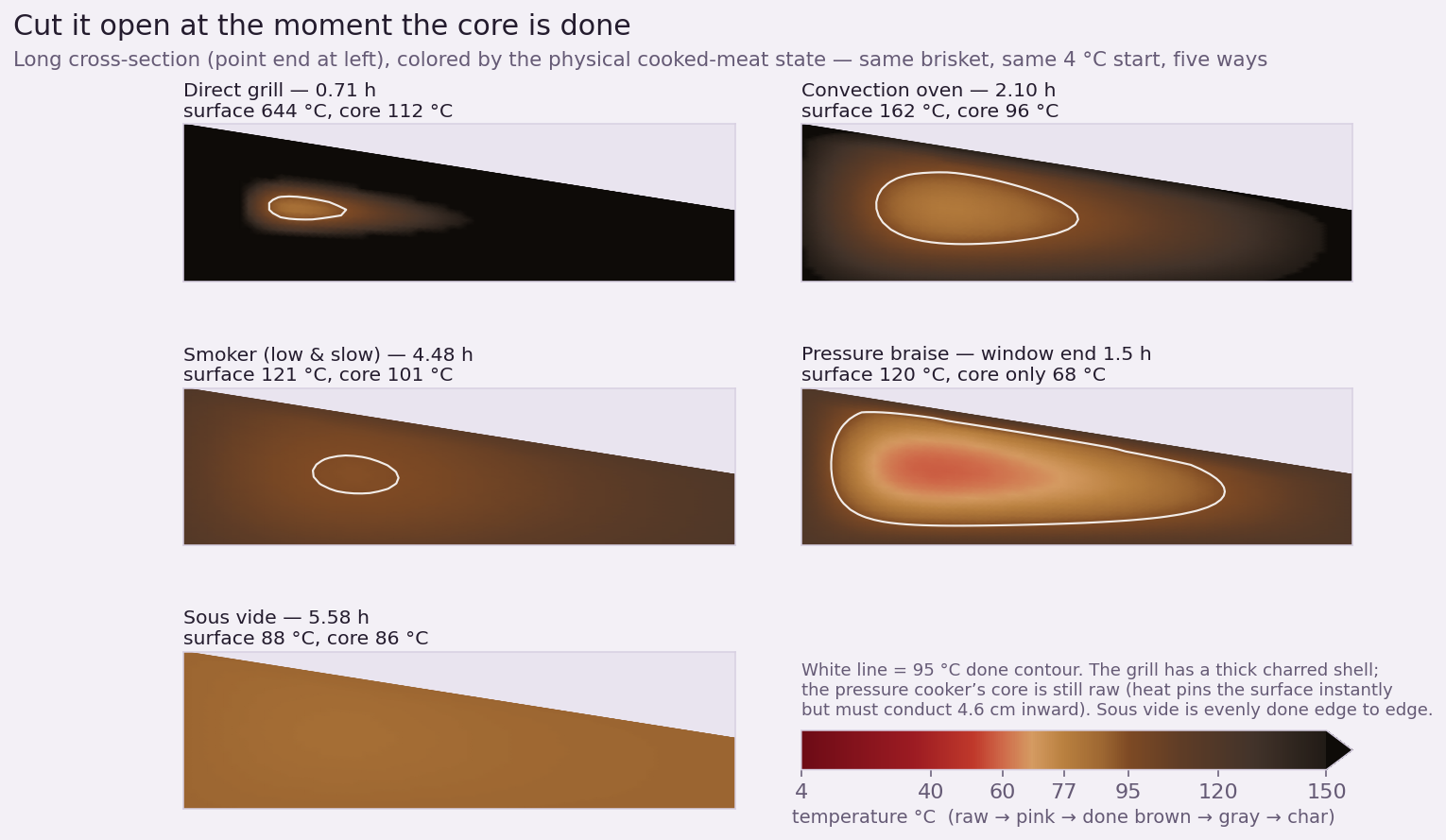
Here is the speed answer. The direct grill drives the core to a done 95 °C in about 40 minutes, the convection oven in about 2.1 hours, and the smoker in about 4 hours. On raw speed to a done core, hotter wins — the grill's 650 °C source is simply a bigger push. So the fastest cooker is the grill, and it is not close.
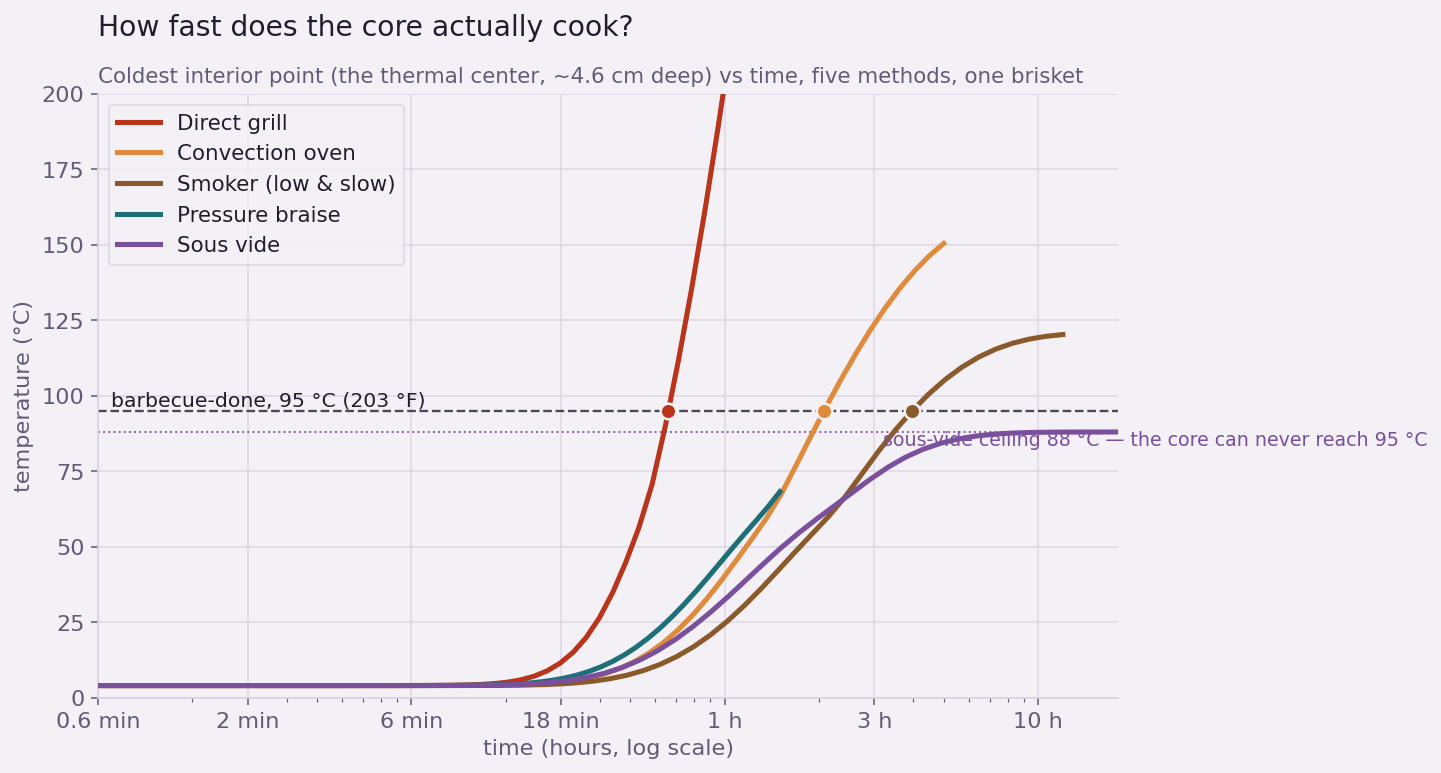
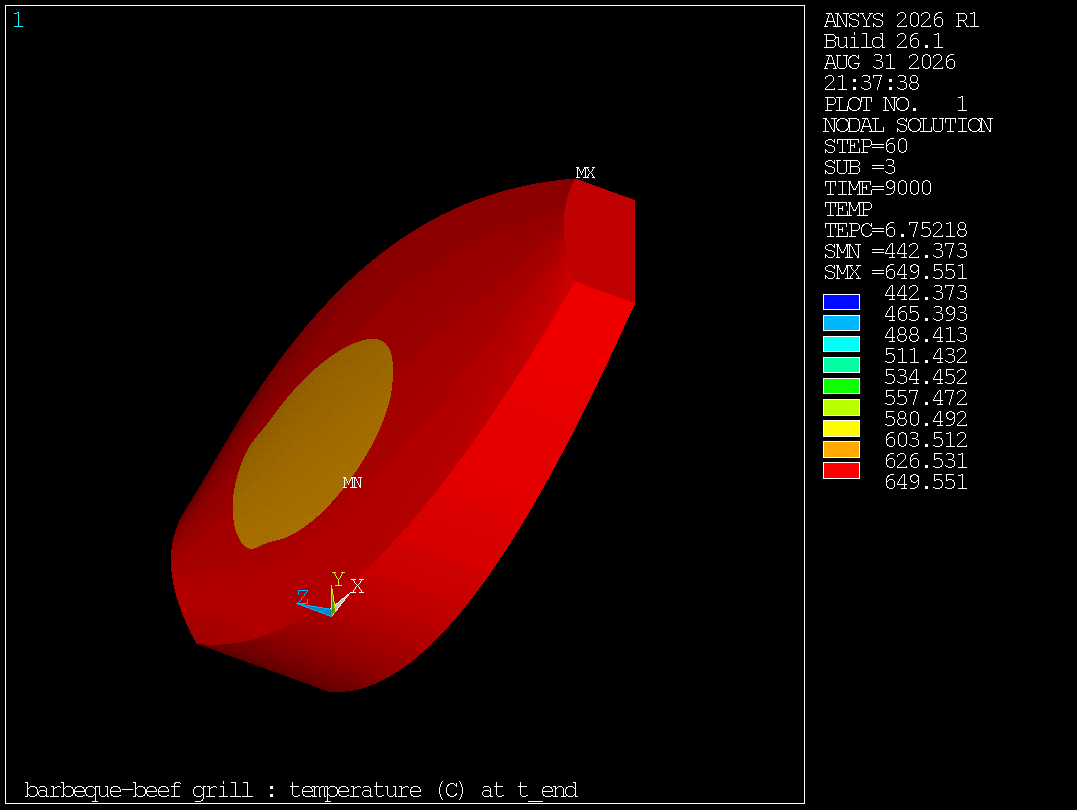
Now look at what "fastest" costs. When the grill's core finally reaches done, its surface is at 644 °C — charcoal. Cut it open and almost the entire cross-section outside a small core is a black, overcooked shell. The oven, milder, still overcooks a thick rind at 162 °C. The smoker, whose surface never exceeds 121 °C, comes out gently and evenly done. And the pressure cooker makes the counterintuitive result vivid: its surface hit 120 °C in the first minutes, yet 90 minutes later the core is only 68 °C — a raw red center inside a done outer shell. All that surface heat-transfer bought nothing for the core, because the bottleneck was never the surface; it was conduction through 4.6 cm of a poor conductor. High heat transfer cannot beat that, which is why the pressure cooker is actually slower to a done core than a hotter oven.
So which method is actually best?
"Best" here means what a pitmaster means: fork-tender and juicy, not a race time. That is a texture judgment, and we do not solve texture directly — but the thermal history is a good, honest proxy for it. Tenderness in barbecue comes from collagen slowly turning to gelatin, which happens in a band roughly 60–77 °C: the longer the meat spends there, the more collagen renders and the more tender and "not fatty" it eats. Drying comes from the opposite — time spent above about 75 °C, where muscle proteins clench and expel water. So we measured, for each method, how long the average point of the brisket spends in each band.
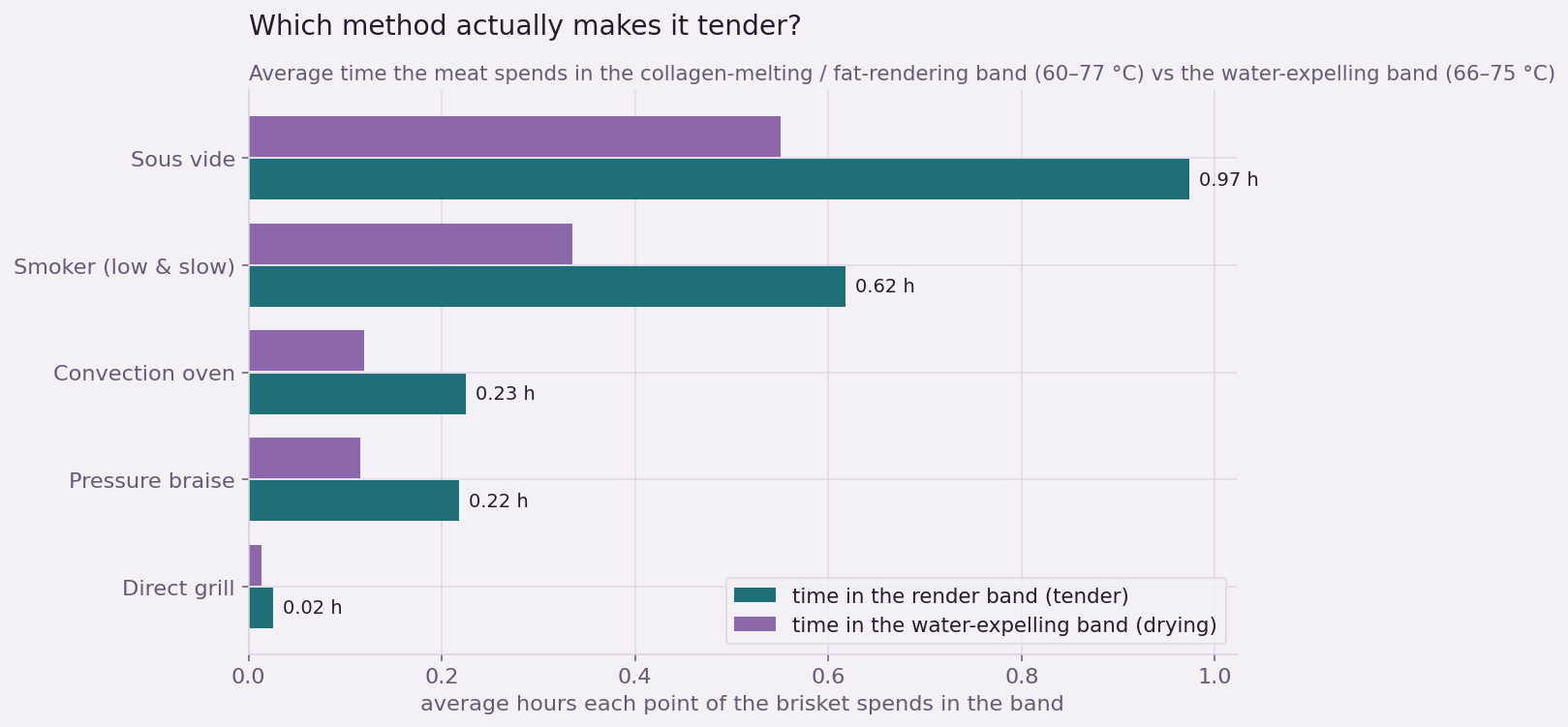
The gentle methods win by a wide margin. The sous-vide bath holds the whole brisket in the collagen-rendering band for nearly an hour on average, and the smoker for about 37 minutes, because both keep the surface cool enough that the meat lingers in that band as the core catches up. The grill spends barely a minute there — it blasts the outside past the band and out the other side before the collagen has any time to work, which is exactly why a hot-and-fast brisket comes out tough and greasy: the fat and connective tissue never get the time-at-temperature they need to melt. This is the whole answer to "fastest versus best." Speed comes from a hot surface; tenderness comes from time in a gentle window; and those two things pull in opposite directions.
The efficiency question
The reader also asked about relative heating efficiency, which splits into two honest pieces. The first we solve outright: the energy that actually has to cross the meat surface to bring it to done. For the gentle methods that is about 300–440 kJ per kilogram of brisket. For the grill it is 1,260 kJ/kg — and three-quarters of that is pure waste, dumped into overcooking the shell far past done. Fast cooking is not just worse for the meat; it is dramatically less efficient at the one job of getting the brisket to temperature.
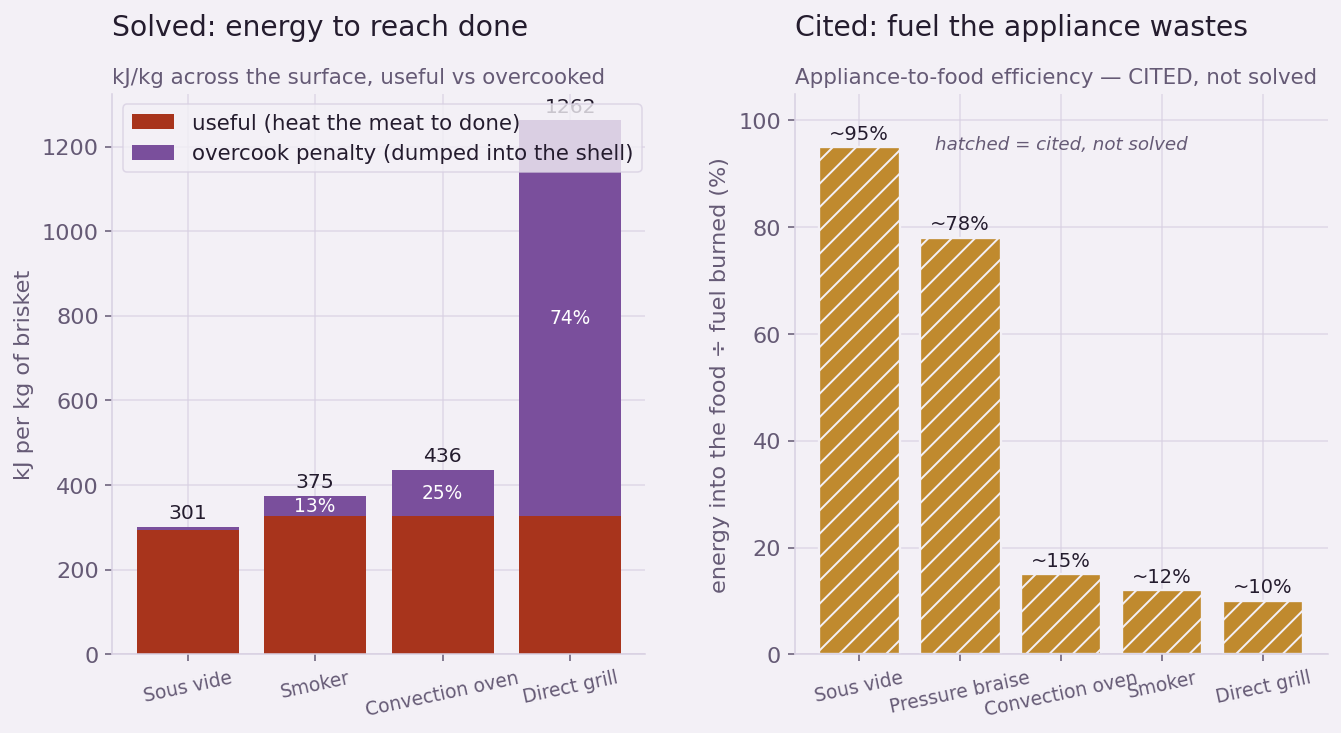
The second piece — how much of the fuel an appliance burns actually reaches the food — depends on the appliance, not the meat, so we do not solve it; we show it as a clearly-labeled cited overlay drawn from published figures. It tells the same story from the other side: a sealed, insulated water bath loses almost nothing, while an open grill throws most of its heat into the room. Between the solved surface energy and the cited appliance losses, the hot-and-fast route is the least efficient way to cook a brisket by a wide margin.
Is it right?
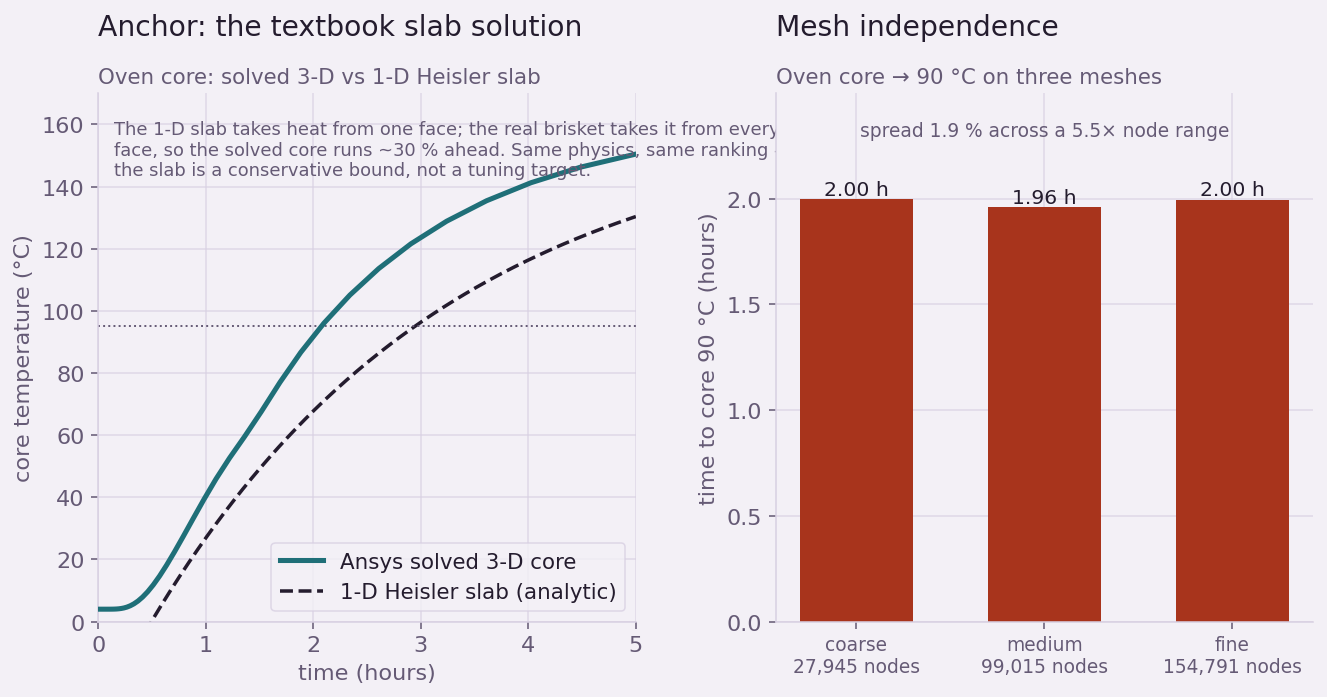
Every solve is anchored. The clearest check is the ceiling we predicted from first principles: each method's core must level off at its own source temperature, and it does — sous vide asymptotes to 88.0 °C exactly, and the smoker to 120.3 °C against its 121 °C source. We also compare the solved oven core against the textbook one-term transient-slab (Heisler) solution: the shapes agree and the ranking is identical, but the solved 3-D brisket runs about 30 % ahead of the 1-D slab — expected, because the real cut takes heat in from every face at once, not one, so the slab is a conservative bound rather than a tuning target. Finally, the oven core reaches 90 °C in 2.00, 1.96, and 2.00 hours on coarse, medium, and fine meshes spanning a 5.5× range in node count — a 1.9 % spread, so the mesh is not driving the answer.
| Method | Time to a done core | Surface when core is done | Energy wasted overcooking | Tenderness |
|---|---|---|---|---|
| Direct grill | ~40 min (fastest) | 644 °C (charred) | 74 % | very low |
| Convection oven | ~2.1 h | 162 °C | 25 % | modest |
| Smoker (low & slow) | ~4.0 h | 121 °C | 13 % | high |
| Pressure braise | >1.5 h (core 68 °C at 1.5 h) | 120 °C | low | modest |
| Sous vide | asymptotes to 88 °C (long hold) | 88 °C | 2 % | highest |
Honest scope. This is a transient heat-conduction model of one representative, self-authored brisket (no brand), solved in Ansys Mechanical (MAPDL) under five cited surface conditions. "Best" is read as fork-tender and juicy — a stated, subjective judgment answered through the solved thermal history and two labeled thermal proxies (time in the collagen-rendering band for tenderness, time in the water-expelling band for drying), not a solved moisture or fat field: no juice-loss in grams and no texture prediction are claimed. Meat properties, cooking heat-transfer coefficients, source temperatures, and the doneness bands are cited representative values, so the numbers describe this brisket, not yours. Moisture transport and surface evaporation are not modeled, so the smoker's evaporative "stall" is absent and its time is a dry-conduction lower bound. Fat rendering and collagen gelatinization enter only as heat-capacity effects and the time-in-band proxies, not as reaction chemistry; bark, smoke ring, and Maillard browning are flavor and color, not heat, and are out of scope. The grill's radiation uses a representative all-around view factor. Appliance-level efficiency (fuel reaching the food) is a cited input shown as an overlay, not a solved number; only the surface-energy metric is solved. The pressure-braise case ran a 1.5-hour window and its core reached 68 °C, still climbing (the analytic anchor puts full done near 3.2 hours); it is reported as a partial, and the "fastest" verdict rests on the four completed cases plus the conduction argument.
Have a heating, curing, or thermal-processing problem where time-at-temperature decides quality — ovens, autoclaves, heat treatment, cold chain? The same transient-thermal workflow that separated fast from good here is how Rand Simulation predicts through-thickness temperature history, soak times, and the trade between throughput and quality before the product line finds them the hard way. That is innovation through insight.