How Many Rage Quits a Game Controller's Solder Survives
Everyone has done it
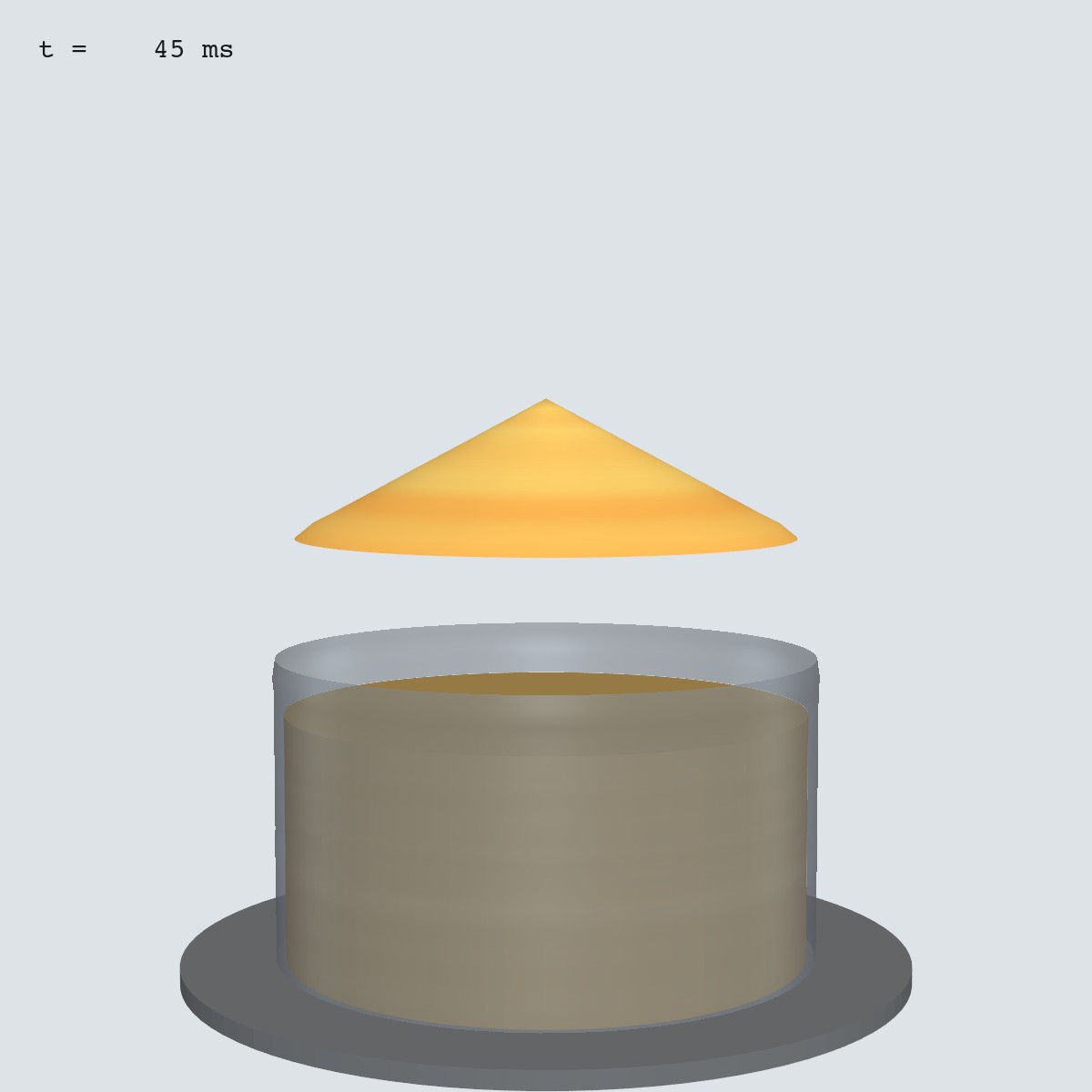
You lose the round, and the controller hits the desk before you have decided to throw it. Every gamer has done it, or watched a friend do it, and every gamer has wondered the same two things: is this actually killing the controller, and is tossing it into the couch instead genuinely safer, or just a slower way to the same funeral? This study answers both with physics. We take a generic wireless gamepad — about 250 g, a 90 × 55 mm circuit board on four standoffs, a thumbstick module standing off the board — and slam it flat onto a hard desk at a hard, deliberate throw speed (3.8 m/s, the speed something reaches falling off a desk). Then we throw the exact same controller, at the exact same speed, into a soft couch cushion, and count the difference.
What actually breaks when you slam a controller
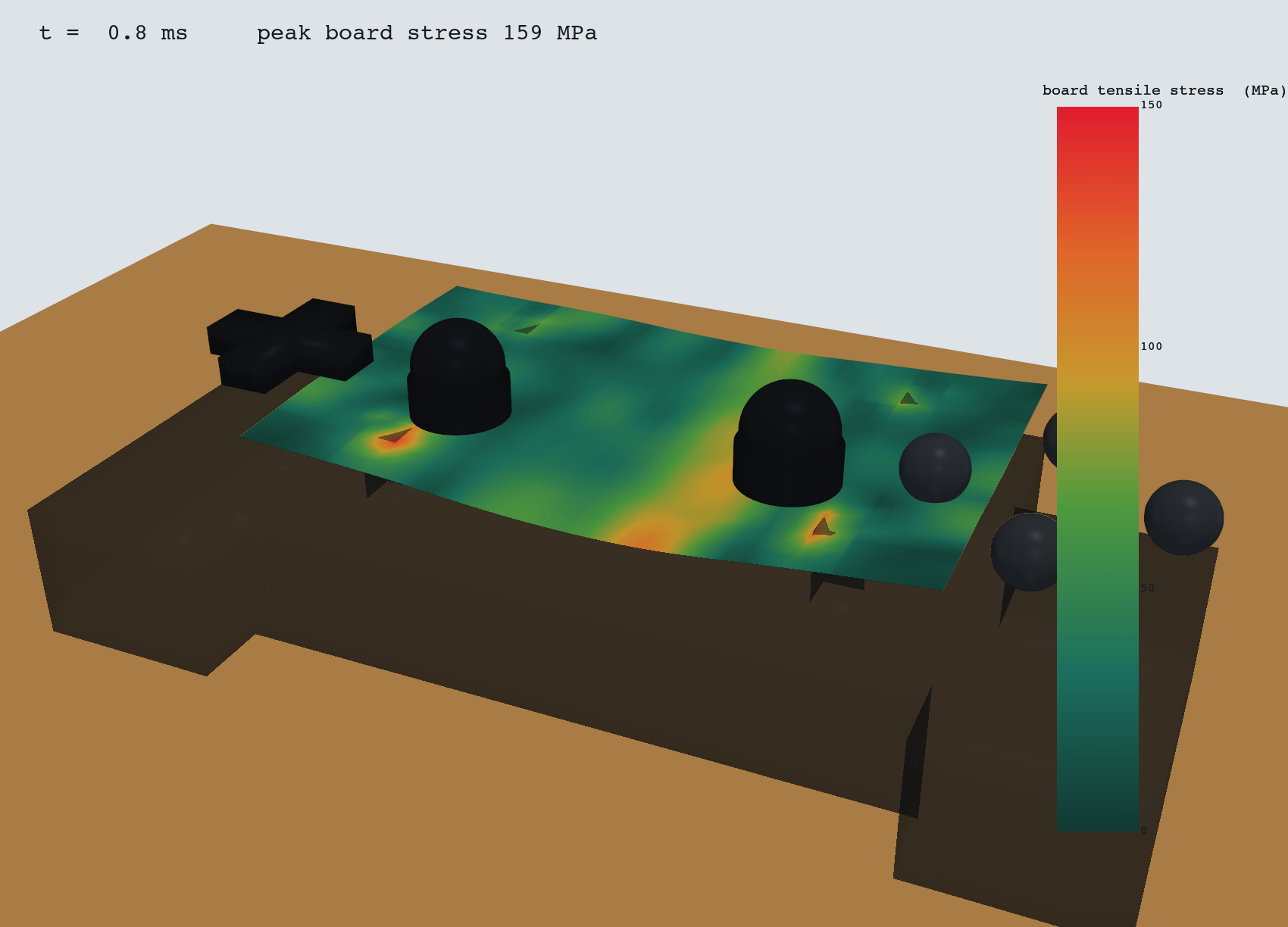
The plastic shell can take an enormous beating; that is not where a slam does its quiet damage. The vulnerable part is inside: the solder joints under the thumbstick module. The thumbstick is the tallest, heaviest thing standing off the circuit board, and when the shell stops dead on impact, the board — held only at a few standoffs — keeps going for an instant and whips about those mounts. The thumbstick’s mass rides that whip and cyclically loads its own solder in bending. Do it enough times and the solder cracks. This is a textbook board-level shock problem, the same failure mode the electronics industry chases with the JEDEC JESD22-B111 drop test.
You cannot honestly re-solve a thousand consecutive slams, and you do not need to. The industry method — and ours — is to solve one representative impact in high fidelity, read the board’s single-slam deflection at the component, and then convert that amplitude into a number of cycles with a stated, cited fatigue law. One rage-quit is one cycle at that amplitude, so cycles-to-failure is the number of rage-quits the solder survives. The impact itself is an explicit Ansys LS-DYNA solve; the fatigue conversion is the classical Steinberg displacement-life criterion with the standard solder S-N curve. LS-DYNA supplies the physics; the fatigue law is the anchor that turns one solved slam into a lifetime.
The slam, in numbers
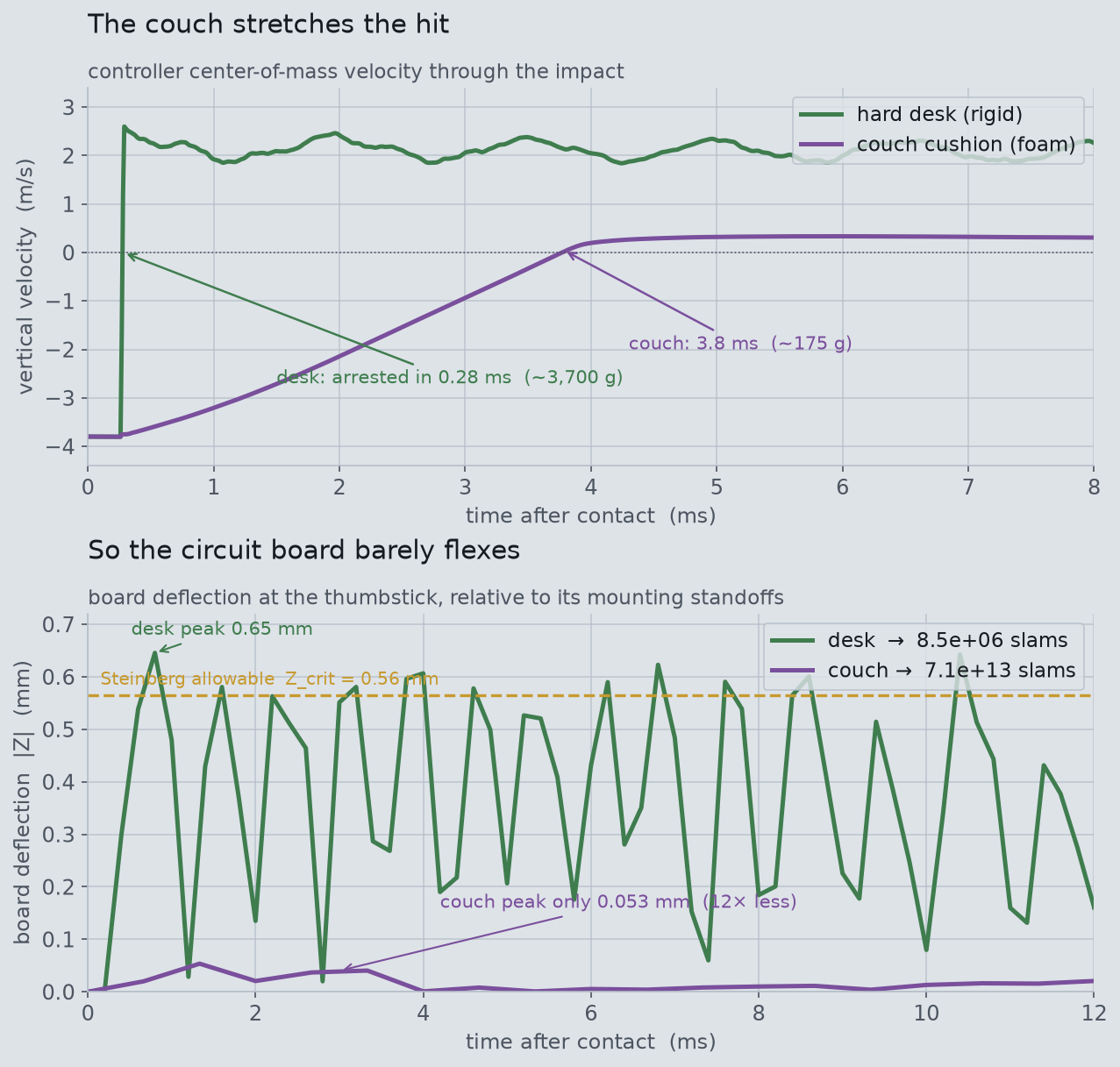
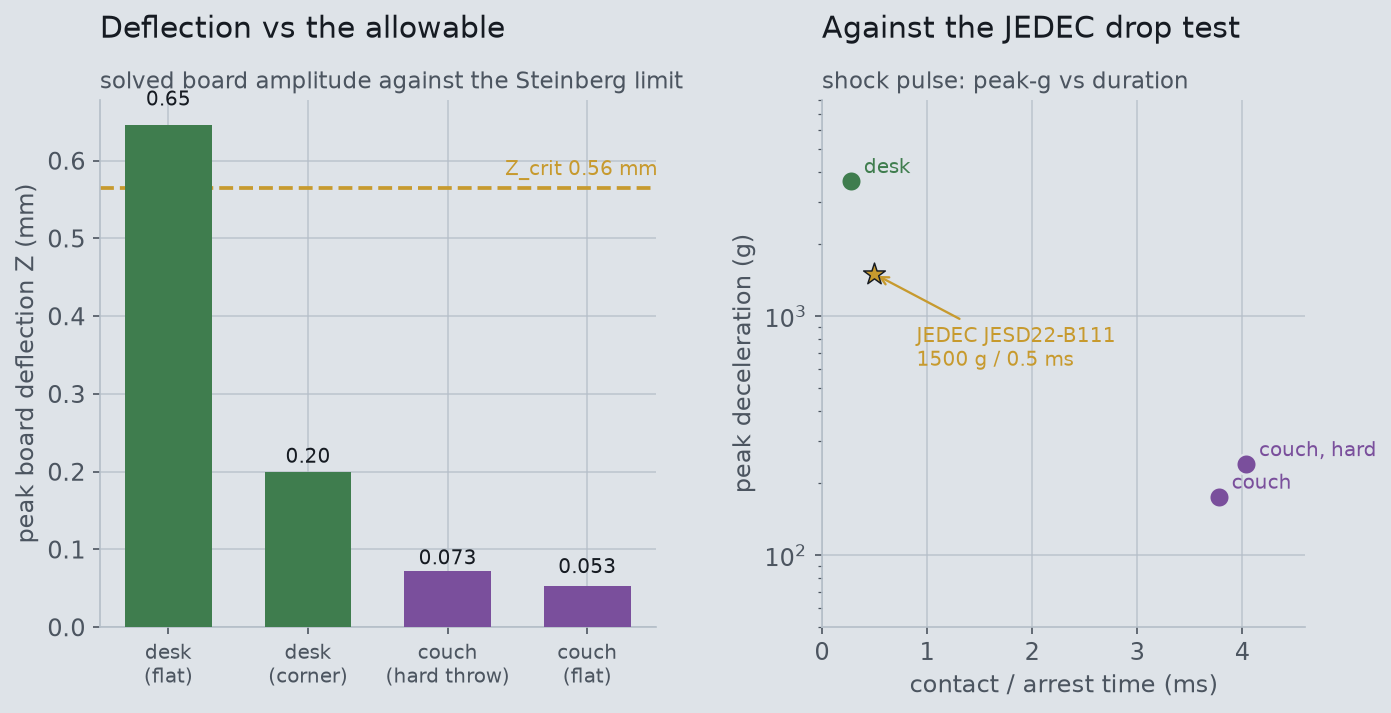
The two surfaces could not be more different, and the difference is entirely about time. The rigid desk has nowhere to give, so it arrests the controller almost instantly — in our solve, about 0.28 ms, a shock of roughly 3,700 g. The couch cushion, modeled as crushable polyurethane foam, squashes and stretches that same stop out to about 3.8 ms at only ~175 g — a gentler deceleration by more than a factor of ten. A shorter, harder stop shakes the board harder: the desk whips it about 0.65 mm at the thumbstick, the couch only 0.053 mm, a 12-fold difference in how far the board bends.
From one slam to a lifetime
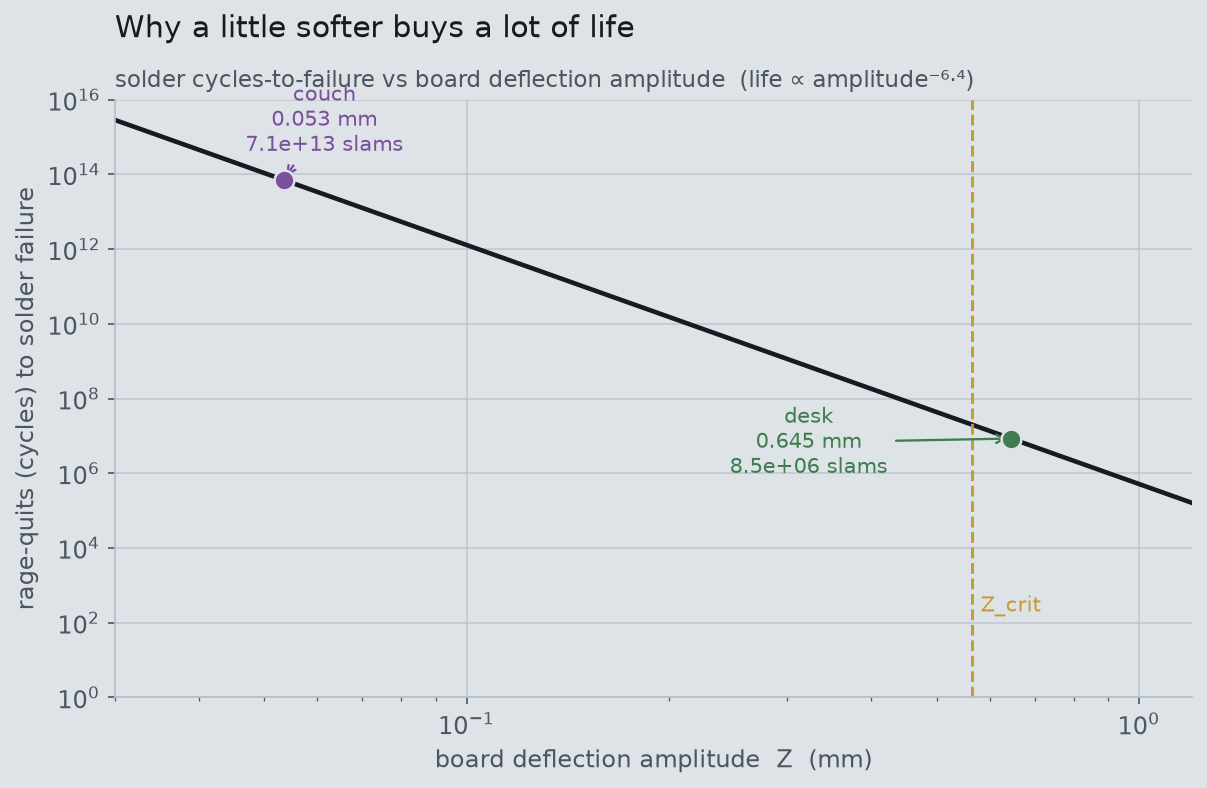
Here is the part that makes a soft landing so decisive. Solder fatigue is savagely nonlinear in amplitude: the number of cycles a joint survives scales roughly as the board deflection to the minus 6.4 power (the standard exponent for lead-free SAC305 solder). The Steinberg criterion gives an allowable single-slam board deflection of 0.56 mm for this board and component — the amplitude a joint could take about twenty million times. Our desk slam lands at 0.65 mm, just over that line, so it drops the life to roughly 8 million slams (a finer mesh reads 2 million — more on that below). The couch slam lands way under the line, at 0.053 mm, and that 12× smaller deflection, raised to the 6.4 power, becomes a life of about 7.1×10¹³ throws. A modest drop in how far the board bends buys an enormous jump in how long the solder lasts.
Is the couch actually safer, or just slower?
“Just slower” would mean the couch buys a factor of a few — you would still kill the controller, only later. That is not what the solve says. The couch buys a factor of about 8.4×10⁶: the desk’s few million slams become tens of trillions. That is the difference between a controller you could plausibly wear out in a lifetime of tantrums and one whose solder will never be the thing that dies. And the verdict is robust. We swept the fatigue exponent from 6.0 to 7.0, allowed the board deflection to be 20% off in either direction, and swapped in leaded SnPb solder for lead-free. Across that whole band the desk stays in the millions to tens of millions (2.6×10⁶ to 3.5×10⁷ slams) and the couch stays in the trillions — even at the worst-case corner of every assumption, the couch beats the desk by at least five orders of magnitude.
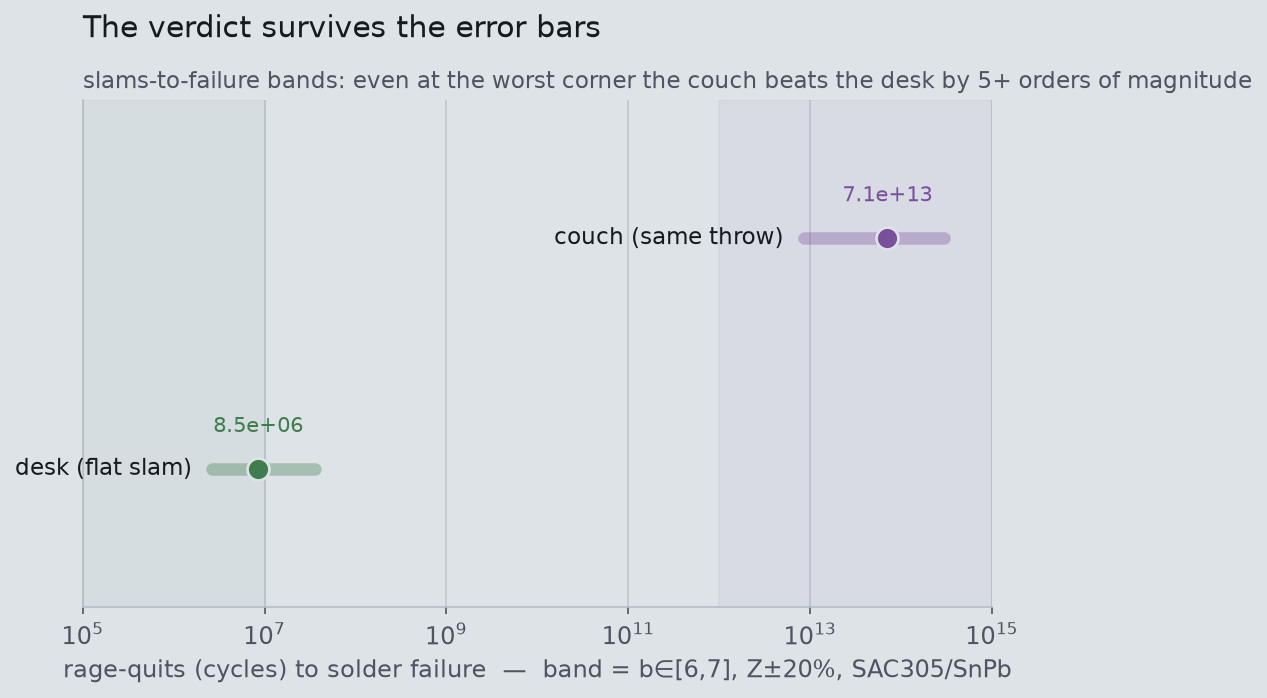
We also checked the obvious objection: what if you throw it into the couch angry? A harder couch toss (5.5 m/s instead of 3.8) still only bends the board 0.073 mm — the foam still stretches the pulse — and the solder still lasts on the order of 1.0×10¹³ throws. The cushion, not the gentleness of the throw, is what saves the controller. And a corner-first slam onto the desk, rather than flat-on-back, actually bends the board less at the thumbstick (0.20 mm) — the flat landing is the worst case for this particular failure, which is the one we led with.
How we know the numbers are real
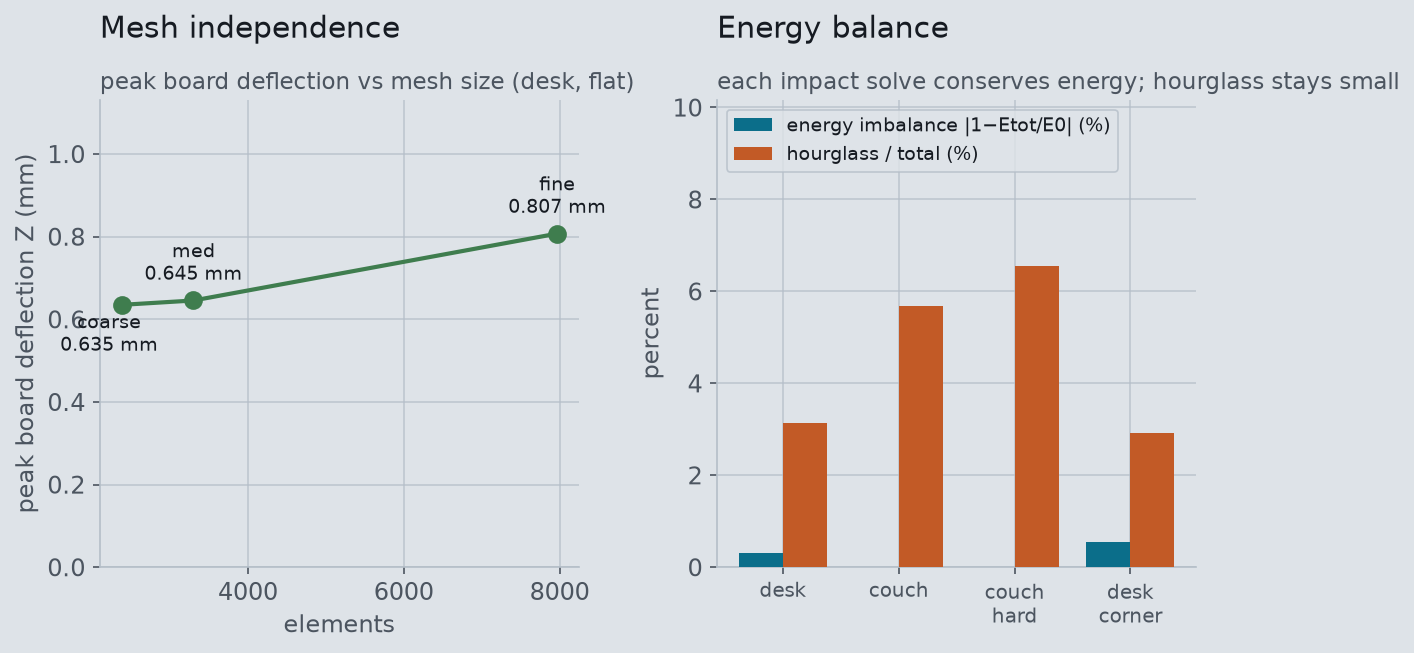
Every impact solve was gated before it was trusted. A one-element free-fall reproduced −4905 mm of drop at one second (the units check that catches the classic gravity error); a lumped mass dropped on the rigid surface conserved its impulse and did not fall through; and every production run closed its energy balance to better than 1% (0.5% or less on the two headline cases), with hourglass energy held to a few percent — never above about 6.5%. The board deflection is mesh-checked across three meshes: the coarse and medium meshes agree to 1.6% (0.63 vs 0.65 mm), and the finest reads about 25% higher (0.81 mm) — not fully converged, but the spread runs the safe way, since a bigger deflection means fewer slams, and the ±20% amplitude band already covers it.
The most honest surprise is the headline itself. “Millions of slams” means the thumbstick solder is not the weak link for a flat desk slam — a controller will wear out its stick potentiometers, crack its shell, or simply be replaced long before a well-mounted board fatigues its solder from being slammed flat. What the numbers really settle is the comparison: whatever eventually kills your controller, slamming it on a hard desk stresses the board right at the edge of its fatigue limit, and throwing it into a couch does not stress it at all. The excuse turns out to be true — for the right reason.
Does your product take a beating it was never spec’d for — a drop, a slam, a shock — and you need to know what breaks and when? The same end-to-end approach behind this study, an explicit Ansys impact solve handed to a cited board-level fatigue criterion, can turn “it feels sturdy” into a defensible number of cycles for your own hardware. That is innovation through insight.