Why an Egg Survives an End-to-End Squeeze but Cracks Across the Middle
It is one of the most reliable bar bets in physics: hand someone a raw egg, tell them to squeeze it end to end as hard as they can inside a bare palm, and — nearly always — watch it hold a shocking load. Exactly how much it can take before it does crack is a number we solve for below. The same egg cracks in an instant if you press it across the middle, or squeeze it with a single fingertip. The egg has not changed — the geometry of the squeeze has. We built a real finite-element model of an eggshell in Ansys and squeezed it from every direction to see exactly where the strength comes from, and where it goes.
An eggshell is a structure, not just a material
An eggshell is astonishingly thin — about a third of a millimeter of brittle calcium-carbonate ceramic, thinner relative to its size than the dome of a cathedral. On its own, calcite is not strong; you can crush a lump of chalk between two fingers. What makes an egg tough is the same thing that makes an arch or a dome tough: its doubly-curved shape. A curved shell can carry a squeeze two completely different ways. It can take the load in-plane, as pure membrane tension or compression spread through the whole wall — the efficient way, the way a dome carries its own weight. Or it can take the load in bending, flexing locally like a diving board — and thin shells are hundreds of times more flexible, and weaker, in bending than in stretch. The whole question of the egg trick is which mode each squeeze direction switches on.
To answer it we authored a parametric egg from the Hügelschäffer egg curve — the classic asymmetric-oval construction that reproduces a real egg’s profile, one broad end and one pointed — sized to a typical large hen egg at 57 mm pole to pole and 44.5 mm across, with a uniform 0.35 mm wall. We meshed it as a surface-of-revolution shell (Ansys SHELL181, 4,722 nodes) and treated the eggshell as a linear-elastic brittle ceramic, using representative values from the eggshell-mechanics literature: a stiffness near 30 GPa and cracking once the peak tensile stress reaches a 10–30 MPa band. Real eggs scatter widely in wall thickness and strength, so we carry these as ranges rather than single numbers and report every failure load as a band. One honest note on how it ran: on this machine, batch Ansys Mechanical APDL sometimes stamps structural runs “verification only,” so we gated against it — a tiny probe deck runs first and the job aborts if that banner appears. It did not; forcing the full Mechanical Enterprise product, all eight decks solved for real. Every number below is read straight off the results files.
Two squeezes, side by side
The clearest way to see the mechanism is to squeeze the egg the two ways the trick describes and put the stress fields next to each other, on one shared color scale.
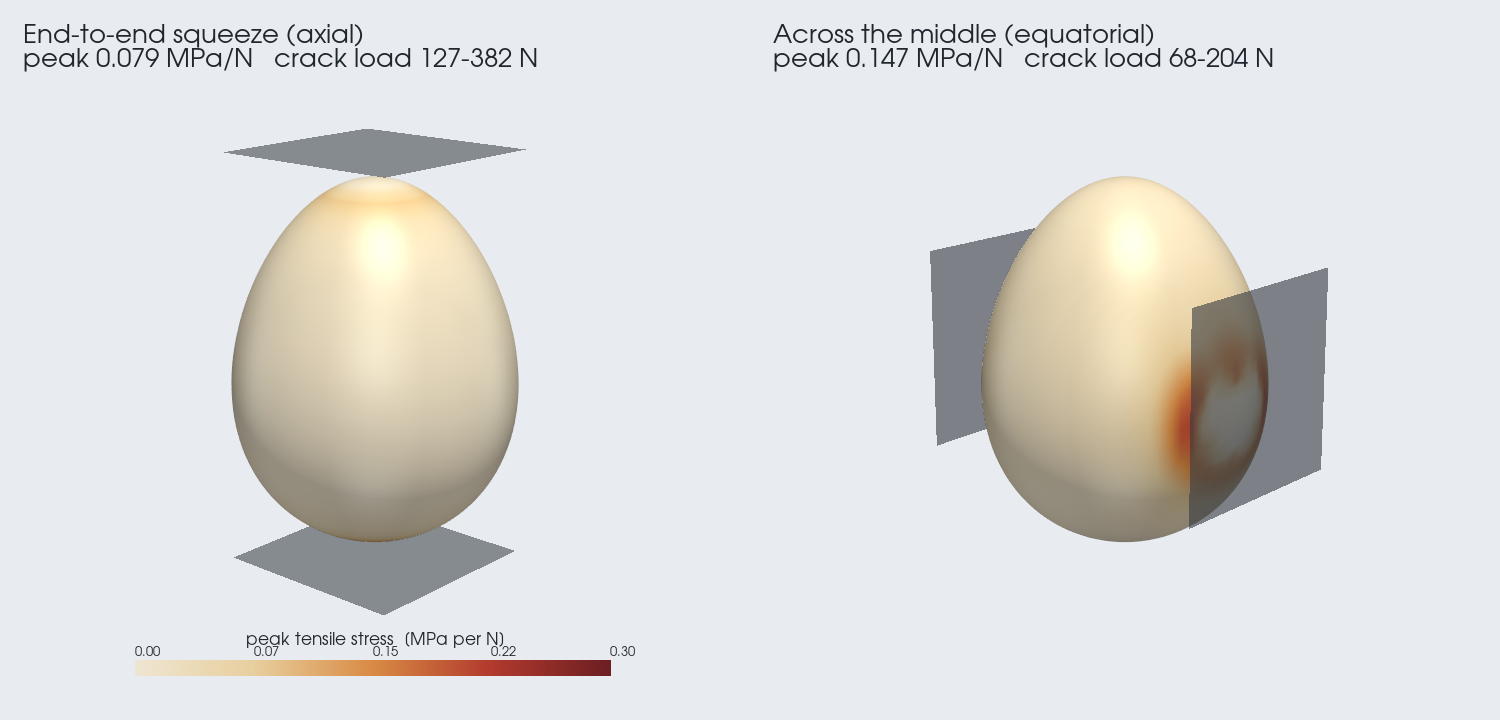
End to end, the shell is calm from pole to pole. Across the middle, a hot spot ignites right under the contact. That is the entire secret of the party trick in one picture: the direction of the squeeze decides whether the arch gets to do its job.
Putting a number on “nearly pure membrane”
The mechanism is not just a story we tell over the picture — a shell model lets us split the peak stress into its membrane part (the average through the wall) and its bending part (the difference between the inner and outer surfaces) and report the actual percentages.
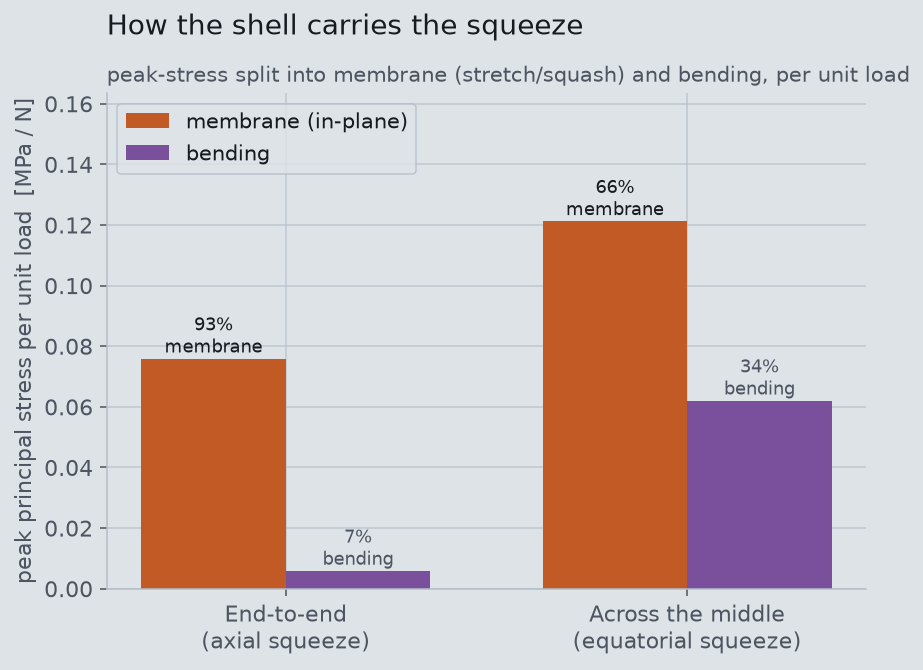
End to end, the peak stress is 93 % membrane and only 7 % bending — the arch is doing almost all of the work in-plane, exactly as the folklore claims. Across the equator, the bending share climbs to 34 %. Bending stress is the villain here: it puts one face of the brittle shell into sharp local tension, and brittle ceramics fail in tension. More bending means an earlier crack.
The failure load, direction by direction
Because the shell is linear up to first crack, we can sweep the squeeze axis through seven directions and turn each peak stress into a failure load — the force at which the tension reaches the cracking band.
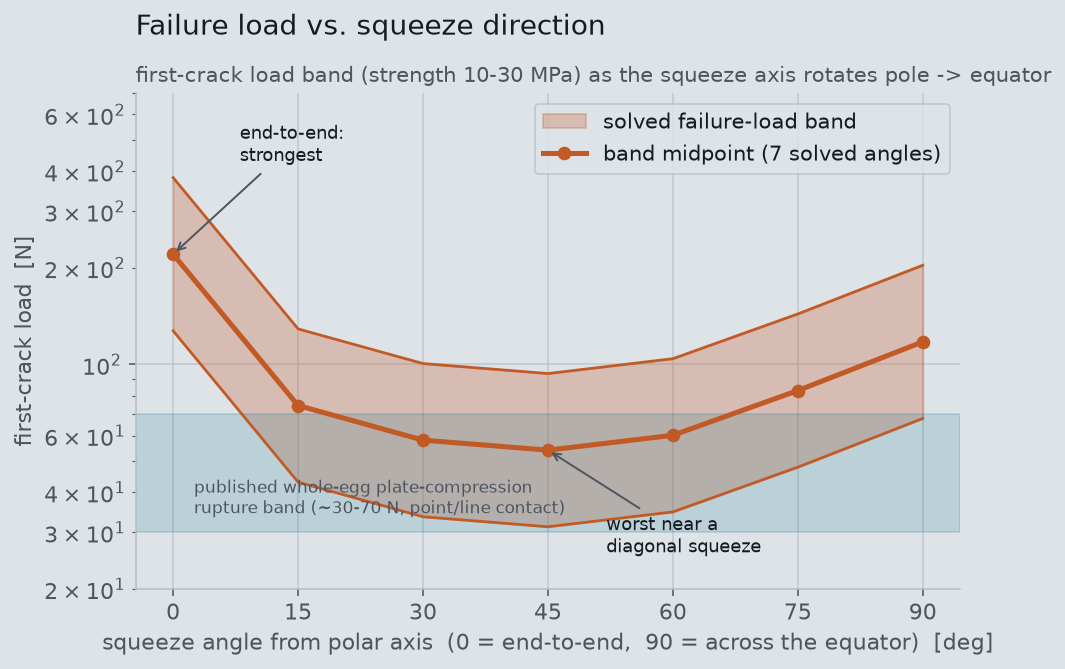
End-to-end is the clear winner, holding two to three times the load of any other direction. There is a genuine surprise in the middle of the curve: the weakest direction is not the equator but an oblique squeeze near 45°, where the load lines up with neither the meridian nor the hoop of the shell and bending is worst. The equator itself is weaker than end-to-end by roughly a factor of two — it caves, just as the trick says — but it is not quite the worst place to press. That two-to-one advantage lines up with the long-standing experimental finding, from quasi-static whole-egg compression tests in the food-engineering literature, that eggs loaded pole-to-pole break at markedly higher force than eggs loaded across the equator — the mechanism our fields make visible.
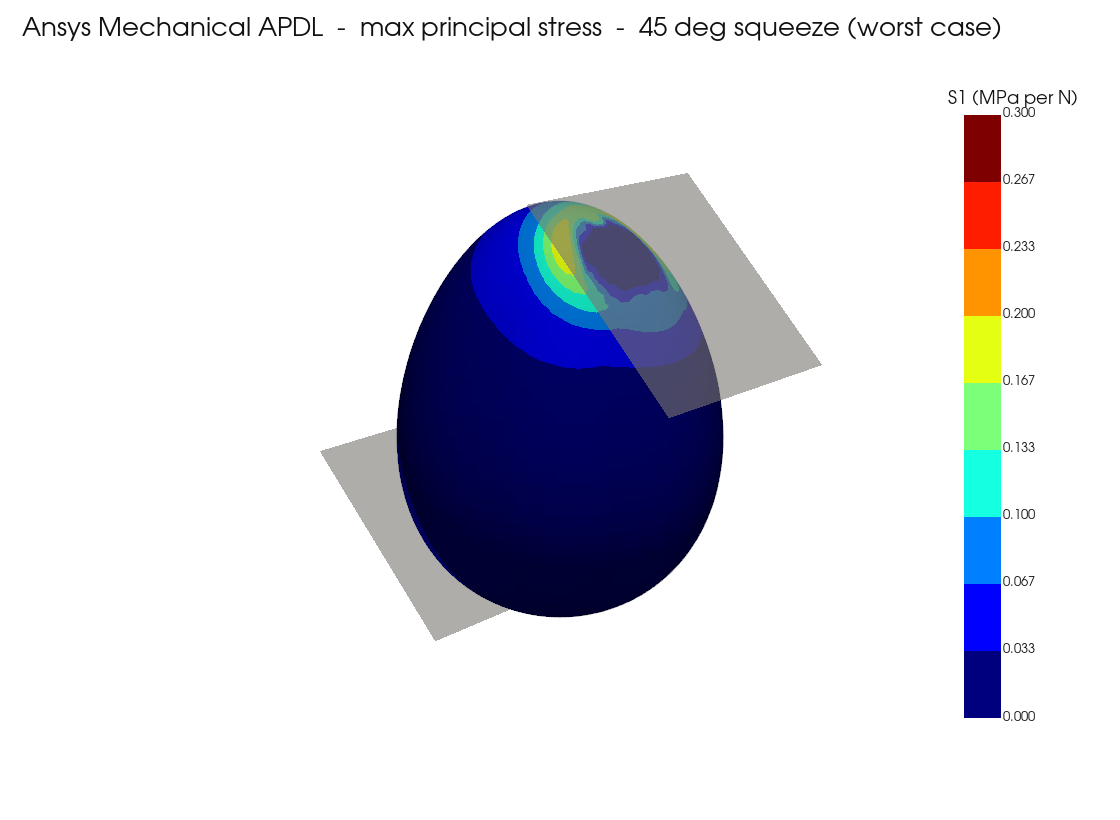
And because it is a real finite-element solve underneath, we can render the worst case straight from the Ansys results file, in the solver’s own banded-contour style — the max principal stress on the shell.
Trusting the numbers
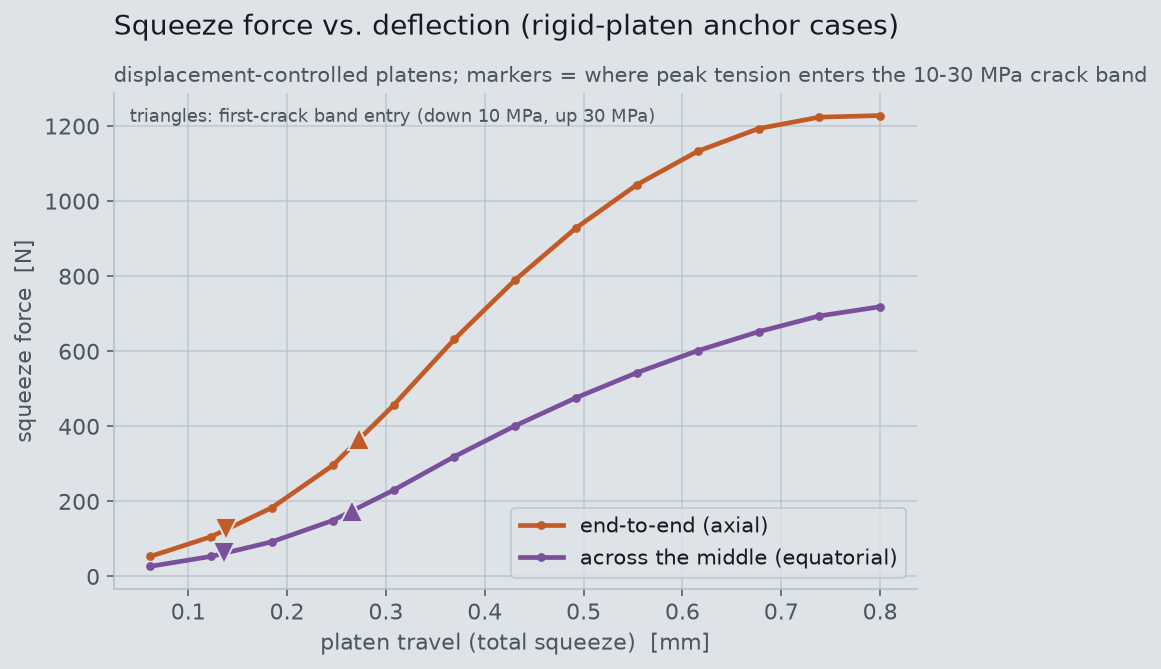
A converged solve that is quietly wrong is the usual way this kind of work fails, so before believing any verdict we ran the model through the usual gauntlet. Equilibrium first: the reaction summed over the fixed cap equals the applied 1 N on every one of the seven angles, to four figures. A second, independent squeeze: we re-ran the two headline directions as displacement-controlled rigid platens pushed into the shell (large-deflection, the way a real press works), and they reproduced the failure loads and the same roughly two-to-one end-to-end advantage — two different loading idealizations, one answer.
Buckling, ruled out: a thin shell under a concentrated squeeze can also snap-buckle, so we ran an eigenvalue-buckling check on both directions. The buckling loads (over 850 N) sit several times above the first-crack loads — the egg cracks long before it buckles, so fracture is the right failure mode to report. Mesh convergence: across a coarse, medium and fine mesh the peak stress moves about 7 %, which we fold into the uncertainty; it does not budge the mechanism or the direction ratio.
Honest scope. Failure here means first crack — the load at which the peak tensile stress reaches the cited 10–30 MPa band — not crack growth or shatter, and the failure loads are reported as bands because the strength and thickness of real eggs scatter widely. The shell is uniform and isotropic, with no inner or outer membranes and no liquid interior (a real egg’s pressurized contents help a little; we claim none of it). We squeeze with flat, stiff platens, which is the configuration published egg-strength tests use; a palm wraps and distributes the load even more kindly, so our platen loads are a conservative bound for the actual party trick. Everything is quasi-static — this is precisely why you cannot throw an egg at a wall and expect membrane magic. We load the shell with displacement-controlled platens and self-equilibrated patch pairs rather than a true growing-footprint frictionless contact, which is the natural next refinement, and we read the peak stress just away from the platen contact, where the mesh cannot resolve the contact-edge singularity; that means our failure loads are the shell’s global strength, which runs higher than the ~30–70 N a hard point or plate edge produces in the lab. That gap is the point: spreading the squeeze over your whole palm, instead of a fingertip or a ring, is exactly what lets the arch — and the egg — win. Finally, the profile is the Hügelschäffer egg curve, the dimensions are a typical large hen egg, and the stiffness, strength band and ~30–70 N rupture reference are representative values from the published eggshell-mechanics and food-engineering literature rather than a calibration to one named specimen — so the robust results here are the mechanism and the roughly two-to-one direction ratio, with the absolute newton figures carrying that literature scatter.
Have a what-if that deserves a real solver instead of a back-of-the-envelope guess? The most satisfying answers often come from taking an offhand question and actually meshing it — a structure, a flow, a field — and letting the physics settle the argument. If you are curious whether an Ansys model could pin down something you have always wondered about, we would love to talk it through. Rand Simulation is an Ansys (Synopsys) Apex Channel Partner, and this whole study — geometry, mesh, solve and post-processing — was run end to end by an agentic AI workflow on our own licenses. Innovation Through Insight™.