Crying Over Spilled Milk: A Father’s Day Drop Test
Every parent knows the sound. A full sippy cup leaves a small hand, tumbles toward the kitchen floor, and — if you’re unlucky — the lid gives up at exactly the wrong moment and a pint of milk goes everywhere. For Father’s Day we did the only responsible thing: we put that tiny catastrophe into an explicit finite-element solver and watched the milk fly, particle by particle.
Three ingredients: a cup, a lid, and a fluid
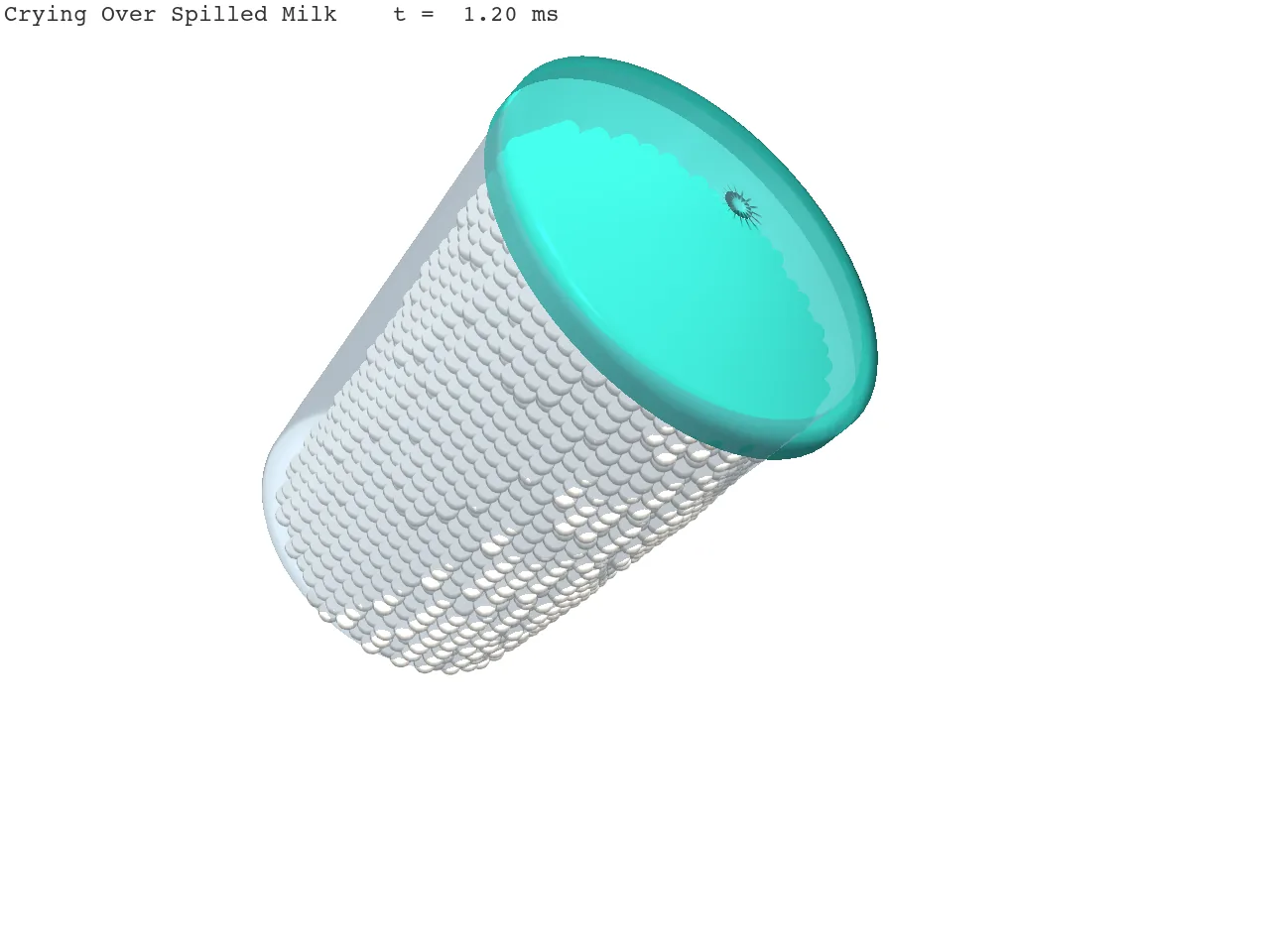
The cup is a thin tapered plastic shell holding about 271.6 mL. The lid is a dome cap whose skirt hugs the rim. And the milk — the interesting part — is a fluid, so we model it with Smoothed-Particle Hydrodynamics (SPH): thousands of little fluid blobs that carry the milk’s mass and momentum and can splash, pool, and fly apart the way a real liquid does. Each blob obeys a water-like equation of state (milk is, to a splash, basically water).
How do you make a lid pop — on cue, but only on cue?
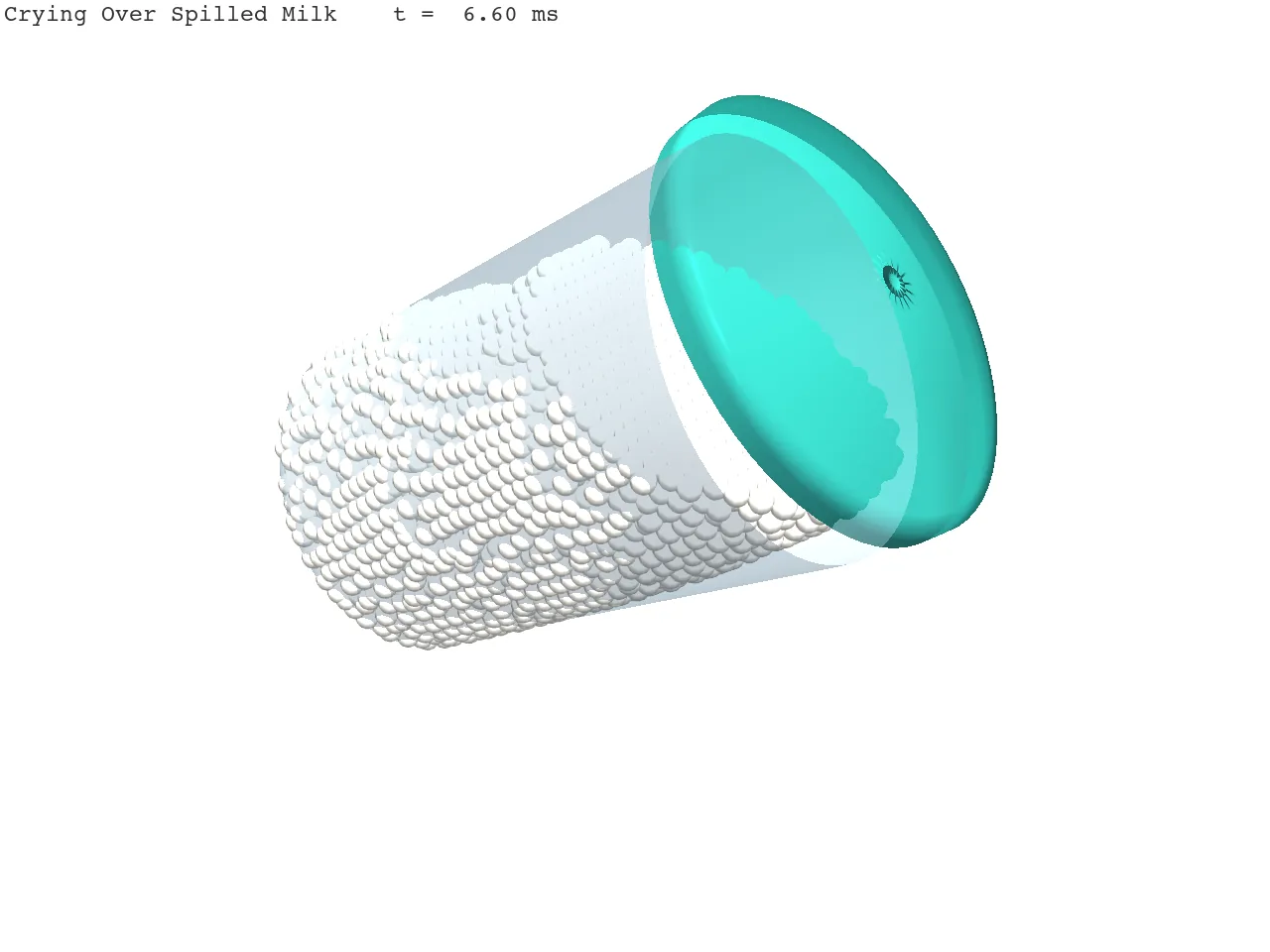
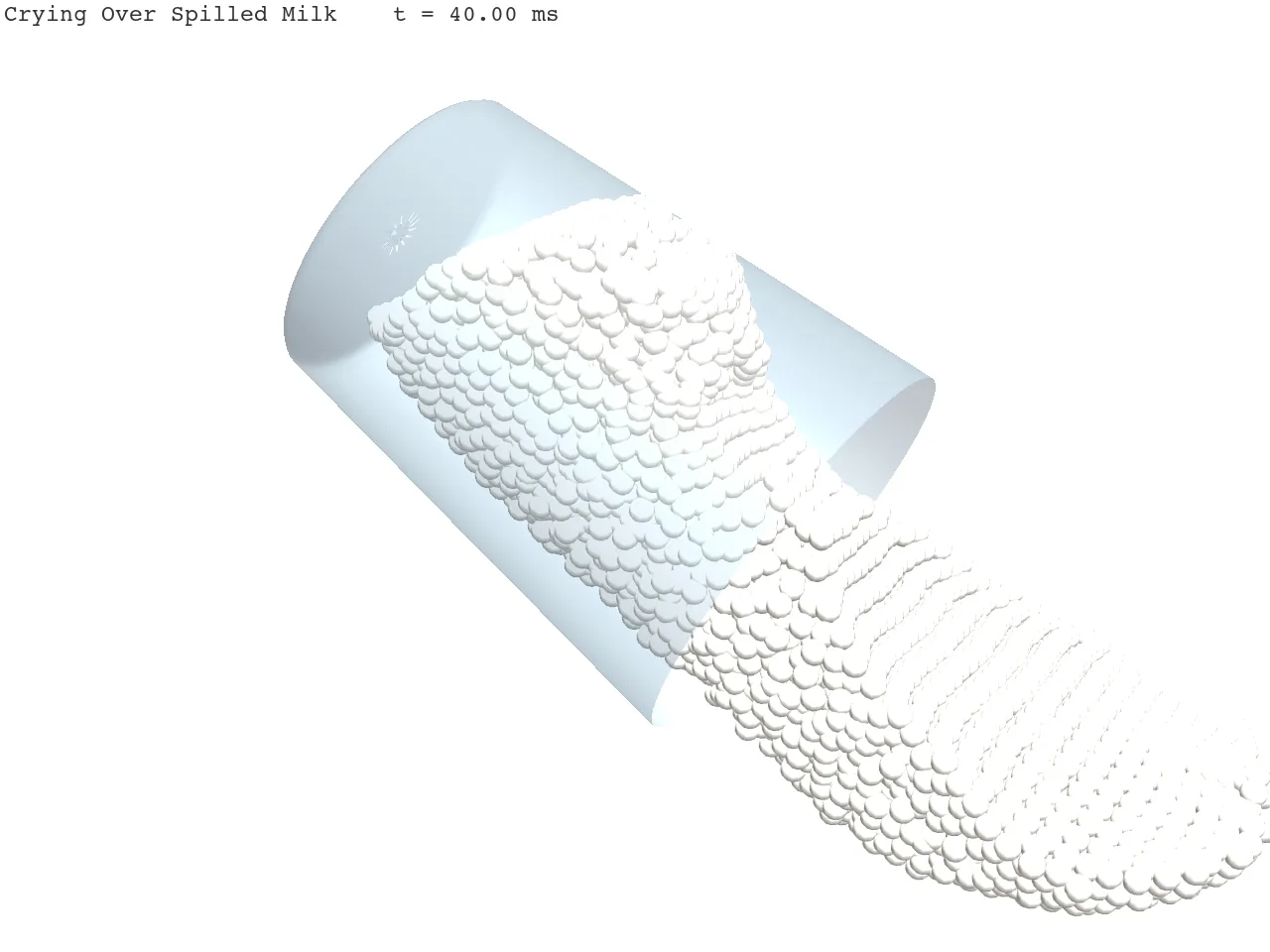
This is the whole trick. The lid has to stay on through the fall (no leaks in mid-air) and come off when the cup slams into the floor. We hold it with a breakable bond — a tie-break contact between the lid skirt and the cup rim that releases once the interface stress crosses a tuned threshold (0.08 MPa here). During free-fall there’s no load, so the bond holds. At impact, the cup decelerates in under a millisecond and the milk’s own inertia yanks on the lid — the bond pops, and the mouth opens. We didn’t script when it pops; we set the threshold and let the physics decide. In this run the cup hits at t ≈ 1.2 ms and the lid lets go at 6.6 ms. One detail that matters: we drop the cup slightly tilted, so it lands on its bottom edge and topples — a perfectly vertical drop just drives the lid straight down into the cup and the milk compacts with nowhere to go. Tip it, and the milk pours out the side like real spilled milk.
The hard part: keeping the milk in until it’s supposed to come out
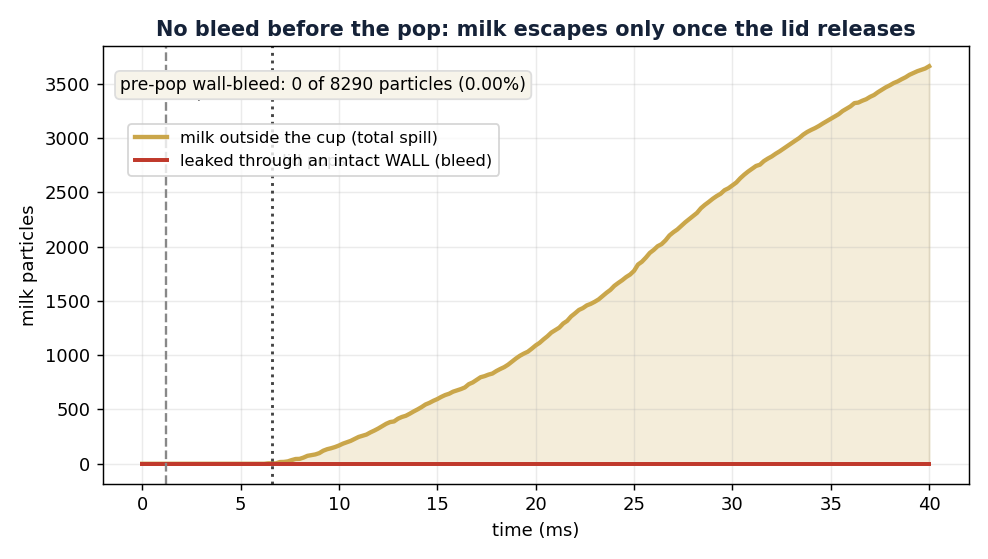
It would be very easy to cheat here. If the fluid contact is sloppy, particles tunnel straight through the cup wall and you get a “leak” that’s pure numerical nonsense — milk teleporting through plastic. The honest version is harder: the milk must stay sealed inside the intact cup and escape only through the opening once the lid pops. We enforce that by meshing the cup wall finer than the particles’ smoothing length (so nothing slips between facets) and using a stiff particle-to-wall contact. The check is simple — count how many particles are outside the cup before the lid releases. In this run that number is 0.00% of the milk. Effectively none. The spill goes through the mouth, the way a spill should.
What this is (and isn’t)
This is a fun, illustrative physics demo — not a product drop-test qualification. The cup, lid, and milk are representative (a generic sippy cup; milk as a water-like SPH fluid), and the lid-pop threshold is a tuned, representative value, not a measured snap-fit strength. The point is the physics of the spill and the discipline of keeping the fluid honestly contained until the lid releases. So here’s the engineering takeaway for Father’s Day: there’s no use crying over spilled milk — but if you really want to know why it spilled, the answer is a sub-millisecond deceleration spike and a bond that picked the worst possible moment to let go.
Does your product hold a liquid behind a lid, a cap, or a snap-fit seal that has to survive a drop? An Ansys LS-DYNA explicit drop like this one — the milk carried as SPH particles that stayed 0.00% outside the intact cup until the tie-break bond crossed its threshold and the physics, not a script, picked the 6.6 ms moment of release — is how simulation shows exactly when and why a seal lets go before a pallet of leaking prototypes does. That's innovation through insight.