Why the Gap Between Two Towers Is Not a Wind Tunnel
The intuition everyone has
Anyone who has rounded the base of a downtown tower on a blustery day knows the ambush: the wind that was a nuisance on the open street suddenly tries to take your umbrella, your hat, and your footing. The folk explanation is a Venturi — squeeze a moving fluid through a narrow gap and it has to speed up, the way a garden hose does when you thumb the end. So the slot between two towers ought to be the worst place of all.
It is a clean intuition, and for a sealed pipe it is correct. For open air around buildings it is not. Blocken, Carmeliet and Stathopoulos showed in 2008 that as the passage between two buildings narrows, more of the approaching air simply escapes over the top and around the sides rather than forcing itself through the gap — so the speed-up never climbs the way the pipe formula predicts. They even found diverging passages more severe than converging ones, the exact opposite of the textbook picture. We wanted to see that play out in a solve.
What we put in the wind
Two square towers — 40 m on a side, 120 m tall, roughly the height of Leeds’ Bridgewater Place — standing 25 m apart, a realistic downtown street gap of about a fifth of a building height. The wind is a 50 mph gale, applied the way a wind engineer would rather than as a uniform block: an atmospheric-boundary-layer profile pinned to 50 mph at the standard 10 m weather-mast height. Over the modeled urban ground roughness that leaves about 11 m/s — a stiff 25 mph — at head height (1.75 m) in the open, before the towers touch it.
The solver is Ansys Fluent: incompressible air, k-ω SST turbulence, a 1.8-million-cell mesh with prism layers packed tight against the ground and the towers so the wind is actually resolved at head height and not sampled 10 m up. The subtle part is how you define “amplification” honestly. We solved the same domain twice — once with the towers, once completely empty — and report R, the local wind speed divided by the empty-domain speed at the very same spot. That is the standard Blocken amplification factor, and it cancels any drift in the approaching profile. The proof it is working: far from the towers, R lands at 1.00.
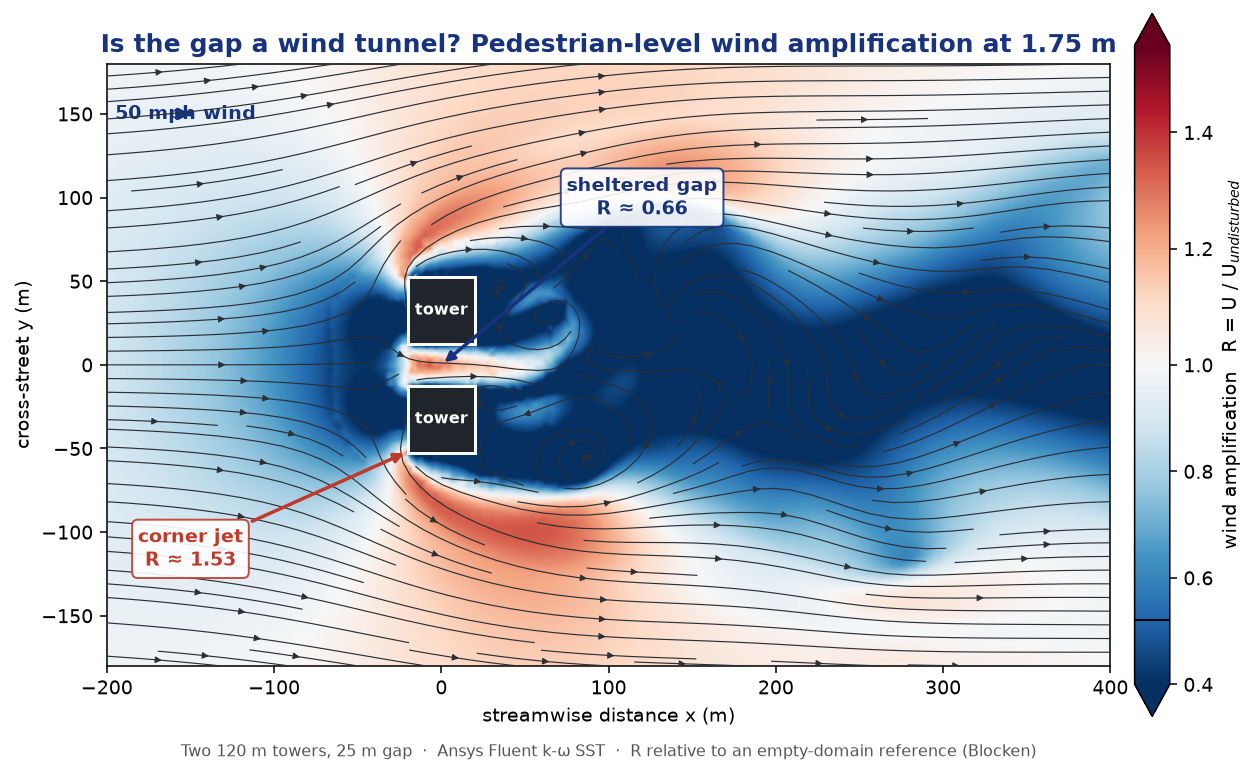
The gap is a shelter, not a tunnel
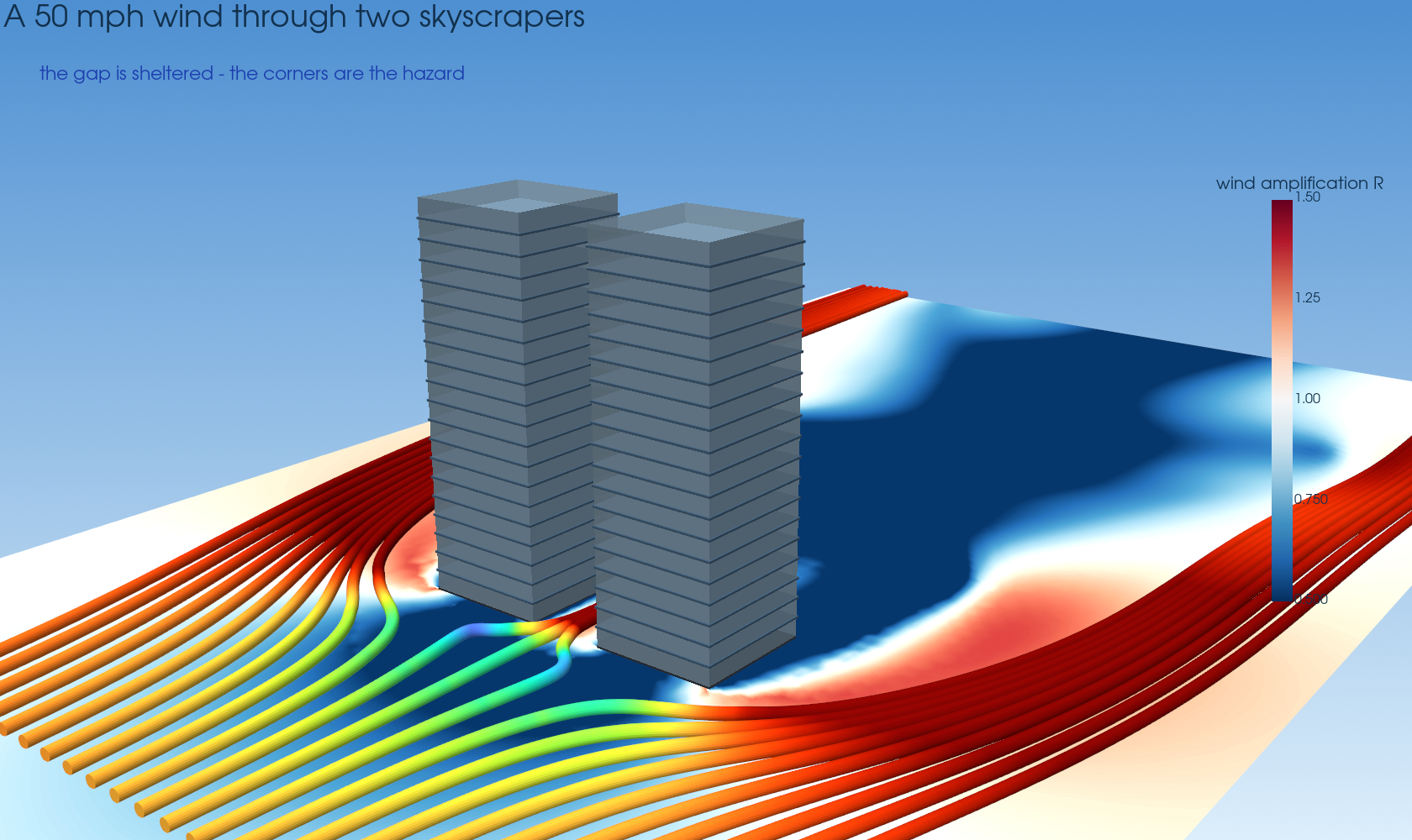
Down the 25 m street between the towers, the mean head-height wind comes out at R ≈ 0.66 — about a third slower than the undisturbed approach. The pair of towers blocks far more air than it funnels, and the surplus spills up and over rather than accelerating through the slot. Directly behind them sits a broad, calm wake. If you were looking for somewhere to get out of the wind on that gusty day, the gap between the towers is one of the best spots on the block — the precise opposite of the wind-tunnel fear.
The real hazard is the corners
The red in the map tells the true story, and it is all at the windward corners. There the flow attaches to the front face, races to the sharp vertical edge, and separates into a narrow, high-speed jet. Amplification peaks at R ≈ 1.53 — a head-height speed near 16.9 m/s, about 38 mph. On the Lawson comfort scale (sitting 4, standing 6, walking 8, brisk walking 10 m/s) that clears the S15 threshold: unsafe for vulnerable pedestrians — the elderly, children, cyclists. And because this is a steady, mean-speed solve, the real gusts a person feels there are higher still.
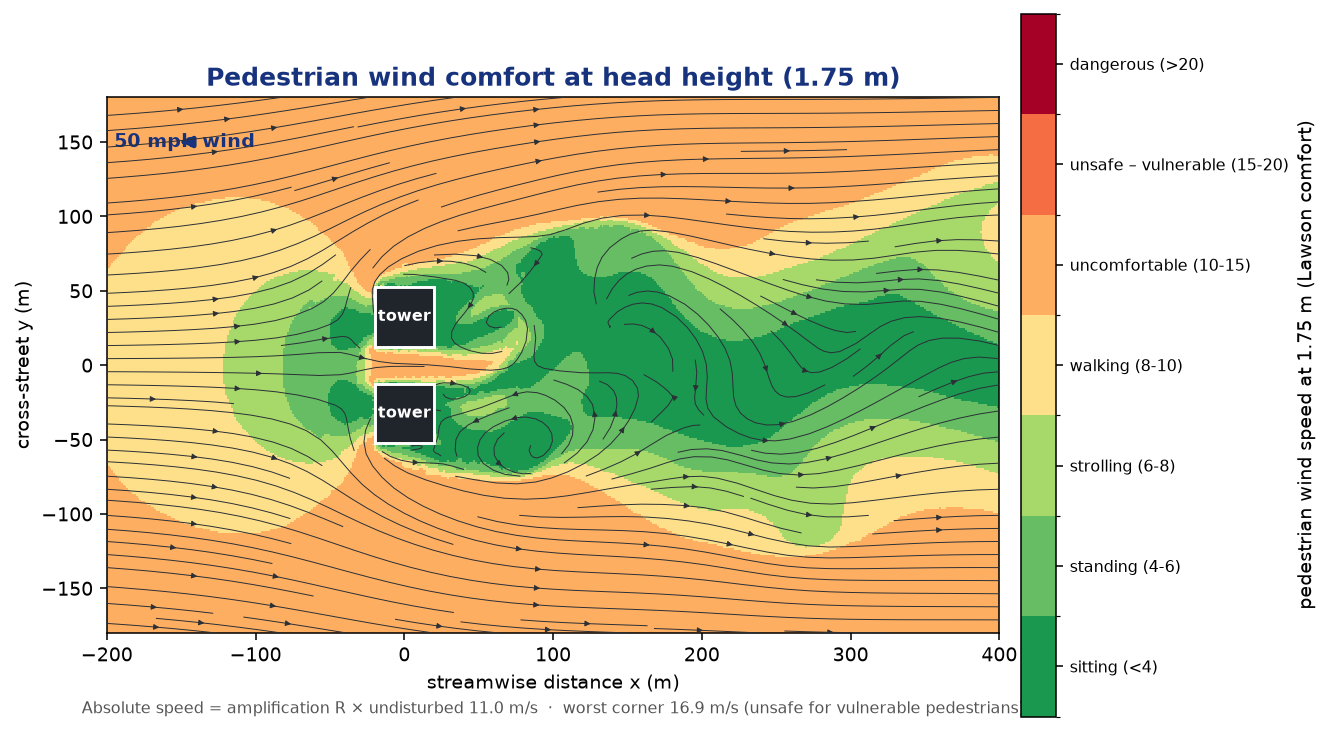
This is not an abstract worry. Bridgewater Place in Leeds, a 112 m slab, funneled street-level gusts of 67–79 mph around its base; in 2011 a pedestrian was killed when a truck was blown over in that wind. The remedy that was eventually built was not a panel across a gap — it was roughly 6 m perforated baffles, vertical screens and a 65 m canopy placed at the corners and along the affected street.
So — would a wind screen be required?
Yes, but not where the intuition points. A screen hung across the gap would shelter the calmest part of the site while doing nothing for the wind that actually endangers people. That wind is at the corners and along the flanks, and that is where baffles, canopies, colonnades or dense planting earn their keep — exactly the Bridgewater lesson. The first job is knowing which square meters are dangerous, and that is what the simulation is for: it turns “the corner feels windy” into a map you can design against.
Planning a tower, a plaza, or a canopy and need to know where the wind actually goes? Pedestrian comfort is a solve, not a guess, and the dangerous ground is rarely where intuition puts it. We run urban wind and pedestrian-comfort CFD in Ansys Fluent, geometry through comfort map. Rand Simulation — innovation through insight.