The Diamonds Inside a Crushing Can: Thin-Shell Buckling
Step on an empty soda can and it never crumples the same way twice — sometimes a neat ring of folds, sometimes a spiral of diamonds. That isn’t randomness; it’s the single most treacherous phenomenon in structural engineering. A thin shell in compression has dozens of ways to fail, all at almost exactly the same load, so it buckles into whichever one a microscopic dent happens to favor — and it does so at a small fraction of the load the textbook predicts. We computed those shapes for a thin steel cylinder.
1 · First, the good news: the number checks out
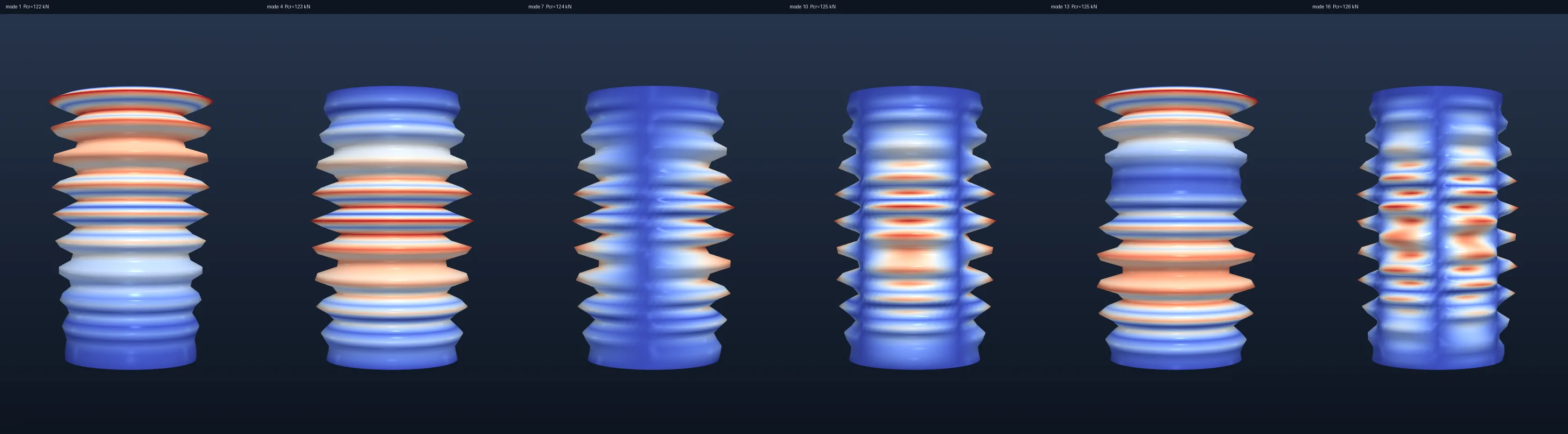
The lowest critical load our model returns is 122.3 kN. The 90-year-old classical formula for a perfect cylinder, σcr = E t / R√(3(1−ν²)), gives 121.6 kN for this geometry. The finite-element eigenvalue lands 0.6% away — the solve is right. If the story ended here, buckling would be easy.
2 · The bad news: the shell can’t make up its mind
It doesn’t end there. Look again at those load values: sixteen completely different buckling shapes are packed into a 3% band of load. When many modes crowd together like this, the structure is hypersensitive to imperfections — a dent a fraction of the wall thickness deep is enough to tip it into one mode early. In real tests, cylinders like this buckle at anywhere from 20% to 60% of the perfect-shell prediction. The ratio of real to theoretical is called the knockdown factor, and for decades it was the embarrassing secret of thin-shell design: theory said one thing, the lab said half of it, and nobody could predict which half.
3 · Why this is a billion-dollar problem
Every efficient structure that carries compression in a thin wall lives on this knife-edge: rocket fuel tanks and interstages (NASA’s SP-8007 knockdown curves exist precisely for this), submarine pressure hulls, grain silos and storage tanks, offshore pipelines, wind-turbine towers, and yes, the drink can. Design too close to the theoretical load and a shipping dent collapses it; design with the old blanket knockdown factors and you carry dead weight — on a launch vehicle, the most expensive weight there is. Getting the buckling load and its imperfection sensitivity right is worth real money and, for a crewed rocket, real lives. It starts with exactly this eigenvalue solve, which tells you the shapes to worry about and how dangerously close together they sit.
A crushed can looks like chaos, but it’s a structure choosing among sixteen near-tied options. The reason thin shells are the hardest thing in structural mechanics is written right there in the load labels: too many ways to fail, all at once.
Linear eigenvalue buckling in Ansys Mechanical 2026 R1; validated against the classical critical-stress formula (0.6%).
4 · Honest caveats
- This is a linear eigenvalue buckling analysis of a perfect cylinder — it gives the upper-bound critical load and the mode shapes, not the real collapse load. The whole point of §2 is that the real load is lower; quantifying how much lower needs a nonlinear post-buckling analysis with seeded geometric imperfections (typically the mode shapes themselves, scaled to a fraction of the wall thickness).
- Boundary conditions (clamped base, loaded rigid top ring) and a uniform axial load are idealized; real end fittings shift the modes.
- The critical loads are for this specific geometry (R = 40 mm, t = 0.4 mm, steel). They scale with E t/R — representative, not a spec.
Does your design carry compression in a thin wall — a storage tank, a grain silo, a wind-turbine tower, a pressure hull — and can anyone tell you how far below the textbook load it will really collapse? An Ansys Mechanical eigenvalue-buckling solve, checked to within 0.6% of the classical critical-stress formula, laying out sixteen competing failure shapes packed into a 3% load band (122 to 126 kN) and honestly labeled an upper bound until a nonlinear post-buckling run with seeded imperfections quantifies the knockdown — is how simulation shows you every shape a shell can fail in, and how dangerously close together they sit, before a shipping dent finds out for you. That's innovation through insight.