The Rose a Swinging Pendulum Plows in Sand
A sand pendulum is one of the oldest desk toys in physics: a weighted stylus tapering to a fine point, hung over a tray of fine sand. Set it swinging and it does not scribble — it engraves a flower of crossing grooves that looks far too deliberate to come from something merely swinging and running down. Both halves of that surprise are physics, and they are different kinds.
Why the shape is a rose, not a circle
The stylus hangs so that its back-and-forth swing runs at a slightly different frequency than its side-to-side swing — a Blackburn pendulum. Identical frequencies would trace one fixed ellipse forever; a small detune makes the ellipse’s long axis rotate slowly — precess — completing a turn every beat period, one over the frequency difference. Here that beat is about 25 seconds, so over a 80 second draw the ellipse turns 3.2 times, and each half-swing lays one outer petal. That is a prediction with a number in it: petals per precession should be about twice the mean swing frequency times the beat period — 26. Counting petals straight off the traced path gives 26.9. They agree: the rose is two detuned oscillators and a slow wind-down, nothing more mysterious.
The part that actually needs a solver: the groove
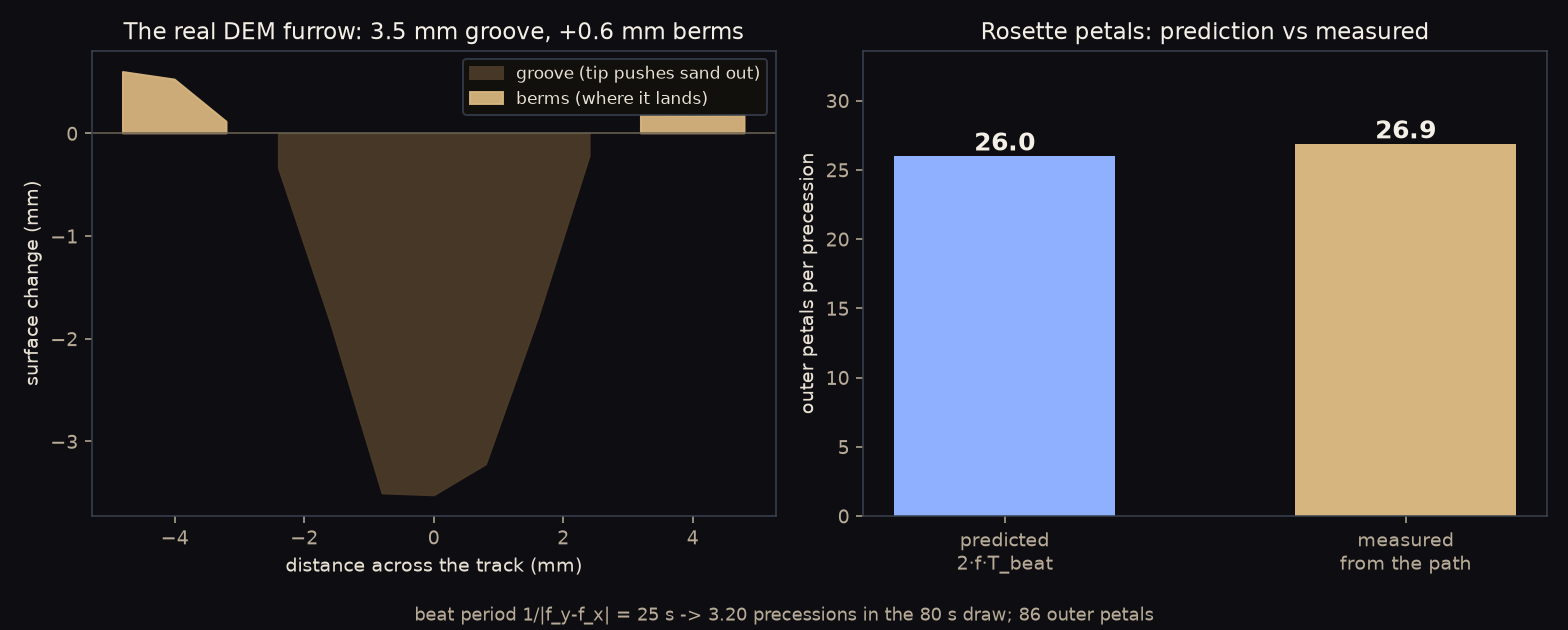
Kinematics says where the point goes; it says nothing about whether sand will keep the mark. A fine point dragged through a granular bed could cut a crisp groove — or the walls could avalanche shut behind it, or the grains could ride ahead of the point in a bulldozed plug that erases the line. Which one happens is a real solve. Ansys Rocky DEM tracks every grain as a body — contact, friction, rolling resistance, and the touch of cohesion that slightly damp fine sand has — while the 0.8 mm point plows through a bed of 0.7 mm grains at the pendulum’s pace. The verdict is the toy’s secret: the groove holds. The point opens a V-channel 3.5 mm deep and only 3.2 mm wide, and the displaced sand does not vanish — it banks into little berms +0.6 mm high along both shoulders, the raised edges that catch the light and make a real sand rose read so crisply.
Putting the two together
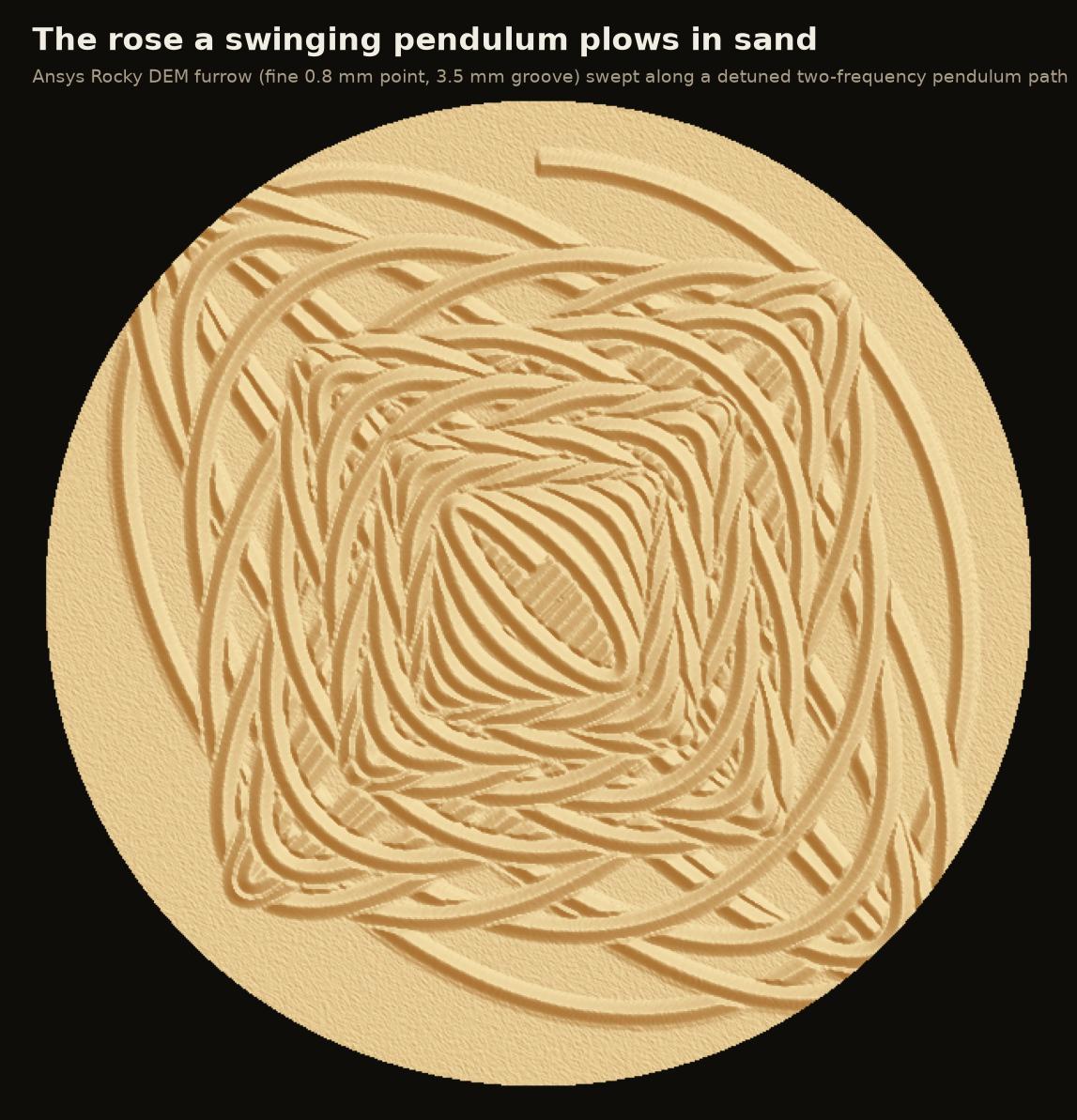
The rose is the measured furrow swept along the pendulum’s path, with one honest bookkeeping rule: where the path crosses itself, the later pass wins, because the point re-plows whatever pattern was there before. We separate the scales deliberately. Resolving every grain in the whole tray for the full drawing is intractable on a workstation — and unnecessary: the granular question (does a fine point cut a holding groove, and what shape?) is answered once, at full grain resolution, and the deterministic pendulum path does not need a particle solver to be known. The result is a rose whose every mark is a solved furrow.
It is a toy, but the split is the same one that makes hard industrial simulations tractable: know which part of the problem needs the expensive physics, solve that part properly, and let the cheap deterministic part carry it the rest of the way.
What this model does and does not cover
Have a process where a tool, tip, or flow has to move granular material precisely — plowing, dosing, furrowing, tabletting, seeding? Whether the material holds the shape you cut or collapses behind your tool is a grain-scale solve, and knowing which scale needs the particles is most of the trick. We do granular-flow and DEM work in Ansys Rocky. Rand Simulation — innovation through insight.