How a Grain-Bin Dust Cloud Explodes, and How Far the Roof Flies
The bomb is the dust, not the grain
Everyone has driven past a grain elevator — the tall corrugated-steel cylinders on the edge of every farm town. Almost no one knows that a few hundred grams of the flour-fine dust those bins shed, suspended in the air inside one, is a bomb. It is not the grain that explodes. It is the almost-invisible dust cloud in the empty headspace above the grain, and only when the cloud is dusty enough — but not too dusty. Below a threshold there is too little fuel to carry a flame; well above it the cloud is too rich to find enough air; in a band in between, one spark turns the whole headspace into a pressure wave that a thin steel bin — built to hold grain, never to hold pressure — cannot contain. This study walks that chain end to end with two Ansys solvers: how dusty is dangerous, what pressure it makes, where the wreckage flies, and who gets hurt.
How dusty is dangerous?
A combustible-dust explosion is a deflagration — a subsonic flame front (here, a distributed reaction through a turbulent cloud) racing through a fuel-air suspension. The fuel is the volatile matter the dust gives off when it is heated: corn, wheat and soy fines are mostly starch, cellulose and protein, and they pyrolyze into combustible gases in front of the flame. We model those volatiles as an equivalent gaseous charge and ask Ansys Fluent, in a transient reacting-flow solve on an axisymmetric section of the headspace, how the severity changes as we sweep the dust loading from too lean to burn, up through the worst case, to fuel-rich.
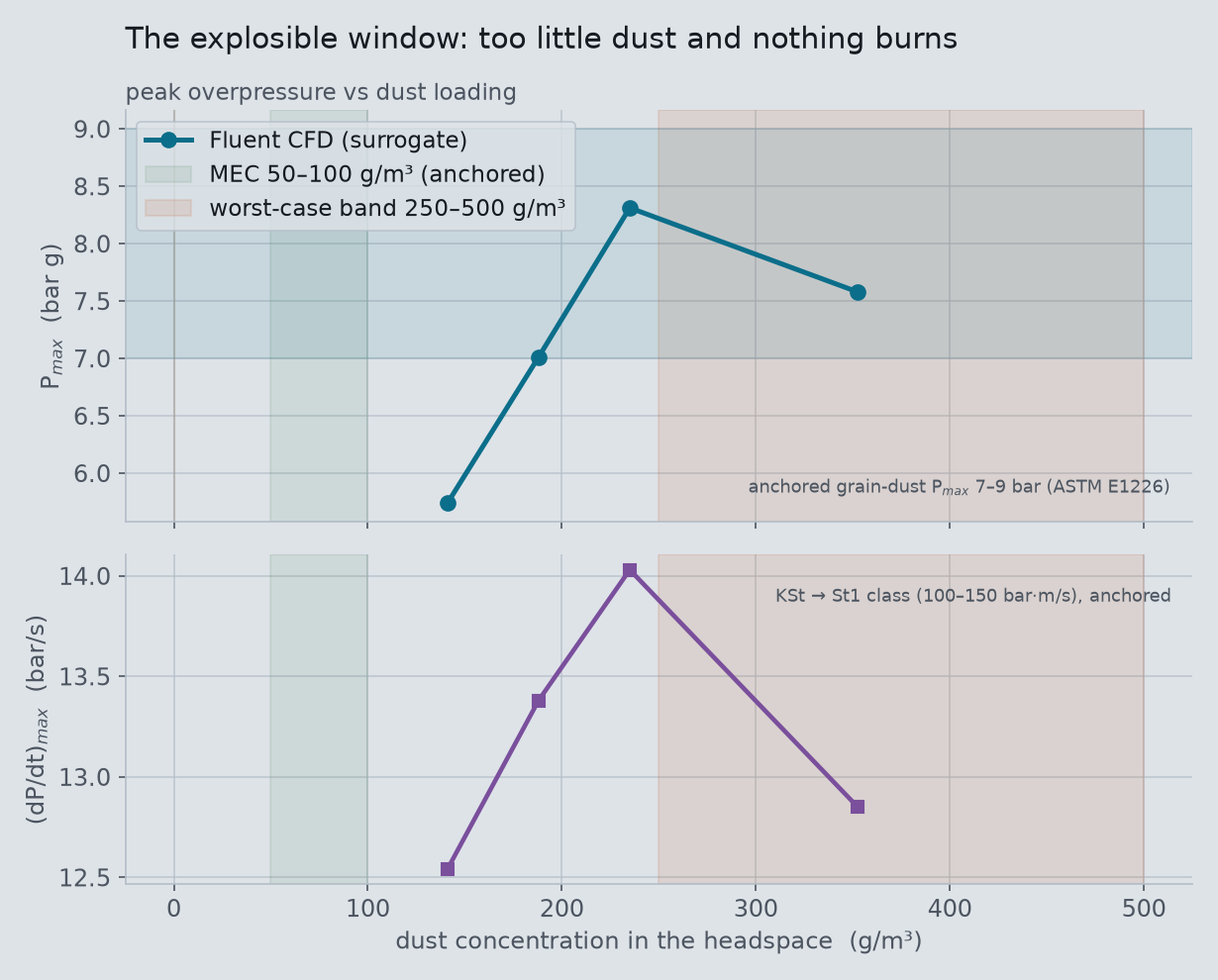
The shape is the whole point: there is a floor and a ceiling. The floor is the minimum explosible concentration (MEC), the dust equivalent of a lower flammability limit; below it, a spark just dies. Grain dust’s MEC is about 50–100 g/m³ — a cloud thick enough that you could not see your hand across the bin. The worst case is a few times richer, around 250–500 g/m³, where there is enough fuel and still enough air; richer than that and the severity falls because the oxygen runs out. We are honest about one thing here: a gas-phase surrogate cannot predict the dust’s MEC from first principles — real dust ignites leaner than any gas would, because burning particles radiate to their neighbors — so the window edges and the peak pressure are anchored to published grain-dust test data (ASTM E1226 / ISO 6184), and the CFD supplies the physics of the flame and the pressure rise in between.
What pressure does it make?
Seal a vessel and burn a stoichiometric hydrocarbon-air mixture inside it and the pressure rises by a factor of roughly eight — the burnt gas wants to expand to about eight times its volume, and with the volume fixed the pressure takes up the slack instead. For grain dust the measured constant-volume peak is 7–9 bar, and our worst-case solve reaches about 8.3 bar in the sealed headspace. Two independent back-of-envelope checks bracket it: the adiabatic constant-volume ratio puts the ceiling near 7.6 bar, and the cubic law ties the modeled rate of rise to a deflagration index in the St1 class (100–150 bar·m/s) — the same hazard class the standardized test assigns real grain dust.
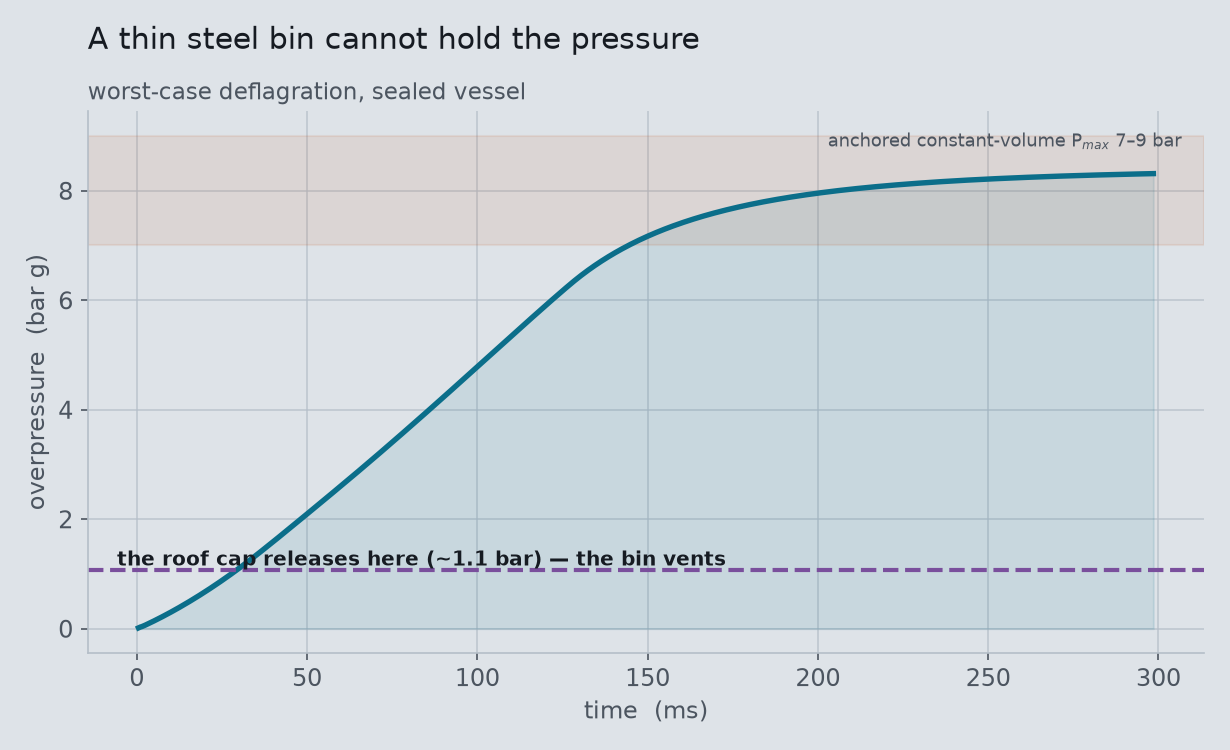
Here is the sober part. A grain bin is a pressure vessel it was never designed to be. A cylinder of radius R and wall thickness t under internal pressure P carries a hoop stress PR/t, and for a 9-meter bin with a 2-millimeter wall that stress reaches the steel’s strength at only about 1.8 bar — well under a quarter of the deflagration’s peak. The bin cannot hold 8.3 bar. It tears open on the way up.
Where does the wreckage go?
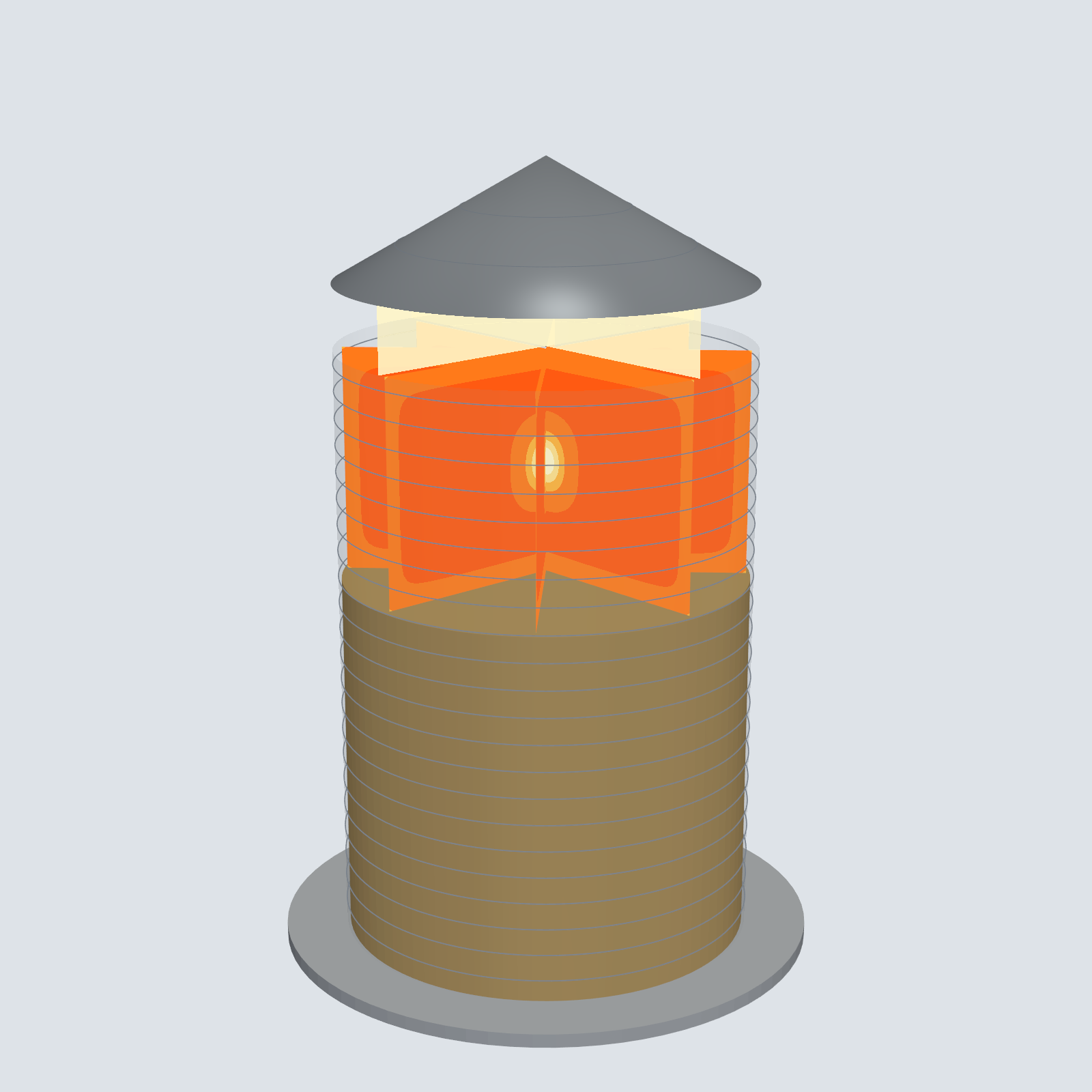
To see how it tears we hand the Fluent pressure history to Ansys LS-DYNA, which carries a thin-steel model of the bin — corrugated wall, bolted conical roof cap, fixed base — through the rupture in explicit dynamics, with the failing joints allowed to erode and separate. The internal overpressure pushes out on every surface, but the loads do not share equally. The roof cap sees a net uplift equal to the pressure times its full plan area, concentrated on the bolt line around its rim, so the bolted seam lets go first — at about 1.1 bar in the model, below the ~1.8 bar the cylinder wall itself needs to tear. The whole cap launches upward at about 47 m/s, and — this is the part that matters for who gets hurt — the opening it leaves behind vents the headspace. With the pressure relieved through the missing roof, the cylinder walls, though they yield, are largely spared. The roof cap is the bin’s de-facto explosion vent, and it does its job by leaving the building.
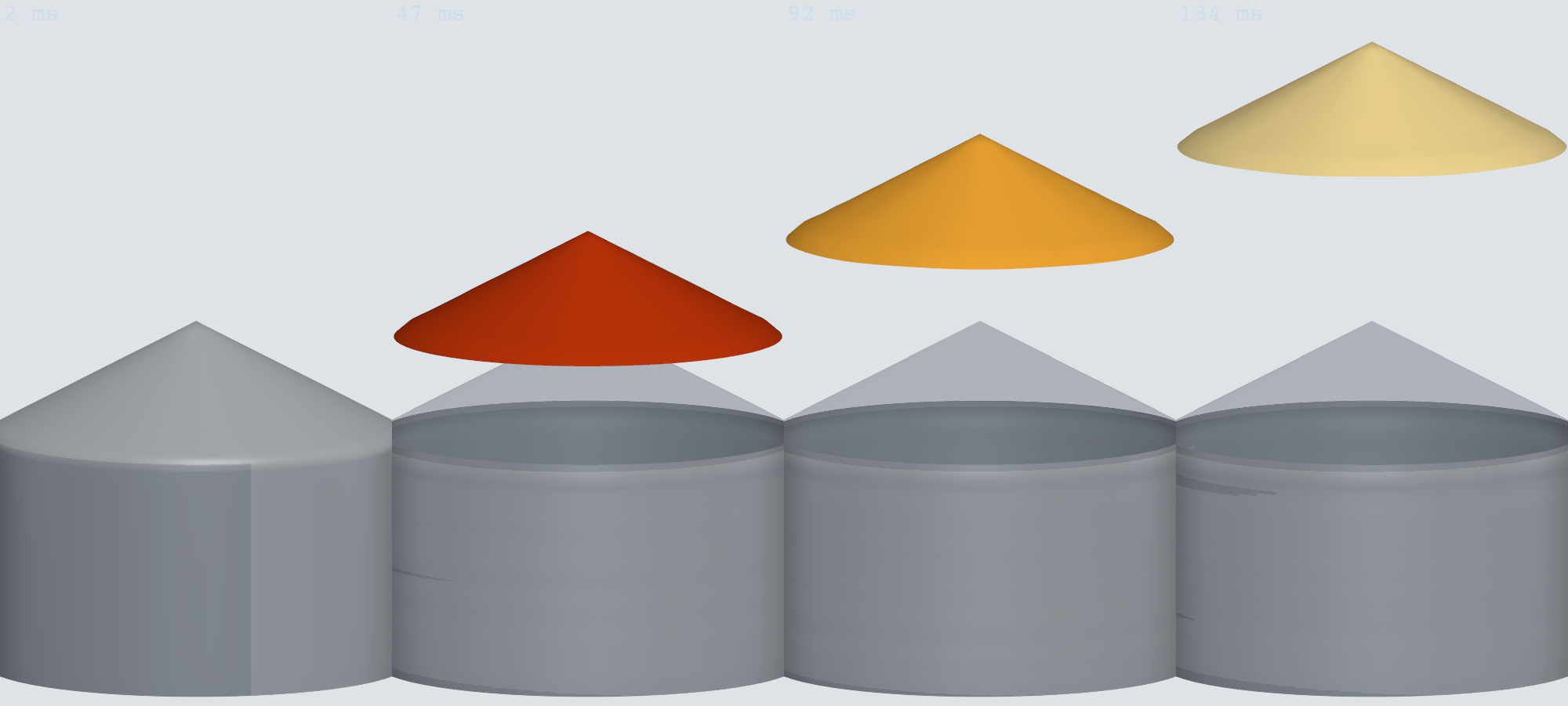
The cap leaves the bin at about 47 m/s, and it does not come down in one piece — it tears into roof sections. How far those travel is a ballistics question, not a structural one — carrying a tumbling fragment a hundred meters in explicit LS-DYNA would cost more timesteps than the rupture itself — so we take the launch velocity from the solve and fly a representative section out with a drag-included trajectory. Thrown at its best angle it carries on the order of 54 meters before it lands. That number is the reason a grain-dust explosion is a neighborhood event, not a bin event.
Who gets hurt, and how far out?
Two hazards reach a person standing nearby: the pressure wave and the debris. The pressure wave from a bursting bin is far weaker than a high-explosive blast — a deflagration vents rather than detonates — and it decays quickly with distance. Set against the standard blast-injury thresholds (eardrum rupture near 0.35 bar, serious lung injury near 1 bar), even the mildest injury threshold stays within roughly 5 m of the bin in our estimate, and serious-injury overpressure barely clears the wall. The fragments do not.
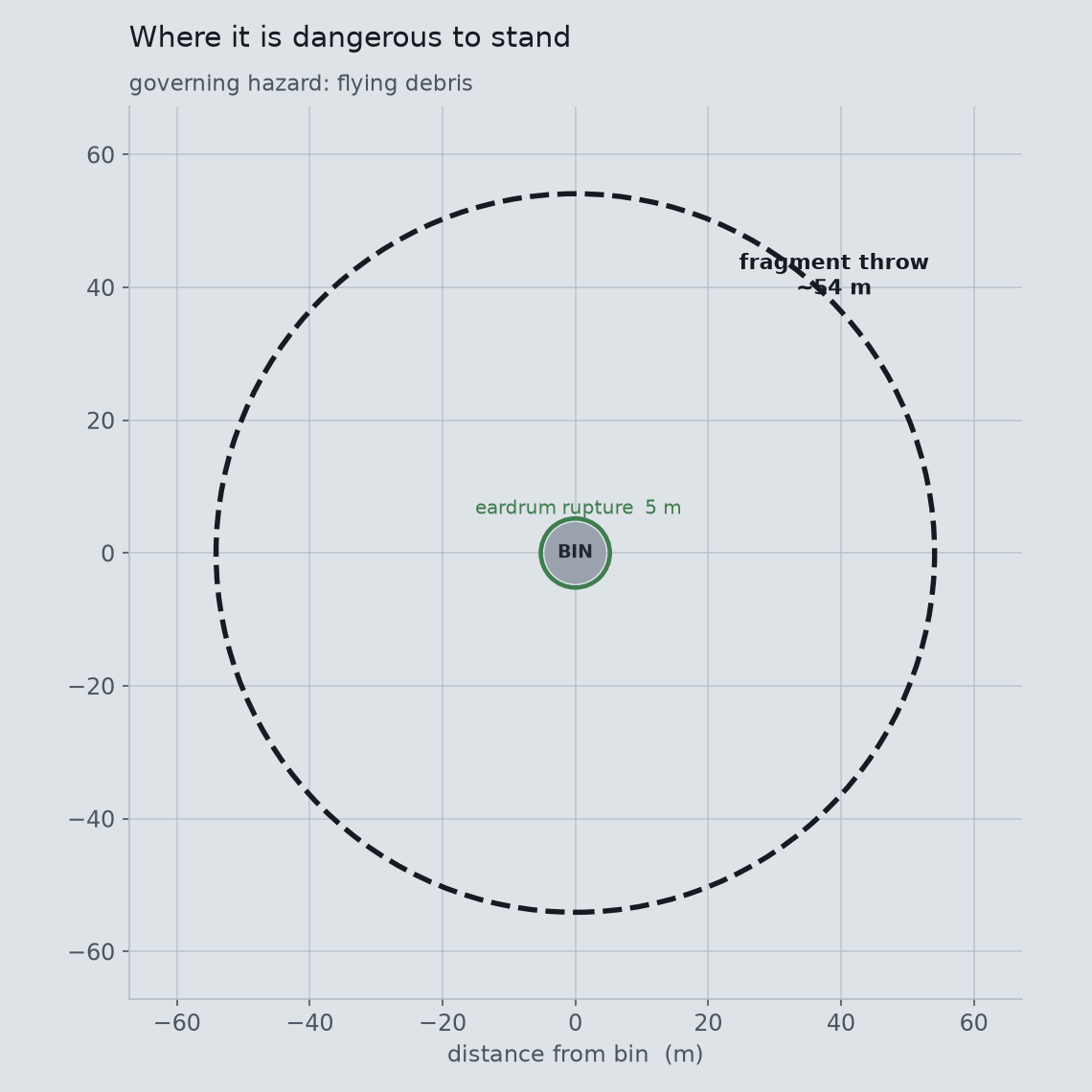
That is the governing-hazard verdict, and it is not intuitive: the thing that hurts people is not the bang, it is the steel. The pressure that would injure a bystander is confined to a few meters, but a launched roof panel can reach someone standing tens of meters away, well outside any zone a person would think of as “too close.” The practical lesson mirrors what NFPA 61 and decades of grain-industry safety practice already teach: control the dust so the cloud never forms, and keep people clear of the blast footprint of a bin, not just its base.
Have a process where combustible dust, high pressure, or a sudden structural failure could put people at risk? The same honest, end-to-end approach that walked this grain-bin explosion from an invisible dust cloud to a roof thrown tens of meters — combustion CFD handed one-way to explicit structural dynamics — can put real numbers on your equipment’s failure modes and the standoff that actually keeps people safe. That is innovation through insight.