The Vacuum Ping-Pong Gun: How 1 Atmosphere Punches a Ball Through a Paddle
Take a ping-pong ball, seal it in a long tube, pump out the air, and break the seal. The atmosphere does the rest: it drives that 2.7 gram ball down the tube and out the muzzle at roughly the speed of sound — fast enough to blast a clean hole through a wooden paddle. It is one of the great physics-demo party tricks (Purdue’s version reportedly hit ~Mach 1.2). We rebuilt it in an explicit finite-element solver to watch the launch and the punch-through frame by frame.
Where does the energy come from?
It feels like cheating, but it is just bookkeeping on a number we usually ignore: atmospheric pressure is about 101 kPa, pressing on everything, all the time. Normally it pushes equally on both sides of a ball and cancels out. Evacuate one side and seal it, though, and that balance is broken: the full atmosphere now pushes on the ball’s back face with nothing behind it.
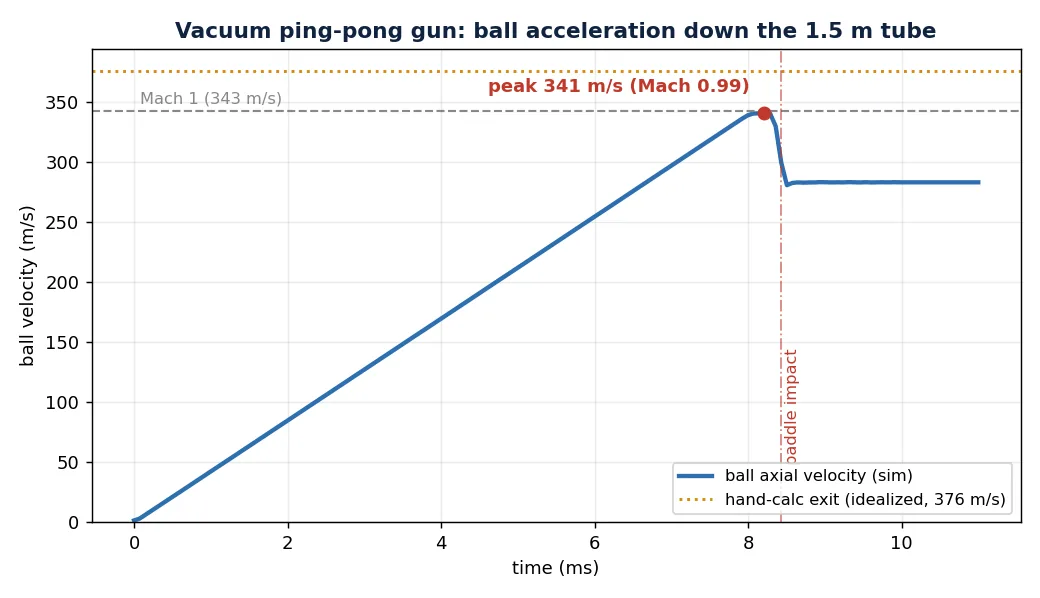
On a 40 mm ball the cross-section is about 12.6 cm², so the net force is F = ΔP × A ≈ (101 kPa)(πR²) ≈ 127 N. That does not sound like much — until you remember the ball weighs only 2.7023 grams. F = ma then gives an acceleration of about 4,803 g. Sustain that over a 1.5 m tube and the ball leaves the muzzle at an ideal v = √(2·(F/m)·L) ≈ 376 m/s — right around the speed of sound. A tiny pressure, a very light ball, and a long run-up: that is the whole recipe.
What the simulation shows
We modeled the ball as a thin celluloid shell sphere, the tube as a rigid guide that keeps the ball centered, and the paddle as a thin wood board that is allowed to fail and erode. The launch itself we applied the honest, simple way: a constant ~1 atm pressure on the ball’s rear face, switched off the instant the ball clears the muzzle (in the real gun, that is when the air behind it vents to atmosphere).
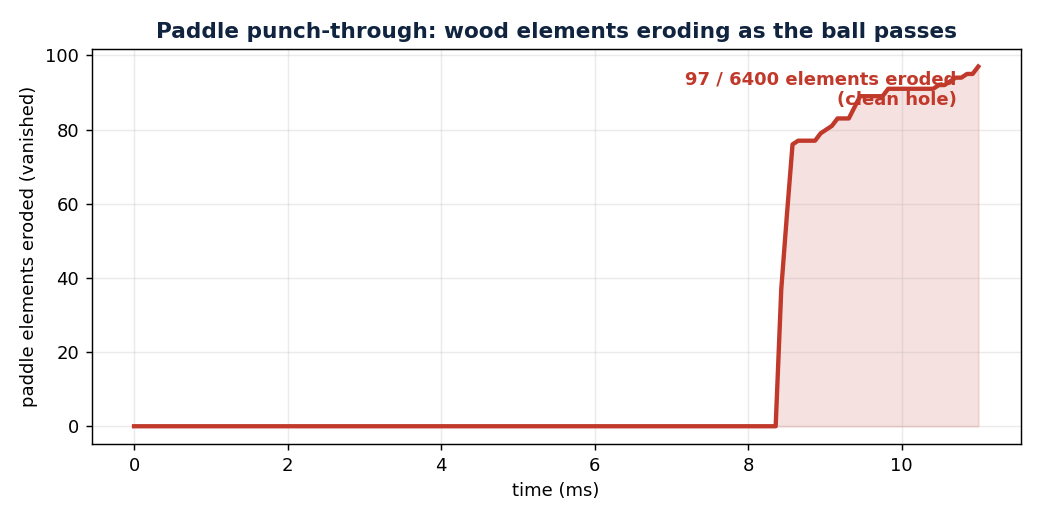
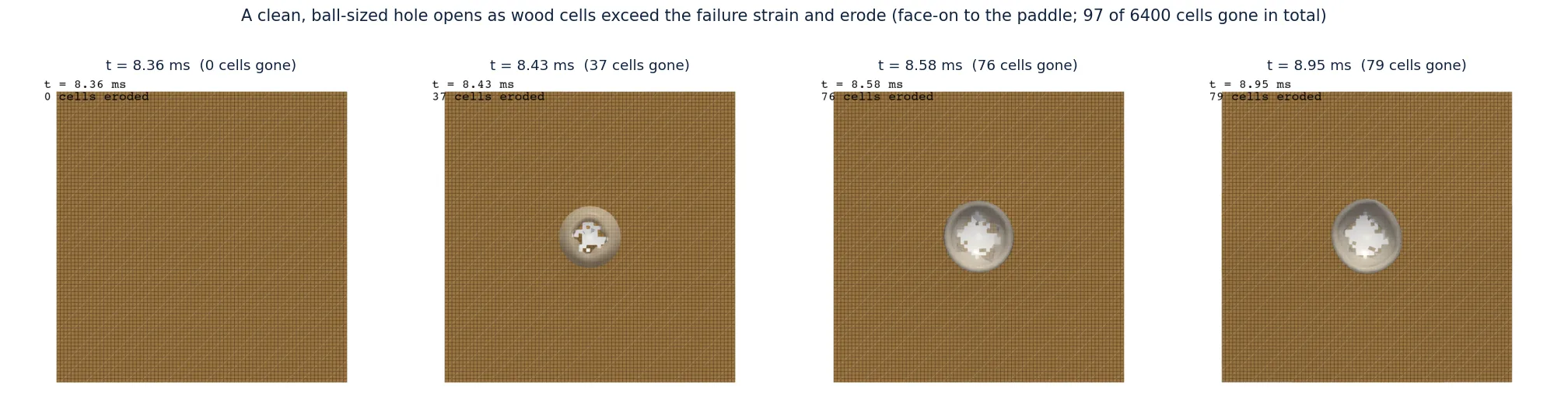
The ball reaches the muzzle at about 330 m/s (Mach 0.96) — about 88% of the idealized hand calculation. The gap is the honest part: a real shell flexes, the guide contact rubs, and the acceleration is not perfectly constant. Then comes the fun part. Carrying roughly 147 joules on a 40 mm face, the ball reaches the 3 mm paddle at t ≈ 8.433 ms and the wood in its path simply cannot take it: those elements exceed their failure strain and erode away, leaving a clean, ball-sized hole — 97 of 6400 paddle elements gone. The ping-pong ball wins.
The punch-through, quantified
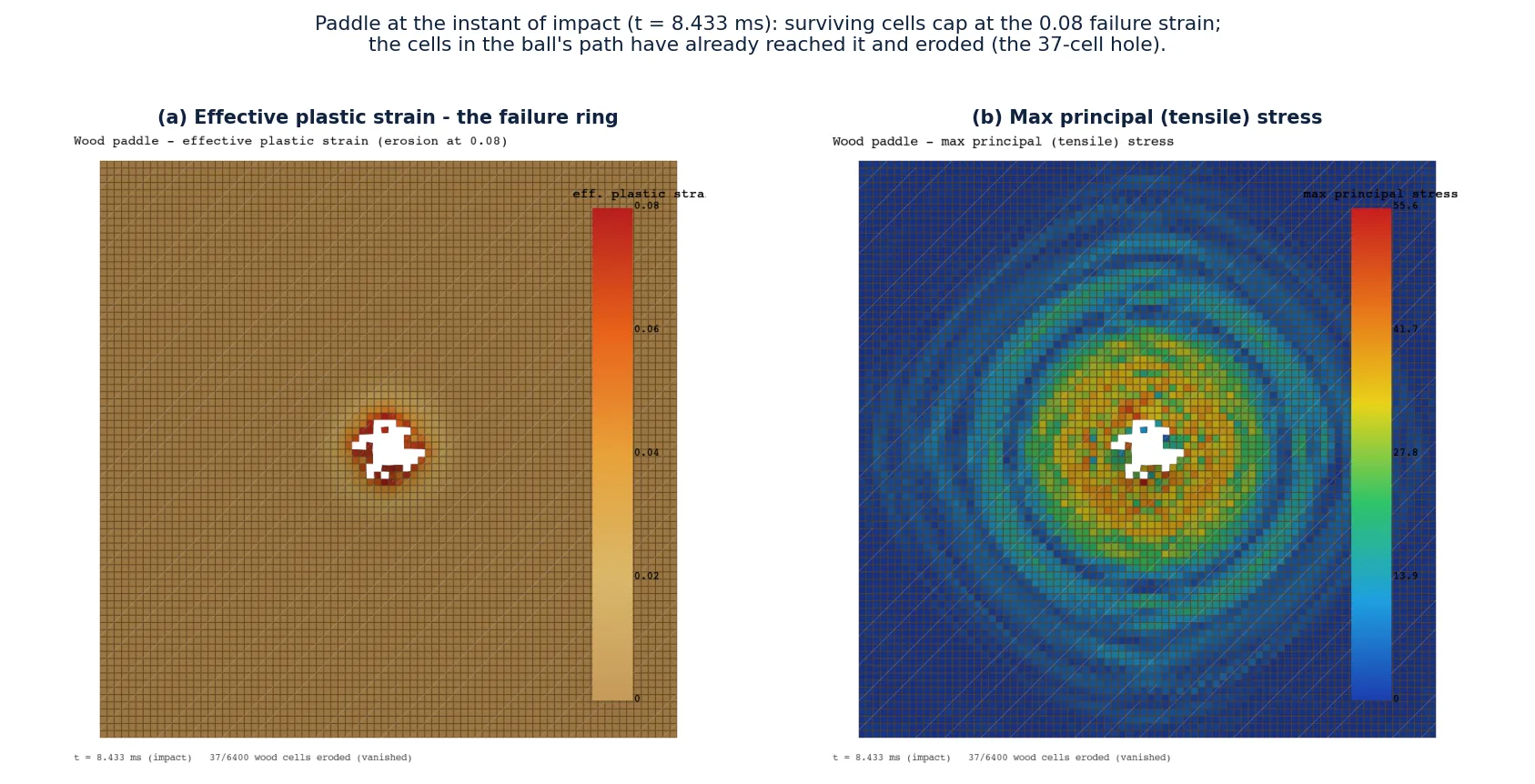
“The wood elements erode” is easy to say and easy to distrust — it can sound like a numerical dodge, elements quietly deleted to make a pretty hole. It is not. In this model the paddle is wood with a real failure criterion: an effective-plastic-strain limit of 0.08. An element carries load right up to that strain; the instant it crosses 0.08 it has failed as a material and is removed (its erosion flag flips, and it vanishes rather than stretching into a junk fragment). So the hole is not painted on — it is the literal set of cells that the ball strained past failure.
The d3plot lets us watch that happen. The entire punch is a single-frame event: at t = 8.36 ms the paddle is pristine (zero stress, zero plastic strain, all 6400 cells alive), and one state later — t ≈ 8.433 ms — the ball has arrived, 37 cells have already blown past 0.08 and disappeared, and the survivors ringing the hole are pinned right at the failure strain. That is the tell-tale signature of an erosion model working correctly: nothing survives above the threshold.
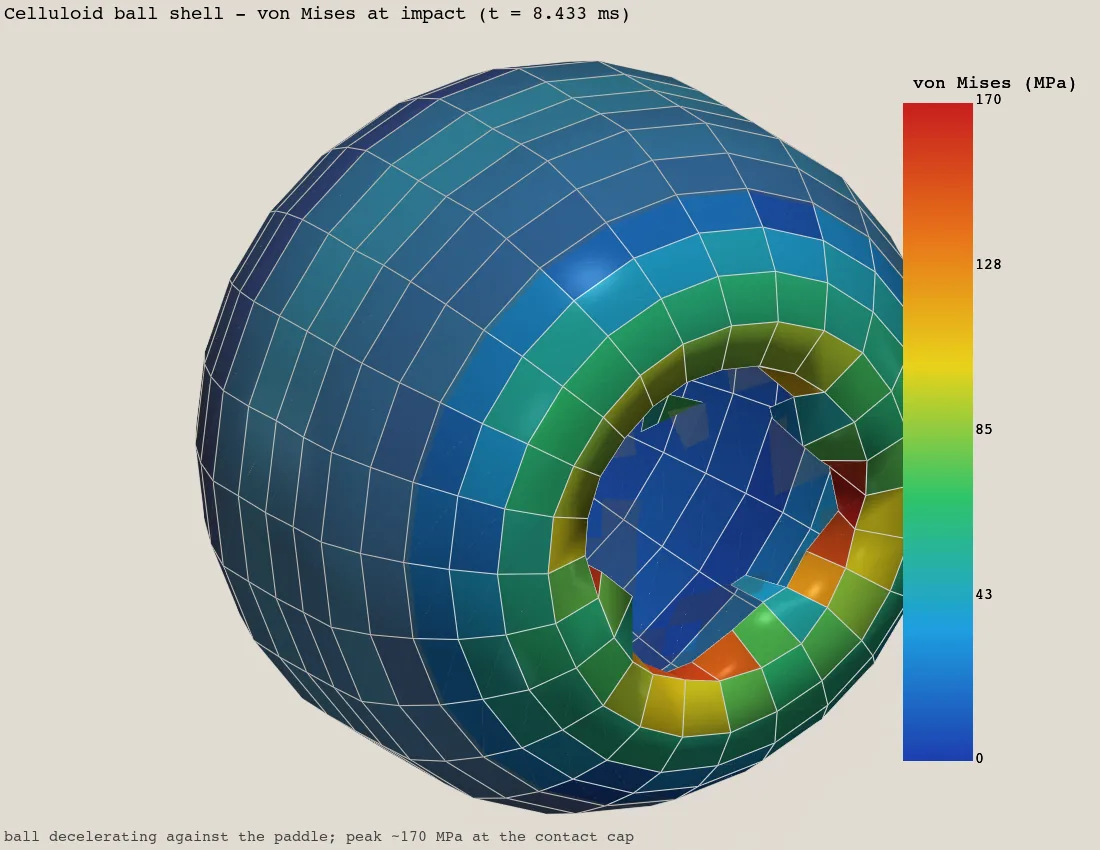
The ball does not get off free, either. As it decelerates against the paddle the celluloid shell crushes, and we can read its own stress straight from the d3plot. At impact the von Mises stress on the ball’s contact cap reaches about 170 MPa — the shell is buckling inward as it spends its momentum on the wood. It punches through, but it pays for it: 94 of its own 576 shell elements erode in the exchange (the ball ends the shot dented and torn, not pristine).
Where does the energy to do all this come from? The velocity curve above shows the speed; the more physical companion is the kinetic energy. With a 2.7023 g ball, ½mv² works out to about 147 joules at the muzzle (330 m/s) — and because the thrust is essentially constant, that energy builds almost linearly with distance down the barrel, the work–energy theorem made visible (W = F·d). 147 J delivered onto a 40 mm face is what does the damage. (As an independent check, the solver’s own global kinetic-energy curve peaks at ~156 J, matching the ball-only ½mv² to under a percent — the ball really is carrying essentially all of the model’s energy.)
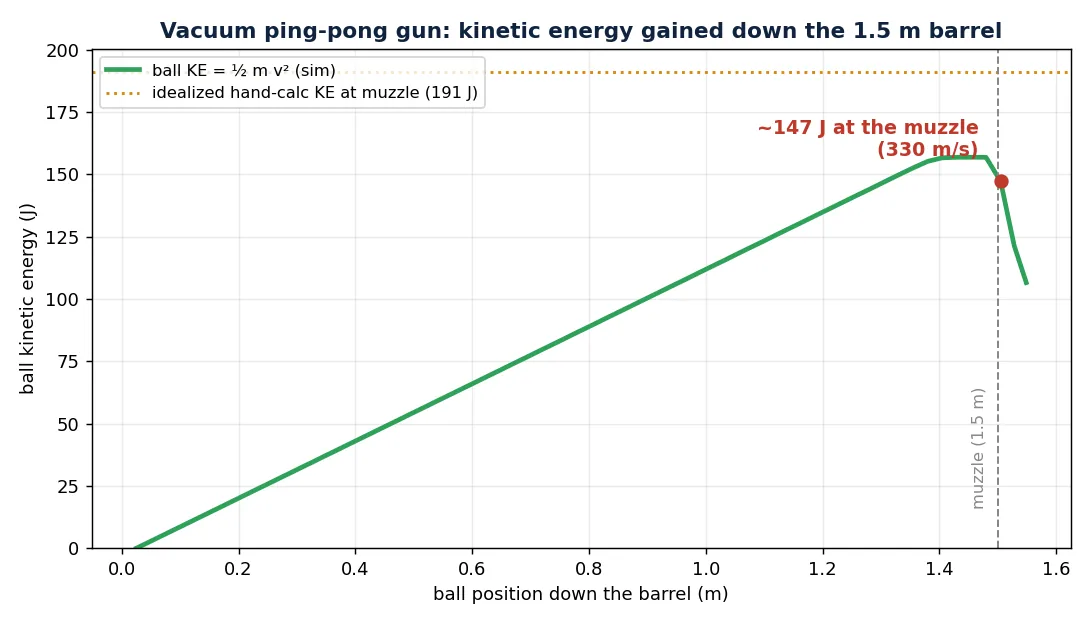
What we can say cleanly: one forgotten atmosphere of pressure, applied to a feather-light ball over a long enough tube, is genuinely enough to drive it transonic and punch it through a paddle. The physics of the everyday is wilder than it looks.
Being honest about the model
One simplification is worth stating plainly. We push the ball with a constant 1 atm, which is an upper bound. In a real evacuated tube the air rushing in behind the ball cannot keep the full atmospheric pressure on it once the ball starts outrunning the inflow — a gas-dynamic limit — and we also ignore tube friction and the mass of the seal. So our muzzle speed is a clean ceiling, not a measured value. The fuller treatment models the air itself as a compressible column behind the ball; that is the natural next step. And the famous ~Mach 1.2 figure from the original demonstrations? That is real-world context for why this trick is so striking — not a number we are claiming as our result.
When something fast meets something thin in your design, do you actually know which side wins? Ansys LS-DYNA resolving the launch and the punch-through frame by frame — a muzzle speed held honest at 88% of the idealized hand calc, wood erosion governed by a genuine 0.08 effective-plastic-strain failure criterion rather than a painted-on hole, the eroded-cell count read straight from the d3plot, and the solver’s own kinetic-energy curve matching ½mv² to under a percent — is how simulation shows you which side wins, cell by eroding cell, before anyone builds the rig and sacrifices the hardware. That's innovation through insight.