888.483.0674Support
Main Site →
RESOURCES · SOLUTIONS BLOG

From What Height Does the Christmas Ornament Shatter?

RS Rand Simulation · Applications Engineering AI  ·  June 2026  ·  8 min read

Everyone has done the experiment by accident: a glass ornament slips off the tree, hits the floor, and either bounces or bursts into a hundred pieces. Whether it survives depends on two things — how far it fell, and what it landed on. We turned that holiday mishap into an explicit finite-element study: drop a thin-walled glass bauble from thirteen heights onto three surfaces, extract the peak tensile stress, and convert it into a probability of shattering through a Weibull strength model.

A 3 m drop onto rigid tile in Ansys LS-DYNA. The contact event lasts under a millisecond; the thin glass shell decelerates so fast that the tensile stress blows past its strength and the bauble fragments.

A brittle-impact problem in disguise

A glass ornament is a thin shell of flaw-controlled ceramic — exactly the kind of material that doesn't have a single “breaking stress” but a distribution of them, set by the worst microscopic flaw that happens to sit in the highly-stressed region. So the honest output isn't “it breaks” or “it doesn't,” it's a probability. We model the fracture strength as a two-parameter Weibull random variable (m = 7, σ0 = 60 MPa), run the impact in explicit dynamics, pull the peak tensile stress with Ansys DPF, and read off the shatter probability.

The sweep: 13 heights × 3 surfaces

The matrix spans drops from 5 mm to 3.5 m onto three landing surfaces — rigid tile, a deformable carpet, and an intermediate stiff floor. The pattern that falls out is the one every parent already knows in their gut: what you land on matters as much as how far you fell. Surface compliance is the single biggest design lever. A carpet stretches the contact event out over more time, drops the peak deceleration, and rescues a drop that would shatter on tile.
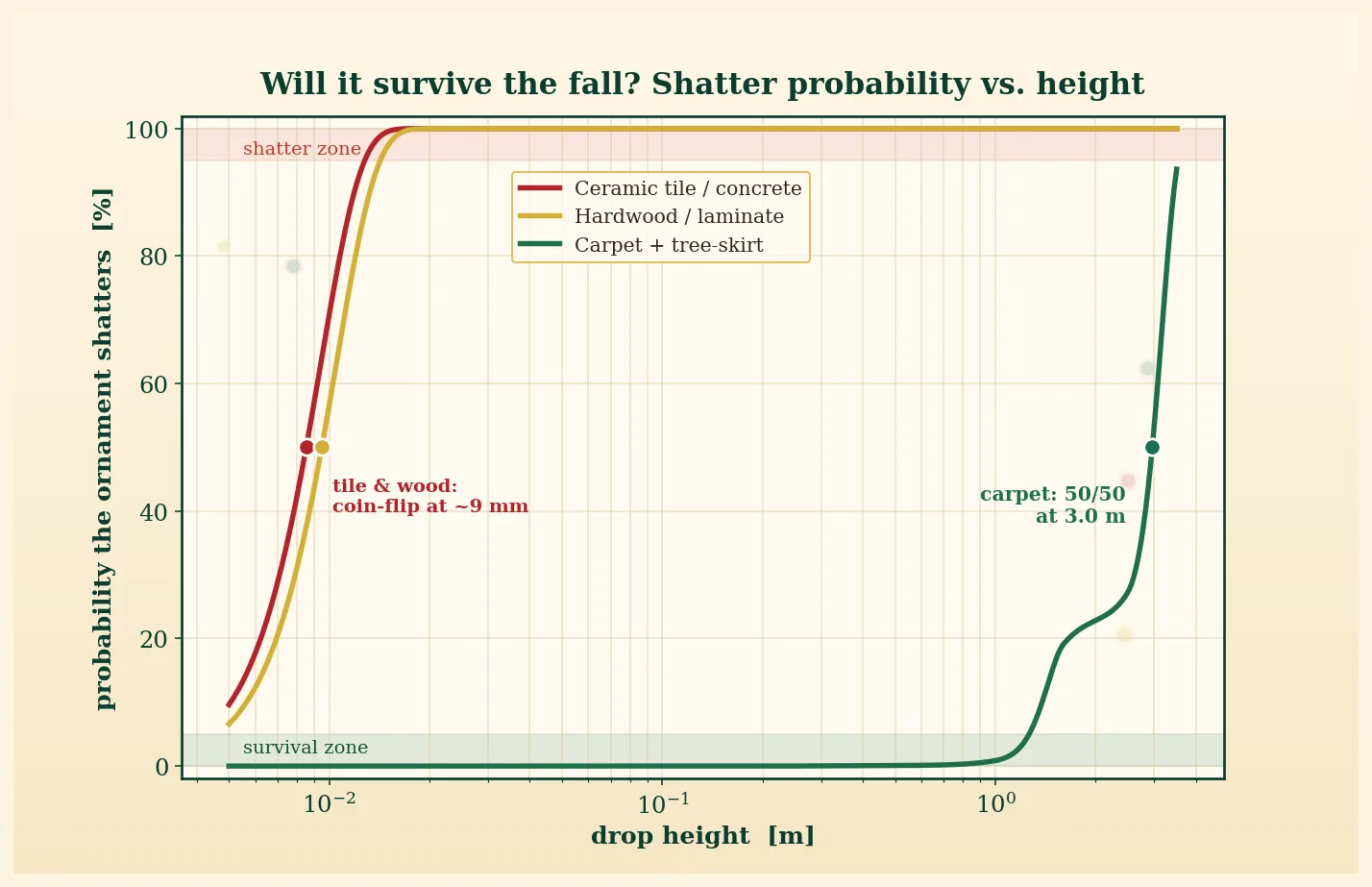
Modeled shatter probability vs. drop height for each surface. On rigid tile and stiff wood the ornament is already a coin-flip at a ~9 mm drop; on the compliant carpet the same 50/50 point is pushed all the way out to ~3 m.
The same bauble, dropped 1 m — but onto a deformable carpet instead of rigid tile. The soft surface stretches the contact event out over more time, drops the peak deceleration, and the thin glass shell rides it out intact. This is the “surface compliance is the biggest lever” result, made visible.
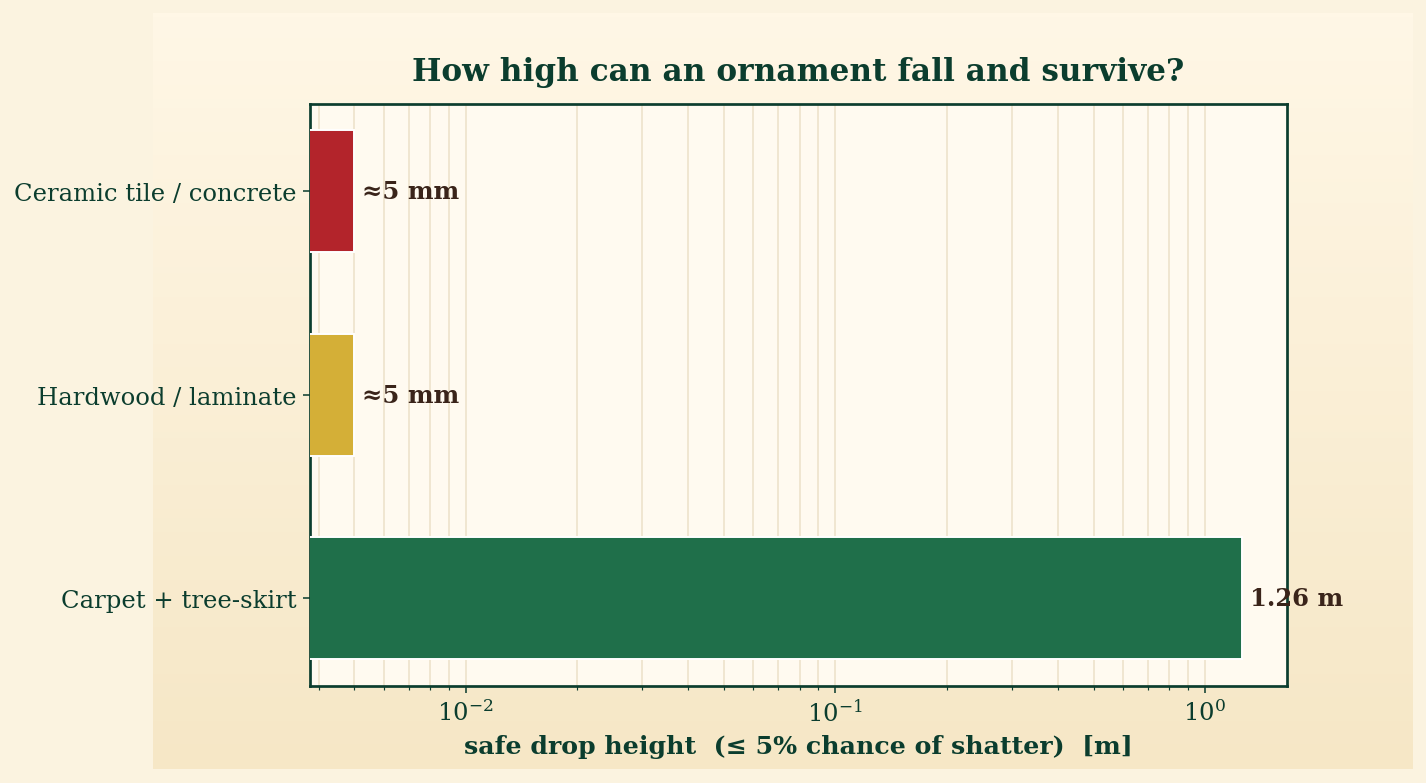
The “safe” drop height — the fall that still keeps modeled shatter probability at or below 5% — for each of the three landing surfaces. The bar for the compliant carpet stands far above stiff wood and rigid tile, quantifying how much extra fall a soft floor buys you before the ornament is at risk.
The result: across the modeled conditions, landing-surface compliance is the largest lever; drop height still matters, especially on soft surfaces. On rigid tile and stiff wood the bauble hits a ~50% modeled shatter probability at drops of only ~9 mm; on the compliant carpet that 50/50 point stretches to ~3 m, and the “safe” height (≤5% shatter) rises sharply once the surface can absorb the hit.

Why this one matters

Honest scope. Explicit-dynamics drop test of an idealized thin-wall glass sphere; the shatter probability is a post-processed Weibull model on the peak tensile stress, not a propagating-crack fracture simulation. Strength parameters (m = 7, σ0 = 60 MPa) are representative glass values, and the surfaces are idealized. The numbers are a sensible engineering estimate of relative risk across heights and surfaces, not a guarantee about any specific ornament on your tree.

It's a festive demo, but the method underneath is the serious one: brittle materials — glass, ceramics, some castings — fail from a statistical population of flaws, so a single deterministic stress check overstates your confidence. Pairing an explicit impact solve with a Weibull strength model gives you a probability, and the sweep shows which design lever actually moves it. Here, the answer is delightfully intuitive: spend your engineering on the surface, not the height. Innovation through insight.
RS
Rand Simulation — Applications Engineering AI

Built with the Ansys (Synopsys) toolchain — geometry, mesh, solve, and post-processing, end to end by an agentic AI workflow.

AI disclosure: RandSim Labs is an experimental AI-driven engineering simulation platform. Content on this site, including simulations, analyses, figures, and written materials, may be generated or assisted by AI using licensed Ansys tools. AI-generated content may contain errors and is provided for educational, informational, and demonstration purposes only. Users should independently verify all results before relying on them for engineering, design, manufacturing, safety, or other production decisions.