Let the Optimizer Find the Shape: optiSLang Lightweighting of a Bracket
Give a bracket five shape knobs — wall thickness, arm thickness, a corner fillet, a lightening hole, and the size of its stiffening gusset — and ask a blunt question: how light can it get while the peak stress stays under 200 MPa? We wired Ansys optiSLang to Ansys Mechanical and let the optimizer answer it, one solved design at a time.
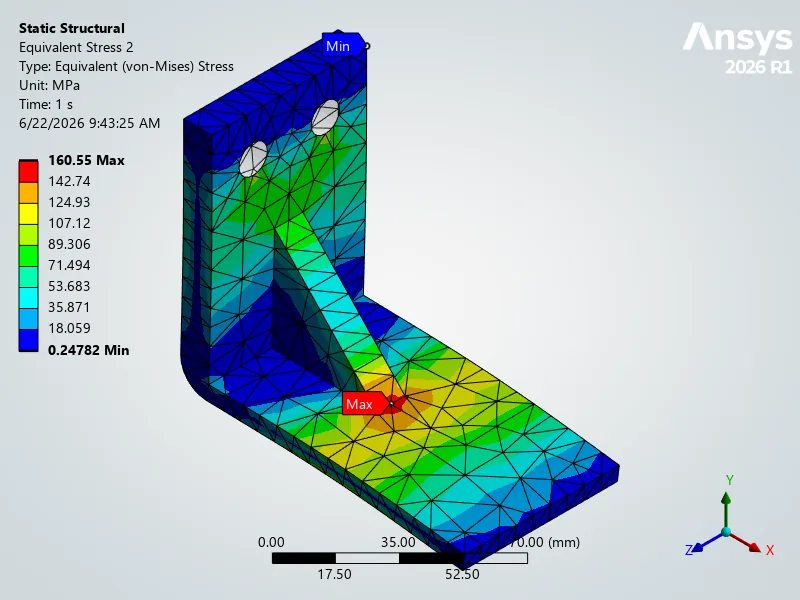
A bracket with knobs
The part is a simple L: a vertical wall that bolts to a structure, a horizontal arm that takes a downward load at its tip, and a triangular gusset bracing the two. That much is fixed. What we let optiSLang vary are five shape parameters — the wall/web thickness, the arm thickness, the radius of the inner fillet, the diameter of a lightening hole punched through the arm, and how far the gusset climbs the wall. Every parameter set is a different bracket: a different mass, a different stress, a different deflection.
Sample, then learn what matters
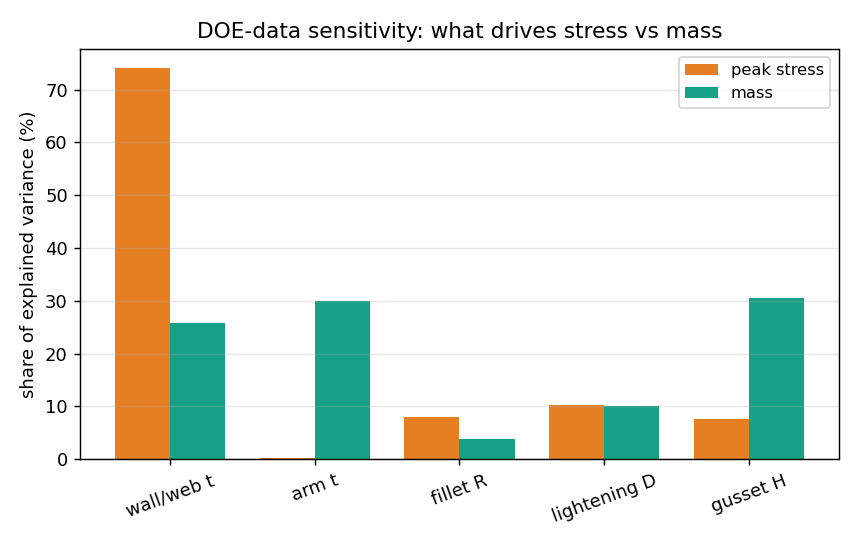
optiSLang draws a space-filling Latin-Hypercube sample across the five-dimensional design box and solves each design in Mechanical — a real static-structural FE run, fixed at the bolt holes, loaded at the tip. From those solved points it fits a metamodel (a MOP) and reads off the sensitivities: which knobs actually move the stress, and which just add weight. In this study the biggest lever on peak stress was the wall/web thickness. That is the whole value of the sensitivity step — it tells you where to spend material and where you are just carrying dead weight.
Optimize on the model — then check the optimizer’s work
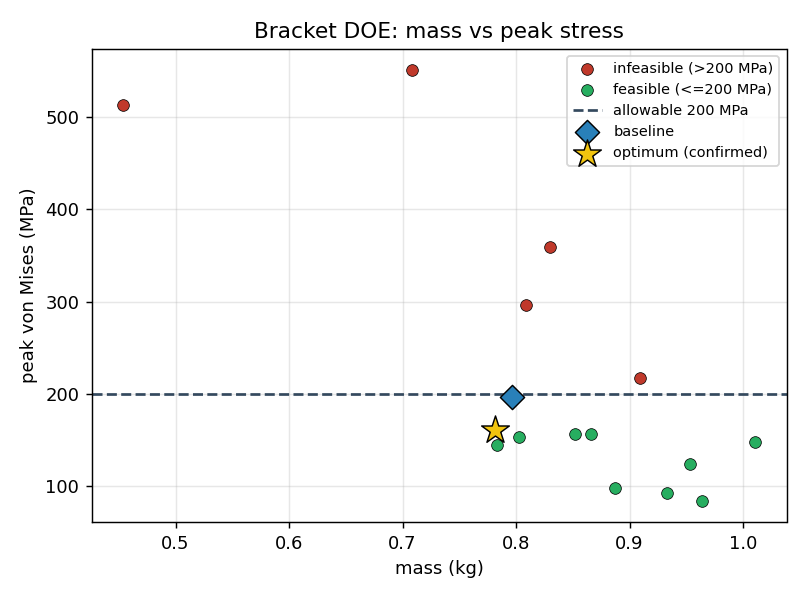
With a metamodel in hand, an optimizer hunts it for the lightest design under the stress cap — fast, because it queries the model, not the solver. But a surrogate optimum is only a prediction, and this is where the demo got honest. The optimizer happily handed back designs around 0.56–0.72 kg that the metamodel swore were under 200 MPa. We took each one back to Mechanical and solved it for real — and they came back at 424 and 313 MPa. Wildly overstressed. The metamodel is optimistic right at the constraint boundary, which is exactly where the optimizer loves to push.
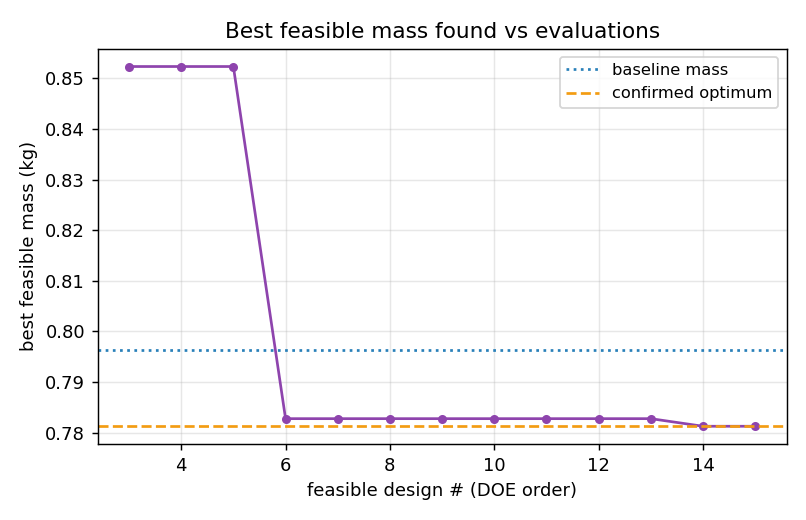
That is the whole reason you confirm. The number we actually report is the lightest design we solved and verified under the cap: baseline 0.796 kg at 197 MPa → optimum 0.781 kg at 161 MPa — a real 1.9% mass reduction, constraint met. Modest? Yes — and worth stating carefully. Under this load the bracket is stress-limited, and this search found little mass that could safely come out. But two diagnostics say the search may have stopped short rather than run out of bracket: the verified optimum sits at 161 MPa against a 200 MPa cap — a constraint that is 20% inactive at a supposed mass minimum, when a true stress-limited optimum should be pressed against it — and the metamodel’s errors exceeded 100 MPa exactly where the optimizer pushes, at the boundary. The right next move, which this study has not yet run, is to feed the verified points back into the metamodel and re-search, or to put the solver directly in the loop and hunt the 161–200 MPa band. Until then, 1.9% is a floor on the saving, not a measure of the bracket. An honest 2% still beats a fabricated 30%.
Honest scope. This is one static load case, a linear-elastic steel, a single fixed-support set, and shape ranges we picked for the demo. The peak stress is read on a consistent coarse mesh with the clamped holes excluded — a fair, apples-to-apples metric for ranking designs, not a mesh-converged absolute; no mesh-convergence study was performed, so that disclaimer rests on judgment, not evidence. And it is the optimum the chosen route (sample → metamodel → gradient search) found inside those ranges, not a proof of the global best. A fair criticism this revision accepts rather than fixes: the problem definition — the tip load magnitude, the bracket’s dimensions, the bounds on the five shape variables, the material properties, the DOE sample count — was never published, so none of the stresses or masses here can be hand-checked from the page, and we will not fake an anchor we cannot compute. Publishing that definition, with a one-line bending estimate against the 197 MPa baseline, is flagged for the next solving pass on this study. What the study is, honestly, is the real thing: a genuine optiSLang study driving real Mechanical solves, with the winning design verified on the metal rather than trusted from the model.
How much mass could you safely pull out of your most over-designed part — and could you defend the number? Ansys optiSLang wired to Ansys Mechanical — a Latin-Hypercube DOE of real static-structural solves, a metamodel that named the wall/web thickness as the lever that matters, and every surrogate optimum re-solved in Mechanical, which caught “feasible” designs actually sitting at 424 and 313 MPa — is how simulation delivers a verified 1.9% under the 200 MPa cap instead of a fabricated 30%, before a prototype cycle finds out the hard way. That's innovation through insight.