The Levitating Slinky: Why the Bottom Hangs in Mid-Air
Hold a Slinky by its top coil, let it stretch out under its own weight, and let go. Common sense says the whole thing falls. Slow-motion cameras say otherwise: the top collapses downward while the bottom just hangs there, suspended in mid-air, as if it hasn't yet heard the news. It waits — and only starts to fall once the collapse finally reaches it. We rebuilt that little miracle inside an explicit LS-DYNA solve. Here's what it took to make a slinky levitate in silico.
The physics: news travels at the speed of a spring
The trick isn't magic, and it isn't an exception to gravity — gravity is pulling on every coil the whole time. The trick is that a stretched Slinky stores a lot of information about its own internal forces, and that information can only travel at the speed of a compression wave running down the coils.
While you hold the Slinky, the top coil carries the entire weight of everything below it, so the spring is stretched tightest at the top and barely at all at the bottom. The instant you release, the top is suddenly unsupported and starts to collapse — but the bottom coil is still feeling exactly the same upward spring tension it felt a moment ago. As far as the bottom is concerned, nothing has changed. It stays put. It keeps hanging until the collapsing front of coils — the "the hold is gone" message — physically arrives from above. Only then does it drop.
The bottom doesn't levitate because gravity took a break. It levitates because it hasn't been told it was let go.
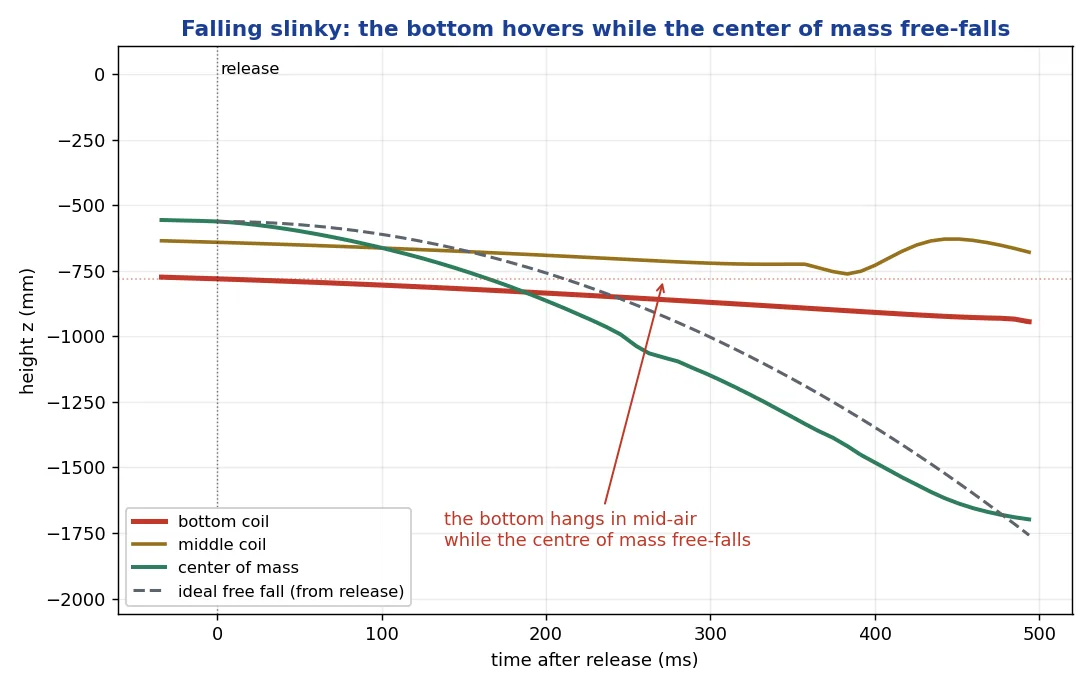
And here's the elegant part that makes physicists smile: even while the bottom hovers, the Slinky's center of mass falls exactly as a free-falling object would. The top accelerates downward faster than free-fall to compensate for the stationary bottom, and it all averages out to a textbook ½gt². Two surprises for the price of one.
Inside the model
Why the obvious model is the wrong model
Our first instinct was the literal one: build the actual helix. Sweep a wire into a coil of beam elements, give it steel properties, settle it under gravity, and drop it. We built exactly that — a full beam helix — and it cleanly reproduced the gravity-stretched hanging shape and a free-falling center of mass. But the bottom refused to hover. It just free-fell from the moment of release.
The reason is a beautiful lesson in choosing the right idealization. In a beam helix, the "release" signal propagates along the wire at the steel's acoustic speed — roughly 5,000 m/s. That's almost instantaneous over a half-meter toy, so every coil "hears" the release essentially at once and the whole thing drops together. But the real Slinky's collapse wave is a slow, geometric spring effect — coils closing on coils — that crawls down the toy in a fraction of a second, not a microsecond. Modeling the wire faithfully modeled the wrong wave.
The right model: a soft 1D mass-spring chain
So we threw away the helix geometry and kept only the physics that matters. The slinky became a straight vertical column of 61 nodes joined by 60 axial truss segments (LS-DYNA *ELEMENT_BEAM with ELFORM=3, the axial-only truss formulation) — exactly the discrete mass-spring chain that Cross & Wheatland use in their 2012 analysis. The "spring" is the segment's own axial stiffness EA/L, and the secret ingredient is a deliberately soft modulus (E ≈ 0.6 MPa, segment stiffness ≈ 0.3 N/mm). A soft material has a low sound speed √(E/ρ), which gives the slow collapse wave we were missing. Total mass: 0.2 kg, distributed along the chain. Units throughout: mm, s, metric ton, N, MPa.
The setup is a two-phase script. Phase 1 — settle: the chain is built packed (coils nearly touching, springs at zero force), the top node is pinned in Z, gravity switches on via *LOAD_BODY_Z, and a time-ramped *DAMPING_GLOBAL bleeds out the oscillation so the chain relaxes into its true gravity-stretched hanging equilibrium. Every node is constrained in X and Y with *BOUNDARY_SPC_SET — this is a strictly 1D problem, and keeping it 1D keeps it clean. Phase 2 — release: at t = 1.2 s the top node's prescribed-motion constraint hits its death time and the damping curve drops to zero simultaneously. The top is free. The drop begins. We ran it on LS-DYNA explicit (lsdyna_dp, R16) with a timestep floor (mass scaling) so the collapsing, near-zero-length segments at the top couldn't grind the timestep to nothing. The solve is tiny — a few hundred steps — and terminates normally with 202 output states.
The result
Is it right?
Two independent checks, both quantitative. First, the center-of-mass free-fall test: from the instant of release we overlay the chain's COM against the textbook z₀ − ½gt² trajectory. They agree to within ~14% across the full drop — the COM falls as if the spring weren't there, exactly as Newton requires. Second, the bottom-hover test: the bottom's total excursion (~164 mm) is a small fraction of the free-fall distance (~1,197 mm) it "should" have covered, so it is unambiguously hovering, not falling. Both behaviors are precisely what R. C. Cross & M. S. Wheatland predict in "Modeling a falling Slinky," American Journal of Physics 80(12), 2012, 1051–1060 — the same mass-spring chain model, and the analysis that underpins the famous Veritasium footage.
The real-world connection
If this looks familiar, it's because the falling Slinky is one of the internet's great physics moments. Derek Muller's Veritasium channel filmed it at high frame rate and the slow-motion clip went on to rack up well over a million views — the bottom of the Slinky just floating there is the kind of result that makes your intuition "buckle," which is exactly the discomfort Muller builds his videos around. The footage was compelling enough that it landed in The Physics Teacher and inspired the Cross & Wheatland modeling paper we validated against.
Want the deeper dive? Veritasium's Slinky Drop analysis walks through the wave-front explanation, and the University of Sydney's falling-slinky page hosts the original Cross & Wheatland work.
The fun is in the punchline, but the engineering lesson is the one we keep coming back to at Rand Simulation: fidelity belongs where the physics lives. Faithfully meshing the steel wire gave us a beautiful model of the wrong wave. Throwing the geometry away and keeping a soft 1D chain — the right idealization — is what finally made the slinky levitate.
*CONTACT_AUTOMATIC_GENERAL coil-to-coil contact) run with real steel and no modulus softening and no mass scaling. There the softness is purely geometric — round wire and many coils make wire torsion govern, landing the effective spring constant in the real-slinky band (~0.8 N/m) — so the slow collapse wave emerges honestly. That higher-fidelity companion independently confirms the levitation (bottom flat ~432 ms, COM tracks free-fall to ~1%) and shows the real coil-on-coil pile-up the 1D chain can't. We also note the earlier beam-helix attempts (v1/v2) reproduced the hang and the COM but could not reproduce levitation — they used a flat-ribbon section that loaded the stiff bending path, so the release wave raced down the wire too fast; the round-wire/torsion fix is what made the meshed helix hover.Is the model you trust faithful to the geometry — or faithful to the physics that actually decides your answer? The pair of LS-DYNA explicit solves behind this drop — a soft 1D mass-spring chain whose bottom hovered while its center of mass tracked textbook free-fall, held to Cross & Wheatland's published analysis, plus a real-steel round-wire helix with genuine coil-to-coil contact confirming the levitation independently — is how simulation puts fidelity where the physics lives, before the solve budget goes into a beautifully meshed model of the wrong wave. That's innovation through insight.