Why Ketchup Refuses to Pour, and What Smacking the Bottle Actually Does
Everyone has done the experiment. Turn the glass bottle over, hold it, wait — nothing. Smack the base — a dollop. The physics behind the standoff is real materials science: ketchup is a yield-stress fluid, a substance with an actual strength, like a very soft solid. Below a threshold stress it simply refuses to flow; past that threshold it thins dramatically and runs. We put the whole standoff inside Ansys Fluent as a two-phase free-surface transient with published Herschel-Bulkley ketchup rheology, and once air is allowed back up the neck the way it is in a real pour, the solver shows the moment everyone is actually waiting for: the whole slug lets go. Thin, well-shaken ketchup releases in one accelerating avalanche — four fifths of the neck charge out in half a minute. Thick, rested ketchup, in the very same vented bottle, just hangs there. And the folklore smack? It genuinely breaks the plug loose — for an instant — then the plug re-forms and the bottle wins. The yield stress decides whether the pour ever starts; how much air can get back in decides how far it gets.
Ketchup is a material with a strength
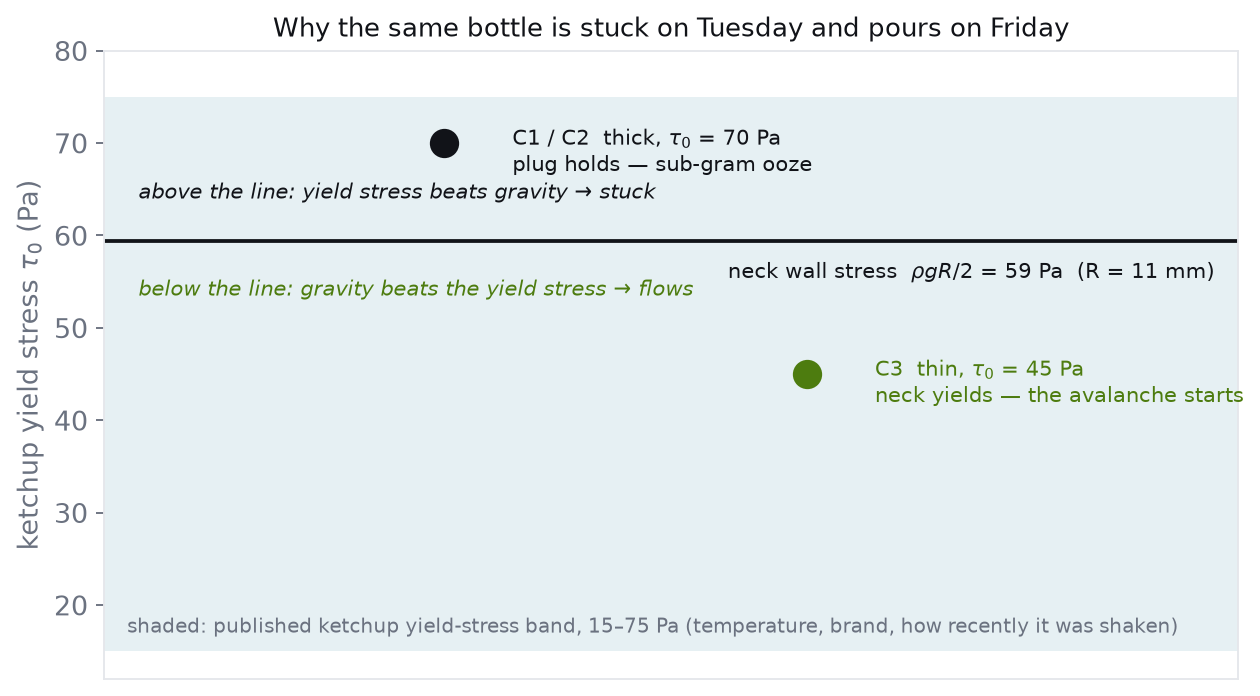
Model ketchup as a fluid whose viscosity is one number and the bottle empties in seconds — which is not the bottle anyone owns. The published rheology is Herschel-Bulkley: a yield stress τ0 below which the sauce holds its shape, then strongly shear-thinning flow above it (flow index n = 0.35, consistency k = 12 Pa·sⁿ). Published ketchup yield stresses span roughly 15–75 Pa depending on temperature, brand, and how recently the bottle was shaken. Meanwhile, the gravity shear stress that an inverted 22 mm bottle neck can put on the plug of sauce inside it is bounded by a closed-form hand number: ρgR/2 ≈ 59 Pa. That collision is the whole maddening experience in one chart — the bottle neck's stress lands inside the ketchup band, so the identical bottle genuinely is stuck one day and pourable the next, depending on the sauce's mood.
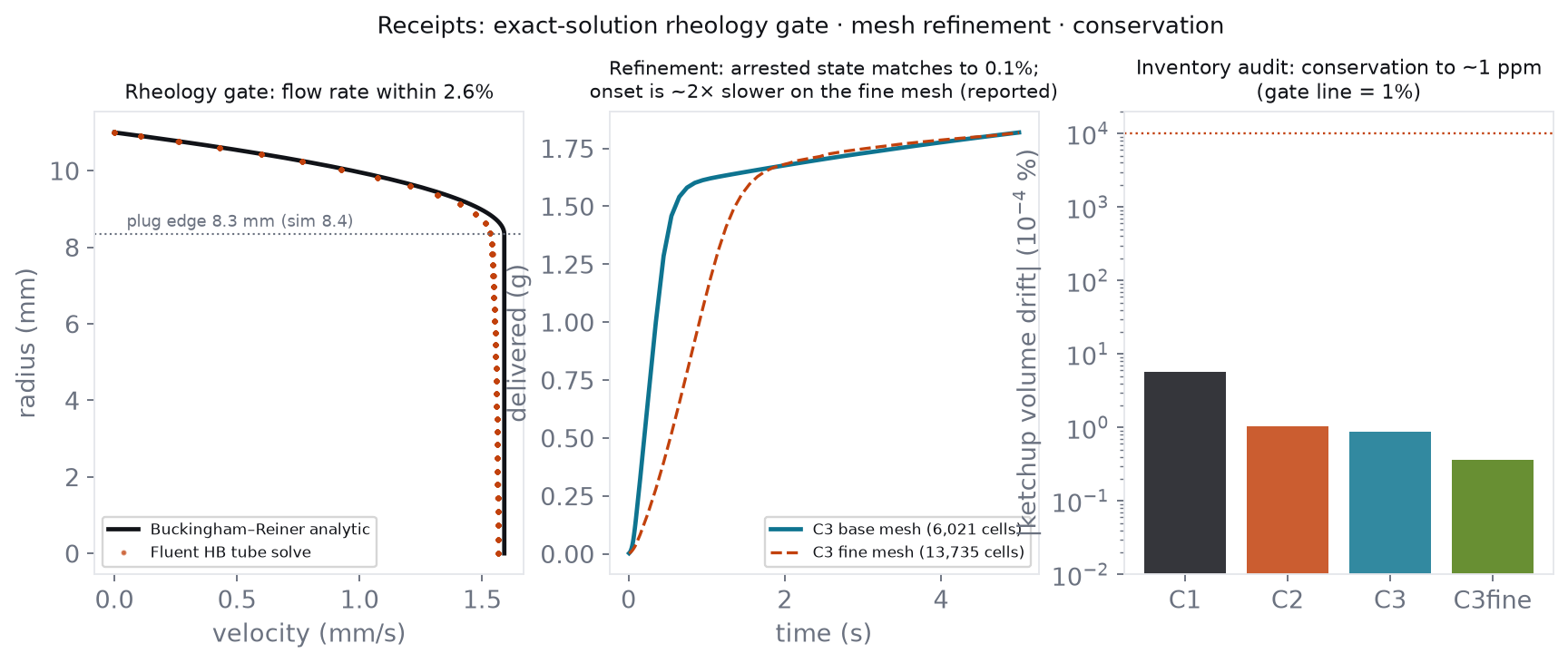
Before trusting a single bottle frame, we made the rheology prove itself against an exact answer. A gravity-driven tube flow of Bingham ketchup has a closed-form solution (the Buckingham-Reiner lineage), including the size of the solid plug riding in the middle of the pipe. Fluent's Herschel-Bulkley model, solved on the same 27-cells-across-the-radius mesh the bottle neck uses, matched the analytic flow rate to 2.6% and put the plug edge at 8.36 mm against the exact 8.34 mm — a plug boundary correct to a tenth of a cell. That same apparent-viscosity criterion is what classifies every yielded/unyielded cell rendered below, so the money shot is gated by the same check.
The whole slug lets go — on the clock
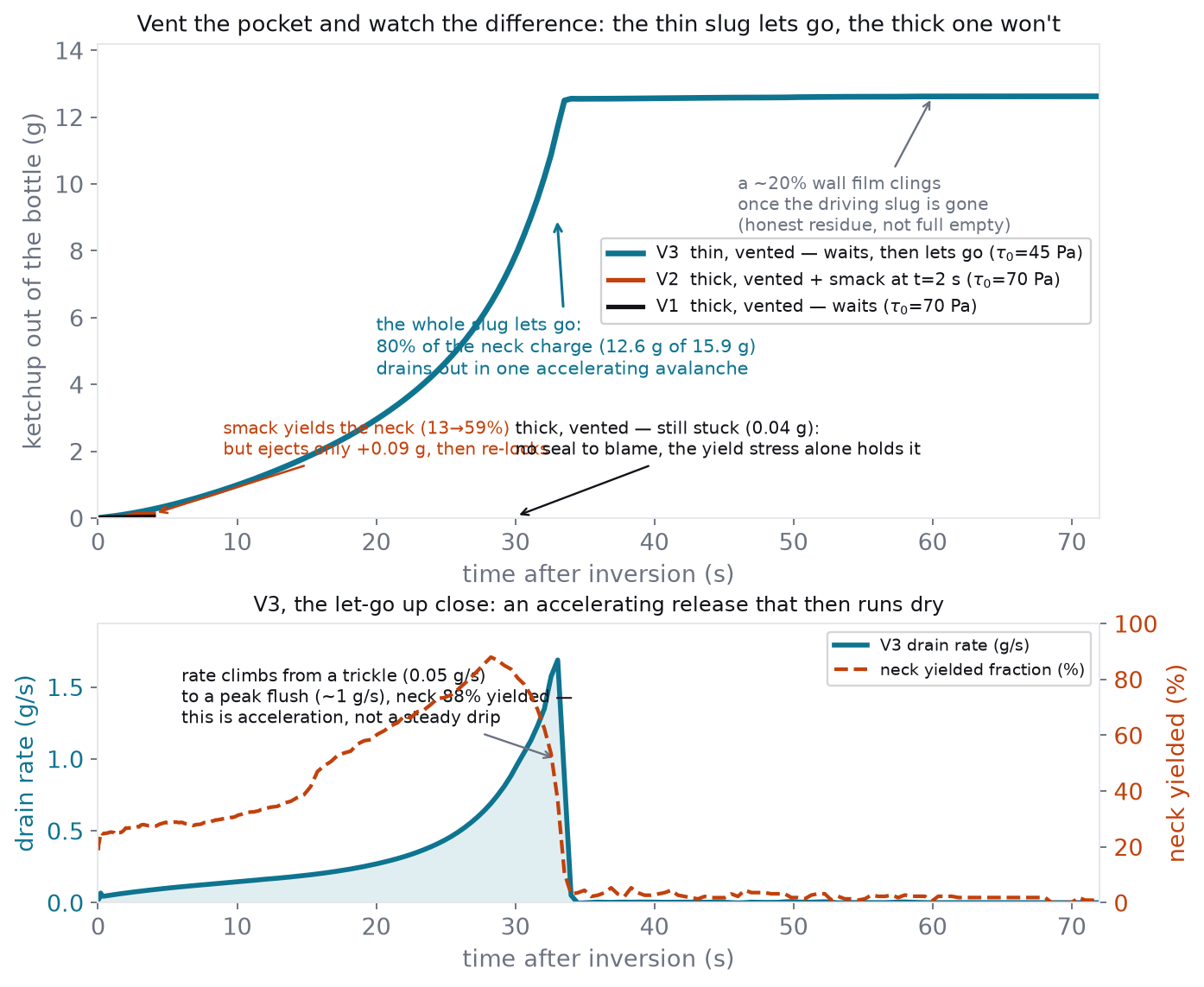
Here is the release the experiment is really about. In the vented thin bottle (τ0 = 45 Pa, just below the 59 Pa neck criterion), the yielded skin starts at the wall, eats inward and down the neck, and the plug narrows to a shrinking core island — and then it goes. Not a dollop: the whole neck slug avalanches out, 12.6 grams of the 15.9 gram charge (about 80%) delivered in one continuous accelerating release. The drain rate climbs from a trickle (~0.05 g/s) to a peak flush near 1 g/s as the yielded fraction of the neck reaches 88%; sauce runs through the mouth at up to 63 mm/s. This is acceleration, not a steady drip — exactly the runaway a yield-stress fluid does once its viscosity collapses. You can watch it happen in the solved apparent-viscosity field:
The release is not instantaneous and it is not total, and the model is honest about both. The bulk of the slug — roughly four fifths of it — lets go over about twenty-five seconds of accelerating flow, then the rate collapses: once the heavy column of sauce has left, what remains is a ~20% wall film with no weight above it to drive it through the neck, so it clings. "All at once," measured, means one continuous accelerating avalanche of the bulk at this rheology, not a bottle wiped clean. That distinction is the difference between marketing and a solve.
The smack works — for an instant — then the plug re-forms
The folklore case is the thick, stuck bottle given a palm smack — modeled as the whole bottle briefly accelerating at 4 g for 40 milliseconds, the deterministic body-force equivalent of one good hit (some glass bottles even emboss the sweet spot they want you to tap). The solver's answer is satisfying and then deflating in exactly the way the real experiment is. During the pulse the extra body force multiplies the neck stress well past 70 Pa, the yielded fraction of the neck jumps to about 59%, and sauce lurches toward the mouth. But it is a pulse: within a fraction of a second the acceleration is gone, the neck stress falls back below the yield stress, and the plug re-forms. The net delivery over the whole event is about +0.09 g above simply waiting — a dollop, squeezed out now instead of never. The mechanism is exactly the folk theory (you are not pushing ketchup out, you are momentarily breaking the plug's strength), and its limit is exactly the frustration: at folklore amplitude a smack cannot empty a bottle whose sauce is genuinely on the stuck side of the line. It can only get you the first bite.
Why a real bottle needs the glug — the airlock, solved
So why does venting matter at all, and why did we have to model it? Because a fully sealed inverted bottle strangles its own pour. We solved that case too: with the air pocket above the sauce sealed, every pour — thick, thin, or smacked — arrests itself at a first dollop, because the pocket pulls a vacuum that deepens with every gram delivered until it carries the weight of the column and the flow stops. It is the finger-over-the-straw effect, and it is real physics, measured here to fractions of a kPa.
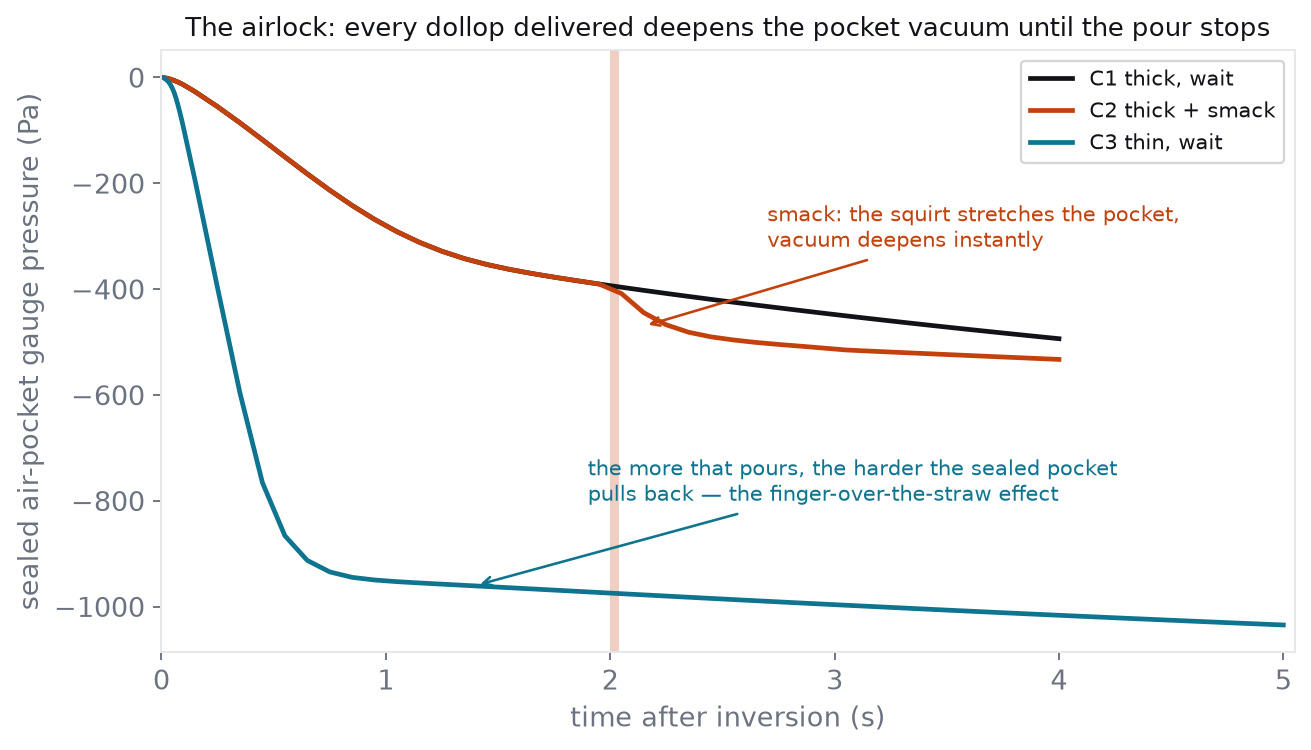
A real pour is a two-way street: as ketchup comes down, air glugs up — an asymmetric finger of air sneaks up one side of the neck, refills the pocket, releases the vacuum, and the pour continues. That glug is what turns the sealed bottle's single strangled dollop into the whole-slug release in the hero. Because the glug itself is an inherently three-dimensional, symmetry-breaking event that an axisymmetric solve cannot form, we model its effect the honest way: we vent the pocket (a pressure outlet at the base), which lets air return without pretending to resolve the 3D finger. That is the difference between the two acts of this study — the sealed solve proves the airlock is real, and the vented solve, with air allowed back in, shows what the yield stress does once the airlock is out of the way. The verdicts that survive both — thick holds, thin releases, a smack buys a dollop — are the study's claims.
The same physics that clogs real dispensers
Swap the ketchup for toothpaste, hand cream, hair gel, mayonnaise, printable battery paste, or grease in a purge line, and this is a working engineering problem: yield-stress products in necked containers, dosing nozzles, and pumped lines all live or die on exactly this margin — the stress your geometry can generate versus the yield stress the product shows up with that day. The regime chart is the design tool: it says how wide a neck, how strong a squeeze, or how hard a tap moves a product from "customer shakes the package and gives up" to "dispenses every time." And the airlock lesson generalizes just as directly — venting, closure design, and headspace decide whether the flow you started is allowed to continue, or whether your package strangles its own dose. A validated Herschel-Bulkley-in-VOF model turns all of that from focus-group complaints into numbers a packaging team can act on.
Dispensing a product that has a mind of its own? The workflow behind this study — Ansys Fluent solving free-surface yield-stress flow, gated on a closed-form rheology benchmark and refinement-checked before any claim shipped — is how Rand Simulation turns "customers say the package is annoying" into geometry and process numbers a team can act on. That's innovation through insight.