Why a Whip Cracks: The Tip Breaks the Sound Barrier
The crack of a bullwhip is not leather slapping leather. It is a miniature sonic boom: the tip of the whip briefly outruns sound itself, and the crack is the shock wave it sheds. High-speed photography settled that decades ago — real whip tips have been measured near Mach 2. What we wanted to see was the machine that does it. So we built a two-meter whip in Ansys LS-DYNA as a chain of 800 articulated links — each link a tiny truncated cone, thick at the handle, whisper-thin at the tip — cast it back over the hand, and threw it the way a person actually throws it: an arm stroke with a 160-degree wrist flick laid over it. The chain did what a whip does. It carried the twist of the handle down its length, amplified it link by link as the cord got lighter, and snapped the tip through a supersonic hairpin at 570–594 m/s — Mach 1.66–1.73 — before the hand had even finished moving. Then it did it again, a second crack as the loop ran out of whip over the top. No motor, no spring, no trick: an ordinary human throw, funneled into ever-lighter cord.
A whip is a chain that remembers your wrist
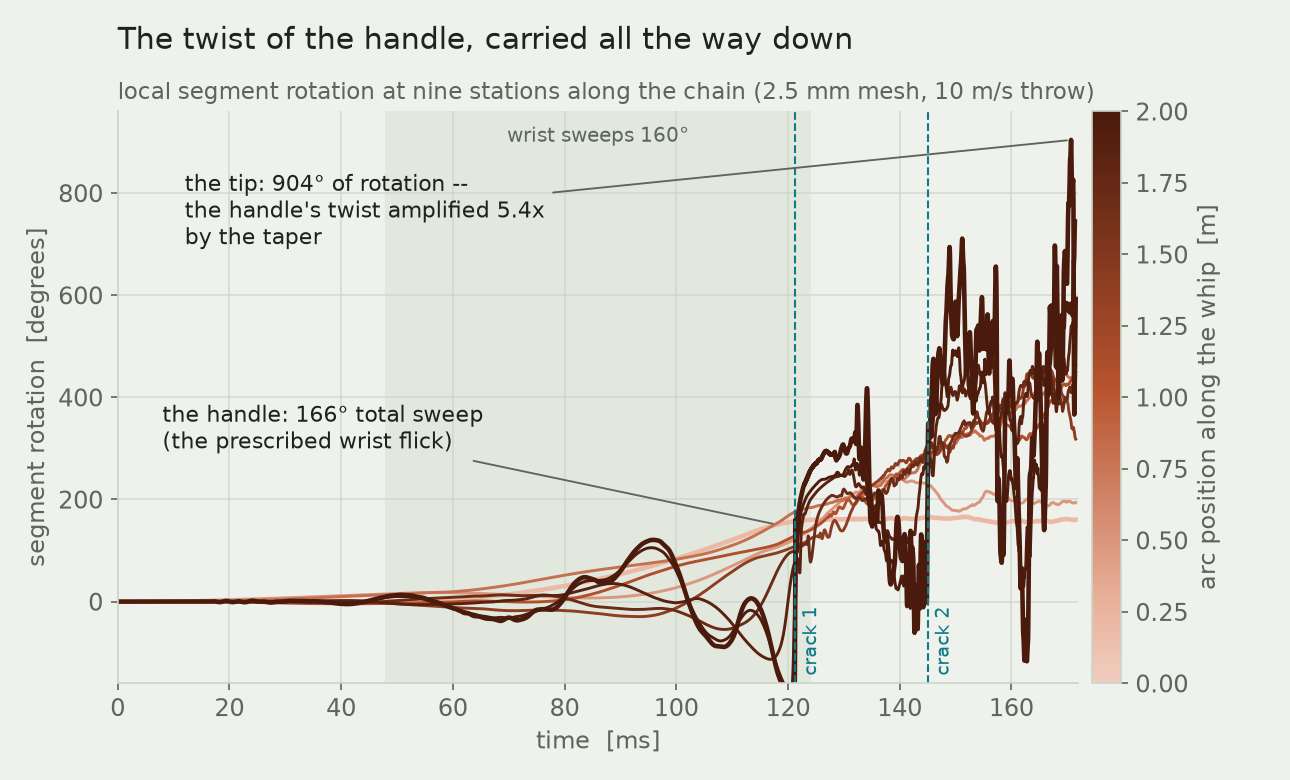
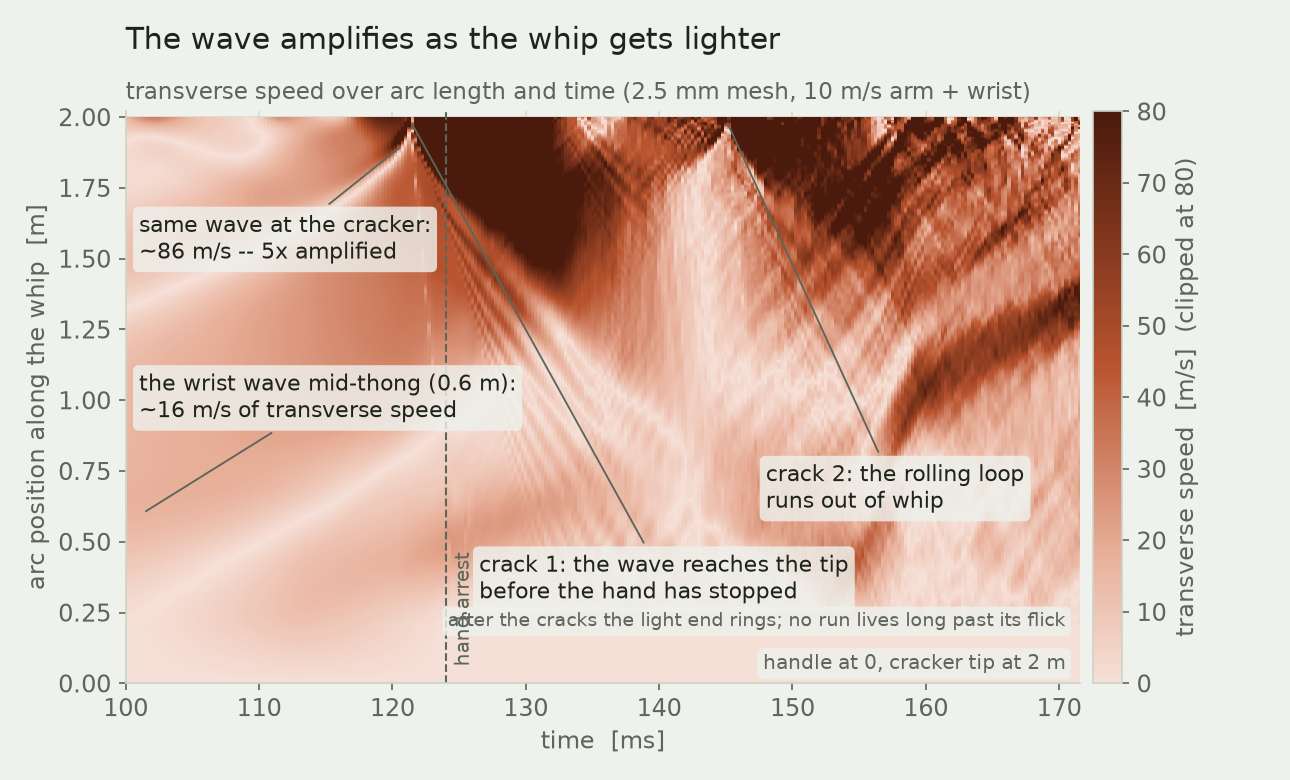
Lay a bullwhip out straight and it is nothing but a taper: a handle about 25 mm across, a long thong thinning to 8 mm, a thinner fall, and a final wisp of cord — the cracker — barely 2 mm across. Ours is 2.0 m long and weighs 319 grams, and along that length the mass per unit of length collapses by a factor of about 156. We modeled it literally as what it is: a chain of 800 short links (1,600 in the refinement run), each one a tiny truncated cone matching the local diameter, joined end to end at joints that carry tension and bending — so whatever the handle does, the chain has to relay it, link by link, all the way to the tip. That relay is the whole machine. A wave traveling toward the tip keeps its momentum and energy while the links carrying them get lighter and lighter, so the motion has to get faster and faster.
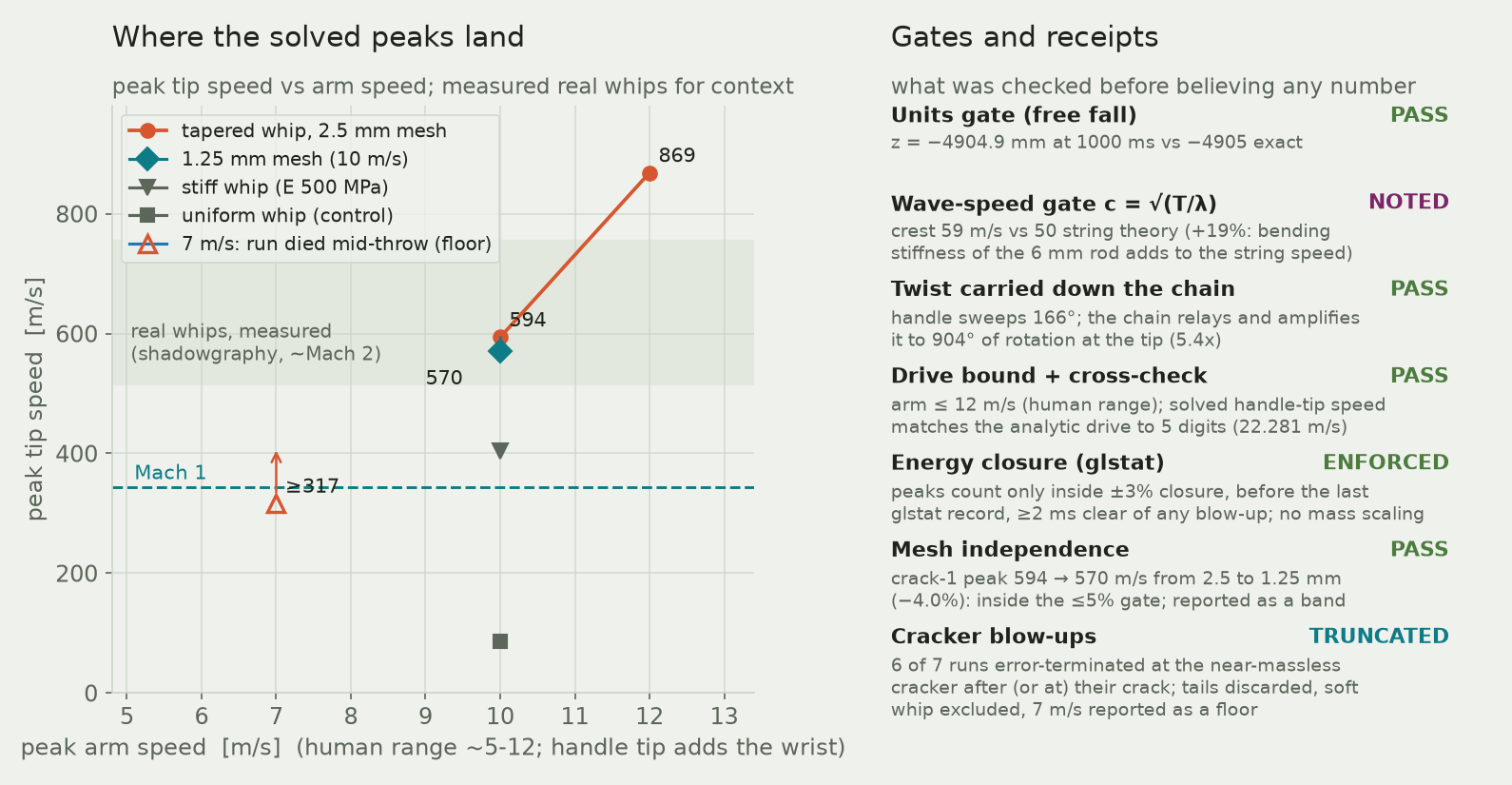
And this time we threw it with a wrist. Earlier drafts of this study dragged the handle forward in a straight line, and the whip answered with an honest but tame wave — the model never quite cracked. A real crack is thrown: the arm strokes and the wrist turns the handle over, and that rotation is what races down the chain. So the drive is now a composite of both, each held to human numbers: the grip accelerates through a 600 mm stroke to 10 m/s (inside the published 5–12 m/s range), while the handle sweeps 160 degrees up and over — peaking near 4,200 deg/s, between a hard wrist snap and a pitcher’s arm — and everything arrests together in 4 ms. The prescribed motion is exact: each handle node follows the analytic arm-plus-rotation path, and the solved handle-tip speed matches the hand calculation to five digits (22.281 m/s), a receipt that the drive we described is the drive the solver ran. The solve is planar, gravity is on, and there is deliberately no mass scaling: this study’s product is a speed, and mass scaling fabricates kinetic energy. Before trusting anything we gated the rig: a free-fall check landed within 0.003% of the exact answer, and a uniform cord under known tension carried a transverse pulse at 59 m/s against a 50 m/s string-theory value — a +19% gap that is the bending stiffness of a 6 mm rod adding to the string speed, exactly the kind of honest discrepancy you want a gate to surface rather than hide.
Flick, wave, snap — twice
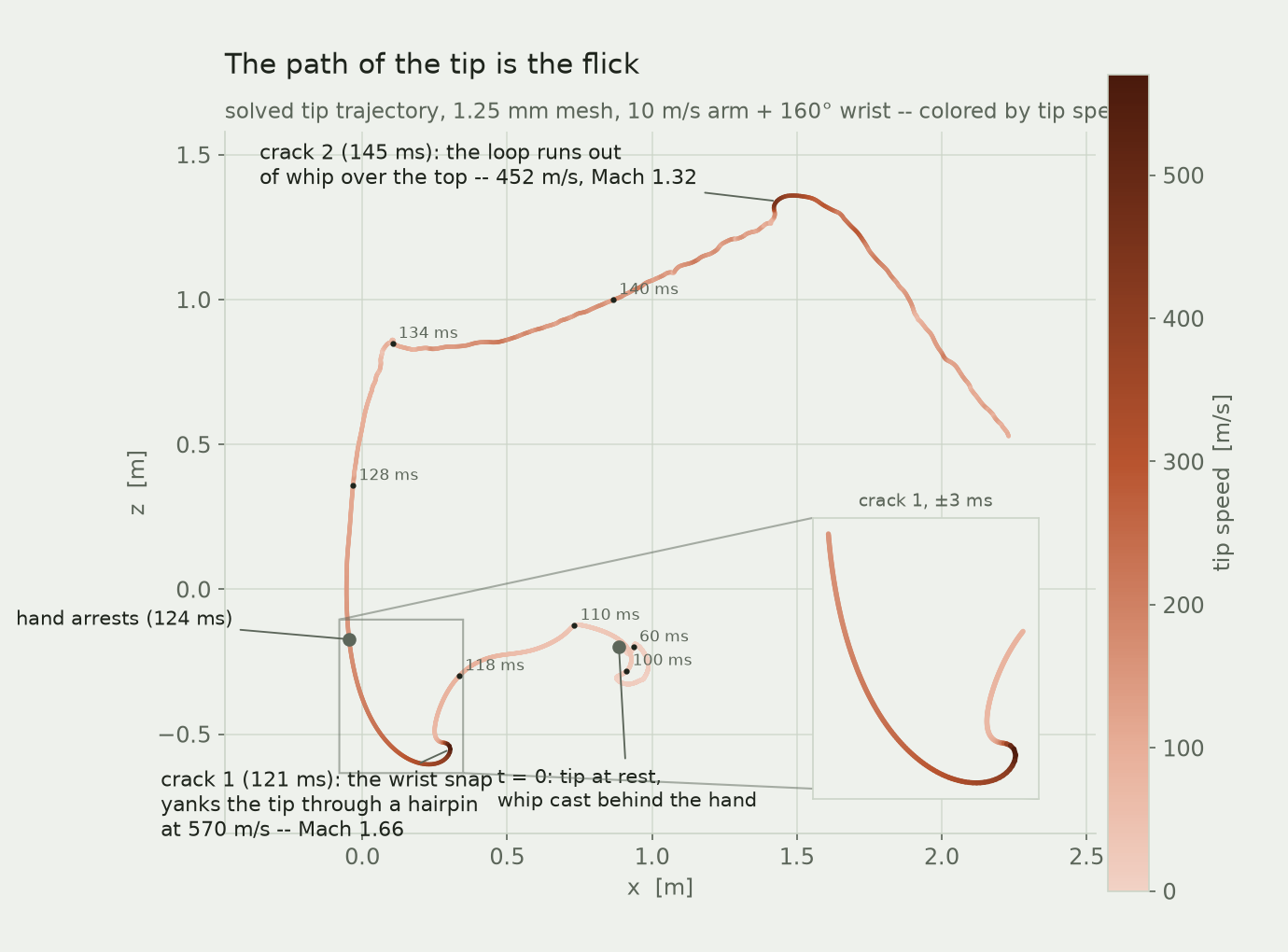
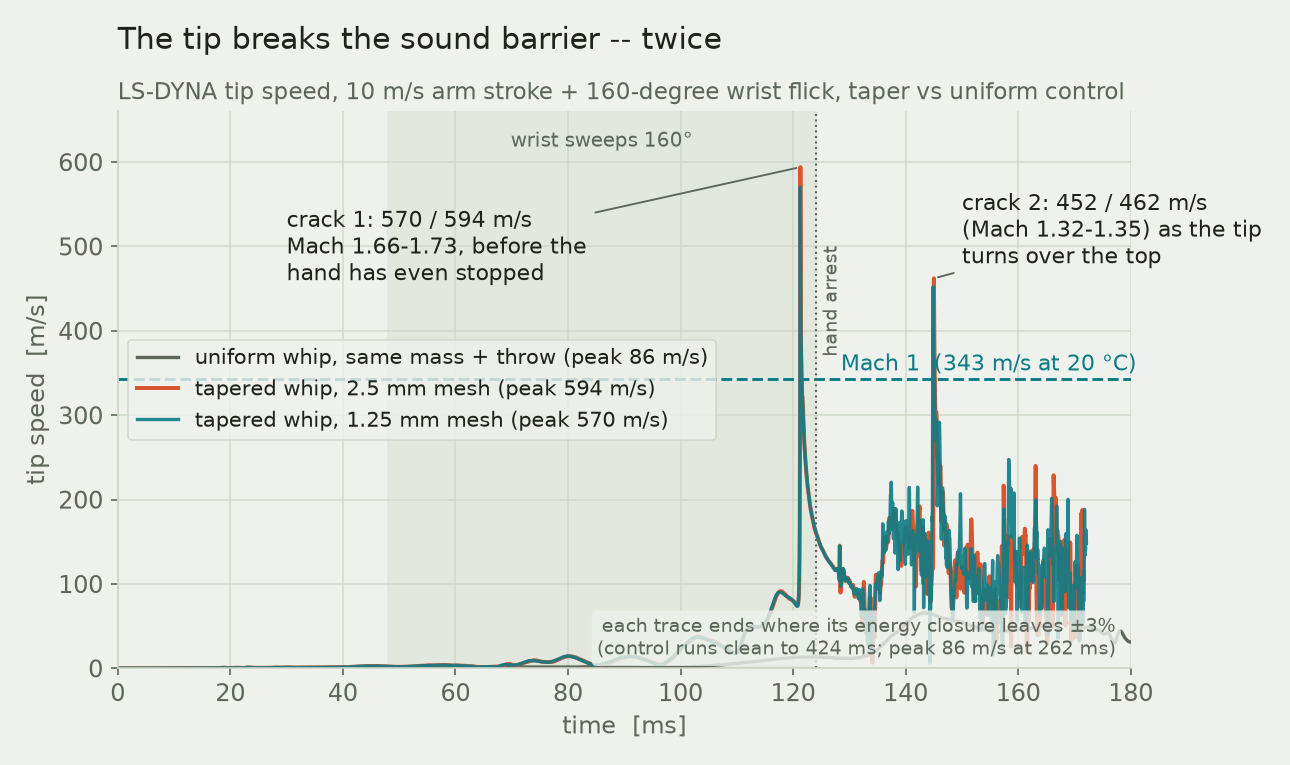
The tip’s own trajectory tells the story. For the first 100 ms it loiters near where the cast left it, drifting while the arm strokes and the whip straightens. Then the wrist wave arrives. The tip is hauled into a sweeping dive — most of a meter of drop in about ten milliseconds — and at 121.3 ms, three milliseconds before the hand has even stopped, it snaps through a hairpin at 594 m/s on the baseline chain and 570 m/s on the twice-refined one: Mach 1.66–1.73. That is the crack. But the throw is not done: the arrest dumps the arm’s remaining momentum into the fold, the whip unrolls skyward, and as the rolling loop runs out of whip over the top the tip turns over a second time — 452–462 m/s, Mach 1.32–1.35, at 145 ms. Two cracks from one throw, which any whip handler will tell you is exactly what a good overhead crack sounds like when it double-taps. Across both bursts the tip spends roughly half a millisecond supersonic — violent brevity being precisely why a crack sounds like a crack and not a whoosh.
The taper is the engine, and the control proves it
The claim “the wave accelerates because the whip gets lighter” deserves a control, not a narration. So we ran the same cast and the same arm-plus-wrist throw into a whip of the same length and the same 319 g total mass, but with the taper removed — a uniform 13.6 mm cord. Same hand, same stroke, same wrist, same arrest, same gravity, same material, same starting fold. Its tip manages 86 m/s, a factor of seven below the tapered whip’s crack 1, and it never comes near the barrier. Put the two side by side and the mechanism is not subtle: one of these is a momentum funnel, the other is a rope.
An honest band, and honest wreckage
First, the good news the gates delivered. Halving the link length from 2.5 mm to 1.25 mm moved the headline peak by 4.0% — 594 to 570 m/s — inside our planned ≤5% mesh-independence gate, with the crack timing agreeing to two hundredths of a millisecond. Earlier, gentler versions of this model failed that gate; the wrist-driven crack is better behaved because the flick is bigger and earlier, and the supersonic verdict no longer hangs on which mesh you believe. We still publish the band, not a favorite: Mach 1.66–1.73.
Now the wreckage, because a hairpin this violent has consequences. Six of the seven whip runs eventually blew up numerically at the near-massless cracker — LS-DYNA terminated them on out-of-range velocities — every one of them at or after its own crack. So every number in this post is energy-gated: a peak counts only while the run’s total-energy accounting closes to within 3%, only up to the last recorded energy audit, and never within 2 ms of a blow-up. That gate has teeth, and what it bites is instructive. The raw output of the baseline run “peaks” at 8,300 m/s at the instant of its death — numerical garbage, discarded. The 7 m/s throw died mid-crack, so its clean window ends at 317 m/s while the tip was still accelerating: we report it as a floor, not a peak. The softest whip (E = 100 MPa) never reached a clean crack at all and is excluded outright. What survives the gate behaves like a whip: throw harder, crack harder — 7, 10, and 12 m/s arms give ≥317, 594, and 869 m/s of tip speed. That last number is Mach 2.53 with clean energy closure, solved at one resolution only in a drag-free plane, so we read it as a trend, not a certified speed — but it brackets the shadowgraph measurements of real expert cracks near Mach 2 from above, exactly where a model with no air resistance should sit. Stiffness, meanwhile, tunes the machine: the stiff whip (E = 500 MPa, 405 m/s) resists the tight terminal turnover and undershoots the 300 MPa baseline. A real whip is not just tapered; it is tuned.
The same physics that snaps tow cables
A whip is the recreational version of a serious failure mode. Any long, tension-carrying line whose mass per length drops toward a free end — a snapped tow cable, a broken crane hoist line, a mooring rope parting under load — is a taper-amplifier waiting for a wave, which is why cable snap-back zones are marked on ship decks and why a parted line can be lethal at its free end. And the wrist lesson generalizes: what the free end does depends not just on how hard the anchored end moves, but on how it turns — the rotation you put into a line is relayed and amplified right along with the translation. Explicit transient dynamics is the tool that turns that intuition into numbers: launch the real wave into the real taper and read off what the free end does.
Have a long, light, fast-moving structure — or a cable that could part? The workflow behind this study — Ansys LS-DYNA solving the transient wave mechanics of a tapered line end to end, gated on closed-form checks and anchored to published measurement — is how Rand Simulation turns “everyone knows it cracks” into numbers an engineering team can act on. That’s innovation through insight.