Why a Karate Board Breaks and the Hand Doesn't
A pine board snaps under a strike that the bones in a hand shrug off, and the trick is not toughness — it is engineering. The board is set up to lose: it is loaded in bending, across its weakest direction, over a span wide enough to give the strike leverage. The hand is set up to win: it takes a short, blunt, compressive pulse on some of the strongest tissue in the body. We built that whole event in Ansys LS-DYNA — an effective-mass hand-form driven into a supported dry-pine board — and let the solve show the bending stress race to the tension face at midspan, reach the wood's weak cross-grain strength, and crack the board in half in the first half-millisecond.
The Board Is Set Up to Lose
Start with the wood. Pine is not one material but three, because grain matters: it is stiff and strong along the grain and weak across it. Along the fibers, the modulus of rupture runs about 60–90 MPa; pull the fibers apart sideways and dry pine gives way at only about 2–5 MPa — more than an order of magnitude weaker. Those bands come straight from the U.S. Forest Products Laboratory Wood Handbook.
Now set the board on two supports and hit it in the middle. That is a three-point bend: the top surface goes into compression, the bottom surface goes into tension, and the tension keeps climbing at midspan until something lets go. In the demo the board is laid so its grain runs parallel to the supports, which means the spanwise tension pulls across the fibers — straight into wood's weakest number. The board is not being broken so much as pried apart along a plane that was always going to fail first.
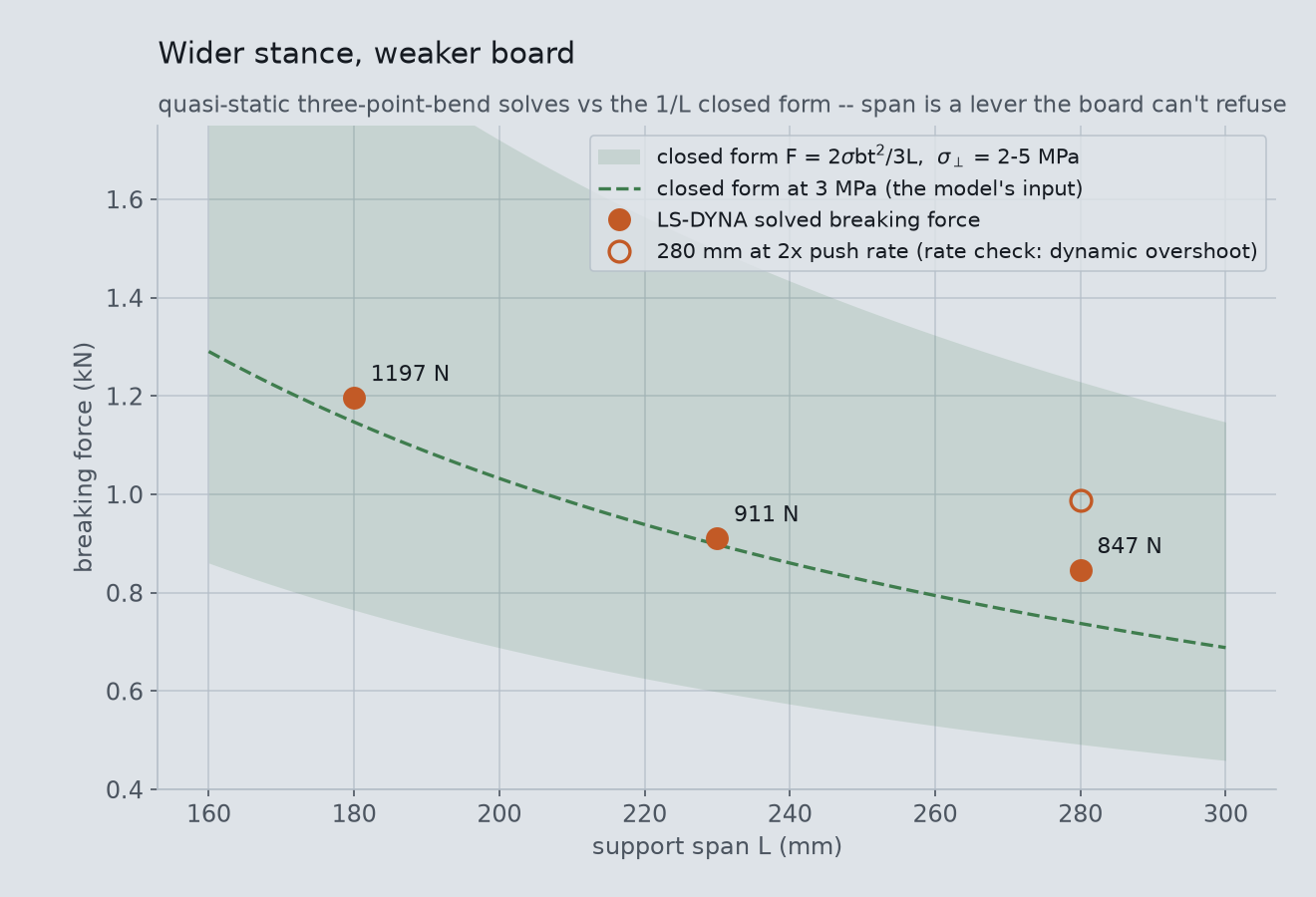
The closed form for the breaking force is F = 2σbt²/(3L): the strength σ, the board width b and thickness t, and the support span L. Put in the cross-grain strength (3 MPa, the middle of the band), a 286 mm width, a 19 mm thickness and a 230 mm span, and it predicts about 898 N — right in the 0.5–0.7 kN range that researchers have measured for real karate boards. Our first job was to make the solver reproduce that number before trusting anything harder.
Inside the model
The board is 300×286×19 mm of solid hexahedral elements — about 34,000 of them in the strike case, with eight elements stacked through the thickness so the bending-stress gradient and the crack growing down through the board are both resolved. It rests on two rigid rounded supports. The wood is an orthotropic-elastic material with direction-dependent stiffness, and it fails by element erosion when the tensile stress in the loaded direction reaches the strength for that direction — the cross-grain value for the aligned board, the along-grain value for the rotated control. The striker is a mass-tuned effective hand: a rigid, bone-representative core wrapped in a few millimeters of soft, tissue-representative padding, totaling 0.7 kg, the published effective mass of a hand strike. Everything runs in Ansys LS-DYNA R16, explicit, on eight cores, with mass scaling off and the standard erosion and timestep guards that keep a thin soft layer between two stiff parts from collapsing into a negative volume.
Across all eleven solves the energy budget balanced to within about 0.2%, so nothing below is riding on fabricated numerical energy. The refinement check — the same bend with twelve elements through the thickness instead of eight — moved the breaking force by under 3%.
Watching the Crack Start
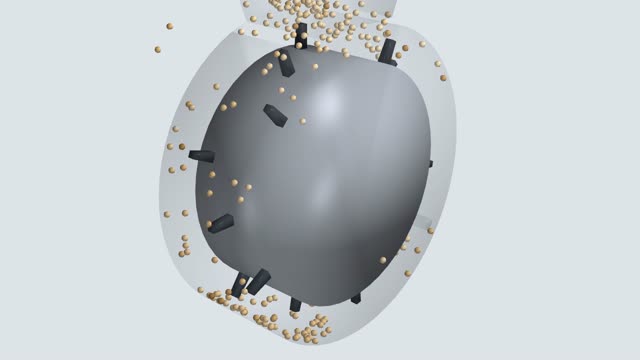
The hero above is the money physics. As the hand-form drives down, a bending wave travels out to the supports and the bottom fiber at midspan starts to stretch. The stress there climbs through the color ramp, and the instant it touches the ~3 MPa cross-grain band the first element erodes — a crack, opening at the exact center of the tension face and running up through the thickness along the grain line. From there it is over fast: the two halves lose their connection, pivot on the supports, and fall away. The board cracks after bending only about 1.6 mm at its center, and the whole fracture is finished within the first half-millisecond of contact.
That the crack starts dead-center on the bottom is not something we drew in; it is where the solve puts the peak tension, which is the whole point the demo is built to show. The failure is emergent from the loading, not scripted.
The Three Secrets, One at a Time
The person who submitted this study named the three levers that make the break work: support span, grain orientation, and strike speed. Each one is its own solved experiment.
Span. The wider the supports, the more leverage the strike has and the less force it takes to break the board — the closed form says breaking force should fall as 1/L. We solved the standard bend at three spans. The board broke at 1197 N over 180 mm, 911 N over 230 mm, and 847 N over 280 mm: a clean downward trend that tracks the closed form across the range.
Grain. This is the one that decides everything. We took the same board and the same 11 m/s strike and rotated the grain 90°, so the spanwise tension now pulls along the fibers instead of across them — into the 60–90 MPa strength instead of the 2–5 MPa strength. It did not break. The board flexed, pushed back on the supports with more than 21 kN, eroded a few hundred surface elements under the contact patch, and held — against 14,000-plus eroded elements and a clean break-through in the aligned case. The direction of the grain is worth roughly a factor of twenty in strength, and it is the difference between a snapped board and a bruised hand.
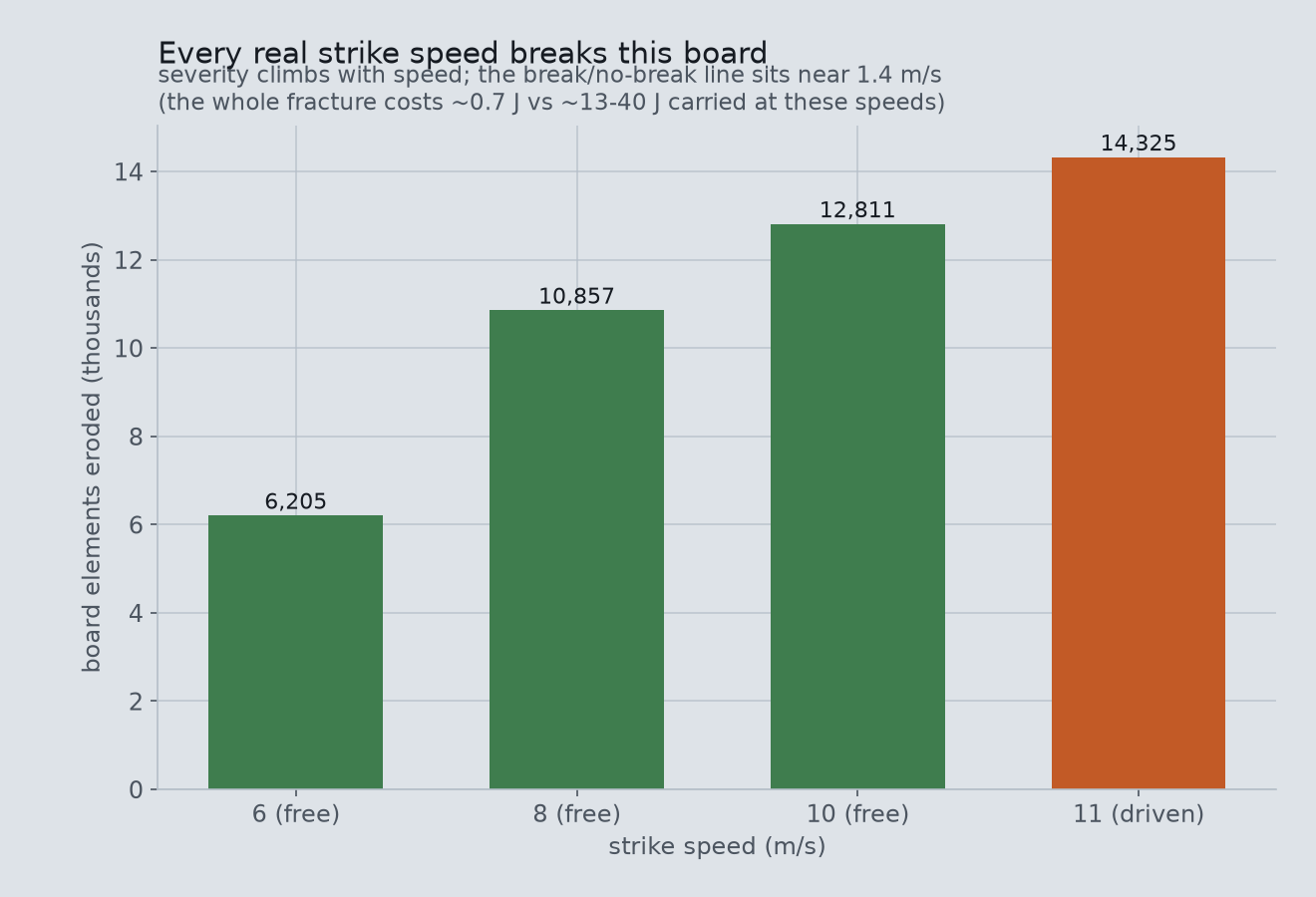
Speed. How fast do you have to be? Less than you would think. The energy it takes to fracture this board is only about 0.74 J, while a 0.7 kg hand at even 6 m/s already carries roughly 13 J. We ran a speed ladder — free-flight strikes at 6, 8 and 10 m/s plus the 11 m/s driven case — and every one of them broke the board; the energy threshold works out near 1.5 m/s, far below any committed strike. Speed is not really a break/no-break switch at realistic values; it sets how violently the board comes apart.
Follow-Through or Pull-Back?
Coaches tell students to aim past the board — to follow through rather than pull the strike. We tested it directly: two strikes at the same 11 m/s peak speed, one that holds its speed through the board plane (follow-through) and one that is already decelerating to a stop just past the surface (pull-back). This is not another rung of the speed ladder; the peak speed is identical, and only the velocity profile after contact differs.
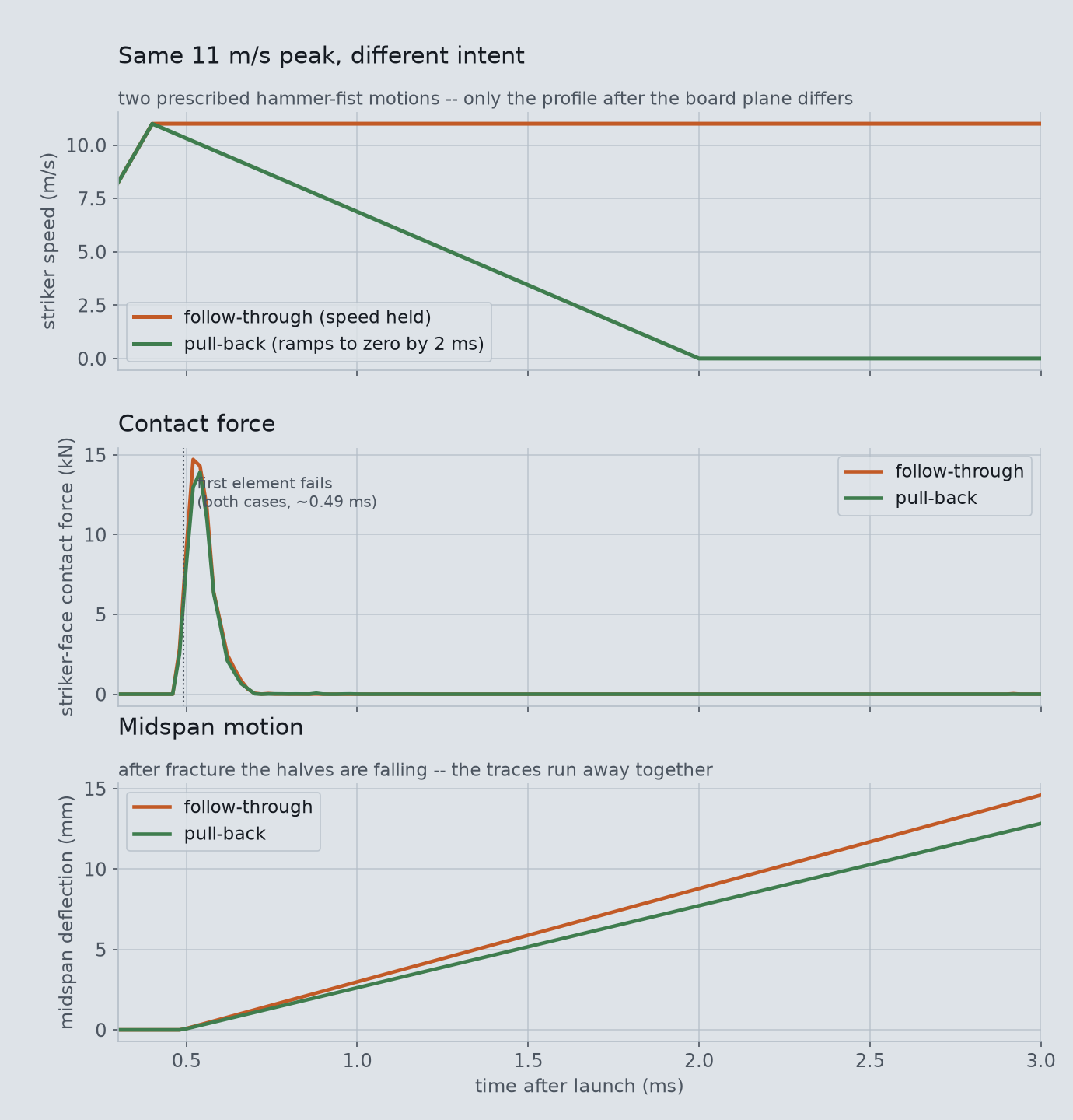
The honest result is that it made no difference here: the board was already cracked through by about half a millisecond, and the pull-back strike does not start slowing until roughly 2 ms — four times too late. Follow-through is real advice, but it earns its keep on marginal strikes, thicker boards, or stacks, where the extra travel keeps delivering energy while the board is still resisting. A committed 11 m/s strike on a single board carries about fifty times the energy the fracture needs; it is over before the arm could ever pull back. We report what the model produced rather than forcing it to match the folklore.
What the Hand Actually Takes
So why does the hand come through it? Because the board can only ever hand back the load it takes to break — and it breaks in tension, at a few megapascals, while the hand is loaded in compression against bone that is far stronger. The contact record on the striker face tells the story: a single spike peaking at about 14.7 kN and only about 60 microseconds wide at half its height.
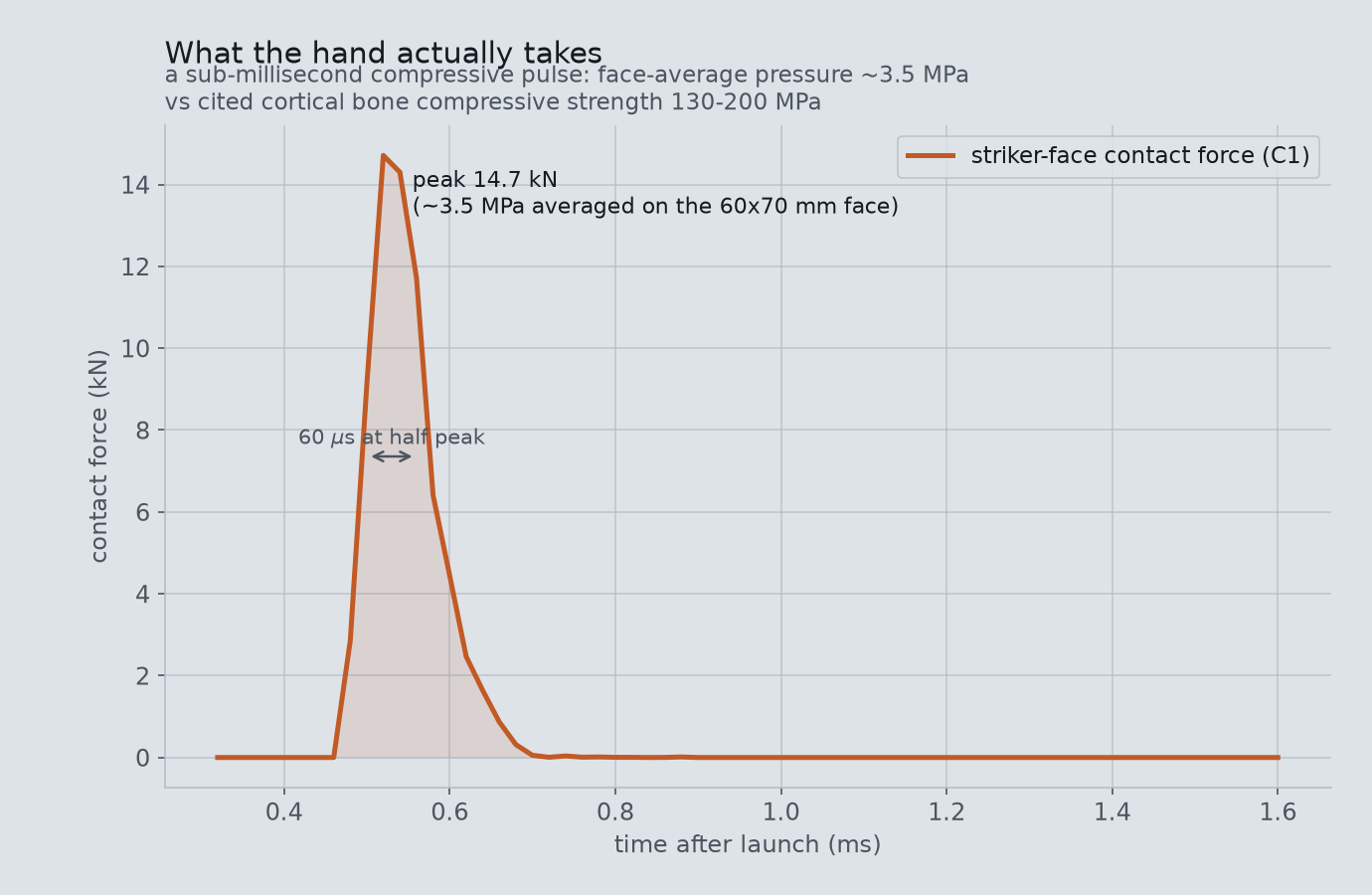
Fourteen kilonewtons sounds like a lot, and locally, right at the contact, the pressure is higher than the face average. But even the face-averaged ~3.5 MPa is roughly two orders of magnitude below what cortical bone carries in compression, and the pulse is gone in under a millisecond. The asymmetry the demo lives on is exactly this: the board fails in its weakest mode — tension across the grain — at a load the hand absorbs in its strongest mode. Set the board up to be pried apart and it obliges; hit it with a blunt, compressive, well-supported hand and the bones never come close to their limit.
Have a part whose survival hinges on which direction the load actually pulls — a composite laid up along the wrong axis, a bracket loaded across its weak plane, a brittle housing that cracks in service but never on the bench? The same Ansys LS-DYNA workflow behind these eleven solves — geometry, mesh, solve, and honest post-processing — is how Rand Simulation turns “everyone knows it breaks there” into a stress you can point to and design against. That's innovation through insight.