How Long Until a Wood Chipper Wears Its Teeth Off?
A drum chipper spins a toothed steel barrel at nearly 1,700 RPM and feeds it a river of hardwood. The teeth take a beating you can hear from across the yard — but nobody actually watches them die, because it happens over hundreds of hours. We rebuilt a generic 36-inch drum chipper in Ansys Rocky, poured a continuous stream of wood chips through it, and measured the one thing that actually wears carbide away: the sliding work the chips grind into each tooth. Then we asked the question the operator really wants answered — which tooth shape lasts longest?
What actually wears a tooth: sliding work, not impact
Carbide is far too hard to dent when a wood chip hits it. What kills a tooth is abrasion — millions of chips sliding across the cutting face, each one dragging a little metal away, like sandpaper run for weeks. The physics that governs this is Archard’s wear law in its energy form: the volume of material removed is proportional to the frictional (tangential) work done at the surface,
V̇wear = (K / H) · Ẇshear
where H is the hardness of the carbide (~14 GPa for WC-Co) and K is a dimensionless abrasive-wear coefficient. So the quantity that decides tooth life is Ẇshear, the rate of sliding work at the teeth — and that is exactly what a discrete-element (DEM) simulation can measure directly. Rocky tracks every chip–tooth contact and reports its tangential force; combined with the sliding speed of the chip relative to the moving tooth face, that gives the frictional power dissipated at the teeth, contact by contact, frame by frame.
Building the chipper in Ansys Rocky
We modeled the machine from the stated specification: a 30-inch (0.762 m) solid-steel drum carrying fifteen carbide teeth that reach a 36-inch (0.914 m) tip-to-tip outside diameter — a 3-inch radial reach — each tooth 1 inch wide, inside a closed shroud with a top feed throat and an anvil bar. It is a generic, self-authored “drum-chipper-style” machine, not any manufacturer’s design. Hardwood scraps (15–25 mm) are modeled as 20 mm equal-volume spheres at 700 kg/m³, fed continuously through the throat while the drum turns at 1,600 RPM. That spin puts the tooth tips through the air at 76.6 m/s — about 172 mph (the closed-form πDN/60 the solve reproduces exactly), which is the highest tip speed we have run in Rocky to date and the reason the model needed a stiff, tunneling-proof contact before it would conserve chips honestly.
The experiment is deliberately clean: three tooth shapes — a flat chisel, a rounded nose, and a forward-rake hook — each solved on its own drum under the identical feed and RPM, so the only thing that changes between runs is the tooth profile. That makes the ranking between them robust even though the absolute numbers carry the wide uncertainty of the wear coefficient. Each case ran on Ansys Rocky 2026 R1, GPU-accelerated, over a 150 ms window (about four drum revolutions) sampled at 300 frames — fine enough to resolve the fleeting sub-millisecond tooth contacts that carry the wear.
The rounded nose wears slowest; the hook grinds itself away
Summing the rigorous sliding power over every tooth contact and averaging over the steady part of the run gives the wear currency directly. The three shapes are not close:
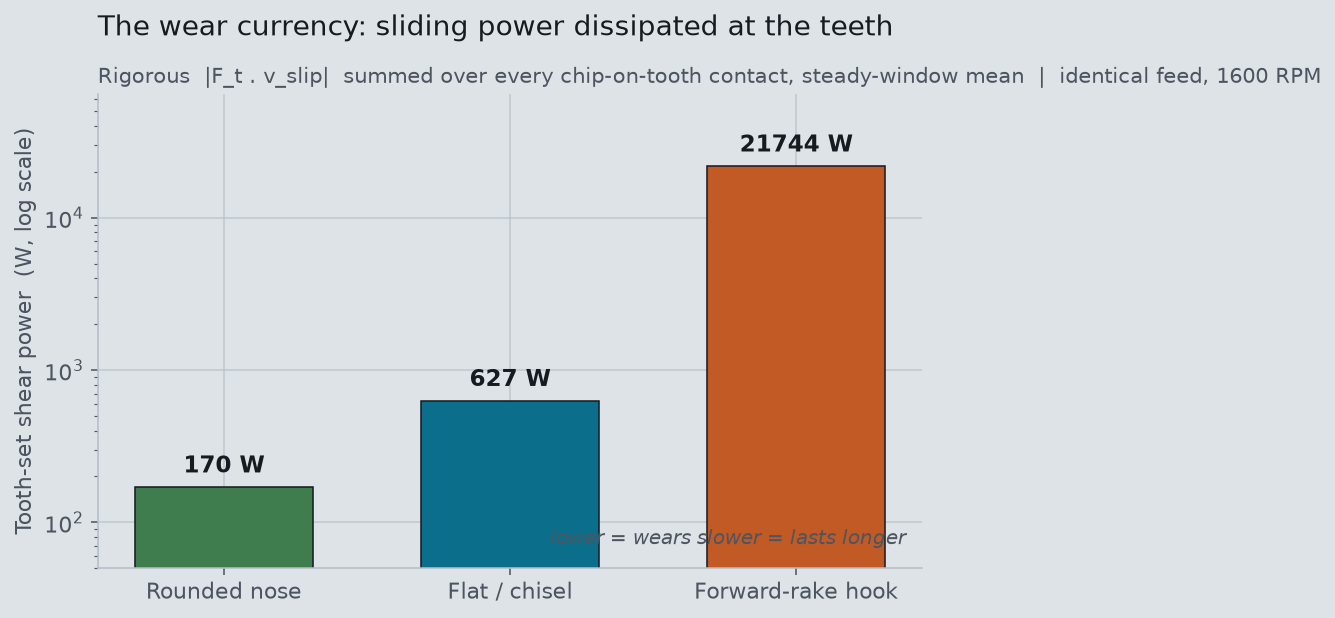
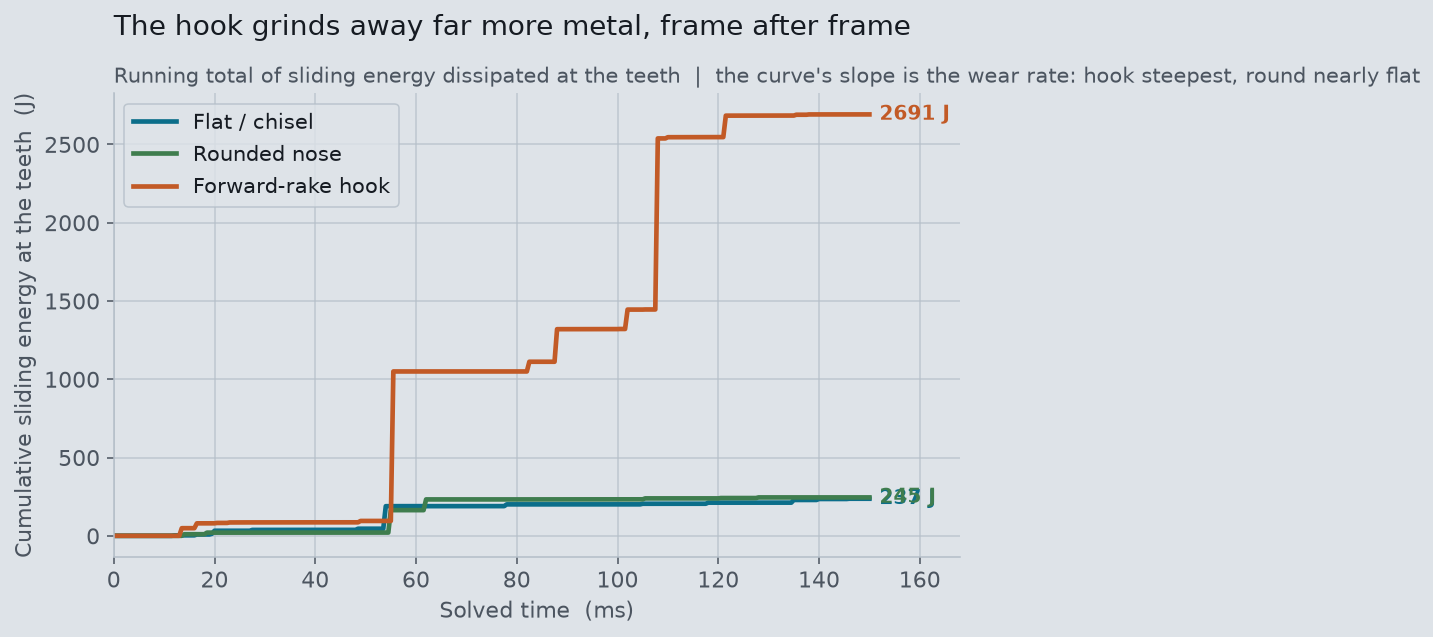
The forward-rake hook leans its edge into the cut, so it strikes chips harder and drags them further — concentrated attack means concentrated wear. Watching the running total of sliding energy makes the divergence unmistakable: the hook’s curve climbs relentlessly while the flat and rounded teeth barely accumulate.
So — how many hours?
Turning sliding power into a service life needs the Archard coefficient, and this is where the honesty lives. The abrasive-wear coefficient K for hard carbide against wood-and-grit spans decades in the published literature — from ~10-4 for a clean feed to ~10-2 once realistic dirt and grit are entrained (grit is the notorious real-world tooth-killer). That two-decade spread, not the simulation, is what makes the answer a band rather than a single number. Defining “worn off” as a 6 mm recession of the cutting tip and feeding the solved sliding power through V̇ = (K/H)Ẇshear gives:
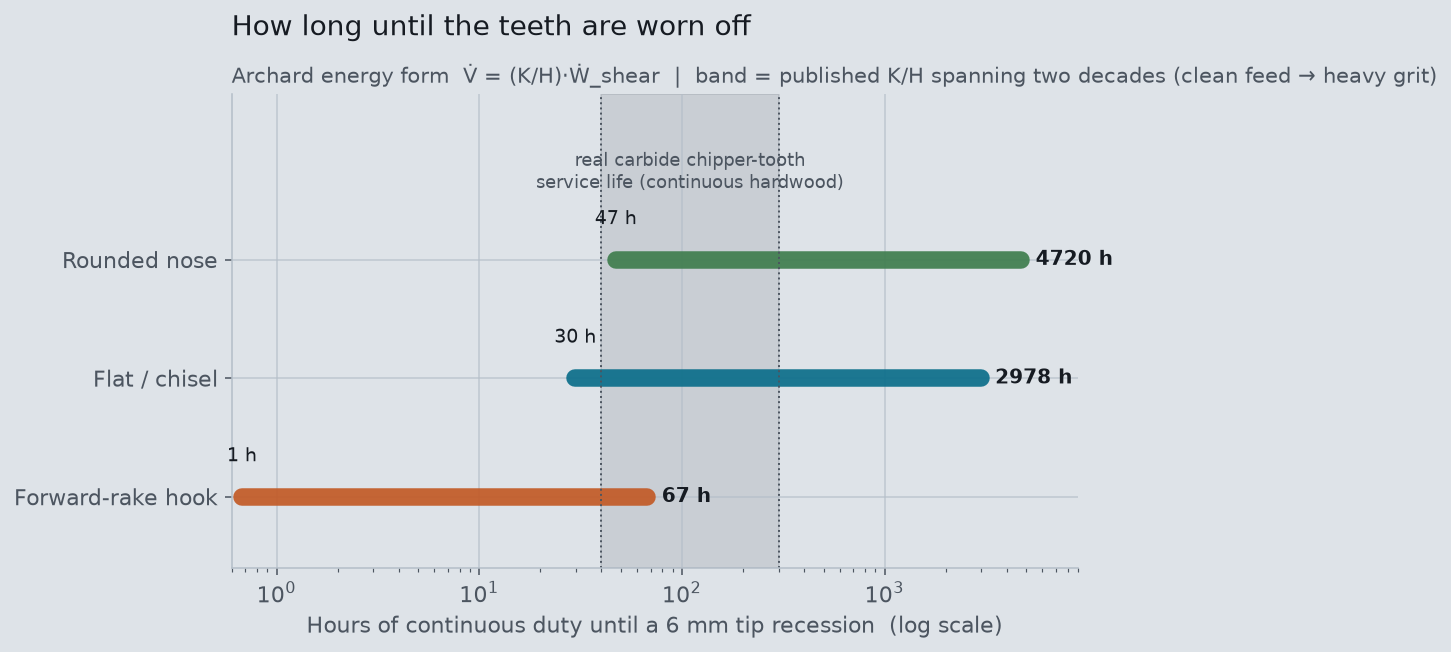
The rounded nose lands at roughly 50–4,700 hours, the flat chisel a little less, and the hook a punishing 1–70 hours. What matters is not the exact figure — it can’t be, given K — but that the model, anchored only to published physics, lands squarely on the same order as real carbide tooth service intervals, and that the shape ranking is unambiguous.
The catch: the slowest-wearing tooth loads its tip hardest
“Best shape” is not quite “lowest wear,” because a tooth also has to survive the hit. Rocky reports the peak contact force on each tooth as well, and here the rounded nose shows its one weakness: its slender tip concentrates the strike, carrying the highest peak per-contact load of the three (~21 kN at the 95th percentile, versus ~12 kN for the flat and ~10 kN for the hook). A real tooth-design decision therefore lives on two axes — grind slowly and keep the peak stress under what a carbide edge tolerates.
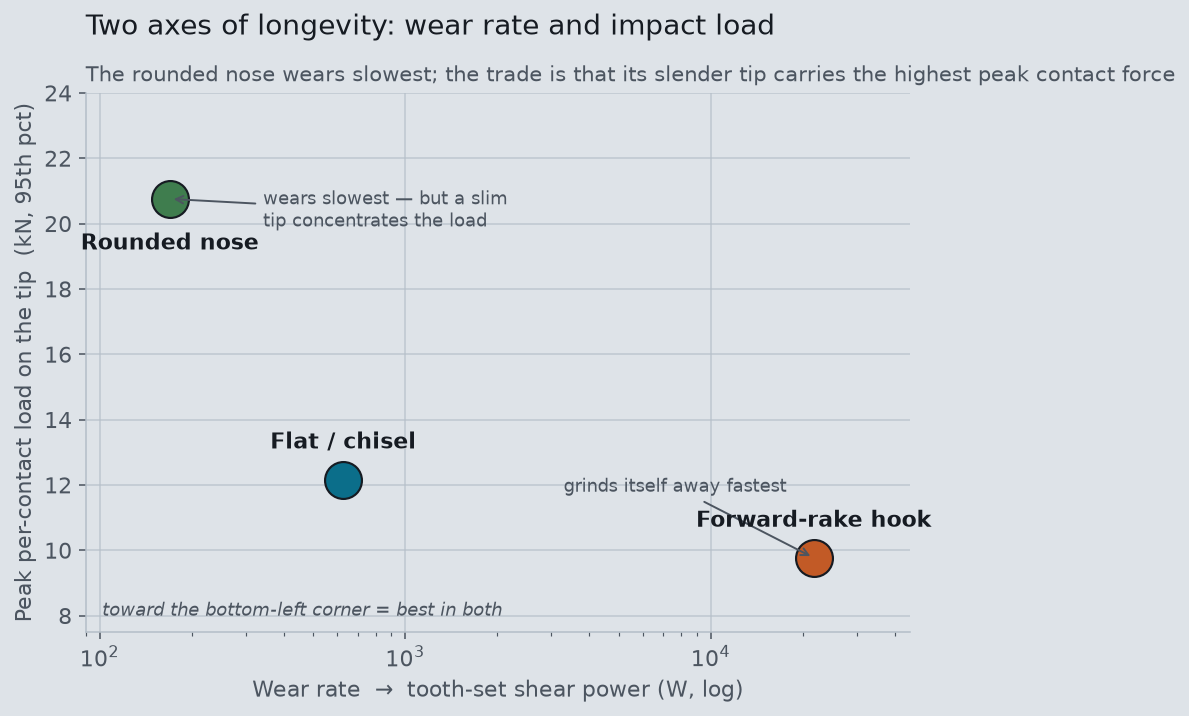
Within the band this study can defend, the rounded nose is the longevity winner and the flat chisel the safe all-rounder, while the aggressive hook — the one that looks like it should chew forever — is the first to wear out. Faster drums only sharpen the verdict: because sliding work climbs steeply with tip speed, running the same machine at 1,800 instead of 1,400 RPM (86 vs 67 m/s at the tips) raises the wear rate and shortens every one of these lives, in the same ranking — a tip-speed scaling argument on the solved 1,600 RPM baseline, not a pair of re-solved cases here.
Designing a tool, a liner, or a wear part that lives or dies by abrasion — chipper teeth, crusher jaws, mill liners, chute plates, pump impellers? The same workflow that ranked these tooth shapes — a discrete-element solve that measures the sliding work at every contact, fed through a wear law with an honestly-banded coefficient — is how you compare designs before you machine and field-test them for months. Ansys Rocky turns “this one feels tougher” into a wear number you can rank. That is innovation through insight.