The Domino Effect, Simulated: One Nudge, a Whole Chain Falls
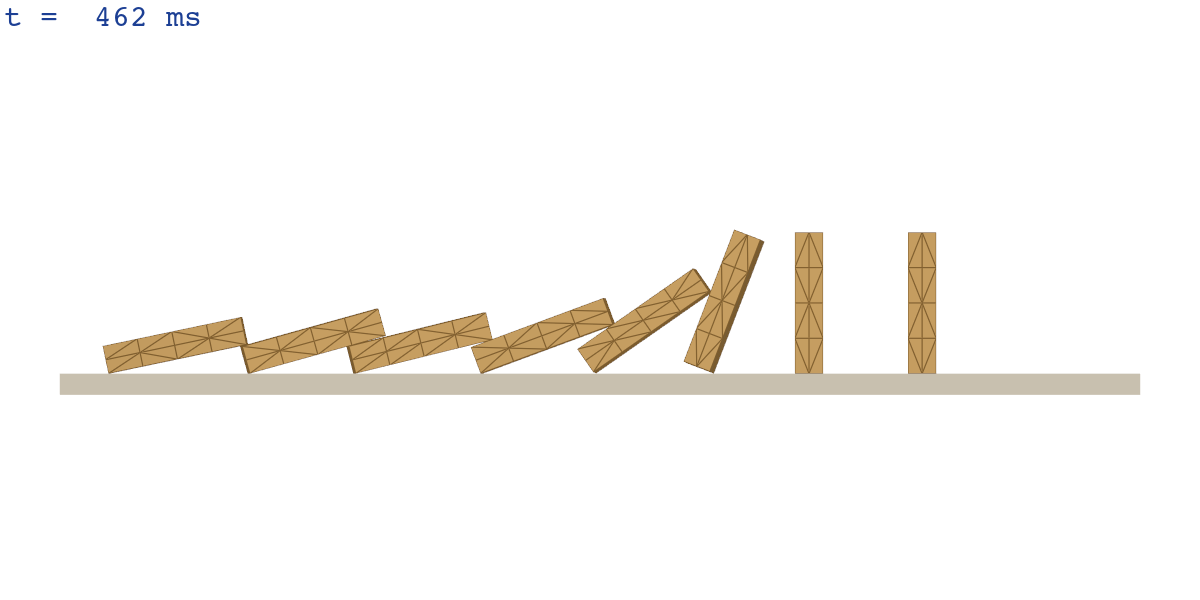
Stand a row of dominoes on end, tip the first one past its balance point, and step back. The fall runs straight down the line all by itself — each domino spending the tiny bit of energy it took to topple the next. It is the most literal version of a phrase we all use, the “domino effect,” and it is the engine behind every record-breaking domino-art video on the internet. We rebuilt it as a real explicit-dynamics contact simulation in LS-DYNA — gravity, friction, deformable wood, the works — and watched the toppling wave march through all eight dominoes from a single starting tip.
The physics: a chain of tiny energy loans
A domino standing on end is a little battery. Lifting its center of mass to balance on that thin edge cost a small amount of work, and that energy sits there, stored, held just shy of falling. It is metastable — stable against small bumps, but only just. Tip it past the point where its center of gravity crosses over the bottom edge — for our slender 1:2:5 domino that happens at only about 11 degrees — and there is no coming back. Gravity converts the stored energy into rotation, and the domino comes down with noticeably more kinetic energy than the gentle nudge it took to start it.
That surplus is the whole trick. The falling domino spends part of its energy knocking the next one past its balance point — a small loan — and that domino then releases its own larger store. Every domino only has to deliver the little push that starts its neighbor; the chain pays for itself. So a single tip at one end can run an arbitrarily long line, and — famously — a domino can even topple a neighbor about one-and-a-half times taller than itself, because the energy released grows with size. That is how a flick the size of a fingertip ends with hundreds of thousands of dominoes on the floor.
The first domino doesn't push the last one over. It pushes the second — and lends it just enough to do the rest.
Inside the model
Eight dominoes, real contact
The chain is eight identical wooden dominoes — 8 × 16 × 40 mm blocks, the classic slender 1:2:5 proportion that topples cleanly instead of just sliding — standing on a rigid floor, spaced about 0.6 of their height apart (the same spacing domino builders use so a falling tile reliably catches the next). Each domino is a deformable *MAT_ELASTIC wood (E ≈ 4 GPa, density ≈ 500 kg/m³), meshed as solid hexes, so the strikes are resolved as genuine surface-to-surface contact rather than scripted motion. Gravity comes in through *LOAD_BODY_Z; an *CONTACT_AUTOMATIC_SINGLE_SURFACE with a friction coefficient of 0.4 ties the whole scene together and — crucially — makes the dominoes topple rather than skate. Units throughout: mm, metric ton, s.
The trigger is the most honest one available. We don't push anything and we don't prescribe any velocity. Domino zero simply starts life pre-leaned 22 degrees — already past its 11-degree balance angle, on the wrong side of the tipping point — so the instant the clock starts, gravity alone takes it over. Everything after that is the simulation discovering, contact by contact, that the wave propagates.
One lesson worth keeping
The first version of this model stalled — the lead domino tipped in slow motion and the chain froze after one tile. The culprit was a classic explicit-dynamics shortcut gone wrong: aggressive mass scaling (artificially inflating the timestep to finish faster) had quietly made the little wooden dominoes about thirty times heavier than they should be. Over-massed and soft, they sagged under their own weight instead of tipping — the energy went into bending, not motion, and the strike never landed. The fix was to drop the mass scaling entirely and use a slightly softer-but-still-rigid wood so the natural timestep stayed affordable on its own. A reminder that the speed trick you reach for can change the very physics you're trying to watch.
The result
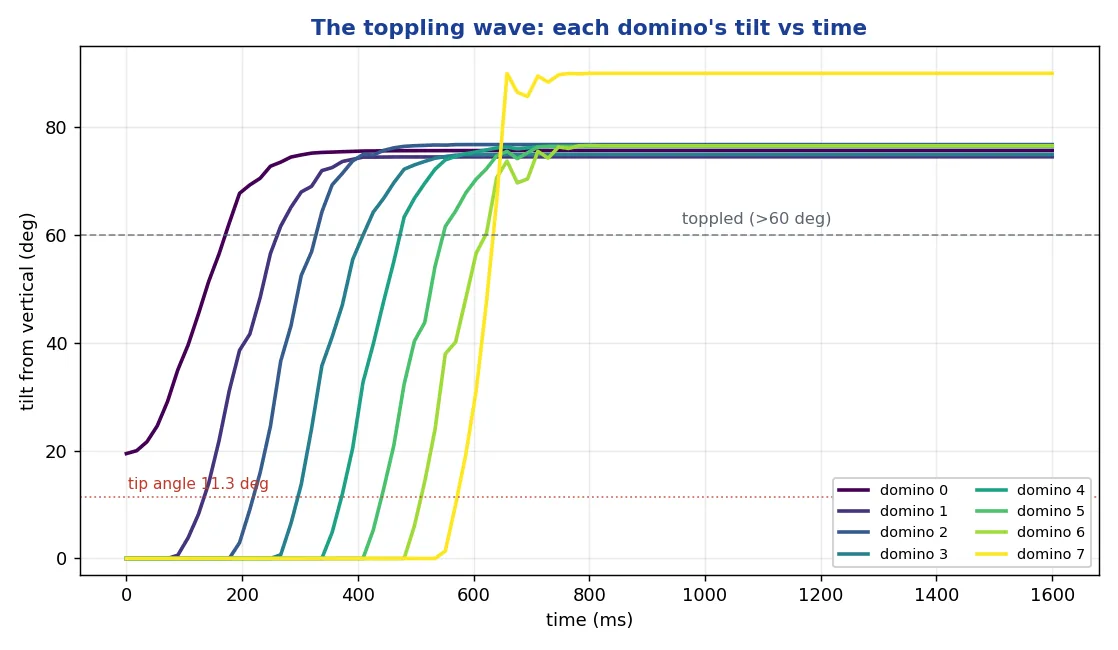
The real-world connection
If a row of falling dominoes feels like internet catnip, that's because it is. Lily Hevesh — “Hevesh5,” one of the few full-time professional domino artists in the world — has built her career on exactly this physics: elaborate installations of hundreds of thousands of dominoes that come down off a single first tap, filmed for her millions of subscribers and for movies and commercials. The Guinness category for the most dominoes toppled in a single chain runs well past the million mark. And the same self-sustaining-chain idea is the heart of every Rube Goldberg machine, where one tipped domino is just the first link in a gloriously over-engineered sequence.
Want the rabbit hole? Hevesh's channel is the obvious starting point — her domino chain reactions are the gold standard — and the physics of why a domino can topple a bigger one was first analyzed by Lorne Whitehead (Am. J. Phys. 51(2), 182, 1983, “Domino ‘chain reaction’”) and later popularized in a much-shared domino amplifier demonstration.
The punchline is pure fun, but the engineering habit underneath is the one we keep coming back to at Rand Simulation: watch what your numerical shortcuts do to the physics. The chain didn't fall because we told it to — it fell because, once the masses and the contact were honest, it had no choice.
Does a design you're responsible for depend on a chain of contact events — parts that have to strike, trip, or topple the next one in line, every single time? LS-DYNA resolving eight deformable-wood dominoes with genuine surface-to-surface contact, letting gravity alone start the cascade, and clocking the 66 ms tile-to-tile hand-off — checked against how real domino runs are spaced and timed, after the mass-scaling shortcut that quietly broke the physics was caught and thrown out — is how simulation proves a cascade will actually propagate before the mechanism riding on it gets built. That's innovation through insight.