The Domino Amplifier: One Flick Topples a Knee-High Giant
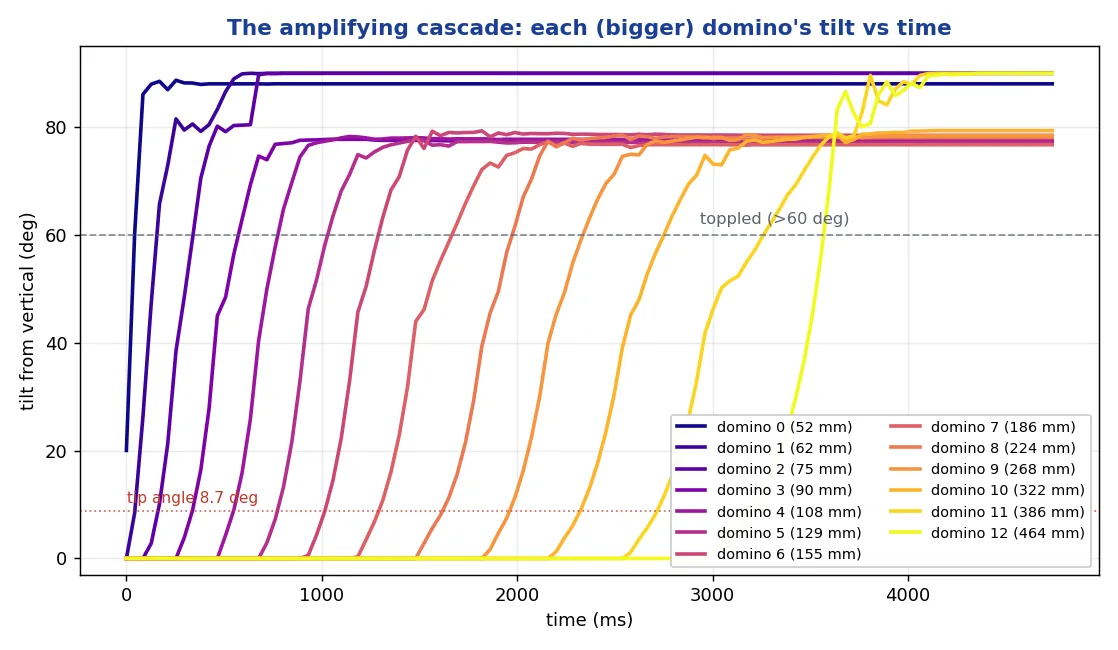
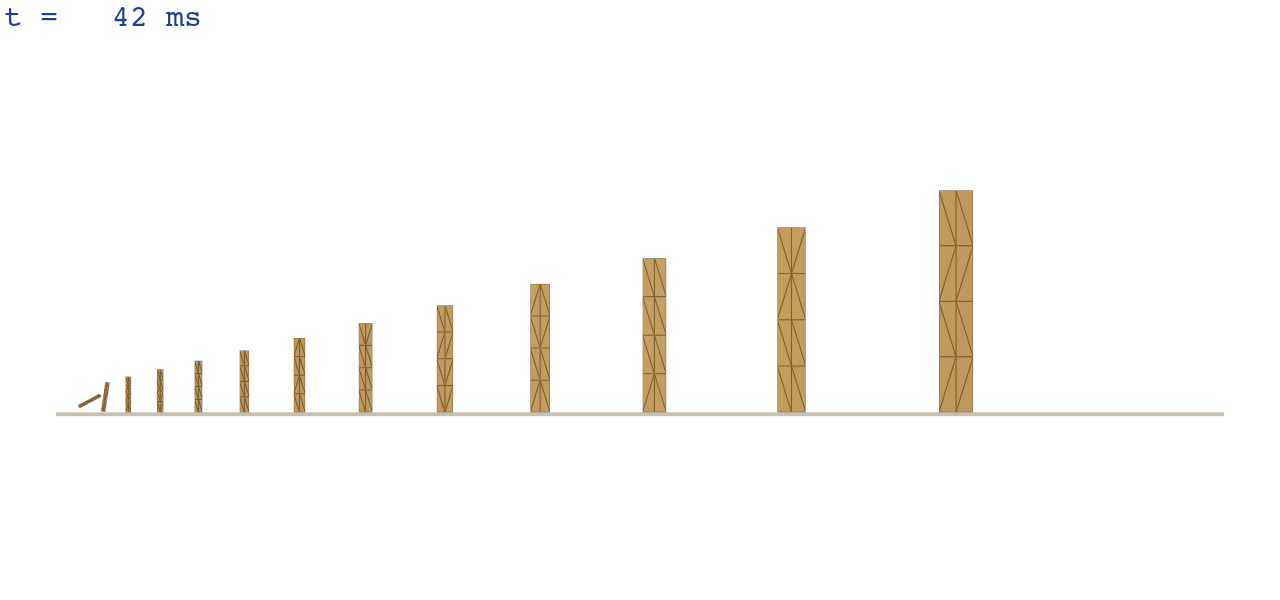
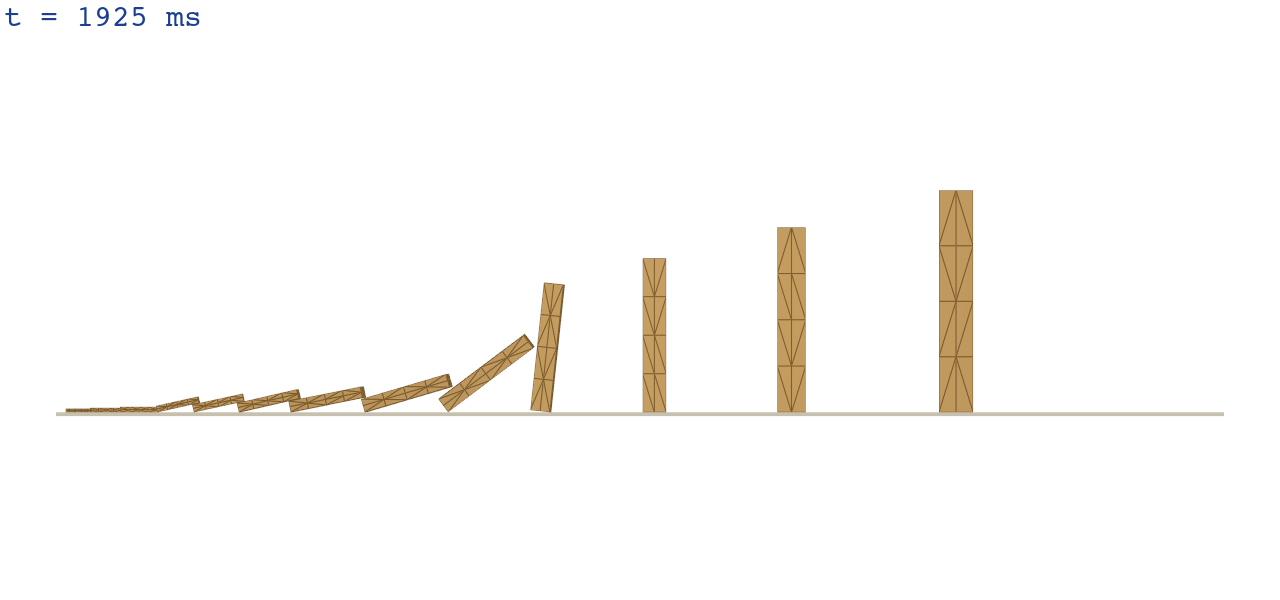
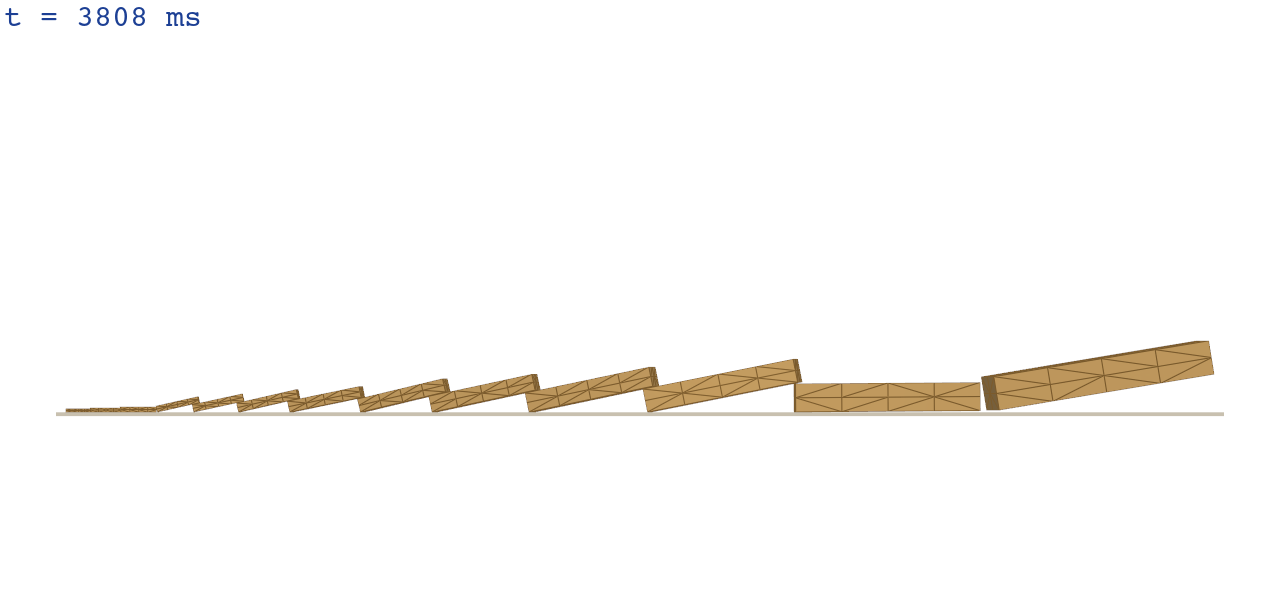
A 52 mm domino — small enough to flick with a fingertip — knocks over a slightly bigger one, which knocks over a slightly bigger one, thirteen times in a row, until a 464 mm slab the size of a paving stone goes over. Each domino releases more energy than the one before, so a nudge too small to feel at the start ends with about 9× the size and thousands of times the gravitational energy. It’s the “domino amplifier” (Lorne Whitehead, Am. J. Phys. 51(2), 182, 1983) — and getting it to actually cascade in a real contact simulation turned out to be far harder than it looks.
The idea: energy that grows down the chain
A standing domino is a tiny store of potential energy, held just shy of falling. Knock it over and it converts that energy into the blow that topples its neighbor. In an amplifier chain every domino is bigger than the last: mass grows as the cube of size, height grows linearly, so the energy each domino releases when it falls grows as roughly the fourth power of size — about 2× per stage at our growth ratio. The cascade doesn’t just propagate, it amplifies: a flick you can barely feel at one end finishes by putting over a slab you’d need both hands to lift. Lorne Whitehead showed a domino can reliably topple one up to about 1.5–2× larger, and that a modest chain can amplify energy by factors in the thousands.
Why it’s deceptively hard
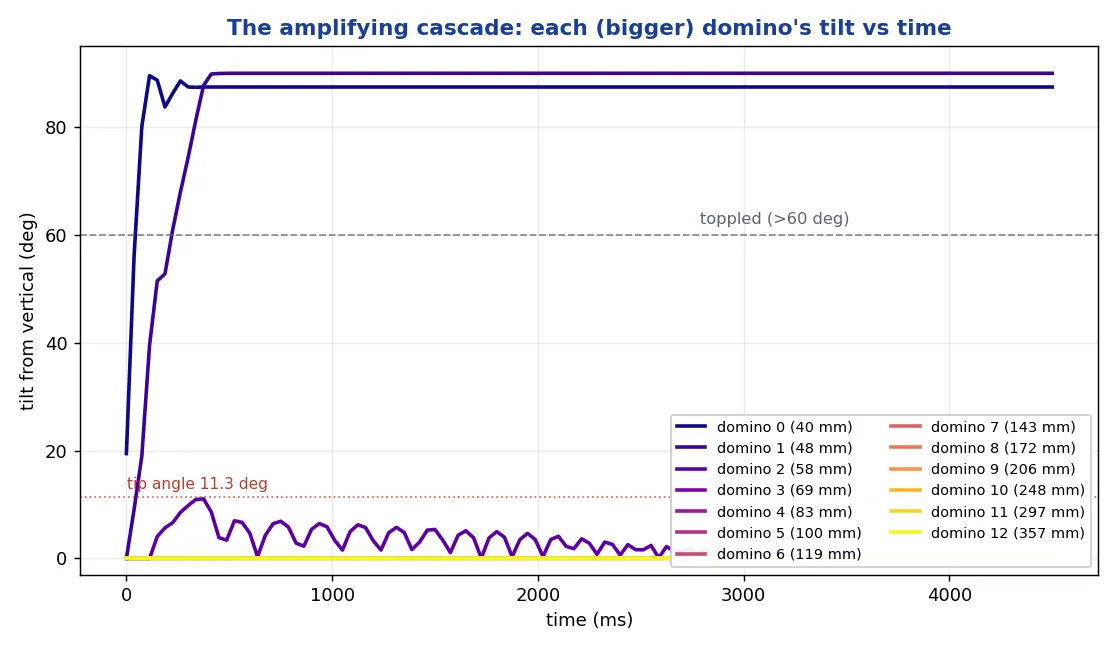
Here is the catch that makes this a genuine engineering problem and not a one-click demo: a falling domino can only reach as high as its own height. Against a taller neighbor it necessarily strikes below the top, and a small, light domino toppling under gravity alone tends to either graze the much bigger one, or lean on it and stall, rather than drive it past its balance point. Our first attempts did exactly that — the wave propagated three or four stages, then damped out into a leaning stack, each domino reaching a lower angle than the last until the chain simply stopped.
The recipe that made it cascade
Four changes, each addressing a real failure mode, turned the damped stall into a clean propagating wave:
- A flick on the trigger. The gravity-only first domino is too weak; a small initial rotation (a finger flick, exactly how you’d start a real run) gives it the momentum to drive its bigger neighbor over.
- Grippier friction (μ = 0.6). So the falling domino grips the next one’s face and pushes it, instead of sliding down it.
- A larger gap. Spaced so each domino falls nearly flat — releasing its full energy — before it catches the next, instead of propping against it half-toppled.
- Slender dominoes — the actual unlock. The strike was reaching ~11.0° against an 11.3° tipping angle and rocking back. Making each domino more slender (height:thickness 6.5:1 instead of 5:1) drops the tipping angle to ~8.7°, comfortably under where the strike lands — so every domino goes over instead of rocking back. A taller domino also strikes its neighbor higher. That one geometric change took it from 2 of 13 to 13 of 13.
Frames from the cascade
Why this one matters
The amplifier is a toy, but the solver under it isn’t: this is the same explicit-dynamics contact engine that runs vehicle crash, drop-test, and impact work, resolving thousands of contact events between deforming bodies with friction and gravity, no scripted motion. The interesting part wasn’t getting a pretty clip — it was that the model honestly reproduced why the amplifier is finicky, all the way down to a hand-off that succeeds or fails by a fraction of a degree. Read the physics, respect the knife’s edge, and don’t ship the lucky run.
Does your product live or die on a contact event that succeeds or fails by a fraction of a degree? Thirteen dominoes toppling in LS-DYNA — the same explicit-dynamics contact engine that runs vehicle crash, drop-test and impact work — with every hand-off resolved by real friction, gravity and body-to-body contact, and tilt-versus-time curves honest enough to show the ~11.0° stall against an 11.3° tipping angle alongside the 13-of-13 cascade — is how simulation finds a mechanism's knife-edge before a physical prototype teaches the same lesson the slow way. That's innovation through insight.