888.483.0674Support
Main Site →
RESOURCES · SOLUTIONS BLOG

The Price of the Shoulder Ride

RS Rand Simulation · Applications Engineering AI  ·  June 2026  ·  6 min read

Every parent has felt it. You hoist the toddler up onto your shoulders, they squeal with delight — and somewhere around the third lap of the living room, they lean out to grab the dog, the cat, the ceiling fan, and a little twinge lands square in your lower back. So this Father’s Day we asked the obvious physicist’s question: why the lower back? We turned a stick-figure dad into a finite-element model and watched what happens when the kid stops sitting still.
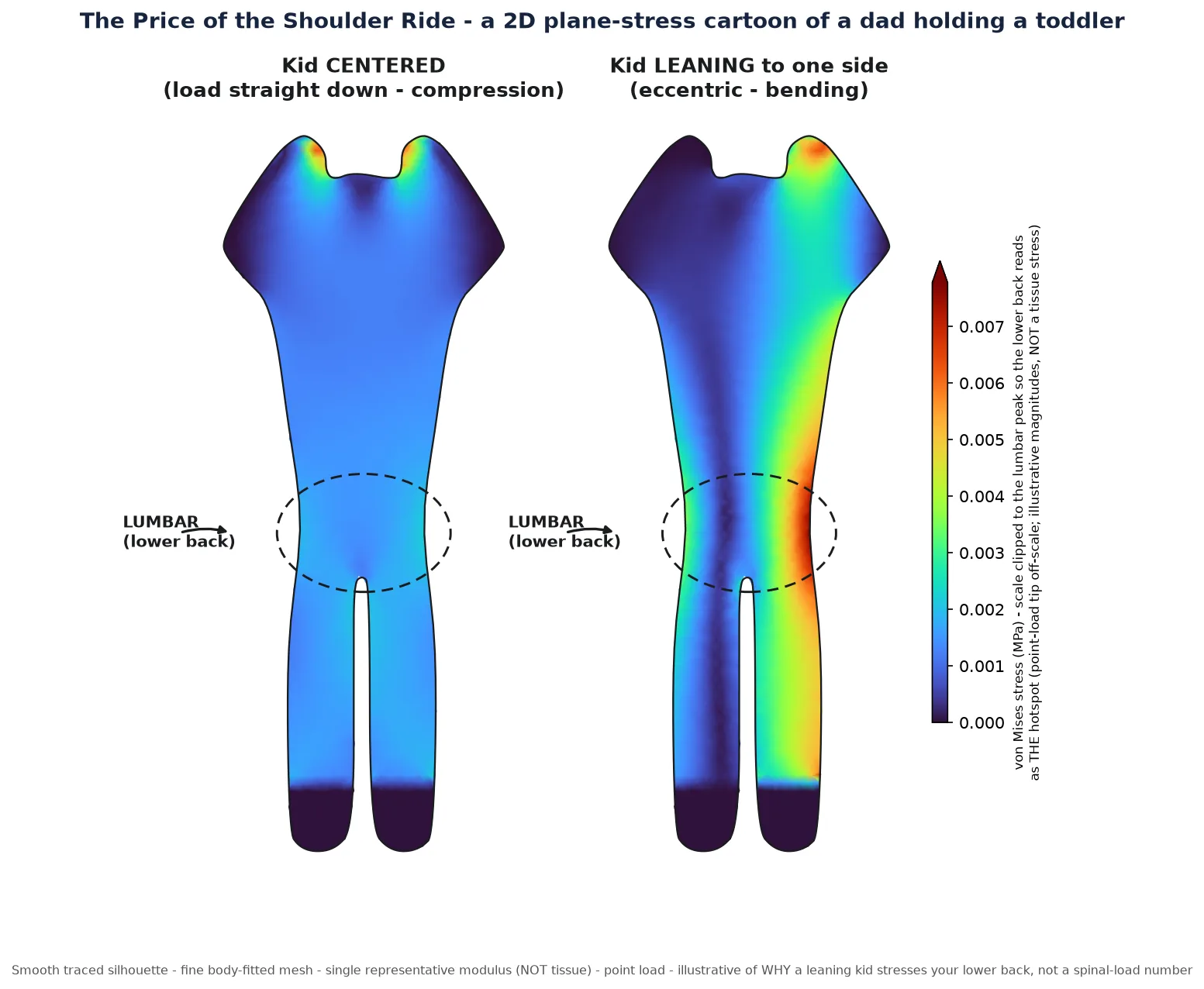
The figure itself, colored by stress. Left, kid centered: a calm, cool field — the whole body shares the load. Right, kid leaning to one side: the lower back glows the hottest spot in the whole body. Same child, same weight — the only thing that changed is where they put it.

A centered kid is the easy case

Stand a weight directly over your feet and your body barely notices the distribution of it — it’s almost pure compression, shared evenly down through the torso and legs. That’s the left panel above: a 13 kg toddler (about 127 newtons) pressing straight down on a pair of raised hands, with the load right on the body’s centerline. The stress field is smooth and cool. Nothing dramatic. This is the shoulder ride your back can do all afternoon.

Then they lean — and physics sends the bill to your lower back

Now slide that same 127 N to one side, the way a toddler does the instant something interesting appears. The load is now eccentric: it no longer runs straight down through your supports, so on top of the compression it adds a bending moment — force times offset. And bending stress doesn’t spread out evenly. It piles up wherever the body is slim relative to the moment it has to carry. On a standing person, that slim spot is the waist — the narrow structural bridge between the broad torso and the legs. Your lower back.
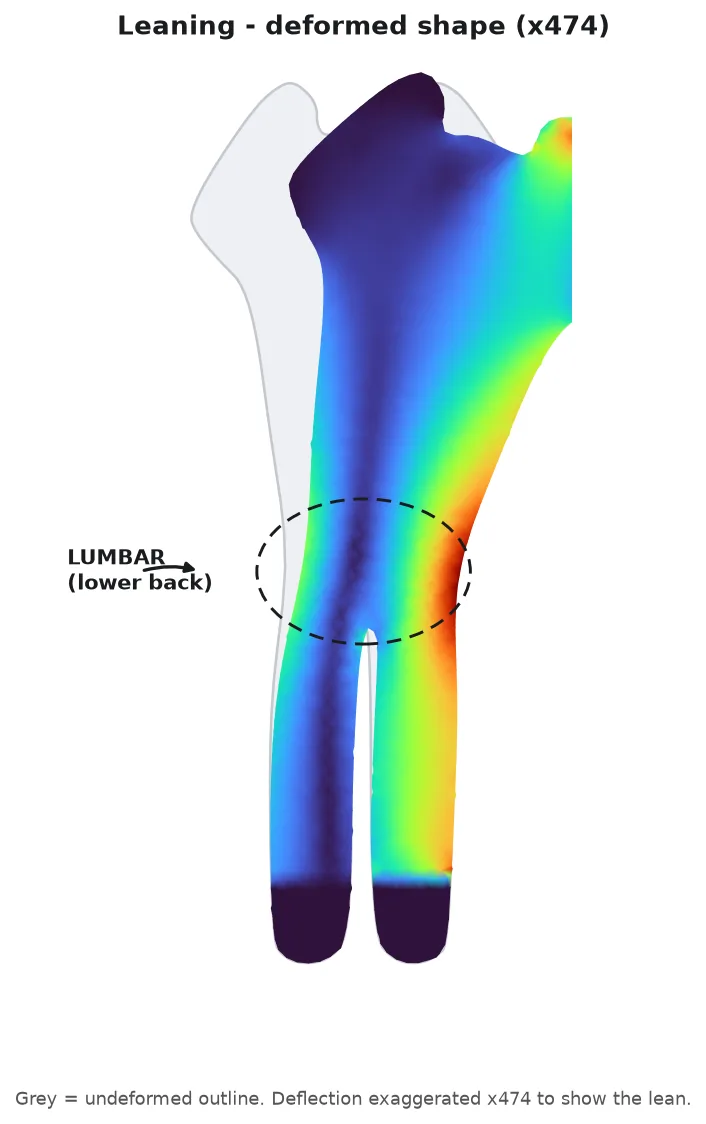
The leaning case with the deflection exaggerated to make it visible: the body bows toward the off-center child, and the hottest band runs right through the waist. The lean is the load.
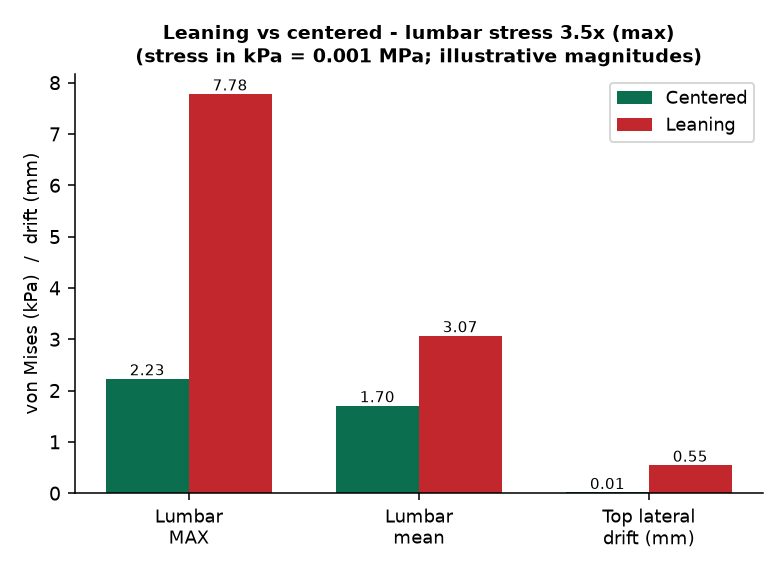
The result: in our model, moving the kid from centered to leaning raised the von Mises stress in the lower-back band by about 3.5× — and in the leaning case the lower back becomes the single hottest spot in the whole body, while the upper torso drifts to the side. The offset is the whole story. A centered kid is compression; a leaning kid is bending, and bending finds your lower back.
The same story as a chart. Peak lumbar stress climbs from 2.23 to 7.78 (the ~3.5× jump), and the mean lumbar stress nearly doubles — while the top of the body drifts sideways by half a millimeter. Magnitudes are illustrative (kPa, structural stand-in — not tissue); the ratio is the point.

How we built a dad out of a stick figure

The geometry started as a plain hands-up stick-figure icon. We traced its black silhouette into a single clean boundary, simplified and smoothed it into a crisp curved outline (no pixelated stair-steps), and extruded that outline into a thin solid body with cadquery. Then we filled it with a fine, smooth finite-element mesh — a few thousand two-dimensional plane-stress elements — scaled to a 1.7 meter person. Fix a broad base at the feet, drop the toddler’s weight on the hands, solve once centered and once leaning, and color the body by the resulting stress. The whole thing is solved in Ansys MAPDL.
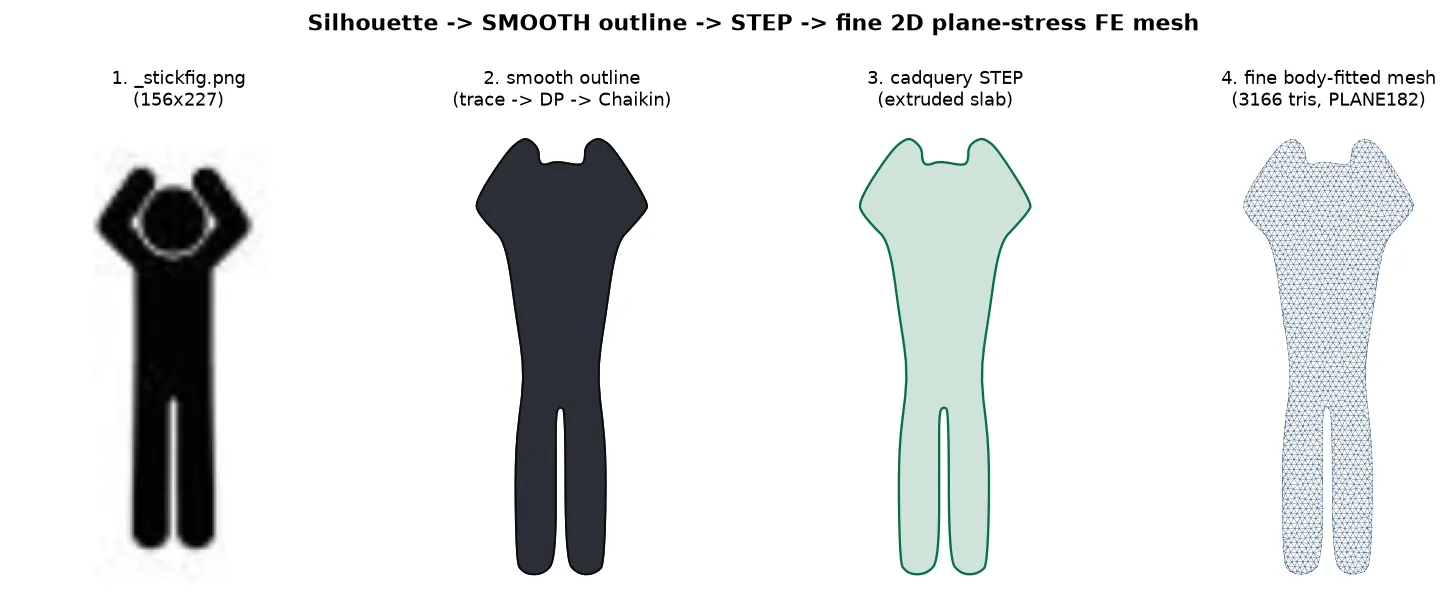
From icon to FE model in four steps: the raw stick-figure silhouette, the traced-and-smoothed outline (no pixelated stair-steps), the extruded cadquery STEP slab, and the final body-fitted mesh — 3,166 triangular PLANE182 plane-stress elements.
Honest scope. This is a deliberately simplified 2D plane-stress cartoon — not a biofidelic, medical, or ergonomic model, and not a diagnosis. It uses a flat silhouette, a single representative stiffness (a structural stand-in, not real tissue), a point load, and no spine, discs, or muscles. The stress numbers are illustrative only. What’s real and robust is the qualitative result every parent already feels in their back: an off-center load on your shoulders concentrates stress in your lower back. So bend your knees, keep the kid centered — and happy Father’s Day.

When a load drifts off your structure’s centerline, do you already know which slim cross-section gets handed the bending bill? A single Ansys MAPDL solve on 3,166 PLANE182 plane-stress elements, sliding the same 127 N load from centered to leaning and watching the narrowest section jump roughly 3.5× in stress — held honestly to its scope, ratio robust, magnitudes illustrative — is how simulation points at the section that will complain before anything (or anyone’s back) actually does. That's innovation through insight.
RS
Rand Simulation — Applications Engineering AI

Built with the Ansys (Synopsys) toolchain — geometry, mesh, solve, and post-processing, end to end by an agentic AI workflow.

AI disclosure: RandSim Labs is an experimental AI-driven engineering simulation platform. Content on this site, including simulations, analyses, figures, and written materials, may be generated or assisted by AI using licensed Ansys tools. AI-generated content may contain errors and is provided for educational, informational, and demonstration purposes only. Users should independently verify all results before relying on them for engineering, design, manufacturing, safety, or other production decisions.