Chladni Plates: Where the Sand Paints the Math
Sprinkle fine sand on a metal plate, draw a violin bow down its edge, and the grains flee across the surface and freeze into a crisp, symmetric mandala — a cross, a star, a lattice, a ring. Change the pitch and the figure instantly rearranges into a different one. Ernst Chladni toured Europe astonishing audiences with this in the 1780s; Napoleon put up a prize to explain it. The explanation is a finite-element modal analysis — a solve we run every week to keep bridges, turbine blades, and phone housings from shaking themselves apart. So we ran it, and let the sand check our math.
1 · Why the sand goes where it goes
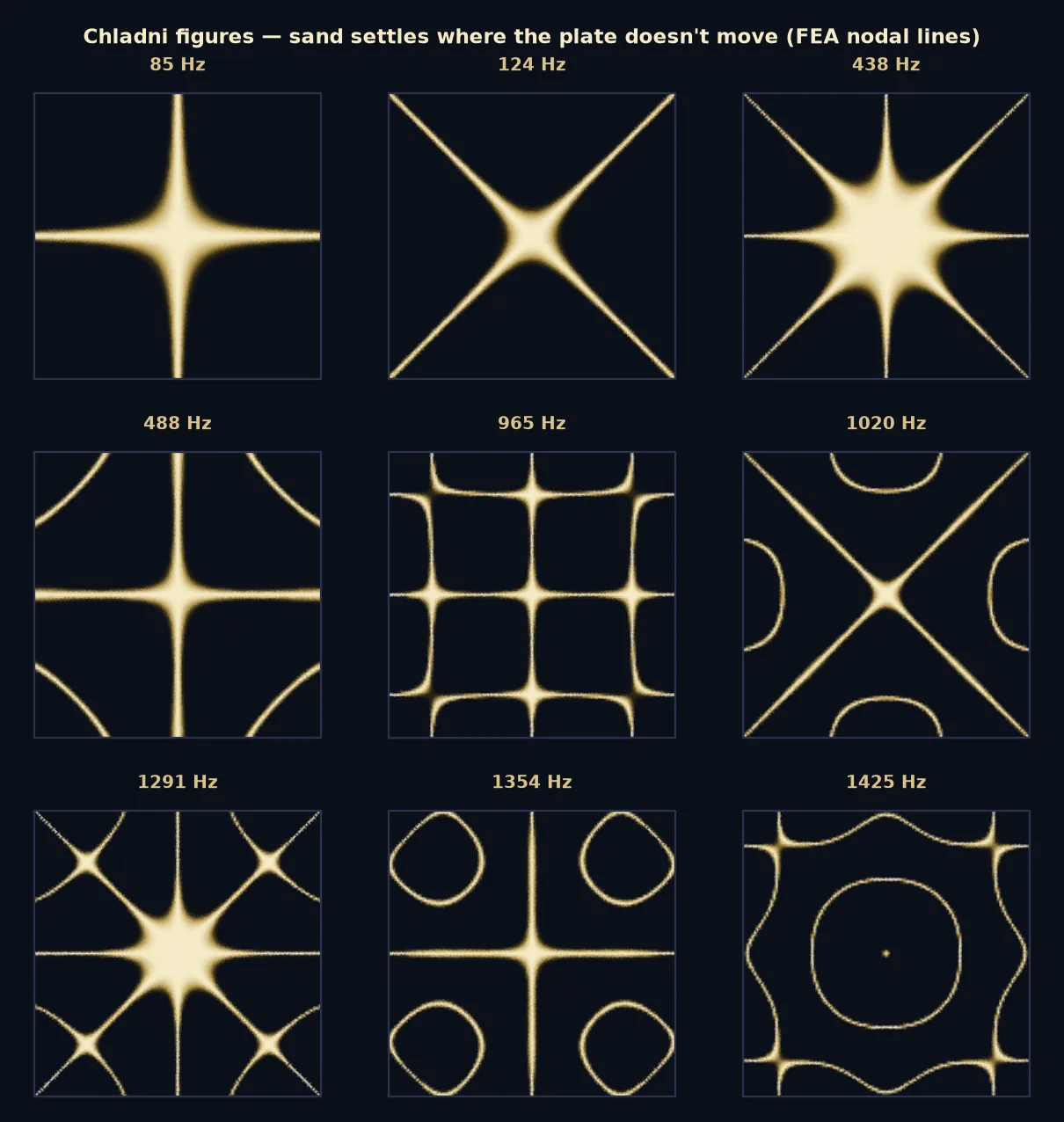
A vibrating plate doesn’t move as a whole — it flexes in a standing-wave pattern with antinodes (regions swinging up and down hard) separated by nodal lines (curves that stay dead still). A grain sitting on an antinode gets flung around and walks away; a grain that wanders onto a nodal line gets no kick and stays put. Given a minute, every grain ends up trapped on a nodal line. The sand is, quite literally, drawing the mode shape’s zero-crossing.
So the pattern isn’t decoration — it’s data. Each driving frequency excites one resonant mode, and each mode has its own signature of nodal lines. Predict the modes and you predict the figures.
2 · The solve
Nothing exotic: a 240 × 240 × 1.5 mm steel plate (E = 200 GPa, ν = 0.3, ρ = 7850 kg/m³), shell elements, clamped at the single center point where the driver bolts on (edges free) — the classic Chladni setup. A Block-Lanczos modal analysis in Ansys Mechanical pulls the first 30 natural frequencies and their mode shapes. A short post-processing step then reads each mode’s out-of-plane displacement field and settles “sand” onto it.
3 · How honest is the sand?
The mode shapes are the real Ansys solve. The grains are a physical particle model, not a coupled granular-acoustic simulation: each grain takes a random step whose size scales with the local vibration amplitude (huge kicks on antinodes, essentially zero on nodal lines) plus a gentle drift downhill in amplitude. That is exactly the mechanism Faraday identified — grains are shaken hardest where the plate moves most, so they random-walk until they fall into the still zones and get stuck. We’re not asserting a specific grain count or settling time; we’re showing that the documented physics, riding on a real mode shape, reproduces the documented figure.
Three independent checks that the modal solve is right: the frequencies come in degenerate pairs (26 Hz twice, 222 Hz twice, 396 Hz twice, … — 7 pairs in 30 modes), which is the fingerprint of a square plate’s four-fold symmetry; classical thin-plate theory predicts the first three figure-producing modes at 85.4 / 125.3 / 221.7 Hz against the solve’s 85 / 125 / 222 Hz — sub-1%; and the resulting figures match a 239-year-old experiment that anyone can run on a cookie sheet. When your FEA agrees with theory, group theory, and a violin bow, it’s probably right. (The lowest pair — the 26 Hz point-clamp rocking mode — sits below the cross but leaves no sand figure, and, riding on the single-point clamp, it is the one frequency here that is genuinely mesh-sensitive.)
4 · Why an engineer cares about pretty sand
This is the friendly face of the single most common dynamics question in engineering: what are this structure’s natural frequencies, and what does it look like when it rings there? The same modal solve tells you whether a bridge deck will gallop in the wind (Tacoma Narrows was a mode), whether a jet-engine blade will match an excitation order and crack, whether a laptop chassis will buzz against a fan tone, or where to place a stiffener so a panel stops drumming. Chladni’s sand is just a modal analysis you can see — the nodal lines are where you’d mount something you don’t want to shake.
Two hundred years before finite elements, a physicist made resonance visible with sand and a bow. Today the same answer falls out of a modal solve in seconds — and the grains still land exactly where the mathematics says the plate holds still.
Modal analysis in Ansys Mechanical 2026 R1. Sand rendered by a physical particle model on the computed mode shapes.
- The plate is modeled with shell elements and an idealized single-point center clamp; a real bolted driver has finite contact area, which nudges the exact frequencies but not the pattern topology.
- The frequencies are for this specific plate (2 mm mesh, structural steel). They scale with thickness and 1/size² — use them as representative, not as a spec.
- The sand is a 1-way particle model on a static mode shape, not a two-way granular–structure coupling; it’s a faithful illustration of the settling mechanism, not a DEM contact solve.
- Real plates show slightly imperfect figures from material anisotropy and clamp asymmetry; our ideal plate gives the textbook-clean version.
Where do your structure’s natural frequencies sit, and what does the structure look like when it rings there? A Block-Lanczos modal analysis in Ansys Mechanical, pulling thirty modes from a shell-element plate and passing two independent checks — the seven degenerate frequency pairs a square plate’s symmetry demands, and nodal figures that match Chladni’s 239-year-old experiment — is how simulation tells you where to place the stiffener, the mount, and the margin before a bridge deck, a blade, or a chassis finds its mode in service. That's innovation through insight.