When a Bullet Meets Armor — and the Bullet Is What Shatters
High-speed footage of a bullet striking a steel plate shows something that feels backwards: the bullet, not the plate, is what comes apart. The reason is simple once you look at the materials — a rifle bullet is mostly lead, one of the softest metals there is, and armor plate is hardened steel several times stronger. At supersonic speed the soft projectile has nowhere to go, so it does what anything soft does against something hard and immovable: it splashes. We rebuilt that instant in LS-DYNA explicit dynamics — and then modeled it four different ways, to show how much the choice of numerical method changes the picture.
The physics of a splash
The brass nose touches first, and the lead behind it — under pressures of tens of thousands of atmospheres — starts to flow sideways like a fluid. The projectile is a two-material idealization of a real jacketed round: a soft lead-antimony core wrapped in a thin brass / gilding-metal jacket, both carried with Johnson-Cook strength and a Mie-Grüneisen equation of state from the open ballistics literature (Peroni et al., DYMAT 2012; Iqbal et al. for the Armox plate). The plate soaks up the energy as a permanent crater — its own fracture is deliberately switched off, so it dishes rather than perforates. This is a study of the projectile, not a penetration prediction.
The same impact, four ways
A debris cloud is exactly the kind of event where the numerical formulation stops being a footnote. We ran the same shot through four LS-DYNA methods, each with a different way of handling material that has torn itself apart:
- Lagrangian + element erosion — the classic. Failed elements are deleted; ~90% of the KE goes to deformation, a 6.7 mm crater. Fast, but the deleted mass under-counts late debris and the single-point elements carry elevated hourglass energy.
- SPH (smoothed-particle hydrodynamics) — the bullet becomes particles that can't be deleted, so it conserves mass (100% retained) and runs clean (hourglass ~3%), but transfers a different share of its energy because nothing erodes.
- EFG (element-free Galerkin) and S-ALE (structured ALE) — two more routes to the same fragmentation, each trading robustness against cost.
Reading the residuals
The headline numbers above are easy to assert and hard to feel. So here we pull the actual fields straight out of the solve — no re-running, just richer post-processing of the existing LS-DYNA results — and let the residuals show why the method choice moves them. Three pictures carry most of the argument.
1 — the lead flows like a fluid, so look at strain, not displacement
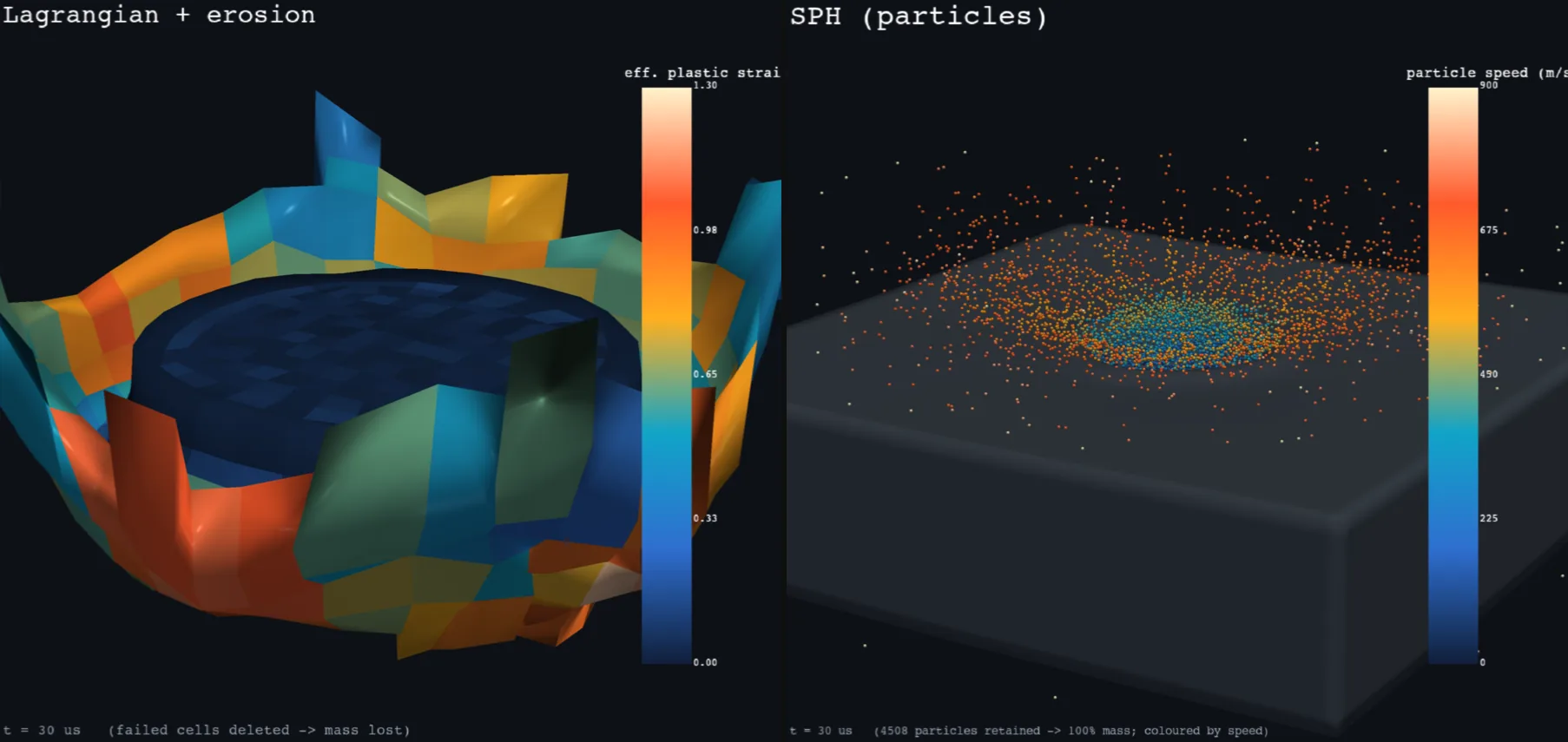
At impact the contact pressure is on the order of tens of GPa — thousands of times the lead core's ~1 MPa yield strength. When the driving pressure dwarfs the material strength, the metal stops behaving like a structure and starts behaving like a fluid: it doesn't deflect, it flows. That is why a displacement plot of the bullet is almost meaningless (every point is moving) while the effective plastic strain field is exactly the right diagnostic — it marks the material that has flowed past its failure strain and is about to be shed.
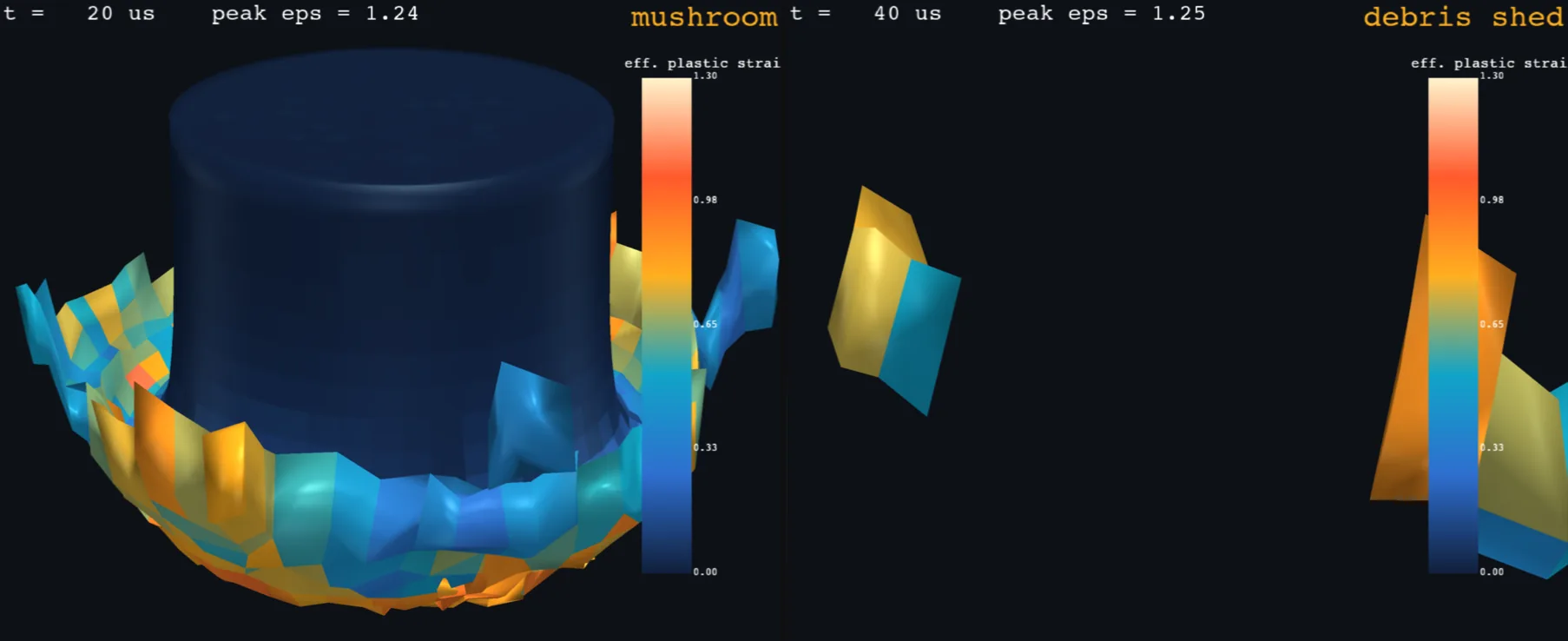
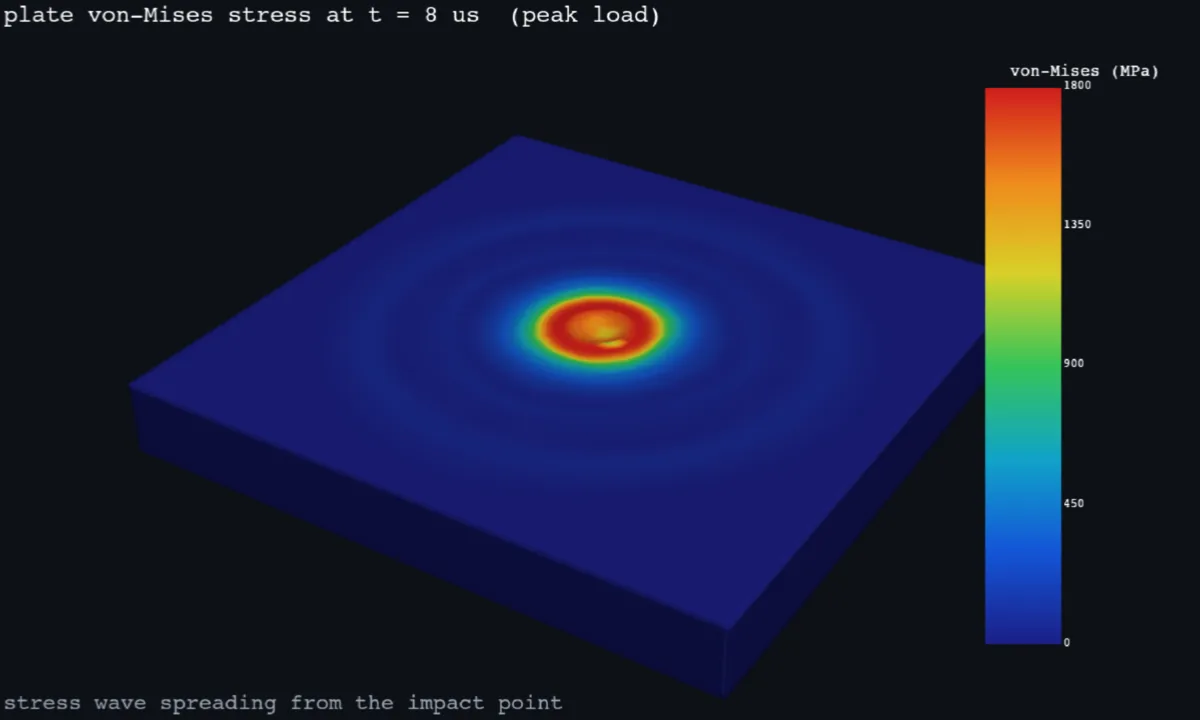
The plate sees the other side of that same flow. As the lead splashes, it drives a stress wave out across the armor face — and because the plate is strong enough to stay a structure, von-Mises stress is the right thing to watch there.
2 — where the energy goes: a permanent crater, not a hole
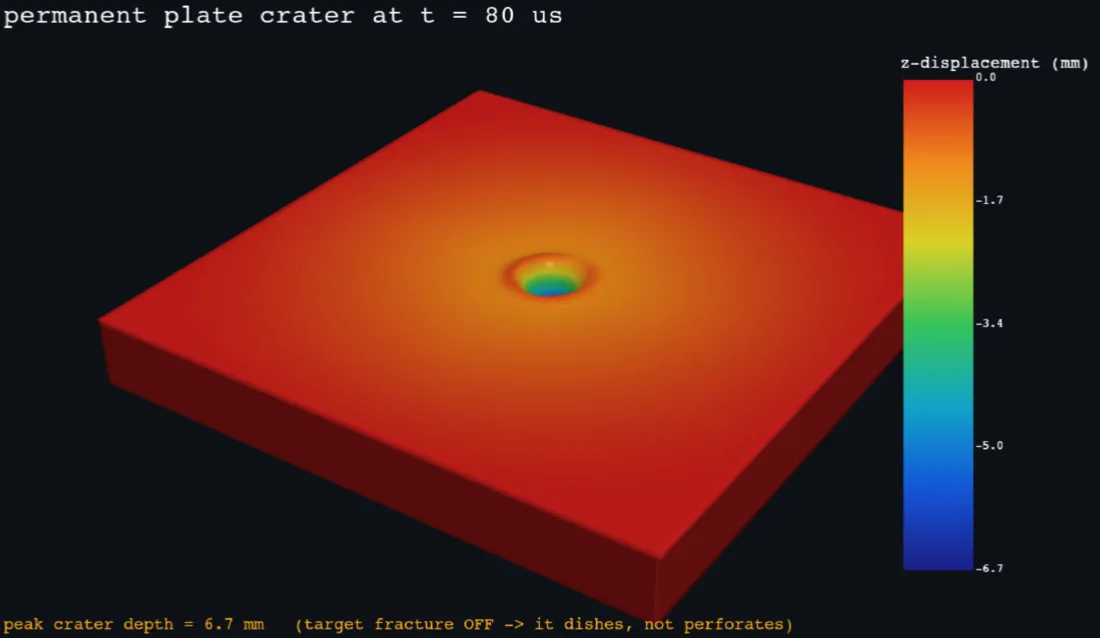
The plate doesn't perforate — its fracture is deliberately switched off — so all that absorbed work has to go somewhere visible. It goes into a permanent dish. Reading the final-state z-displacement over the plate nodes only (excluding bullet debris) gives the crater depth directly, and it lands on 6.7 mm — the same number quoted up top, now measured off the field instead of asserted.
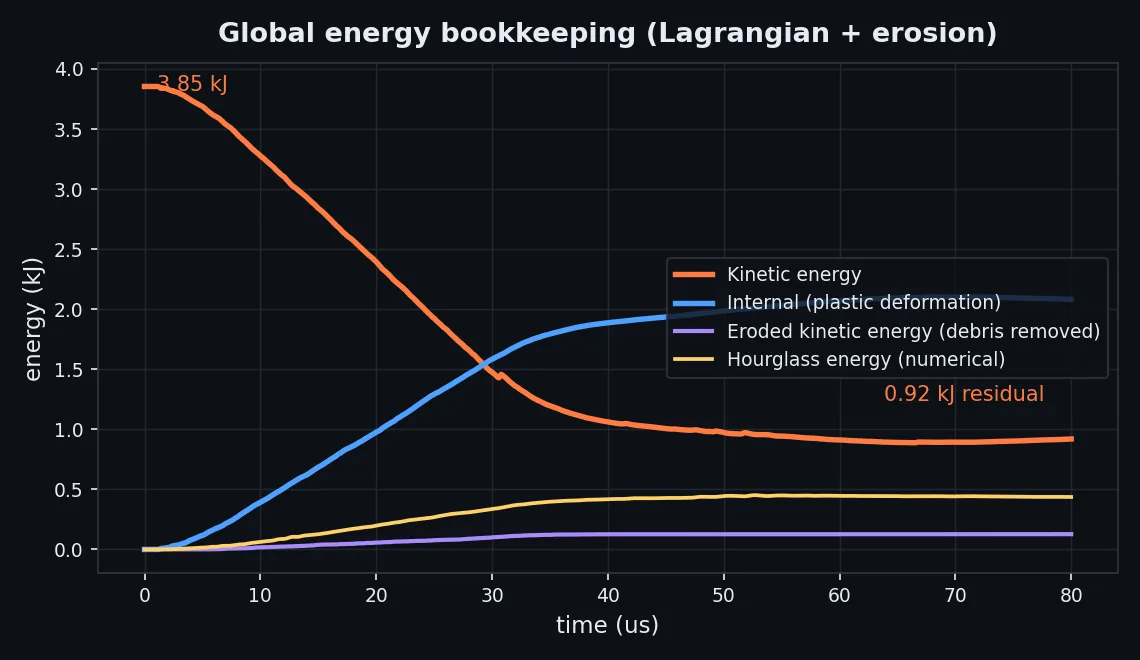
Tracking that energy globally closes the books. The bullet arrives with 3.85 kJ of kinetic energy; the curve below shows it draining almost entirely into internal (plastic-deformation) energy — the crater and the splash — while two smaller terms quietly tell the Lagrangian story: an eroded-KE term that carries energy out of the model with each deleted fragment, and a hourglass term that climbs to ~21.5% of the internal energy (the numerical tax of single-point solid elements under this much distortion).
3 — the method-to-method difference, made visible
That hourglass-and-erosion signature is precisely what changes when you change the formulation. The Lagrangian model represents failed lead by deleting the element — the mass and its kinetic energy simply leave the simulation. SPH represents the same lead as particles that cannot be deleted: the bullet conserves 100% of its modeled mass and persists as a spray. Put the same instant from both runs side by side and the bookkeeping difference stops being a sentence and becomes a picture.
Why this one matters
Impact and fragmentation problems live or die on the formulation. A Lagrangian erosion model gives you a fast, intuitive answer and quietly loses mass; SPH keeps the mass and changes the energy split; the meshfree methods sit in between. The engineering value isn't a single hero number — it's knowing which method to reach for, what each one is honest about, and what each one hides.
When your hardware has to survive an impact that tears material apart, which solver formulation would you stake the answer on? Running one 850 m/s shot through LS-DYNA explicit dynamics four ways — Lagrangian erosion against SPH, EFG and S-ALE — with the energy books held open (erosion's deleted mass and 21.5% hourglass tax versus SPH's 100% mass retention at 2.7%) and the 6.7 mm crater read off the displacement field instead of asserted — is how simulation shows you what each method is honest about, and what it hides, before anyone fires a live round to find out. That's innovation through insight.