Why the Big Nuts End Up on Top: The Brazil-Nut Effect, Simulated in Ansys Rocky
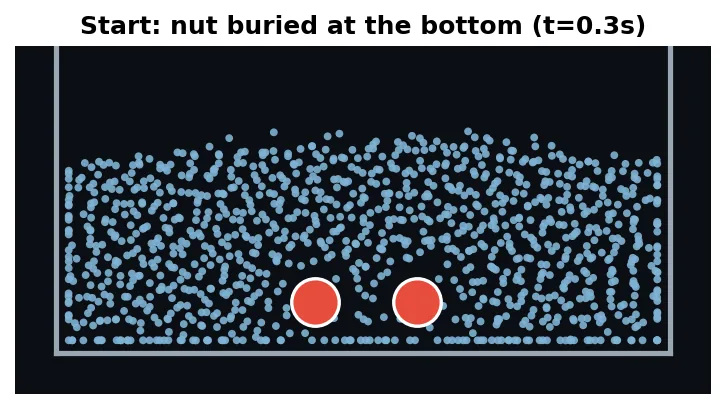
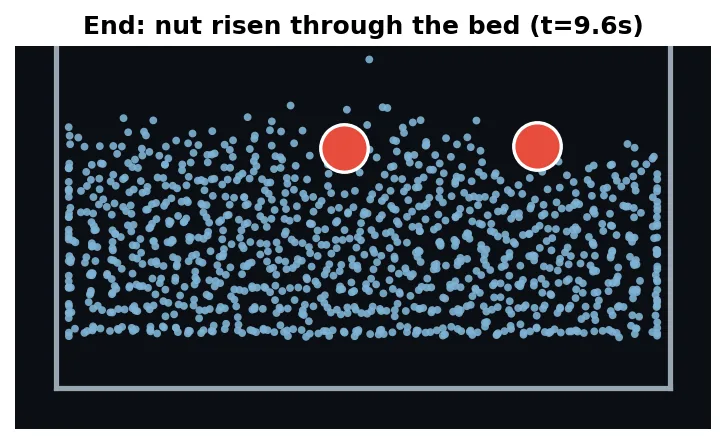
Open a can of mixed nuts and the big Brazil nuts are always sitting on top. Pour a box of muesli and the whole oats rise while the dust settles to the bottom. It feels like it breaks a law of nature — heavy things are supposed to sink — yet it is one of the most dependable effects in all of granular physics. We rebuilt it as a discrete-element (DEM) simulation in Ansys Rocky: a box of small grains with a pair of big “nuts” buried at the bottom, shaken straight up and down, and let them climb to the top on their own.
The trick that looks backwards
Drop a heavy ball into a jar of sand and it sinks — that’s buoyancy and density doing the obvious thing. But start shaking the jar, and the heavy ball does the opposite: it rises. The counter-intuitive part is that being bigger, not lighter, is what lifts it. A single large intruder in a sea of small grains will march to the top under vibration almost regardless of how dense it is. Physicists named it the Brazil-nut effect after the can of mixed nuts, and it has been studied for decades precisely because it is so stubbornly real.
There is no “buoyancy” rule in the model and no segregation force. The nut rises purely from how differently sized grains rearrange when you shake them.
Two mechanisms, both emergent
The climb comes from two cooperating effects, and the satisfying thing about a DEM model is that it reproduces both from nothing but contacts, friction and gravity:
Void-filling — the ratchet. Each time the bed is thrown up and falls back, a gap opens for an instant under the big nut. Small grains are small enough to trickle sideways into that gap; the nut is far too big to drop back down into the thin spaces the small grains leave behind. So every single cycle props the nut a little higher and won’t let it back down — a one-way ratchet.
Granular convection. Friction against the shaking walls drives slow circulation: grains rise in a broad plume up the middle and stream back down in thin sheets along the sides. The nut rides up the plume but can’t fit into the narrow down-streams — so it gets stranded at the surface, exactly where you find the Brazil nuts.
Building it as physics, not as a formula
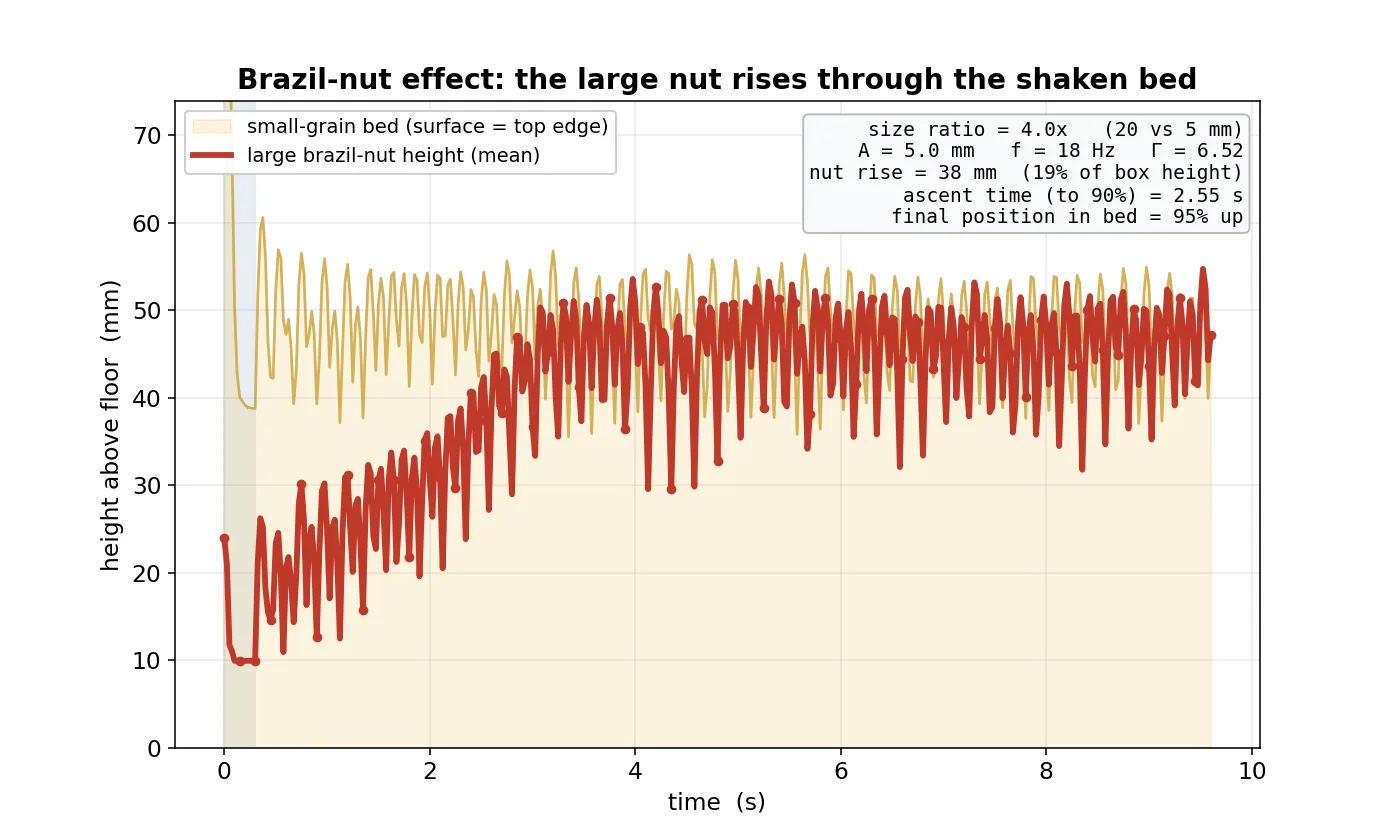
The model is a real DEM solve: a quasi-2D box, ~1,100 small 5 mm spheres and a pair of 20 mm nuts — a 4× size ratio, the classic strong-segregation regime — with the big ones seeded at the bottom. After a brief settle, the entire container is driven with a vertical sine wave. The one number that decides whether anything happens is the dimensionless shake intensity, Γ = Aω²/g: below 1 the bed just sits there; above 1 it briefly “fluidizes” each cycle and segregation switches on. We ran at Γ ≈ 6.5 (5 mm at 18 Hz) — energetic, but a regime where the forward effect (big-rises) is robust. Then we read the nut’s height out of the solved centroids and watched it climb — over about nine seconds of shaking it rose ~38 mm from the floor and ended up sitting on the bed surface.
Why this one matters
Size segregation under vibration is a multi-billion-dollar headache in pharmaceuticals, food, metal powders and bulk handling, where a blend that looks perfectly uniform un-mixes itself in a hopper, a railcar, or a tablet press — ruining dose uniformity or product consistency. The very same Rocky DEM workflow that lifts one nut to the top of a shaken box is the one we use to predict and design against segregation in real silos, feeders and blenders. That it nails a textbook effect from first-principles contacts is a small, honest sign the model is doing real physics.
Run in Ansys Rocky DEM v261 on a single GPU. Want the step-by-step how-to and the build log of what broke along the way? Ask us.
Does a blend that leaves your mixer uniform arrive at the tablet press un-mixed? Ansys Rocky solving every contact in a shaken bed — ~1,100 small grains, a pair of 4× intruders seeded at the bottom, a deliberately forward-regime shake at Γ ≈ 6.5, and a ~38 mm climb read straight from the solved centroids with a timestep verified to neither tunnel nor explode — is how simulation predicts where a silo, feeder, or blender will segregate before a ruined production batch reports it for you. That's innovation through insight.