Why a Blunt Nose Runs Cooler at Mach 6
This is a new study, but it leans on the same compressible-flow toolchain as our rocket-nozzle work. The question is one most people get backwards: to survive a plunge through the atmosphere at Mach 6, should the nose be a sharp spike or a round dome? Intuition says sharp — cut through cleanly. The physics says round, and the reason is entirely about where the shock sits.
Re-entry is a heating problem because of simple bookkeeping. A vehicle coming back from orbit carries an enormous store of kinetic energy — tens of megajoules for every kilogram — and to land it has to shed nearly all of it. That energy does not disappear; it becomes heat, in the air and, unless the shape is chosen carefully, in the vehicle. The nose decides how the heat is split. Get it wrong and the leading edge climbs past where any material survives; get it right and the very same descent is survivable.
One honest boundary up front: the solves in this study run Mach 2 to 6 at 30 km — high-supersonic flight, roughly a quarter of orbital-entry speed, with none of entry's real-gas chemistry (see the scope box). The geometric principle they demonstrate, though, is the same one the capsules bank on, and it is fully on display at Mach 6.
The shock does the shielding
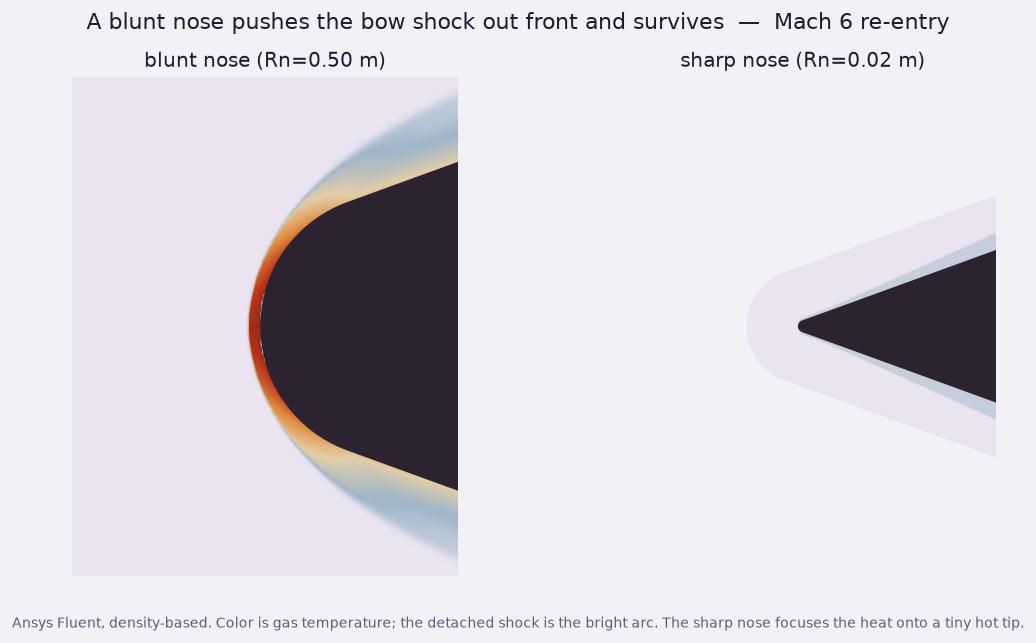
Anything moving faster than sound pushes a shock wave ahead of it. On a sharp point the shock clings to the tip; on a blunt body it detaches and stands off in front as a bow shock. That detachment is the trick. The detached shock does most of the heating to the AIR, and the thick, hot cushion of shocked gas between the shock and the nose spreads what is left over a broad, gently-curved face. A sharp nose has no cushion — the shock sits right on the tip and funnels the heat into a point. The blunt body, in effect, hides behind a self-made blanket of hot gas: the shock creates it, the stand-off gives it thickness, and the moving flow carries most of that energy away downstream before it can soak into the wall.
Where the shock sits: the CFD versus Billig
The one thing a CFD like this resolves cleanly and inviscidly is the shock geometry — where the bow shock stands relative to the nose. There is a classic engineering correlation for exactly that, Billig's, and it says something non-obvious: the stand-off, as a fraction of nose radius, depends on Mach alone, not on the size of the nose. A bigger nose simply pushes the shock proportionally further out.
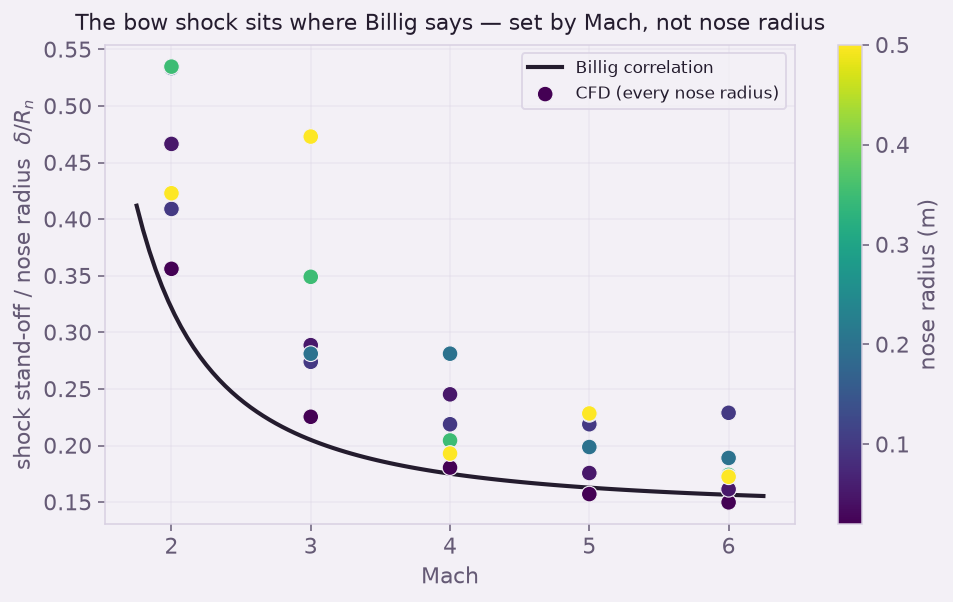
A hand check says the offset sits in the CFD, not the correlation. At Mach 6 an ideal-gas normal shock compresses air by ρ2/ρ∞ = (2.4 × 36)/(0.4 × 36 + 2) = 5.27, and the classic continuity estimate for a sphere's stand-off, Δ/R ≈ 0.78 × (ρ∞/ρ2), gives 0.148. Billig's fit at Mach 6, 0.143·e3.24/M², gives 0.157. Theory and correlation agree with each other to about 6%; our Mach-6 solves average Δ/R ≈ 0.18. With two independent references on one side and the CFD alone on the other, the finger points at the mesh — and first-order shock capture on ~31k cells is exactly the kind of numerics that pads a stand-off distance.
Blunter runs cooler — the design law
Now the payoff. The stagnation heating on a blunt body follows a well-established law — Sutton-Graves — in which the peak heat flux scales as one over the square root of the nose radius, and with velocity cubed. Quadruple the nose radius and you roughly halve the peak heating. That is the blunt-body paradox in one line, and it is a direct consequence of the shock structure the CFD shows: a blunter nose stands its shock further off, thickens the cushion, and spreads the load.
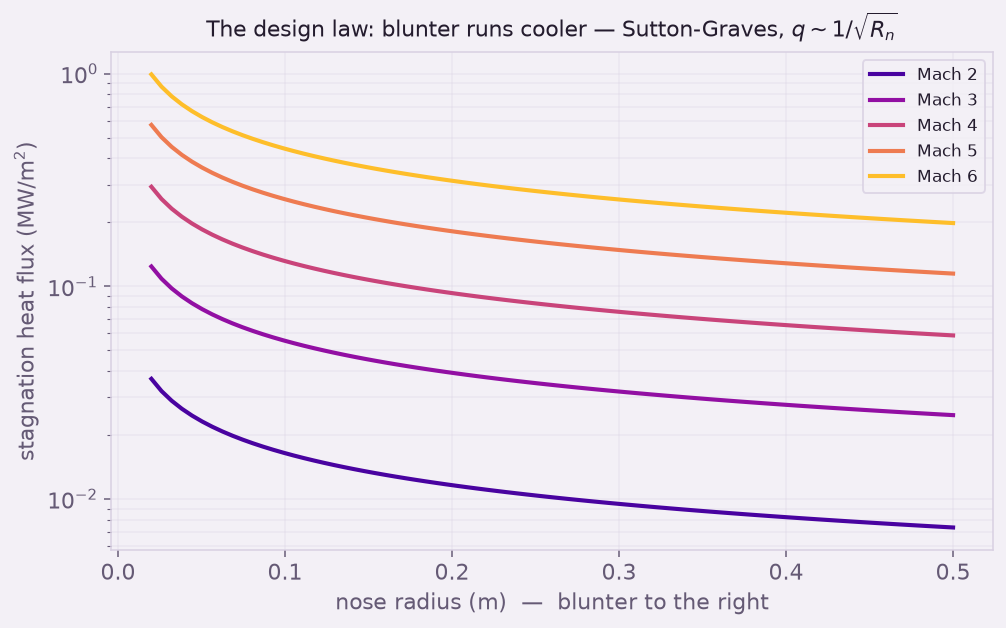
Turn that into temperatures and the stakes are plain — with one distinction the first version of this page blurred. The gas behind the bow shock reaches its stagnation temperature: about 1857 K at Mach 6 here, which is exactly the ideal-gas value for the 226.5 K free stream at 30 km — 226.5 × (1 + 0.2 × 6²) = 1857 K — a clean check on the solver's energy bookkeeping. But that is a gas temperature, and the wall never sees it. What the wall experiences is a heat flux, set by how steeply the hot layer's temperature falls through the boundary layer to the surface; the wall settles wherever that influx balances what it can shed, and computing it properly needs the wall-resolved mesh this study deliberately does not claim (see the scope box). The design lesson survives the distinction: the blunt nose keeps most of the energy in the shock-heated air and washes it downstream, while the sharp nose funnels the flux into a point — and metal gives up long before gas-temperature numbers like 1857 K. Structural steel has lost roughly half its strength by around 900 K and melts near 1720 K; aerospace aluminum quits several hundred kelvin sooner. For a vehicle whose job is to come home in one piece, the nose radius is the single most consequential line on the drawing.
Why not simply always blunt?
Because bluntness costs drag, and drag is not always the enemy. A blunt body decelerates high and early, bleeding off speed while the air is thin and the heating is manageable — exactly what a returning capsule wants. A vehicle that needs to drive down through the atmosphere fast wants the opposite: a slender nose, low drag, and a material engineered to ablate the intense tip heating away on purpose. So the honest rule is not “blunt always wins” but “match the nose to the mission.” For anything whose job is to slow down and survive, from Mercury to Apollo to Dragon, the answer has been the same broad round face.
What the automation did
A script marched one nose shape across a Mach ladder and a range of nose radii — 30 converged supersonic Fluent solves at Mach 2, 3, 4, 5 and 6 over nose radii of 20, 50, 100, 200, 350 and 500 mm — resolving the bow-shock field in each and reading back its stand-off against Billig, with no one at the keyboard. The result is the picture and the geometry check: the shock detaches, tracks Billig's Mach trend (carrying the ~20% high bias disclosed above), and forms the cushion that the blunt-body design law depends on. Turning one flow solve into a swept, self-checking picture of a physical principle is the everyday value of scripting a solver.
Have a part where the counter-intuitive shape is the right one? Heat shields, shock trains, cooling passages, blast structures — the intuitive shape is often wrong, and the way to know is to solve the real physics and read the picture. We do this in Ansys Fluent, CFX, Mechanical and LS-DYNA. Rand Simulation — innovation through insight.