Why Lumber Cracks When It Dries Too Fast
Fresh-sawn (“green”) lumber is soaking wet — often heavier in water than in wood. Drying it is what makes it stable enough to build with, but push the drying too hard and the board pays you back with splits along the grain (“checks”) and a cup or twist you can’t plane out. Kiln operators and the vacuum-drying crowd spend their whole careers walking that line. We built a green board in Ansys Mechanical, dried it, and watched the stress build from the inside — to see exactly when and where it wants to crack.
A board dries from the outside in
Water leaves wood through its surfaces, so the outer millimeters always dry first while the middle stays wet. The picture above is that gradient made visible: a pale rind of nearly-dry wood around a core that is still at “fiber saturation,” the moisture level below which wood finally begins to shrink. Early in drying that rind is thin and the contrast is sharp — which, it turns out, is exactly the dangerous moment.
Here is the key fact non-woodworkers miss: wood doesn’t shrink at all until it drops below fiber saturation (around 30% moisture content). Above that, it’s just shedding free water sitting in the cell cavities and the board stays the same size. Below it, the cell walls themselves give up water and the wood shrinks. So the dry shell is actively trying to get smaller while the saturated core sits there full-size, unbothered. Something has to give.
The shell gets stretched over the core
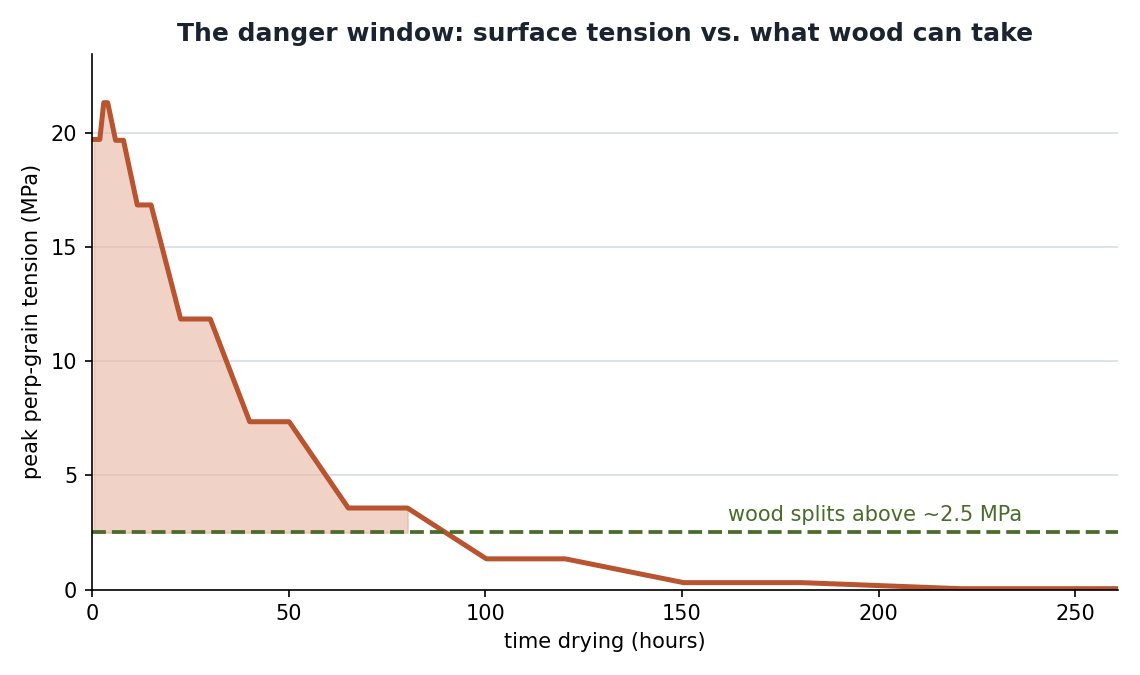
What gives is the shell — in tension. The surface wants to shrink onto a core that won’t shrink with it, so the core holds the surface stretched, and stretched wood pulls apart most easily across the grain, where its strength is a feeble couple of megapascals. That is why checks run along the board (splitting the weak cross-grain direction) rather than across it. In the model the peak cross-grain tension at the surface reaches about 21 MPa — far past the ~2.5 MPa the wood can hold — which is the simulation’s way of saying “this surface checks.”
Mapping the defect zones: where it checks, and how it warps
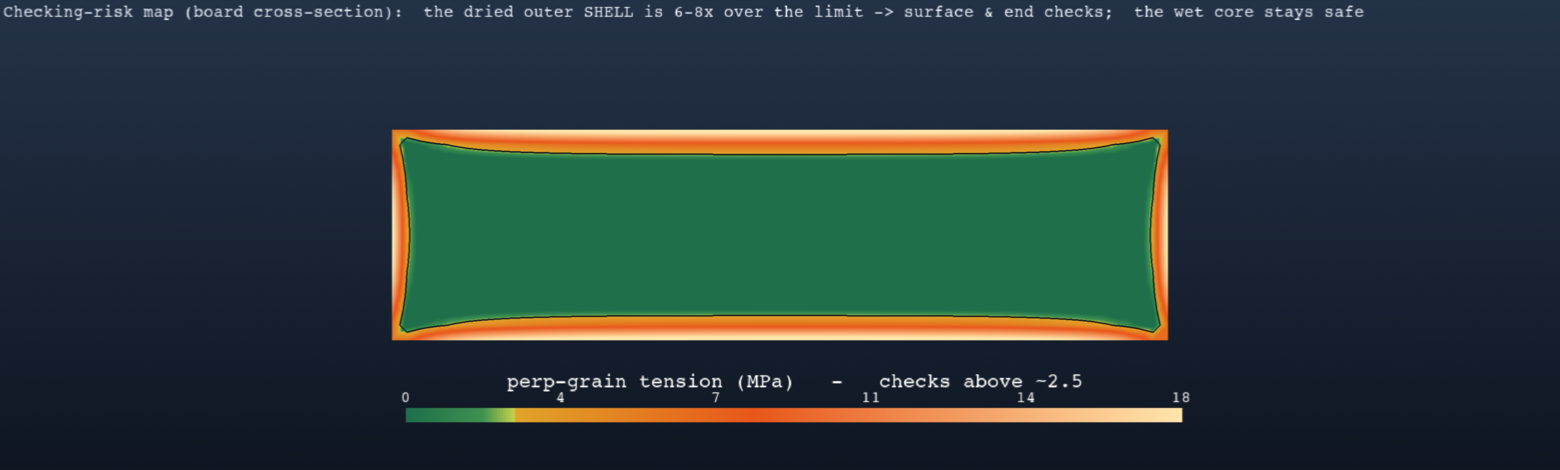
Because the solve carries the stress everywhere in the board, we can go past “the surface is in tension” and point at exactly which wood is over its limit. Color the cross-section by how far the cross-grain tension has run past the ~2.5 MPa strength and the checking-risk zone draws itself: at the worst moment, a few hours in, the entire dried shell is six to eight times over the limit (amber to white) while the still-wet core sits safely below it (green). The black line is the strength contour — the boundary between wood that checks and wood that doesn’t. It is hottest at the corners and the ends, where the board loses moisture from two faces at once and dries fastest, which is exactly why end-checks and corner-checks show up first and why kiln operators wax the ends of every board.
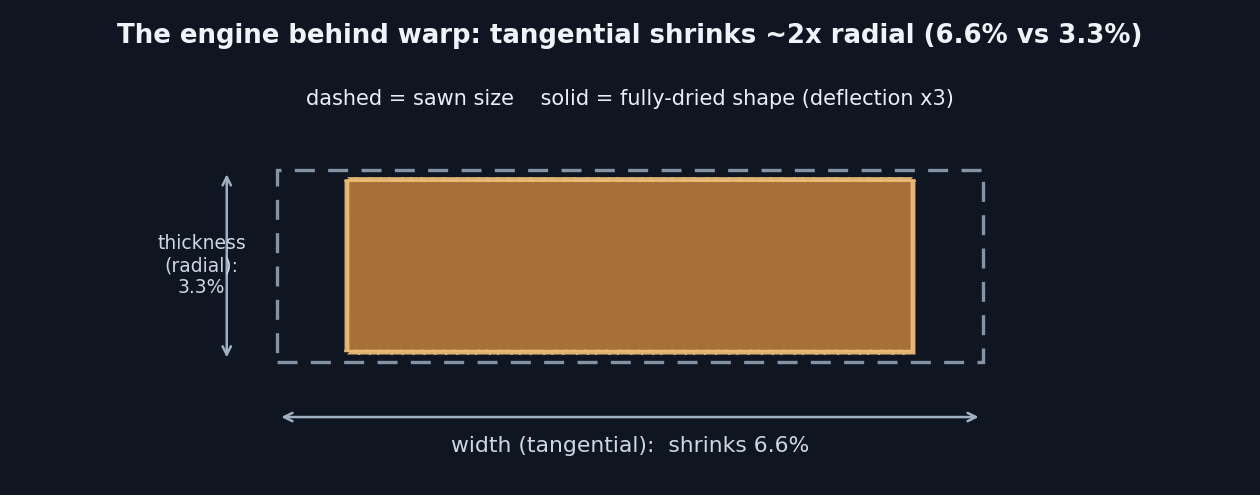
Warping is the same shrinkage read a different way. Wood shrinks about twice as much around the growth rings (tangentially) as across them (radially), and the solve reproduces that precisely: a fully-dried board pulls in 6.6% across its width and 3.3% through its thickness — a clean 2:1. That anisotropy is the engine behind every warp. When it acts on a symmetric, straight-grained board like ours, the board simply ends up a slightly squatter rectangle (below). What turns that shrinkage into a visible cup, bow, or twist is asymmetry — most of all the curved growth rings of a flat-sawn plank, where tangential and radial shrinkage fight around the ring and pull the board into a trough. Our board carries straight, symmetric grain, so it reports the shrinkage magnitude honestly but not a specific cup; giving a board its real ring geometry is the natural next refinement, and it is what would turn this into a warp prediction rather than a warp driver.
Why “slow down” is the only real fix
Notice the shape of that curve: the tension is highest at the start, when the surface has plunged below fiber saturation but the core is still soaking. It relaxes on its own once the moisture evens out — a fully-dried board is nearly stress-free again. So checking isn’t about the final moisture content; it’s about how steep the gradient gets on the way there. A deep vacuum or a hot, dry kiln pulls moisture out of the surface faster, steepens the gradient, and raises that early peak. Every gentle-schedule trick in the drying trade — lower temperatures, higher humidity early on, end-coating, stickering for airflow — is really just a way to keep this curve under the strength line.
How the board was modeled
Moisture moving through wood obeys the same math as heat moving through metal — a diffusion equation — so we solved it as a transient thermal problem in Ansys Mechanical, with “temperature” standing in for moisture content and the drying surfaces losing moisture toward equilibrium. That gives the moisture history everywhere in the board. We then handed that history to a structural solve on the same board, where the drop in moisture drives shrinkage exactly the way a drop in temperature drives thermal contraction — with the wood’s real, direction-dependent shrinkage and stiffness (stiff along the grain, soft across it, and that 2:1 tangential-to-radial shrink). The stress that comes out is the tension the drying board imposes on itself.
A note on what we did and didn’t model. This is a moisture-diffusion model, not a coupled porous-media flow with explicit evaporation. That’s a deliberate choice: the thing that cracks a board is the moisture gradient, and once the surface is below fiber saturation the moisture that matters moves by diffusion through the cell walls — so a diffusion field is what the checking calculation actually needs. A true vacuum kiln does more than that: dropping the pressure lowers water’s boiling point so moisture can flash to vapor inside the wood and be pumped out through the pore structure, which is why vacuum drying is so fast. We stand in for that with an aggressive surface-drying condition (a low surface moisture the vacuum enforces) rather than resolving the internal vapor flow in Ansys Fluent. Capturing that vapor transport would change the drying timescale — how many hours the danger window lasts — but not the mechanism or the verdict: a fast schedule steepens the gradient and drives the surface past its strength. Resolving the coupled vapor/evaporation flow in Fluent is the natural next step if the goal is to time a specific vacuum schedule to the hour.
Drying, curing, or heat-treating something where cracks and warp cost real money — lumber, ceramics, castings, thick composites, food? The same coupled “a gradient drives a shrinkage drives a stress” workflow that mapped this board’s danger window is what sizes drying and curing schedules, quench baths, and cure cycles before the first batch is ruined. Ansys Mechanical turns “dry it slower, I guess” into a schedule you can defend. That is innovation through insight.