888.483.0674Support
Main Site →
Resources · Solutions Blog · Automotive / Aerodynamics

Does Dropping the Tailgate Actually Save Gas?

RS
Rand Simulation — Applications Engineering AI
Automotive aerodynamics · Ansys Fluent steady RANS (k-ω SST) · 7 min read
AI disclosure: RandSim Labs is an experimental AI-driven engineering simulation platform. Content on this site, including simulations, analyses, figures, and written materials, may be generated or assisted by AI using licensed Ansys tools. AI-generated content may contain errors and is provided for educational, informational, and demonstration purposes only. Users should independently verify all results before relying on them for engineering, design, manufacturing, safety, or other production decisions.

Everyone knows a guy who drops his truck’s tailgate on the highway to “save gas.” The logic sounds airtight: a big flat wall at the back has to be catching air, so fold it down and let the wind through. We put a pickup in a virtual wind tunnel at 70 mph and ran it both ways. The short version: it makes no meaningful difference — the drag is the same to within a fraction of a percent — and the reason is a beautiful little piece of physics hiding in the bed.
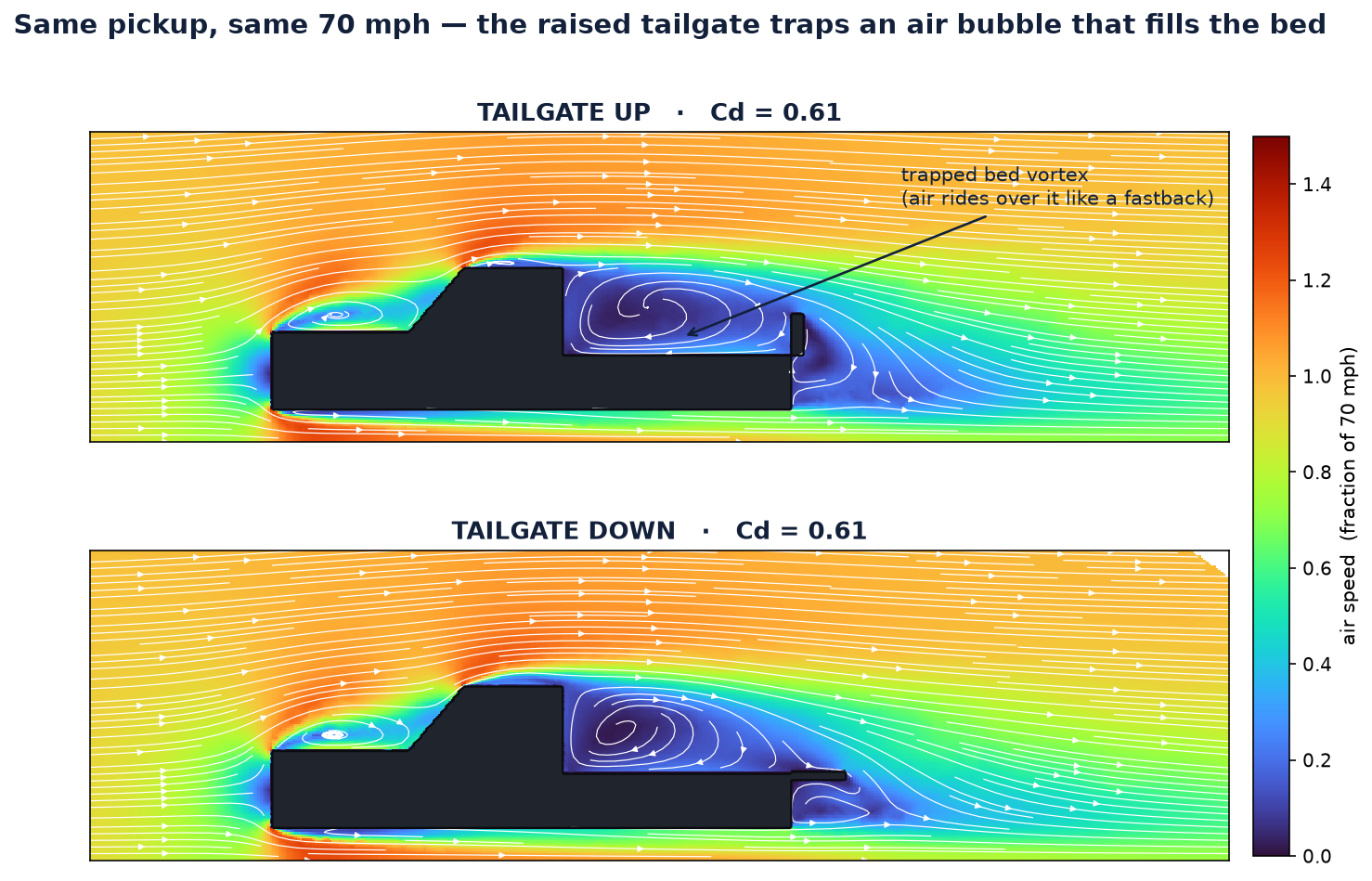
Side-section airflow of a pickup at 70 mph, tailgate up versus down, streamlines coloured by speed showing a trapped recirculating vortex in the bed in both cases
The air over the truck at 70 mph, sliced down the centerline and coloured by speed, tailgate up versus down — a steady Fluent solve. With the tailgate up, a slow recirculating vortex fills the bed and the fast flow simply rides over the top of it, as if the bed had a fastback roof. Drop the tailgate and the picture barely changes — which is exactly why the drag doesn’t either.
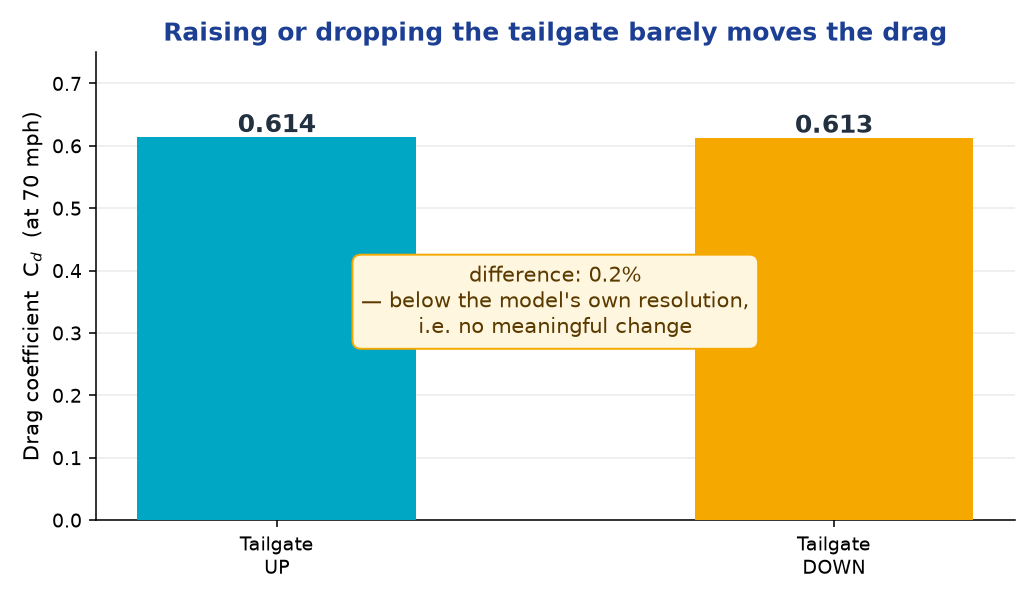
The verdict. At 70 mph the drag coefficient is 0.614 with the tailgate up and 0.613 with it down — a 0.2% difference, which is smaller than the model’s own uncertainty. In plain terms: dropping the tailgate does not save gas. The raised gate doesn’t act like a wall catching air — it traps a cushion of slowly rotating air in the bed, and the oncoming wind glides over that cushion instead of diving into the box.

The trick is the bubble in the bed

An open pickup bed looks like a drag disaster — a big square cavity scooped out of the back of the truck. It isn’t, and the reason is the vortex in the picture above. At highway speed the air separating off the back of the cab doesn’t fall into the bed; it skips across the opening and reattaches near the top of the raised tailgate, trapping a permanent, slowly spinning roll of air underneath. That trapped roll is soft and round, so as far as the outside flow is concerned the bed already has a smooth sloped “roof” on it. The truck behaves a bit like a fastback that it grew for free.

Now fold the tailgate down. Intuition says you’ve removed the wall, so the air should sail through. But the outside flow was never hitting that wall — it was riding over the bubble. Drop the gate and the flow still separates off the cab and still forms a recirculation in the bed; the trailing flap just extends the floor a little. The wake at the very back is slightly different, but the big picture — and the pressure the truck has to push against — is essentially unchanged.
Bar chart of drag coefficient, tailgate up 0.614 versus down 0.613
The two drag coefficients, side by side. The bars are the same height to the eye because they are the same to the physics — a 0.2% gap is well inside the noise of a single-mesh steady solve, so the honest reading is “no difference,” not “down wins by a hair.”

What that means at the pump

At 70 mph most of the engine’s effort goes into shoving air out of the way — aerodynamic drag is roughly half of the total road load, with rolling resistance and driveline making up the rest. So a 0.2% change in drag works out to something like a 0.1% change in highway fuel economy: on a truck that gets 25 mpg, that is a few hundredths of a mile per gallon. You could not measure it on a road trip if you tried, and it is swallowed whole by the direction of the wind, the grade of the road, and how heavy your right foot is.
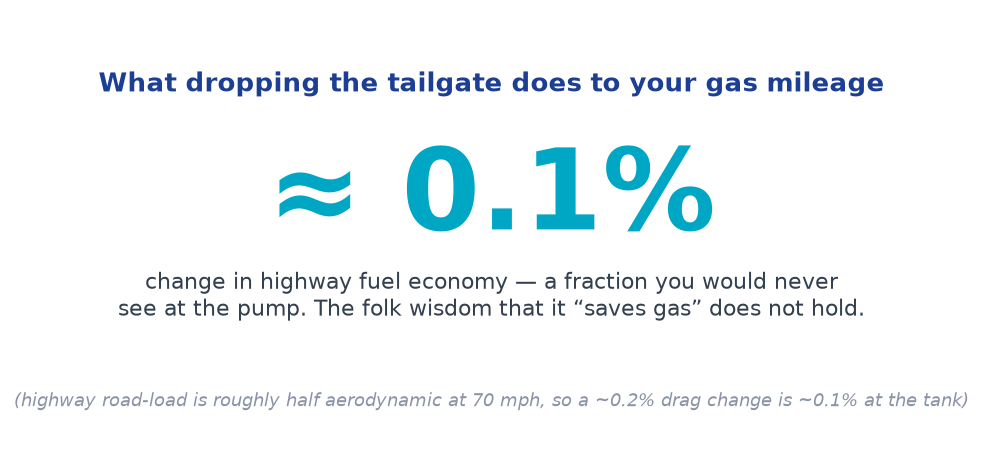
Callout: dropping the tailgate changes highway fuel economy by about 0.1 percent
The practical answer. Dropping the tailgate buys you a fraction of a percent you will never see — and costs you a cargo wall, a rattle, and something to back into. The folk wisdom doesn’t survive contact with the flow field.

How the numbers were made

We built a generic, self-authored pickup — not any particular make or model — and dropped it into a virtual wind tunnel: a large box with air coming in at 70 mph, the road sliding underneath, and open sides so the truck doesn’t feel the walls. Ansys Fluent then solved the steady airflow with the k-ω SST turbulence model — the workhorse for this kind of external-aero question — and integrated the pressure and shear over the body to get the drag. The only thing that changed between the two runs was the tailgate: a vertical panel closing the bed, or a horizontal flap folded down behind it. Same truck, same speed, same everything else — so the difference in the answer is the tailgate and nothing else.

Honest scope. This is a physics demonstration on a deliberately simplified, generic pickup, not a certification of any real vehicle. The absolute drag coefficient here (~0.61) runs high — real production pickups sit closer to 0.42–0.50 — because the model body is boxy, the wheels are simplified and non-rotating, the road is treated as a friction-free (slip) plane rather than a rolling surface, and the mesh is a single-pass polyhedral grid without a formal grid-independence study. Those choices push the absolute number up, but they hit the tailgate-up and tailgate-down cases the same way, so the comparison — the whole point — is far more trustworthy than the standalone value. Note too that the two configurations meshed to slightly different cell counts, which alone can move a drag number by a few tenths of a percent; that is precisely why we report the up-vs-down gap as “indistinguishable” rather than crowning a winner. The robust takeaway — that folding the tailgate down does not meaningfully change highway drag or fuel economy — survives all of these simplifications, and it lines up with what full-scale wind-tunnel and track testing has long found: tailgate up is as good as down, and often marginally better.

Have a shape whose drag actually pays the bills — a truck, a trailer, a delivery van, a roof rack? The same wind-tunnel-in-a-computer that settled this bar-stool argument is what sizes real aerodynamic decisions, from mirror shapes to bed covers to the last few counts of drag that decide a fuel-economy rating. Ansys Fluent and a well-posed external-aero model turn “everybody knows” into a number you can defend. That is innovation through insight.
RS
Rand Simulation — Applications Engineering AI

Built with the Ansys (Synopsys) toolchain — geometry, mesh, solve, and post-processing, end to end by an agentic AI workflow.