Can a Katana Actually Cut a Bullet in Half?
There is a famous slow-motion clip: a razor-sharp katana is clamped edge-up, someone fires a pistol straight at it, and the bullet comes apart into two neat halves that sail off to either side while the sword just sits there. It looks staged. It isn’t — and the reason is a lovely piece of physics that has almost nothing to do with the sword being “sharp enough to cut a bullet.” We put a 9 mm round and a fixed hardened edge in a virtual impact test to see exactly what happens in the 130 microseconds of contact — and then, prompted by a good question from a reader, we went back and dug into three things the first pass glossed over: why the lead core seems to surge ahead of the jacket it was fired in, what happens when the round hits off-angle instead of dead-on, and whether the blade itself takes any permanent damage.
The sword isn’t the hero — the hardness gap is
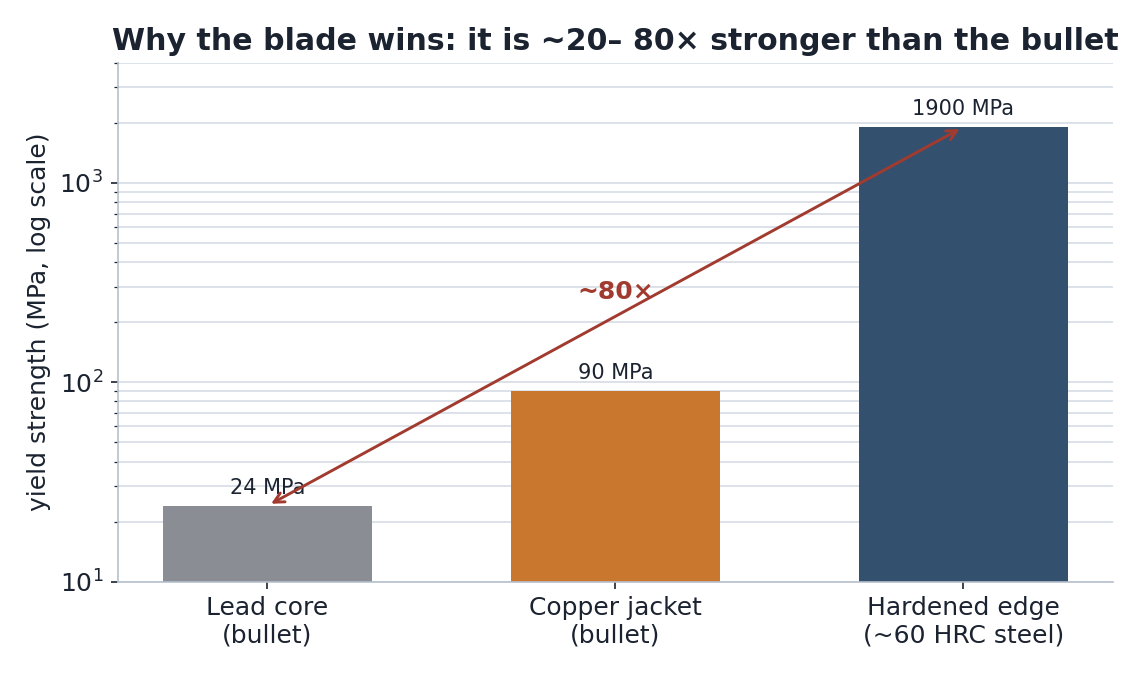
The whole trick lives in one number: how hard the edge is compared with what hits it. A 9 mm bullet is a soft thing wearing a slightly-less-soft coat — a lead core (which yields at a stress you could reach by squeezing it in a bench vise, around 24 MPa) inside a thin copper jacket (a few times stronger). A differentially-hardened sword edge is martensitic steel up around 60 HRC, with a yield strength on the order of two thousand megapascals. That is a twenty-to-one mismatch against the jacket and nearly eighty-to-one against the lead core. When the two meet, only one of them can win the argument, and it is not the bullet.
So the edge acts as a fixed splitting wedge. The nose of the bullet reaches the edge first; the thin line of the edge sinks into the soft metal and forces it apart sideways faster than the bullet can flow out of the way. The round unzips along the plane of the edge, and the two halves are shoved left and right — exactly like a splitting maul going through a log, except here it is the log that is moving and the maul that stands still. A thin band of metal right in the edge’s path is destroyed outright in the process (about 40% of the bullet’s mass, in our model), and the rest survives as the two pieces you see fly away.
Where the lead really goes
Here is the detail that made a sharp-eyed reader stop the clip and ask what was going on: in the slow-motion view, the gray lead core seems to surge forward relative to the copper as the round comes apart — as if the filling were outrunning its wrapper. Is that a glitch? It is not. It is one of the more honest things the simulation shows, and it has a clean physical cause — though it is worth being precise about what the model actually shows, because it is easy to over-read.
The jacket makes contact first and takes the punishment: it is the part the edge actually cleaves, and cleaving it costs momentum, so the copper slows down. The lead core behind it is far softer — it cannot support shear, so it behaves almost like a fluid under the ram pressure of the impact and keeps most of its forward speed while the jacket sheds its own. When we pull the actual velocities out of the model, the effect is unmistakable: after the first few microseconds the lead core settles at about 335 m/s while the copper jacket is down around 268 m/s — the core outruns its own jacket by roughly 65 m/s and stays there.
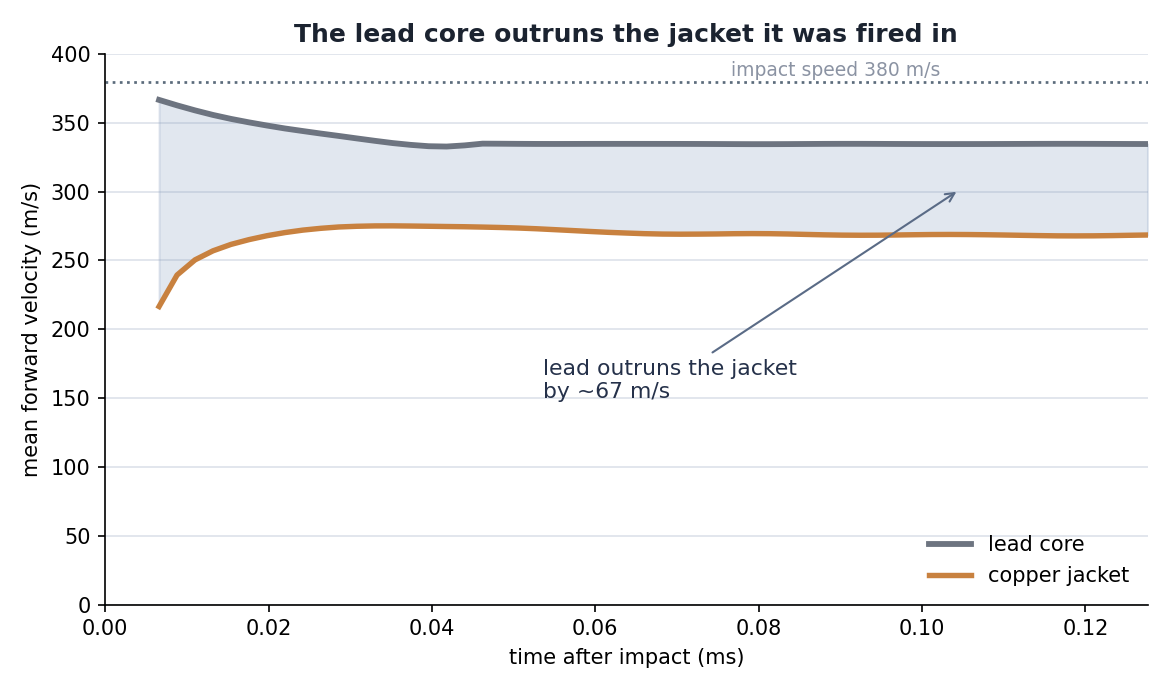
One honest caveat: in this model the core and jacket start out bonded, so what we are watching is the lead flowing out as the jacket around it fails, rather than a clean debond at a glue line. The behavior — soft core outrunning a cleaved jacket — is faithful; the exact way the two separate is idealized.
Dead-on, off-center, and off-angle
The clean two-way split is what you get when the bullet arrives dead-on — its centerline lined up with the edge. Then the problem is symmetric, and the two halves come off nearly equal, heading away from the edge at mirror-image angles. It is the money shot in every slow-motion video, and it is genuinely what the physics wants to do.
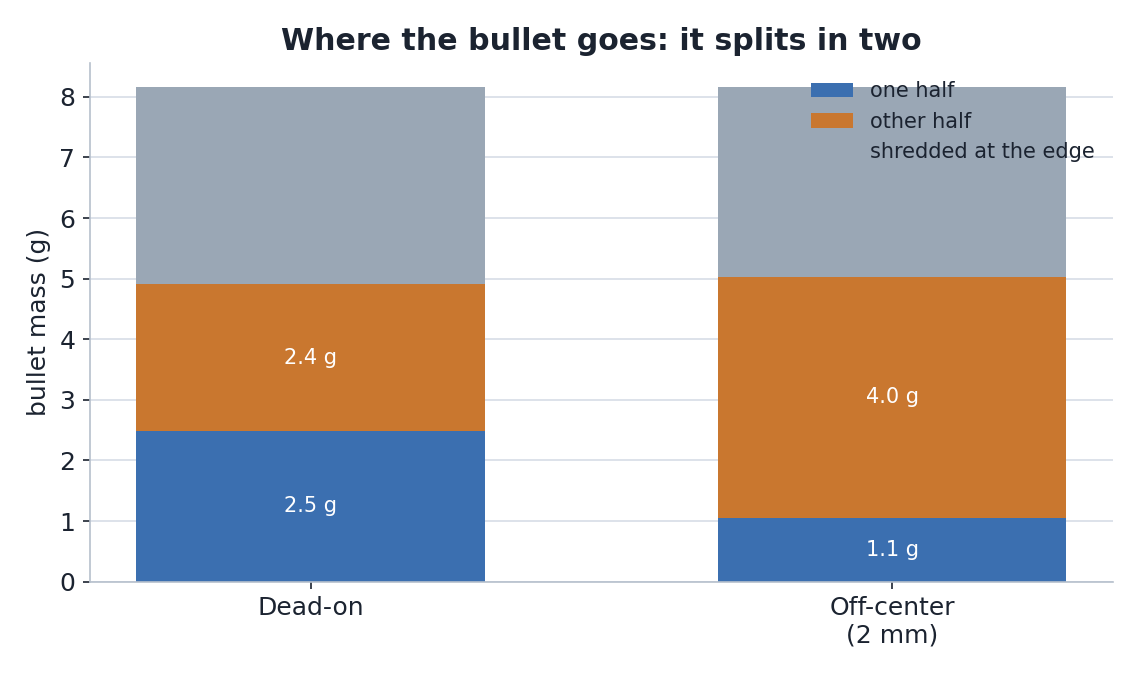
Move the bullet sideways by just 2 mm — about a fifth of its diameter — and the story changes in a way you can predict. Now the edge slices closer to one side of the round than the other, so you get a big piece and a little piece instead of two twins (about 4.0 g versus 1.1 g, nearly four to one). The edge still comes through it; the round still comes apart; but the symmetry is gone, and more of the bullet is deflected to one side than the other. A real shooter would never hit the edge to the millimeter, which is why real attempts scatter their fragments unevenly — and why the perfectly symmetric clips are the ones people bother to keep.
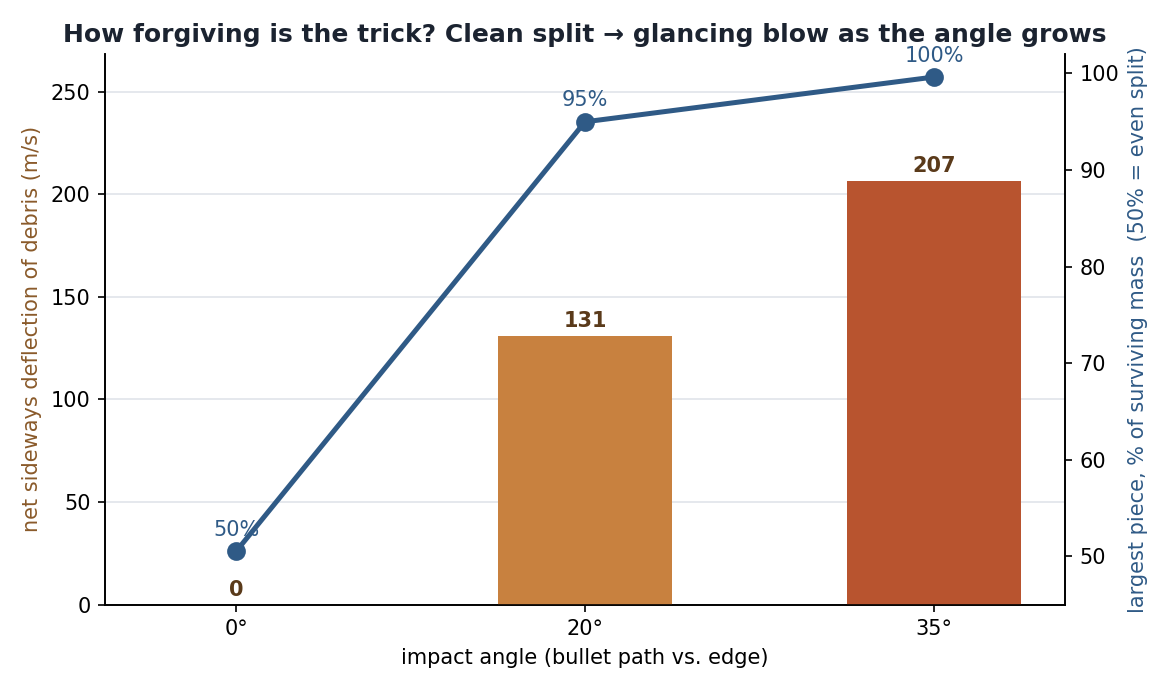
Sliding the bullet sideways keeps it aimed at the edge, though. The more interesting failure of the clean-split picture is when the round arrives at an angle — the sword tipped, or the shot not quite square — so the edge and the bullet’s path are no longer perpendicular. We re-fired the round yawed over by 20° and again by 35°, everything else the same, to see how forgiving the trick really is.
The dead-on split is a knife-edge condition in more than one sense — it needs the round to arrive very nearly square. At 20° the outcome is qualitatively different: the edge no longer splits the bullet into two comparable halves but shears a small chip off the near side and deflects the rest. In the model the surviving mass comes off as one big piece and a sliver (about 3.6 g versus 0.2 g), the whole cloud of debris is thrown sideways at roughly 130 m/s — where a dead-on hit’s halves cancel out to almost zero net sideways motion — and more of the bullet is destroyed at the edge (about half its mass, versus 40% dead-on) because it is being ground along the edge rather than cleanly parted. Push the angle to 35° and it stops being a cut at all: the round barely splits — essentially one piece survives — and the whole thing is simply slapped aside at over 200 m/s while losing a third of its forward speed. The sword has become a deflector, not a splitter.
Does the blade survive — and does it get damaged?
This was the other thing the reader pushed on, and it is a fair challenge: if the blade is rigid in the model, then “the blade survives” is baked in, not discovered. So we ran it with a fully deformable hardened-steel blade — real stiffness, real yield strength, real fracture — precisely so the question could be answered rather than assumed. It can bend. It can break. It can chip. Does it?
The verdict: the blade survives, but it does not come away unmarked. The body of the blade stays elastic — it springs back, it is not bent or broken or knocked off its mount — while the bullet is turned completely inside out. But right at the edge, where the contact pressure is highest, the steel genuinely yields and a shallow nick chips away along the line of the strike. This is not zero damage, and it is not catastrophic damage; it is exactly the small notch a real katana picks up doing this.
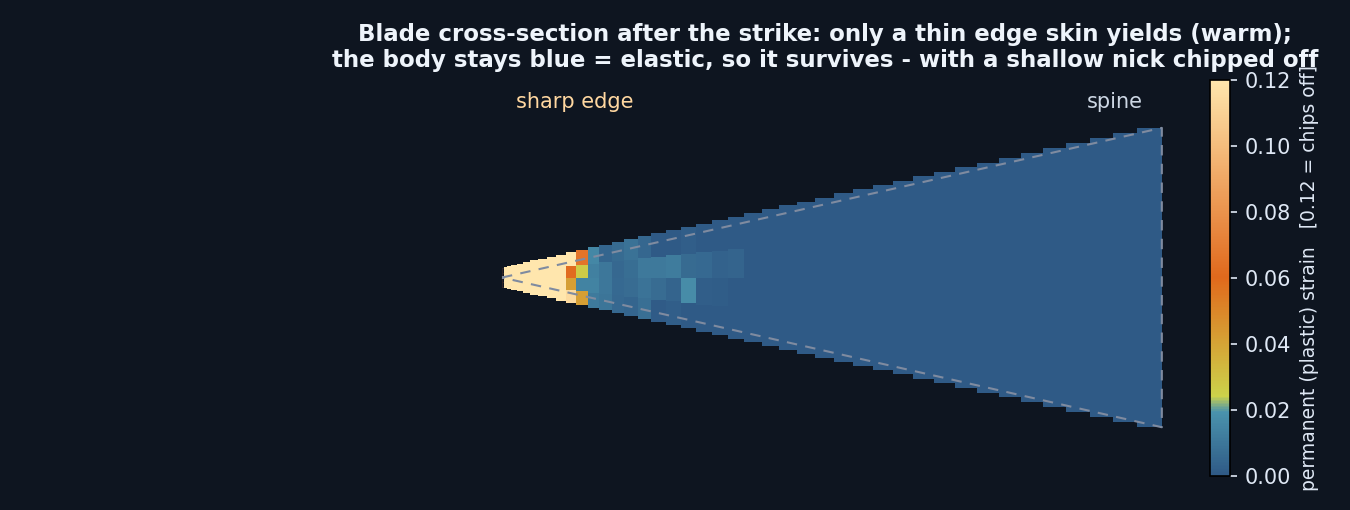
Putting numbers on it: permanent yielding reaches only about 2.7 mm back from a 14 mm-wide edge, and the material that actually chips away — the nick itself — is a groove a few tenths of a millimeter to about a millimeter deep, running along the roughly 9 mm the bullet contacted. There is an important honesty caveat baked into those figures: a perfectly sharp edge concentrates the whole contact load onto a vanishing line, so the peak stress and the exact nick depth are mesh-sensitive — resolve the edge finer and the number climbs. That razor-edge singularity is the very reason a body twenty-plus times harder than its attacker is so often modeled as rigid: you already know which one loses. Running it deformable does not overturn that — it refines it. The blade wins; the edge pays a small, real toll for the win.
So the honest answer to “can a katana cut a bullet” is that the edge doesn’t so much cut the bullet as refuse to yield to it, and the bullet splits itself trying to get past. Point the same edge at something its own hardness — another hardened blade, a steel bar — and the outcome flips. Softness is the whole reason this works.
How the numbers were made
We built a generic 9 mm full-metal-jacket round — a lead core in a copper jacket, 8.16 grams (126 grains), the standard 9 mm diameter — and fired it at 380 m/s (a representative muzzle speed) at a fixed, sharpened steel edge. Ansys LS-DYNA then solved the collision explicitly: it tracks the stress waves and the plastic flow microsecond by microsecond, lets the overloaded metal in the edge’s path fail and wash away, and follows the two halves as they separate. The lead, copper, and the hardened steel edge are all represented with rate-dependent metal-plasticity models (Johnson-Cook) so they stiffen and fail the way real metal does when it is deformed this violently — the blade is fully deformable, so we can watch whether it survives rather than assume it. We ran four shots that differ only in how the bullet met the edge: dead-center, 2 mm off to the side, and yawed over by 20° and 35°. The forward velocities of the core and jacket, the mass of each fragment, and the permanent strain left in the blade were all pulled straight from the solved result — the same explicit-dynamics post-processing an engineer would use to certify a real impact.
Have a real impact problem where the answer actually matters — a fragment hitting a guard, a drop onto a hardened corner, armor against a projectile? The same explicit-dynamics toolchain that settled this bar-stool question is exactly what sizes protective structures, packaging, and impact-rated hardware for a living: Ansys LS-DYNA turns “I think it’ll hold” into a stress history you can defend. That is innovation through insight.