Can You Survive a Falling Elevator by Jumping?
You’ve heard the myth: the cable snaps, the elevator plummets, and if you time a jump for the instant before it hits the bottom, you’ll walk away. It is a lovely idea — and physics has never been kind to it. The usual hand-wave is “your jump is 3 m/s, the fall is 15, so you barely dent it.” True, but it misses the more interesting half of the story. We built the impact in Ansys LS-DYNA and let it play out, and jumping turns out to be not just useless — it is the worst of the options.
The setup
We drop the car from about 11 meters — a few stories, brakes failed — so it arrives at the bottom doing 14.7 m/s (about 53 km/h). At the bottom sits a crushable buffer (real shafts have them), which we sized so it stops the car over its stroke and absorbs essentially all of the energy — the model conserves energy to within half a percent. Standing on the car floor is our occupant — a crash-test-dummy stand-in: a rigid torso-and-head mass on two crush-strut legs that squash at a set force, a simple shock-absorber stand-in for real legs (just as an automotive dummy stands in for a body). Then we run the same crash three ways and watch the deceleration at the torso:
- Stand — locked knees, riding it straight down.
- Brace — knees bent, legs set soft and long so they crush over a bigger distance.
- Jump — push off the floor just before impact, so the body is moving down a few m/s slower than the car when everything reaches the bottom.
The jolt, three ways
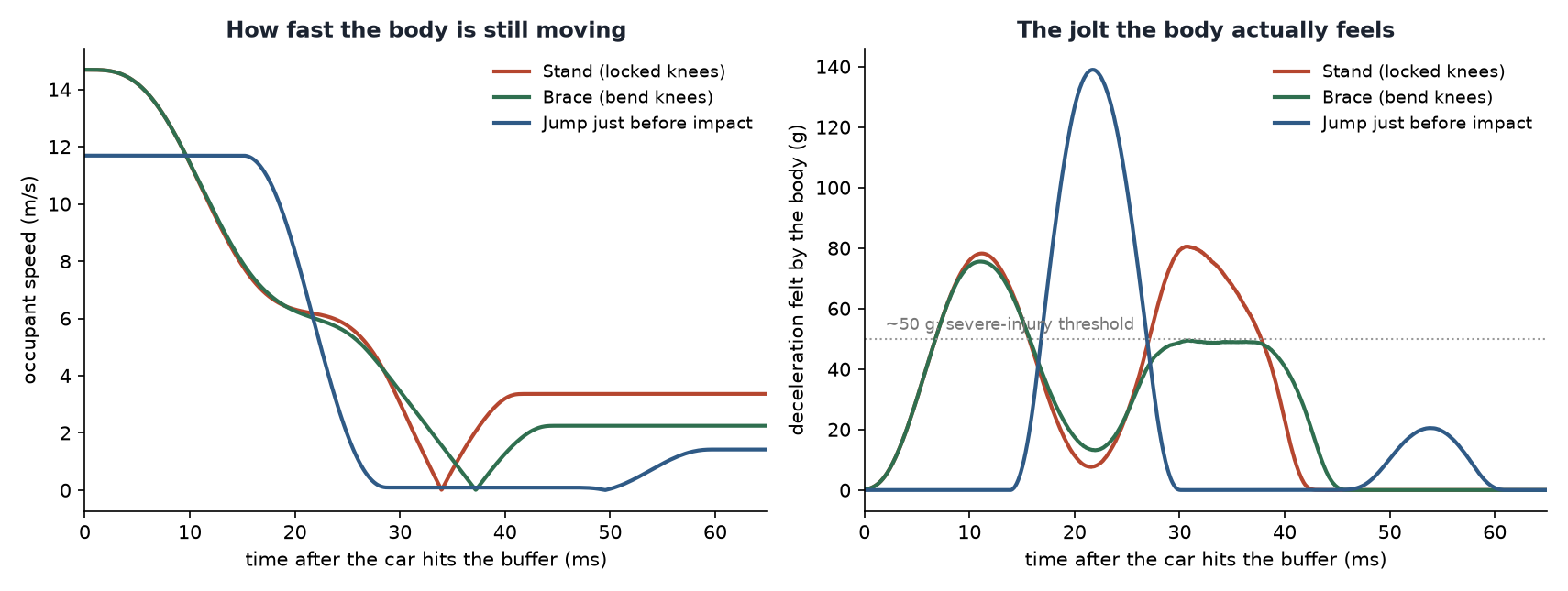
Why is jumping worse when it lowers your speed? Because peak deceleration isn’t set by how fast you’re going — it’s set by how sharply you stop. When you jump, you leave the floor. The floor then slams into the buffer and decelerates hard without you — but it keeps moving down, just much slower now. A few milliseconds later your still-falling body catches back down onto that now-slowed floor, and your legs alone have to absorb the entire stop, over their short stroke, in the ~10 ms it takes. That is a second, separate, very abrupt collision — a short, tall spike instead of the longer, gentler squash you get by staying planted and letting your legs and the buffer work together the whole way down. Trading a little speed for a much sharper stop is a bad trade.
Bracing is the mirror image: by bending your knees you turn your legs into a longer-stroke shock absorber, stretching the stop out over more distance and more time, which is exactly what lowers the peak. It is the same principle as rolling when you land a jump, or the crumple zone in a car — and it is why “bend your knees” is the one piece of falling advice that actually holds up here (even if, at 14.7 m/s, it is nowhere near enough).
So what actually saves you?
Not technique. The numbers say the best and worst human responses land in the same place — at or beyond the edge of survivable whole-body tolerance, where walking away would be exceptional. What keeps elevator falls almost unheard-of is engineering redundancy: multiple independent brakes, a speed governor that clamps the rails if the car overspeeds, and — if all of that fails — the buffer at the bottom of the shaft, the same crushable element we modeled here. Real shaft buffers are sized to stop a car arriving at roughly its rated speed — because the governor is supposed to have already caught it — not the 14.7 m/s of a multi-story unbraked fall. That is exactly why the same element that saves you in practice is overwhelmed in our deliberately worst-case scenario: we switched off the very protection (the brakes and governor) that keeps the impact speed low in the first place. The passenger’s best move is to lie down and spread the load if there’s time; but mostly, the part that saves you was designed in long before you stepped on.
But doesn’t the car itself collapse on you?
Here’s the question we get every time this comes up: fine, jumping doesn’t help — but even if you somehow got clear of the floor, wouldn’t the car come down and crush you anyway? So we made the car structure deformable too: a heavy roof (the ceiling plus the overhead machinery it carries, about 220 kg) sitting on the car’s frame, the whole thing riding the same shaft-bottom buffer with the occupant standing inside.
With an intact frame the answer is no — and the reason is simple once you see it. A real elevator’s hoist frame (the “sling” the car rides in) is built to carry the car plus a full load with a big safety margin, so it is far stronger than the roof it holds. It doesn’t crumple — so we model it as elastic, non-crumpling by assumption, which its real-world strength margin more than earns — and it carries the roof down together with the floor: in our solve both drop about 0.45 m onto the buffer as one unit, the frame flexing only a few centimeters, so the roof never closes on the occupant. The gap stays open the whole way down — roughly a third to a half meter of headroom, dipping and recovering as the elastic frame rings, but never closing. The ceiling isn’t what gets you; the shared deceleration is, exactly as the first half of this post found.
That leaves the darker version of the question: what if the frame itself fails — a corroded or severed sling, or a car that lands hard enough to buckle its own structure? Then the roof really can come down on you. We didn’t force that outcome here, because doing it honestly means modeling the whole hoist frame buckling and folding — a bigger structural problem than a single-car drop — and a block of steel rigged to collapse on cue would just be theater. So we flag it plainly instead: a collapsing car is a real danger, in the same family as the other hazards a single intact-car model doesn’t contain — a severed frame dropping the car with nothing to catch it, the counterweight coming down the adjacent rails, and loose overhead machinery or ceiling panels shaking free. Those are worth naming; what our model can say cleanly is the reassuring half: an intact car does not crush its occupant with its own roof.
Have something that has to survive a drop, a crash, or a shock — a shipping case, a battery pack, a piece of equipment that gets dropped on a dock? The same explicit-dynamics toolchain that ranked these three responses is exactly how Rand Simulation sizes crush zones, buffers, and mounts so the thing inside sees a survivable pulse instead of a lethal spike. That is innovation through insight.