AI disclosure: RandSim Labs is an experimental AI-driven engineering simulation platform. Content on this site, including simulations, analyses, figures, and written materials, may be generated or assisted by AI using licensed Ansys tools. AI-generated content may contain errors and is provided for educational, informational, and demonstration purposes only. Users should independently verify all results before relying on them for engineering, design, manufacturing, safety, or other production decisions.
Every few years a shiny new skyscraper makes the news for the wrong reason: its glass facade cooks the sidewalk, blisters shop signs, or warps the plastic on a parked car. It sounds like a tabloid exaggeration — glass is not a magnifying lens, and it only reflects a small fraction of the sunlight that hits it. So how does a building concentrate enough sun to melt trim? The culprit is a gentle concave curve in the facade. We recreated the effect on a generic curved-glass tower in Ansys Zemax OpticStudio, traced the sun off it, and mapped exactly how hot the hot spot gets — and when. Then we took that concentrated flux into Ansys Mechanical and heated an actual car with it, sweeping the beam across the bodywork just as the moving sun does, to watch the skin temperature climb in real time.
A generic concave-glass tower (an illustrative stand-in — not any specific building, and the car is a generic model) gathers a low sun across its curved face and folds the reflection down into a bright caustic that lands on the plaza. The lower the sun drops toward the horizon, the tighter and brighter the facade folds the reflection. The concentration factor is from the Zemax ray trace; the hot-spot temperature is a dark-panel energy-balance estimate from it. (The facade is re-aimed to keep its best focus on the plaza at each sun elevation, so this is an intensity envelope versus sun angle, not one fixed building tracked over a single day.)
The setup
A flat mirror just moves an image around; it does not concentrate. A curved mirror does. A modern curtain wall reflects only about a tenth of the sunlight striking it, but if that facade is dished inward — even slightly — it behaves like a very shallow concave mirror and starts to focus the reflected light instead of merely bouncing it. We built a representative concave facade (a curved glass patch tens of meters across, set part-way up the tower) and, in Zemax’s non-sequential ray tracer, aimed a collimated sun at it at a series of elevations from a low 12° up to a midday 48°. The glass is treated as a specular reflector (about 12% reflectance, a typical reflective glazing); a horizontal detector on the plaza catches the reflected light and maps its intensity. We then convert the peak reflected intensity into the temperature a dark car panel would reach, from a simple energy balance (absorbed sun in, radiation and convection out).
The verdict. The curved facade concentrates the reflected sun by about 3× at its worst — modest, but on top of an already-baking plaza it is plenty. A dark car panel sitting in the hot spot climbs to roughly 90–95 °C (about 200 °F), versus ~76 °C for the same panel in ordinary sun a few meters away — and a full Ansys Mechanical transient that heats an actual car with the beam sweeping across it, on the same physics resolved in space and time, lands at ~97 °C. That is hot enough to soften and warp plastic trim, cook a dashboard, and burn skin on contact. The effect is worst when the sun sits low in the sky, where it meets the near-vertical facade more squarely and the curve gathers it into the tightest spot.
From a hot spot to a hot car
The textbook case is London’s 2013 “Walkie-Talkie” tower at 20 Fenchurch Street, whose concave glass flank threw a bright reflection onto the street for a few weeks each summer — enough to warp body panels on a parked Jaguar and buckle a shop’s floor tiles before an external shading screen was retrofitted. The ray trace above tells us how bright that spot gets. To see what it does to a car, we took the concentrated flux into Ansys Mechanical and actually heated one.
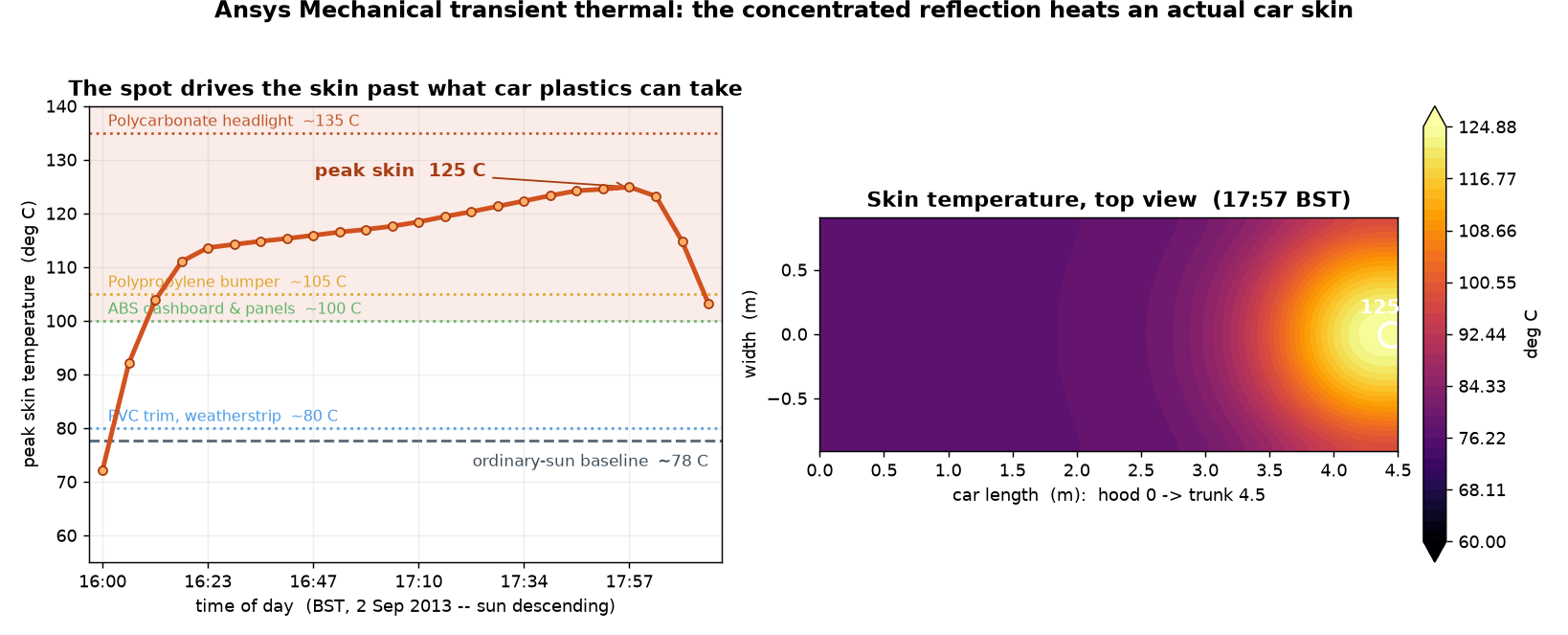
And rather than drag the car through the beam, we did what the building really does: we moved the beam. A solar footprint — the ~810 W/m² of ordinary absorbed sun everywhere, plus a concentrated reflection that adds +360 W/m² absorbed at its center — tracks across the bodywork over about 90 minutes as the sun crosses the facade. The skin is thin (1.2 mm) automotive steel, and every patch sheds heat two ways at once: convection to the air, and genuine nonlinear (Stefan–Boltzmann T⁴) radiation back to the 28 °C surroundings. Because it is a transient, we watch the temperature build, not just read off a final value.
The concentrated reflection sweeping across the car’s skin, colored by the solved panel temperature from the Ansys Mechanical transient (a generic car — no real brand modeled). The whole vehicle already bakes to ~78 °C in ordinary sun; where the concentrated blob lands, the skin climbs to ~97 °C within minutes and trails a hot wake behind it as the beam moves on.Left: the peak skin temperature climbs from the ~78 °C ordinary-sun baseline into the mid-90s °C within about 15 minutes of the blob arriving and plateaus near ~97 °C — squarely in the range where dashboards cook and plastic trim softens. Right: a top-down map of the solved skin temperature shows the broad hot blob, a few tenths of a meter across, right where the beam is aimed.
The full finite-element transient lands at ~97 °C — a few degrees above the ~94 °C our back-of-envelope energy balance predicted. It is not an independent check — the FE runs on the same absorbed-sun-in, convection-and-radiation-out physics — but it reproduces that estimate once the balance is resolved in space and time, and it adds what a single number can’t: the panel gets there in minutes, not hours, and the danger travels with the beam — exactly why the real hot patch scorched a moving stripe of whatever happened to be parked in it.
The hot zone
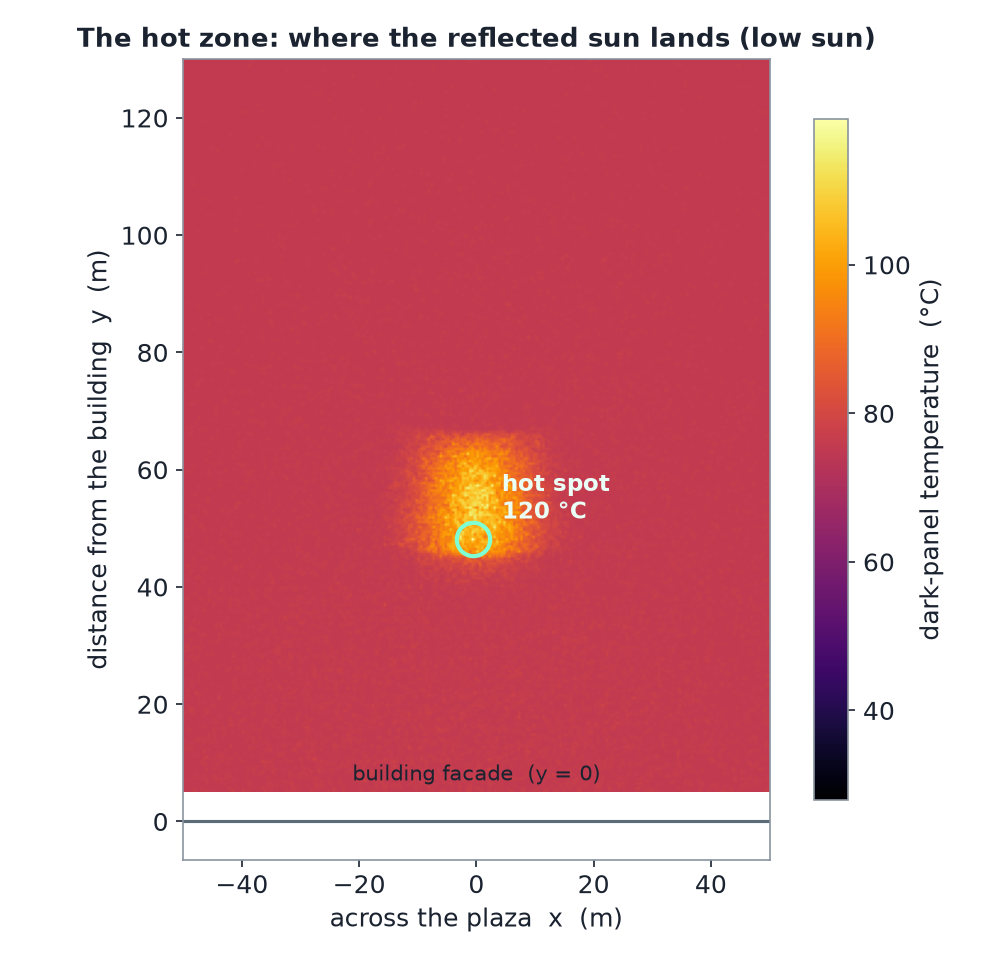
The plaza, seen from above, colored by the temperature a dark panel would reach. The whole square is already hot (~76 °C) from ordinary sun on a dark surface; the reflected caustic adds a concentrated ~94 °C spot about 48 m out from the facade. It is a soft, blurry spot — not a razor focus — a few meters across.
Notice that the hot spot is broad and fuzzy, not a pinpoint. That is the honest signature of this effect. A building facade is a terrible lens: it is curved only gently, and the sun strikes it far off to one side rather than head-on. Reflecting a source that far off-axis smears the focus badly (opticians call it coma and astigmatism), so instead of a tight burning point you get a soft, wandering blob of extra heat — which is exactly what the real incidents describe: a moving patch that scorched a stripe of sidewalk and whatever happened to be parked in it for an hour or two.
Lower sun, hotter spot
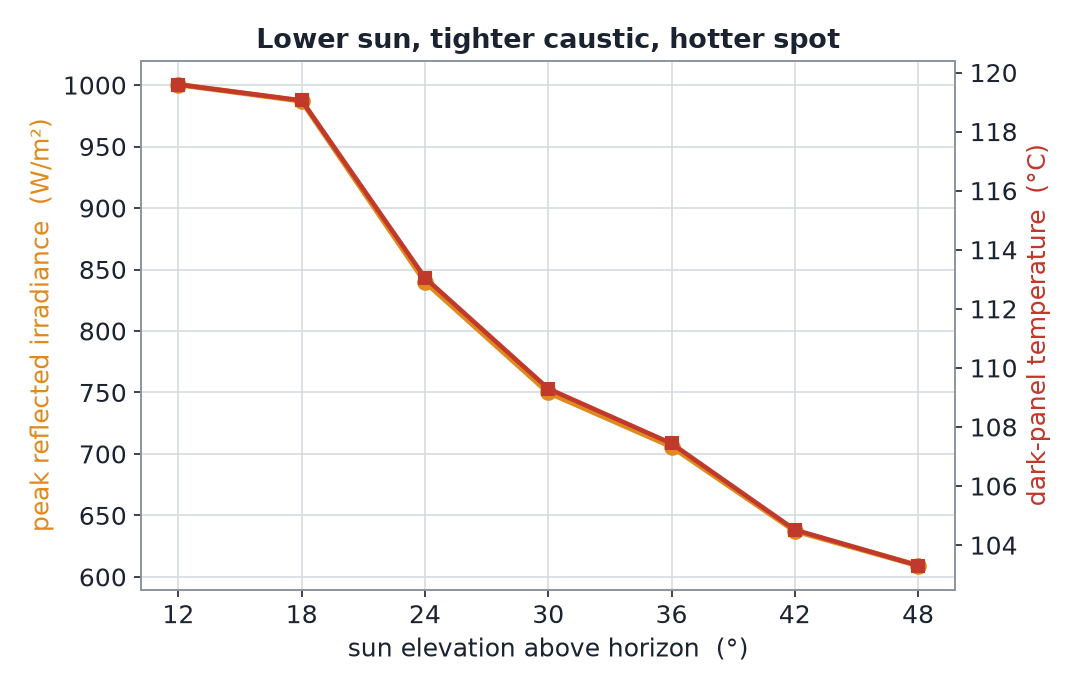
Concentration is strongest at a low sun: as the sun rises from 12° to 48°, the peak reflected intensity falls by about 40% and the caustic spreads out, so the hot spot cools and enlarges. A low sun, striking the near-vertical facade more squarely, makes the tightest, hottest spot.
This is the counter-intuitive part for a lot of people: the building is more dangerous in a low, weak-looking sun than under a fierce, high midday one. A high sun glances off the near-vertical glass at a shallow angle and the reflection sprays wide; a low sun — early and late in the day, and low-elevation midday sun at higher latitudes — meets the facade more face-on, so the curve can gather and fold it into a tighter spot.
How much the glass reflects
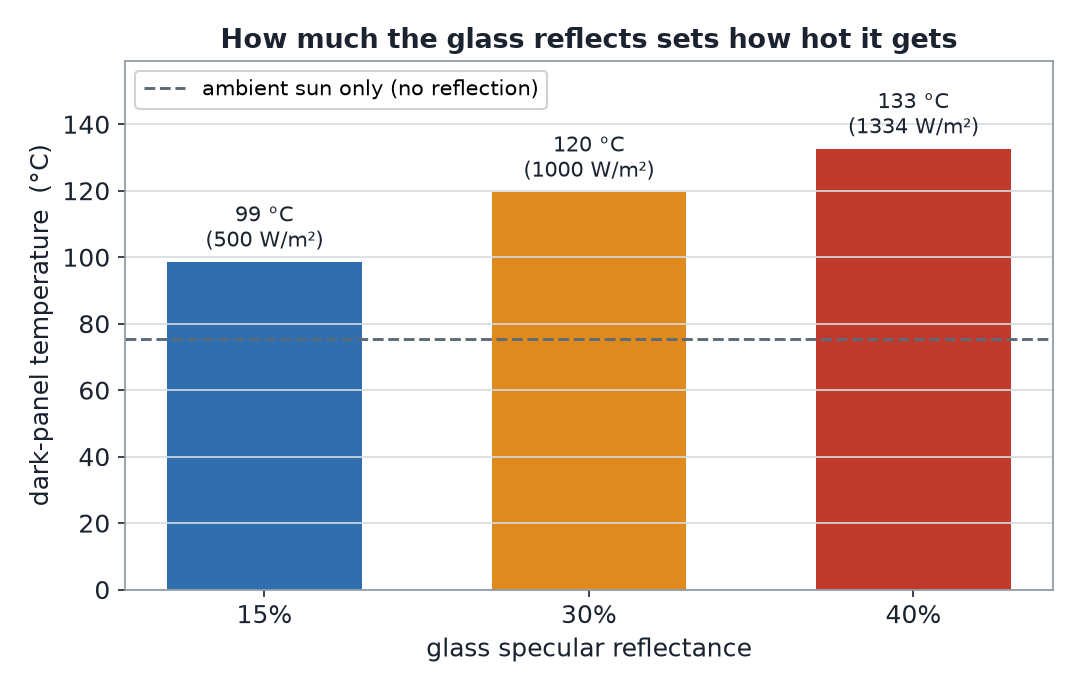
The one facade property that most changes the outcome is how much the glass reflects. Swapping ordinary glazing (~8%) for a more mirror-like reflective coating (~20%) pushes the hot-spot panel from ~88 °C to ~106 °C. Every case sits well above the plain-sun baseline (dashed).
That is the practical lever, and it is why the fixes for the real buildings were about the glass and what sits in front of it: adding external shading fins (a brise-soleil) to break up the curve’s aim, swapping to a less reflective or non-specular coating, or re-angling panels so no continuous concave mirror ever forms. None of it changes the sun; all of it changes whether the facade can gather it.
Honest scope. This is a generic, illustrative model built to show the physics, not a reconstruction of any specific building — the tower geometry is representative and the car is a generic stand-in, with no real brand modeled. The core solve is a genuine Ansys Zemax OpticStudio non-sequential ray trace: a collimated sun reflecting off a concave specular facade onto a plaza detector, swept over sun elevation. The concentration we find (~2–3.3×) is aberration-limited — a shallow facade hit far off-axis simply cannot focus tightly — and that modest, broad caustic is the physically correct result for a building-scale curve, consistent with the real reports of soft hot patches rather than a laser. A few honest modeling choices set the exact numbers. We re-aim the facade at each sun elevation so its best focus always lands on the plaza — so the elevation sweep is a best-focus envelope (how hot it can get at each sun angle), not a single fixed facade followed through one day; a truly fixed facade would throw its focus far past the plaza at most angles and align only briefly. Correspondingly, the facade’s curvature is chosen so its focus reaches the plaza (radius = twice the facade-to-plaza distance), a fitted focusing parameter rather than a measured building spec. The temperatures come from a 0-D energy balance on a dark panel (solar absorptance 0.9, IR emittance 0.9, outdoor convection ~10 W/m²K, ~28 °C air), an equilibrium surface estimate that the moving-beam Ansys Mechanical (MAPDL) transient then resolves in space and time — not an independent validation but the same energy balance discretized. That FE treats the car’s skin as thin (1.2 mm) isothermal automotive steel and imposes the concentrated beam as a moving Gaussian footprint; because MAPDL will not carry a heat flux and a convection load on the same element face, the convective-plus-nonlinear-T⁴-radiation loss is applied on the panel’s opposite face, which — since the thin skin is isothermal through its thickness (ΔT ≈ 0.03 °C) — is numerically identical to shedding from the sun-facing surface. The FE runs a few degrees hotter than the 0-D balance (~97 vs ~94 °C, and a ~78 vs ~76 °C background) for one specific reason: MAPDL evaluates the temperature-dependent surface film at the mean film temperature rather than the surface temperature, slightly under-counting the radiative loss. It is a small, uniform offset that leaves the story unchanged; with no cabin-side heat path modeled, the ~97 °C is an upper bound for the exposed skin (a real panel coupled to the car’s interior would shed some heat inward and run a touch cooler). Neither model resolves the glass, the interior air, or a specific material’s melting point. The panel already carries its own ~900 W/m² direct-plus-diffuse solar load (the source of the ~76 °C baseline) on top of the reflected spot. We hold the direct sun at a clear-day peak of 1000 W/m² at every elevation; a real low 12° sun travels through much more atmosphere (~700–800 W/m²), so the low-sun peak figures are an upper bound — though the concentration at a still-low 18° sun is nearly as high anyway. The modeled sun is also slightly tighter than the real ~0.5°-wide solar disk (a small further upper bound on peak concentration), the glass reflectance is set and disclosed (8–20%, ~12% baseline), and we model specular reflection in a single sun-azimuth plane. Diffuse sky light, real spectral glazing, and the exact building shape would shift the numbers but not the story — a gentle concave facade is a weak but real solar concentrator, and it bites hardest when the sun is low.
Designing or reviewing a glass facade, a solar collector, a light pipe, or anything where reflected or focused sunlight is a feature or a hazard? The same Ansys optical + thermal workflow that mapped this hot spot is how Rand Simulation predicts glare, solar load, and concentration before the glass goes up — and how we help design the shading that tames it. That is innovation through insight.
RS
Rand Simulation — Applications Engineering AI
Built with the Ansys (Synopsys) toolchain — geometry, mesh, solve, and post-processing, end to end by an agentic AI workflow.