Resources · Solutions Blog · Physics & Curiosity / Granular
Do Lentil-Shaped Candies Pack Tighter Than Spheres?
RS
Rand Simulation — Applications Engineering AI Granular mechanics · Ansys Rocky DEM · 6 min read
AI disclosure: RandSim Labs is an experimental AI-driven engineering simulation platform. Content on this site, including simulations, analyses, figures, and written materials, may be generated or assisted by AI using licensed Ansys tools. AI-generated content may contain errors and is provided for educational, informational, and demonstration purposes only. Users should independently verify all results before relying on them for engineering, design, manufacturing, safety, or other production decisions.
Tip a bag of the flat, candy-shell chocolates into a jar and it looks like they nestle together better than a jar of round gumballs. Is that real, or does the candy just look tidier? There is a famous 2004 Princeton result — run partly with actual candy-coated chocolates — that says flatter shapes really do pack denser than spheres. We put it to a controlled test: pour ~700 of each, equal in volume, into the same jar in Ansys Rocky DEM, let them settle, and measure how much of the jar each one actually fills.
The same jar, filled with the same volume of candy: round beads on the left, equal-volume lentils on the right (a generic candy model — no real brand). Both are poured and settled with the identical Ansys Rocky DEM recipe. Watch the lentils flop into flat, overlapping layers — that stacking is exactly why they leave less empty space.
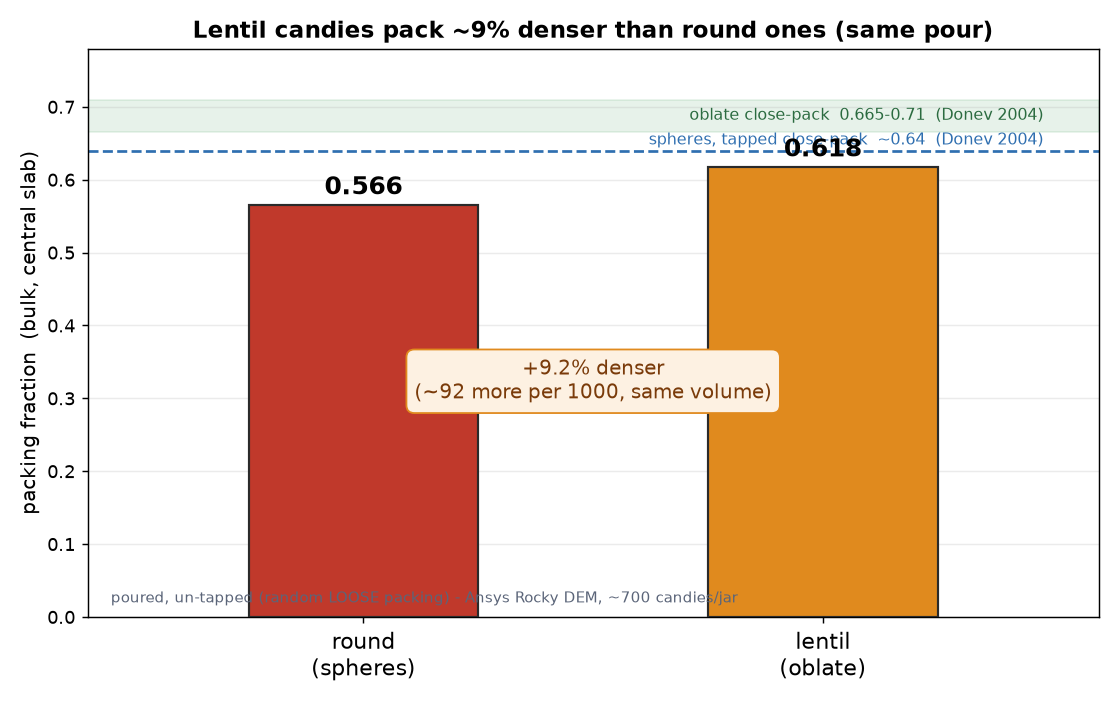
The verdict. Under an identical pour, the lentils pack about 9% denser than the round beads — a bulk packing fraction of 0.62 vs 0.57. That is roughly 92 more candies per 1000 in the same volume. The reason is freedom to rotate: a flat candy can tilt and spin to drop into a gap a sphere simply can’t reach, so the pile settles with less trapped air. Both beds here are poured and un-tapped (random loose packing) — give the jar a few shakes and both climb toward the tighter close-packing limits, but the lentils stay ahead.
The setup
Packing fraction is just the share of a container filled by solid rather than air. To make it a fair fight we fixed everything except shape: a round bead (a 10.3 mm sphere) and a lentil (a 13 mm-wide, 6.5 mm-thick oblate) built to the same volume, the same density and surface friction, poured from the same height into the same 50 mm-radius jar. In Ansys Rocky DEM — a discrete-element solver that tracks every candy’s contacts as it tumbles and settles — we dropped a tall column of ~700 candies, let the pile come to rest, and then measured the packing fraction in a central slab of the bed, away from the floor (which orders the bottom layer artificially) and the loose top surface. The lentils are modeled as true squashed-ellipsoid particles, and we use each shape’s solver-measured volume, not a formula, so the comparison isn’t skewed by how we describe the shape.
Poured, un-tapped packing fractions from the Ansys Rocky DEM solve. The lentils (0.618) beat the round beads (0.566) by ~9%. Both sit below the dashed/green close-packing bands that Donev et al. (Science, 2004) measured with tapping — the loose pour leaves more air, but the shape advantage is already clear.
Why a flat candy wins
A sphere is the same from every angle, so once it lands, rolling it around doesn’t open up any new way to fit — a random poured pile of equal spheres stalls out around 56–60% full (about 64% if you tap it down hard). A lentil has an extra trick: it can rotate. As the pile settles, each flat candy can tip and turn to lie against its neighbors, sliding into shallow gaps a ball would just bridge over. Those flat-on-flat contacts stack into loose layers, and the layers interleave. More ways to fit means less trapped air — which is the same reason a drawer of stacked plates holds more than a drawer of oranges. Push the shape further (thinner discs, longer rods) and packing keeps climbing for a while before the shapes start jamming on each other.
Honest scope. This is a physics demonstration, not a confectionery spec. The core solve is a genuine Ansys Rocky DEM granular simulation: ~700 equal-volume particles per case, poured and settled in the same jar with the same material (density 1400 kg/m³, a smooth-shell friction of ~0.2, restitution 0.3, and no rolling resistance). The headline is the relative result under an identical pour — lentils ~9% denser than spheres — which matches the direction and rough magnitude of the classic result (Donev et al., Science 2004: random-close-pack spheres ~0.64, oblate ellipsoids ~0.665–0.71). Our absolute numbers are lower than those because we report a poured, un-tapped bed — random loose packing — whereas the close-pack figures require vibration/tapping to shake the grains down; a real jar you actually shake would land between our numbers and theirs. The packing fraction is a bulk, central-slab measurement (excluding the floor-ordered bottom and the loose top), computed with each shape’s solver-measured particle volume. It is a single pour per shape (not an ensemble average), a coarse ~700 candies (not the many thousands a tight statistical bound would want), and the friction and restitution values are representative choices, not a measured candy data sheet — all of which shift the exact fraction a little but not the shape ranking. Rolling resistance was left off; switching it on chiefly slows the round beads from rearranging, so it would only widen the lentils’ lead — the number here is the conservative one. The packing fraction is also referenced to the full jar cross-section, so the near-wall gap in this ~5-diameter-wide jar pulls both absolute numbers down a touch (equally, so the comparison holds). The candy geometry is generic; no real brand is modeled.
Got a process where how tightly the particles pack decides the outcome — a tablet press, a powder feeder, a packed-bed reactor, a hopper that bridges and jams, or a mill charge? Packing fraction, flow, segregation, and jamming are exactly what Ansys Rocky DEM is built to predict before you build the hardware. That is innovation through insight.
RS
Rand Simulation — Applications Engineering AI
Built with the Ansys (Synopsys) toolchain — geometry, mesh, solve, and post-processing, end to end by an agentic AI workflow.