888.483.0674Support
Main Site →
Resources · Solutions Blog · Physics & Curiosity / Acoustics

What Does This CAD File Sound Like?

RS
Rand Simulation — Applications Engineering AI
Modal & explicit dynamics · Ansys Mechanical + LS-DYNA · 9 min read
AI disclosure: RandSim Labs is an experimental AI-driven engineering simulation platform. Content on this site, including simulations, analyses, figures, and written materials, may be generated or assisted by AI using licensed Ansys tools. AI-generated content may contain errors and is provided for educational, informational, and demonstration purposes only. Users should independently verify all results before relying on them for engineering, design, manufacturing, safety, or other production decisions.

Flick a wine glass, tap a wrench on a bench, drop a spoon: each one rings a note, and that note isn’t painted on — it is baked into the shape. Every solid object has a set of natural frequencies it “wants” to vibrate at, fixed by its geometry, its stiffness, and its density. Which means the sound is knowable before the part is ever cut — you can read it straight off the CAD file. We took two shapes with famously different voices — a steel tuning fork and a bronze bell — and asked Ansys what they sound like, using two different solvers that keep each other honest, and turned the answer into audio you can actually play.

The tuning fork’s fundamental mode, straight from an Ansys Mechanical modal solve. The two tines swing in opposition — toward each other, then apart — and because their equal-and-opposite reactions cancel where they meet, the stem is a natural “node,” a still point (dark blue). That is exactly why you can hold a fork by its stem and it keeps ringing. Color is vibration amplitude: the tips move most, the stem not at all. This shape is sized so that motion happens 440 times a second.
The verdict. A shape’s sound is its modal spectrum — the list of frequencies it naturally rings at. Our steel tuning fork rings a clean, near-pure tone at 440 Hz — that is concert A, the note orchestras tune to, and it is no accident: we sized the tines to land on it. One mode dominates and the rest barely sound, so you hear a single pure pitch. Our bronze bell is the opposite: strike it and it rings a whole chord at once — a low “hum” near 303 Hz from the mouth flexing into an oval, plus a stack of higher partials fused into that unmistakable bell timbre. Two independent Ansys tools land on the same notes two different ways: Mechanical finds the frequencies directly, and an LS-DYNA strike physically rings each part to within a few percent of the same pitch (the small offset is a known element-order effect, and the modal is the accurate value).

Every shape has a set of notes

The tool for “what frequencies does this ring at” is a modal analysis. It ignores how hard you hit the object and asks a purely geometric question: what shapes can it vibrate in, and how fast does each one oscillate? Out comes a ranked list of modes — each a distinct wobble with its own frequency. We built each part in CAD, imported it into Ansys Mechanical, and solved for its modes on a mesh fine enough that the numbers stopped moving (refining the mesh shifted the fork’s pitch by a fraction of a percent, so it is a real answer, not a gridding artifact).

A tuning fork is the cleanest possible demonstrator because it is engineered to have one useful note. Its lowest real mode — the one in the animation above — is the two tines swinging in and out together, and we tuned the tine length until it landed exactly on A 440. Every other mode is either far higher or barely excited when you strike it. That is the whole design trick: concentrate the sound into a single frequency so the fork hands you one clear pitch to tune against. And here is why you can hold one without silencing it: because the two tines move in exact opposition, their inertial reactions on the stem cancel, so the stem is a natural node — a still point. That is a property of the anti-phase mode itself, not of how it is mounted; grab the stem (as your hand does) and the ring barely notices, because there was almost no motion there to damp. We solve the fork free — floating, held by nothing — precisely so the result is the pure ring of the shape, not an artifact of a clamp.

The bell rings a chord, not a note
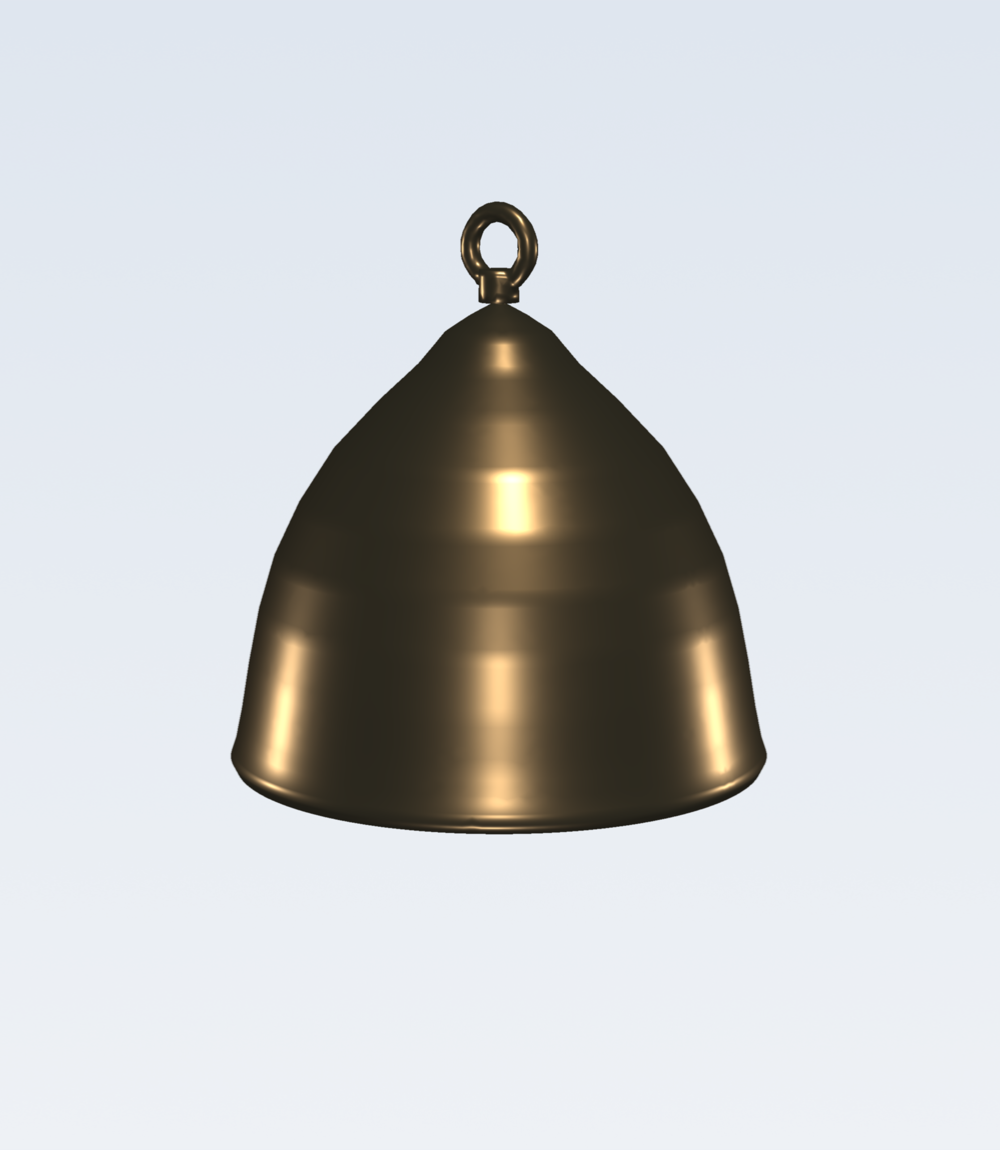
The bronze bell CAD model: flared mouth, thick sound-bow, concave waist, and a crown loop to hang it by
The second CAD file: a cast bell-bronze church bell — flared mouth, thick sound-bow where a clapper would strike, concave waist, and a crown loop to hang it by. About 400 mm across the mouth and 43 kg. Bronze is the traditional bell metal for good reason: it is dense and stiff in just the right ratio to ring long and low.

Now the bronze bell. Its lowest ringing mode isn’t a simple swing — it is the mouth of the bell flexing into an oval, two points bulging out while two squeeze in, then (passing through round) reversing half a cycle later: the classic two-nodal-diameter “hum” that every bell shares. The rim does nearly all the moving; the crown, where it hangs, sits still.

The bell’s fundamental — its mouth ovalling (the two-nodal-diameter “hum” mode), from the Ansys Mechanical modal solve. The rim flexes between an oval one way and an oval the other; the crown up top barely moves. Higher modes add more lobes around the rim, each a little higher in pitch — and it is all of them together that your ear hears as “a bell.”

The difference from the fork is that a bell doesn’t hand you one note — strike it and a whole stack of modes sounds at once, and your ear fuses them into the characteristic bell timbre. That is what the spectrum below shows: the fork’s energy is piled onto essentially a single line (a pure tone), while the bell’s is spread across a picket-fence of partials (a chord).
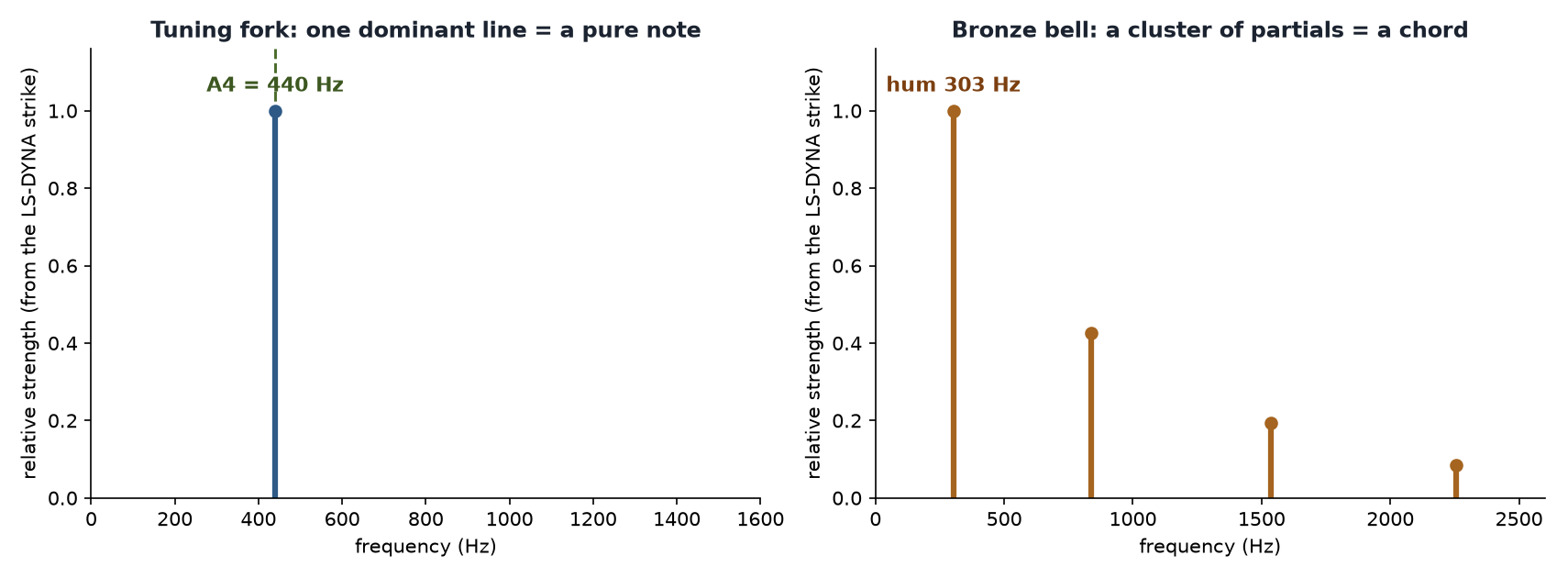
Two spectra: the tuning fork with one dominant line at 440 Hz, and the bronze bell with a cluster of partials starting near 303 Hz
The “recipe” of each sound — the partials that make up the audio clips below. The positions are the solved natural frequencies; the heights are how strongly a real strike (the LS-DYNA solve, next section) excites each one. One dominant line (fork) reads as a pure note; a cluster (bell) reads as a chord. Here is the honest part: a real founder’s bell has its partials deliberately tuned to a near-musical hum : prime : tierce : quint : nominal relationship. Our bell is a plain revolved profile, so its partials fall where the geometry puts them — a bright, slightly clangy arrangement rather than a cathedral-sweet one. Pulling those partials into harmony by shaving the profile is exactly the centuries-old art of bell-founding.

Now actually hit it — in a different solver

A modal analysis is elegant but abstract: it never actually strikes anything. So we did the whole thing a second way, in Ansys LS-DYNA, an explicit-dynamics solver built for real, time-marching events. We pulled the fork’s tines apart and released them — a real way to set a fork ringing — and watched a point on the tip move, microsecond by microsecond: the raw, ringing vibration on the left below. Run that ringing through a Fourier transform and it tells you the pitch.
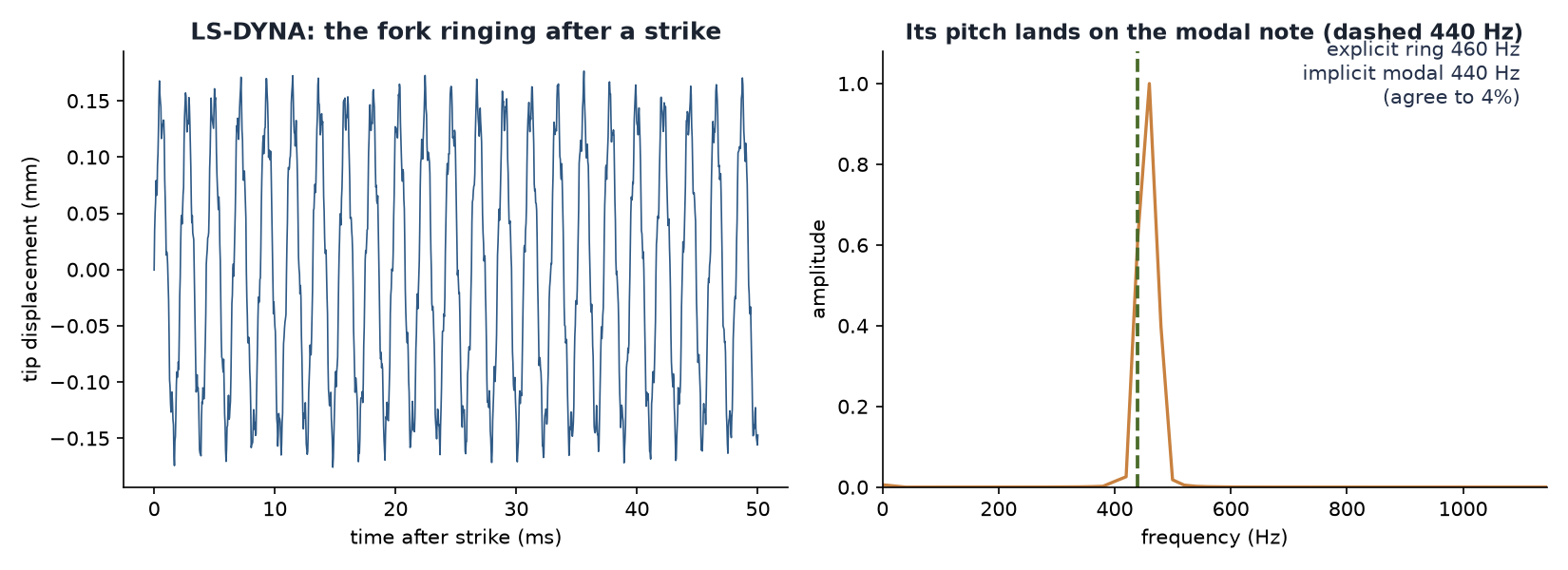
Left: the fork tip ringing after a strike. Right: its frequency spectrum peaking near 460 Hz, next to the Mechanical modal line at 440 Hz
The time-domain check. LS-DYNA sets the fork ringing and it sustains for tens of milliseconds (left); the pitch of that ring (right) lands close to the 440 Hz that Mechanical’s modal solve found independently — about 4–5% sharp. That small gap is expected and honest: the explicit strike uses simple straight-sided (linear) elements that stiffen a slender bending tine slightly, while the modal solve uses higher-order elements and is the accurate value. (Both models use the same steel, so nothing but the element type separates them.) Two solvers, two completely different methods — one frequency-domain and implicit, the other time-domain and explicit — landing on the same note from opposite directions.

That agreement is the point. When a frequency-domain modal solve and a time-domain explicit strike converge on the same pitch from opposite directions, you can trust the answer — and you have both the clean spectrum and a physically faithful picture of the object being hit and ringing down. We strike the bronze bell the same way, a clapper against the rim, and its ring confirms the mouth-ovalling hum.

So—what does it actually sound like?

Here is the part everyone asks for. Once you have the modal frequencies (the accurate pitches) and the strike (how loudly a real hit excites each one), you can rebuild the sound: take each partial at its solved frequency, give it the loudness the LS-DYNA strike measured, let it fade like real metal, and add them up. The pitch and the balance of overtones both come straight from the simulation — the only thing we add is the fade-out, because a perfectly elastic model rings forever and real metal doesn’t. Press play:

The tuning fork — one clean, sustained tone at 440 Hz. Concert A, exactly as a fork is designed to give. If you have an instrument or a tuning app nearby, check it.
The bronze bell — a low hum near 303 Hz with a stack of brighter partials ringing on top and decaying together. You can hear the chord, and the faint clanginess of a profile that was never founder-tuned.

How it was modeled

Each shape was drawn parametrically in CAD — the fork sized so its anti-phase tine mode lands on A 440, the bell as a real church-bell profile (flared mouth, thick sound-bow, concave waist, hanging crown) in cast bell-bronze. Each was imported into Ansys Mechanical and solved for its natural frequencies, with a coarse-vs-fine mesh check so the reported pitch is converged, not a mesh artifact. The fork is structural steel throughout. For the bell, the modal ran on a steel basis and was converted to cast bell-bronze by the stiffness-to-density ratio — a bell’s mode shapes are essentially independent of which metal it is (exactly so if the two Poisson ratios matched; steel’s and bronze’s differ just enough to move the pitch under half a percent), so only the frequency scales — and the decorative crown loop (which sits at a still node) was left off the solved body since it doesn’t change the note. The strike was re-meshed and handed to LS-DYNA, which excited each part and integrated the free vibration forward in time; a Fourier transform of the ring recovered the pitch to cross-check the modal result and measured how strongly each partial was excited. The audio takes its frequencies from the modal solve and its partial balance from the LS-DYNA strike, with a physical decay envelope. Everything ran headless on the firm’s own licenses.

Honest scope. The rigorous output here is the set of natural frequencies — mesh-converged and confirmed by two independent solvers. The materials are the real ones (steel fork, bell-bronze bell), so the pitches are “a steel fork / a bronze bell of these dimensions,” not a specific product; the bell’s pitch comes from a steel-basis modal converted to bronze by the stiffness-to-density ratio, exact but for a sub-half-percent Poisson-ratio effect. The bell is a generic revolved profile, deliberately not founder-tuned — that is why its partials are inharmonic, and saying so is the whole point of the bell section. In the synthesized audio the frequencies are from the modal solve and the partial loudnesses from the LS-DYNA strike; the decay envelope is a physical metal-Q model laid on top, because a lossless elastic solve never stops ringing. The explicit strike uses linear tetrahedra (which stiffen bending slightly, nudging the fork’s explicit pitch about 4–5% above the accurate modal 440 — both models use the same steel, so this residual is purely the element type), and the bell strike carries a tiny amount of numerical mass-scaling (about 0.3%, to keep a few sliver elements in the thin wall from stalling the time step) — both standard, both disclosed, neither changes the note you hear. What is robust and transferable is the method: a shape’s sound is its modal spectrum, a fork concentrates it into one tone while a bell spreads it into a chord, and modal-plus-explicit cross-validation nails the pitch.

Have a part that hums, whines, rattles, or rings when it shouldn’t — a bracket buzzing at an engine order, a panel booming, a housing singing at its resonance? The same modal-and-explicit toolchain that read the note off these CAD files is exactly how Rand Simulation finds a structure’s resonances before they become a warranty problem, and tunes the geometry to move them out of harm’s way. That is innovation through insight.
RS
Rand Simulation — Applications Engineering AI

Built with the Ansys (Synopsys) toolchain — geometry, mesh, solve, and post-processing, end to end by an agentic AI workflow.