
Why Cheap Lenses Fringe Color — and How Zemax Designs the Fix
Look through a cheap magnifier or a toy telescope at something bright and you will see it: a faint colored fringe, blue on one side, red-orange on the other. That is chromatic aberration — a single lens cannot focus all colors of light to the same point, because glass bends blue light more than red. It is the oldest problem in optics, and the reason every real camera, microscope, and telescope objective is built from two or more glasses. We put it under Ansys Zemax OpticStudio: measured exactly how badly a single lens fringes, then let the software design the two-glass fix itself.
The problem: glass is a weak prism
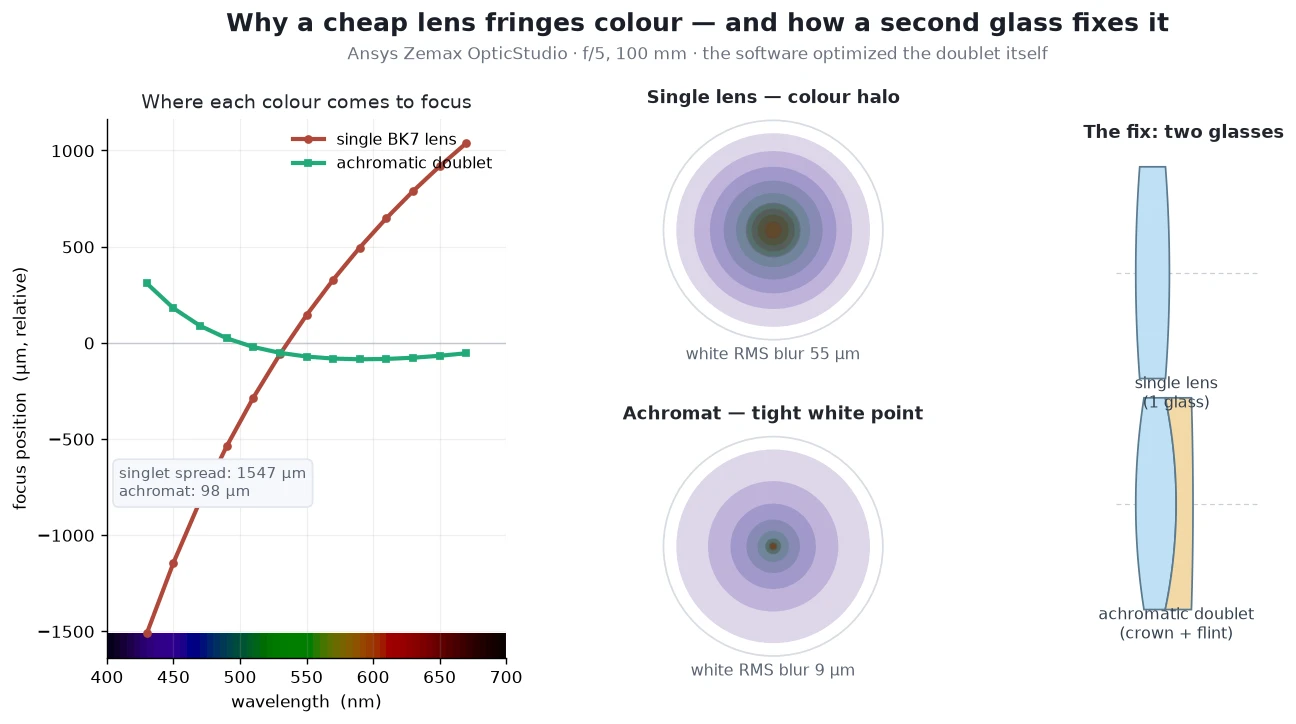
Every lens is, in a sense, a prism that has been bent into a circle — and like a prism, it disperses: its refractive index is slightly higher for blue light than for red. A common optical crown glass (N-BK7, the modern version of the classic BK7) bends the blue F line (486 nm) noticeably more than the red C line (656 nm), so blue rays cross the axis sooner and red rays later. There is no single plane where all colors are in focus. Put a single f/5, 100 mm N-BK7 lens in Zemax and trace the three reference colors, and the focus positions spread over 1547 µm — a millimeter and a half. A thin-lens hand check lands in the same place: a simple lens’s F-to-C focal spread is just f / Vd, the focal length divided by the glass’s Abbe number, which for N-BK7 (Vd ≈ 64.2) at f = 100 mm is 100/64.2 ≈ 1.56 mm — within about 1% of the 1547 µm Zemax traced for the real singlet. On a sensor placed at best white focus, a point of light smears into a colored blur about 55 µm in RMS spot radius: the fringe you can see with your eye.
Try it: move the sensor, chase the color
Here is what makes chromatic aberration so stubborn. Slide the sensor position below and watch each lens. For the single lens, you can bring one color to a crisp point — but the others bloom into halos, and there is no position where they are all sharp at once. For the achromat, all three colors snap tight together and stay that way. That is the whole game of color correction, in one slider.
The fix: let two glasses fight each other
You cannot cancel dispersion with a single glass — but you can with two. Pair a low-dispersion crown (N-BK7) with a high-dispersion flint (F2), one converging and one diverging, and choose their powers so their color errors are equal and opposite while their focusing powers still add up. The blue and red come back to a common focus; only a tiny higher-order residual (the “secondary spectrum”) remains. This is the achromatic doublet, invented in the 1700s and still in essentially every lens today.
We did not hand-tune it. We handed Zemax the two glasses and a target — keep the focal length at 100 mm, drive the axial color to zero, minimize the white-light blur — made the lens radii variable, and ran the optimizer. It converged on a cemented doublet (radii 50.1 / -38.1 / -257.3 mm) that pulls the color spread from 1547 µm down to 98 µm — a 16× improvement on that F–C axial-color metric — and shrinks the white-light RMS blur from 55 µm to 9 µm, about 6× on the quantity that actually reaches the sensor. That is the authentic lens-design loop: define what “good” means, set the variables free, let the solver find the glass shape.
| f/5, 100 mm lens | Color focus spread (F–C) | White-light blur (RMS) | Glasses |
|---|---|---|---|
| Single N-BK7 lens | 1547 µm | 55 µm | 1 (crown) |
| Achromatic doublet (Zemax-optimized) | 98 µm | 9 µm | 2 (crown + flint) |
Why an engineer cares
Chromatic aberration is a toy example of the whole discipline of optical design: define an image-quality target, expose the lens shapes and glasses as variables, and let a solver search a space no human can hold in their head — balancing color against spherical aberration, coma, field curvature, cost, and weight across every field and wavelength at once. That is how camera lenses, endoscopes, lithography optics, AR/VR headsets, LiDAR, and space telescopes are actually designed. The single-lens-vs-doublet story is where every optical engineer starts; the same Zemax loop scales to a fifteen-element cinema zoom.
Designing or troubleshooting an optical system — a lens, an illuminator, a sensor front-end — and need to know how it will really perform across color, field, and tolerance? The same Ansys Zemax OpticStudio workflow behind this study — build, analyze, set the variables free, optimize — is how simulation turns “it looks blurry” into a manufacturable prescription. That's innovation through insight.