
Watermelon vs the Rubber-Band Belt: Where It Splits, and How It Bursts
It is one of the internet’s great patient thrills: wrap rubber band after rubber band around the middle of a watermelon and wait. BuzzFeed did it live to 800,000 people in 2016 — the melon started weeping juice around band 660 and blew its top near 690. Two questions a fruit stand can’t answer but a solver can: where does the rind give way first, and once it does, how does the whole thing come apart?
The physics: the rind fails in tension, not in the squeeze
It feels like the bands crush the melon. They don’t — not directly. The belt pushes inward at the equator, but watermelon flesh is mostly water, and water doesn’t compress. Cinch the waist and that volume has to go somewhere, so the melon bulges above and below the belt and the rind is forced to stretch. Rind is strong in compression and weak in tension, so the failure never happens where you are pushing; it happens just off the belt, where the skin is bent outward and pulled tight. Keep tightening and the tensile stress there climbs until it reaches the rind’s breaking strength — and it splits along the belt line.
Inside the model
We built the melon as a 250 mm-diameter sphere (radius 125 mm) with a well-conditioned all-hex mesh — about 6,900 solid elements, a soft flesh core (elastic modulus ~2 MPa, treated as nearly incompressible, like the water-filled fruit it is) under a stiffer rind skin (~15 MPa, roughly 12 mm thick). The rind is given a tensile failure at its measured breaking stress, 1.15 MPa, so an element tears out of the skin once it is pulled past that; the flesh carries a low tensile cutoff of its own, so it fragments and sprays rather than stretching like taffy. The load is an equatorial belt pressure standing in for the accumulating bands, ramped slowly so the melon responds quasi-statically up to the tear — and then kept climbing so the failure can propagate and the halves clear the frame. The solver is Ansys LS-DYNA R16, double precision, units in g–mm–ms, full 360° melon (no symmetry, so the crack is free to run wherever the physics sends it). Reading the belt pressure back to a band count is a one-line force balance: a band of tension T wrapped on radius R over a belt of width w presses with pressure N·T / (R·w). With R = 125 mm, a per-band pull T ≈ 4 N and the model’s ~38 mm-wide belt, the 0.8 MPa first-tear pressure returns N = p·R·w / T ≈ 950 bands (the ~956 quoted later), and the thin-wall hand calc’s lower pressure lands near 280 — but because T itself is only known to about a factor of two, so are both counts.
Past the threshold: the crack runs and the melon bursts
Finding the tear is only half the fun; the reason people film this is what happens next. So we kept squeezing past the first tear and let the explicit solver carry the failure through. The story the model tells is the same one the camera does. The first rind element gives way at the belt edge, and because the near-incompressible flesh keeps the whole midriff loaded, the tear doesn’t stay a single nick — it runs right around the belt line and up and down off it, unzipping the skin along the equator. Once the belt has parted all the way around, the melon is no longer one body: the top dome lets go and lifts off, the bottom becomes a bowl, and the squeezed flesh — which has been storing energy like a compressed spring — decompresses and throws the halves apart, flinging red debris out of the middle. In slow motion you can watch the pale rind edge appear as the skin tears and the flesh spray follow it out. It is the same “splits at the waist, pops its top” signature the BuzzFeed melon showed — a threshold event, nothing then everything, driven by the water the fruit is mostly made of.
Is it right? A hand-calc, a measured strength, and a viral stunt
One animation can look like a trick, so we pinned the number down three independent ways. First, a back-of-the-envelope control: treat the pressurized melon as a thin-walled sphere (wall stress = p·R / 2t) and solve for the belt pressure that reaches the rind’s strength — that puts the split near 280 bands. Second, the rind strength itself is not invented: laboratory tensile tests of watermelon rind report a failure stress of 1.1–1.2 MPa, which is exactly the value we hand the model. Third, the BuzzFeed stunt landed near 690. All three sit in the same few-hundred-band band.
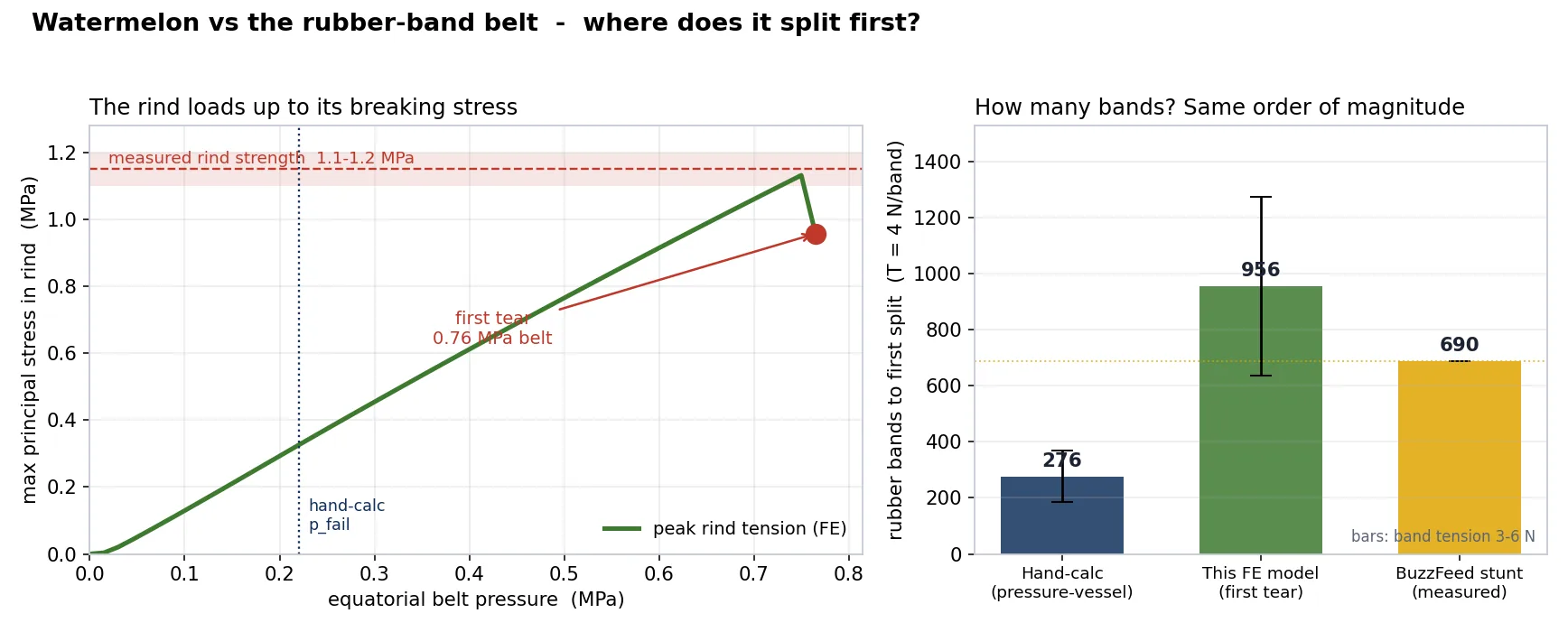
The interesting disagreement is why the two calculations differ. The napkin math assumes the whole rind pressurizes like a balloon, so it thinks the skin reaches its limit early. The FE model shows the real load path: the near-incompressible flesh shoves the load into a narrow ring at the belt edge, and the sphere quietly ovalizes — which means it can take a good deal more squeezing before that ring reaches breaking stress. That gap is precisely the value of running the solve instead of the formula.
The real-world connection
The slow-motion melon is a genuinely good physics demo because the failure is a threshold, not a gradual crush — nothing, nothing, nothing, then all at once the belt lets go and the halves fling apart on the stored water pressure. What makes it worth an explicit-dynamics solve rather than a formula is that both halves of the answer fall out of the same model: where and when the skin first fails (a quiet, quasi-static stress problem) and how it comes apart afterward (a violent, large-deformation one, with elements tearing free and fragments flying). The same physics — a stiff skin over a nearly incompressible, pressurized interior, failing in tension at a stress concentration and then unzipping — shows up wherever a filled, sealed, or turgid part lets go: a bulging battery cell, an over-pressured gasket or seal, a sealed food package, a soft-goods enclosure. The fruit just makes it delicious to watch.
Have a soft, layered, or water-filled part that fails somewhere non-obvious — a seal, a gasket, a food package, a soft-goods enclosure? Squeeze-to-failure of soft materials, with the tearing skin and the honest “where does it go first,” is the kind of workflow that helps teams find the weak seam before the field does. Innovation through insight.