
Why Does Dropped Toast Always Land Butter-Side Down?
Your phone is full of slow-motion toast clips, and every one ends the same way: butter-side down, every time. It feels like the universe has it in for breakfast. It doesn’t. It’s physics — and, as the physicist Robert Matthews showed in 1995, it comes down to two numbers you can’t change: the height of your table and the value of g. We built the tumble in Ansys LS-DYNA and let a slice slide off a table edge to see exactly how far it turns before it hits the floor.
The physics: it’s a half-turn, and a table is exactly the wrong height
Toast doesn’t topple because it’s buttered — it topples because it gets nudged past the edge. Once its center of mass clears the lip of the table, gravity torques it about the edge and it starts to rotate. It leaves the edge with a fixed spin, and then it’s a free-falling object: it keeps turning at that same rate until it lands. So the landing orientation is set by one race — how many turns it can fit into the time it takes to fall.
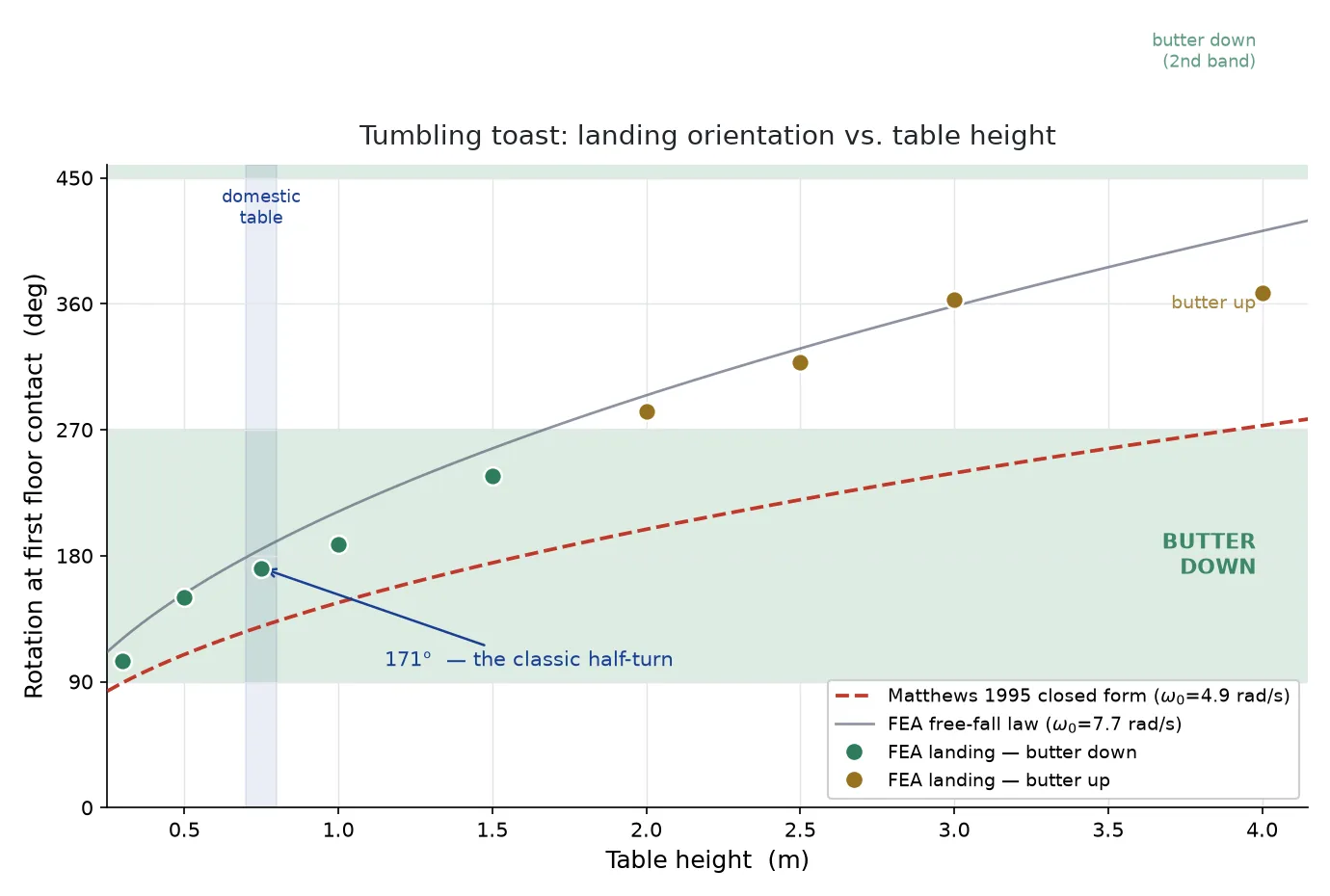
And that time is short. A slice leaving a 0.75 m table is in the air for about 0.39 s. At the spin it picks up off the edge, 0.39 s buys it roughly half a rotation — 180°. Butter started up; half a turn later it’s down. To land butter-up again you’d need it to complete three-quarters of a turn or more, and that takes a taller table than almost anyone owns. The whole domestic range of table heights lands inside the butter-down band. That is Murphy’s Law — not bad luck, just geometry.
Inside the model
The slice is a 100 × 100 × 12 mm slab (a real slice of toast), meshed with 300 hex elements and given the density of bread (~0.25 g/cm³). A thin top layer is tagged as the butter so we can track which way it points. The table is a rigid surface with a sharp edge and realistic bread-on-laminate friction (μ = 0.3); the floor is a rigid plane a table-height below. Gravity is the only load. We give the slice a small horizontal shove so it slides off the edge, then let Ansys LS-DYNA (explicit dynamics, g-mm-ms units) integrate the pivot, the detachment, and the fall — and we read the rotation angle at the instant the first corner touches the floor. Then we swept the table height from 0.3 m to 4 m.
Is it right? Matthews’ hand-calc vs. the FEA
This exact problem won Robert Matthews an Ig Nobel Prize in 1996, and his 1995 paper (Eur. J. Phys. 16, 172) gives a closed form for it: the slice leaves the edge with an angular velocity set by the overhang and friction, then rotates ω₀·τ more during a free fall of time τ = √(2h/g). Matthews’ numbers say a 0.75 m table gives about half a turn (butter down), and that escaping Murphy needs a table of order 3 m. Our FEA reproduces the half-turn at 0.75 m independently — it computes the departure spin from first principles (the overhang lever, the edge friction, the detachment), and lands ω₀ ≈ 8 rad/s, the same 5–9 rad/s ballpark as the closed form. The control isn’t one simulation; it’s that a 30-year-old pencil-and-paper result and a modern contact solve agree on the thing that matters — the half-turn that dooms your toast.
Where they differ is instructive. Our slice leaves the edge with a little more spin than Matthews’ canonical figure, so in our model the escape to butter-up arrives nearer 1.8 m than his 3 m. The extra spin is set by how the slice leaves the edge — the launch — not by the two things you might expect. We swept edge friction (μ = 0.15–0.5) and slab stiffness (a 20× change), and the landing angle barely moved — 176–181°, butter-down every time. The launch is the real lever, and it is what opens the two escape routes.
The real-world connection
The escape routes fall straight out of the same sweep. Swat the toast off hard and it leaves the edge with almost no spin — it sails off nearly flat and stays butter-up. Nudge it too gently and it clings to the edge, pivots too far before it lets go, and over-rotates past the recovery point — butter-up again. Only the ordinary slide in between — the one that actually happens at breakfast — lands in the butter-down band. Matthews’ punchline was that you can’t win by being careful; you’d have to eat at a table taller than you are. A better fix, he noted dryly, is to butter the other side.
Need the landing orientation, the impact angle, or the tumble of a real part — a dropped phone, a deploying mechanism, a part coming off a conveyor? The same Ansys explicit-dynamics workflow — contact, friction, gravity, and an honest sensitivity bracket — is how simulation can answer “which way does it land, and how hard” for hardware that matters. Innovation through insight.