
Does the Pistol Shrimp Really Boil Water With a Snap of Its Claw?
The pistol shrimp is barely the size of your thumb, but it hunts with a bang. It snaps one oversized claw shut so fast that it fires a jet of water across the gap — and something in that jet flashes bright, cracks louder than a real gunshot, and stuns the prey. The story that gets passed around is that the snap is so violent it boils the water. It is a great line, and it is wrong in an interesting way. The water never gets hot enough to boil. It does something stranger: it cavitates, tearing itself apart at room temperature because the pressure — not the temperature — crosses a threshold. We built the jet in Ansys Fluent to find that threshold, and then did the collapse arithmetic that produces the famous flash.
The physics: boiling and cavitation look alike and are opposites
Both boiling and cavitation turn liquid water into vapor, so from across the room they can look like the same thing — bubbles. But they get there from opposite directions on the same phase diagram. Boiling raises the temperature until the water’s vapor pressure climbs up to meet the surrounding pressure. Cavitation holds the temperature fixed and drops the local pressure down below the vapor pressure. Same phase change, crossed from opposite sides. A pot on the stove boils; a ship’s propeller, a garden hose pinched at the nozzle, and a snapping shrimp claw all cavitate.
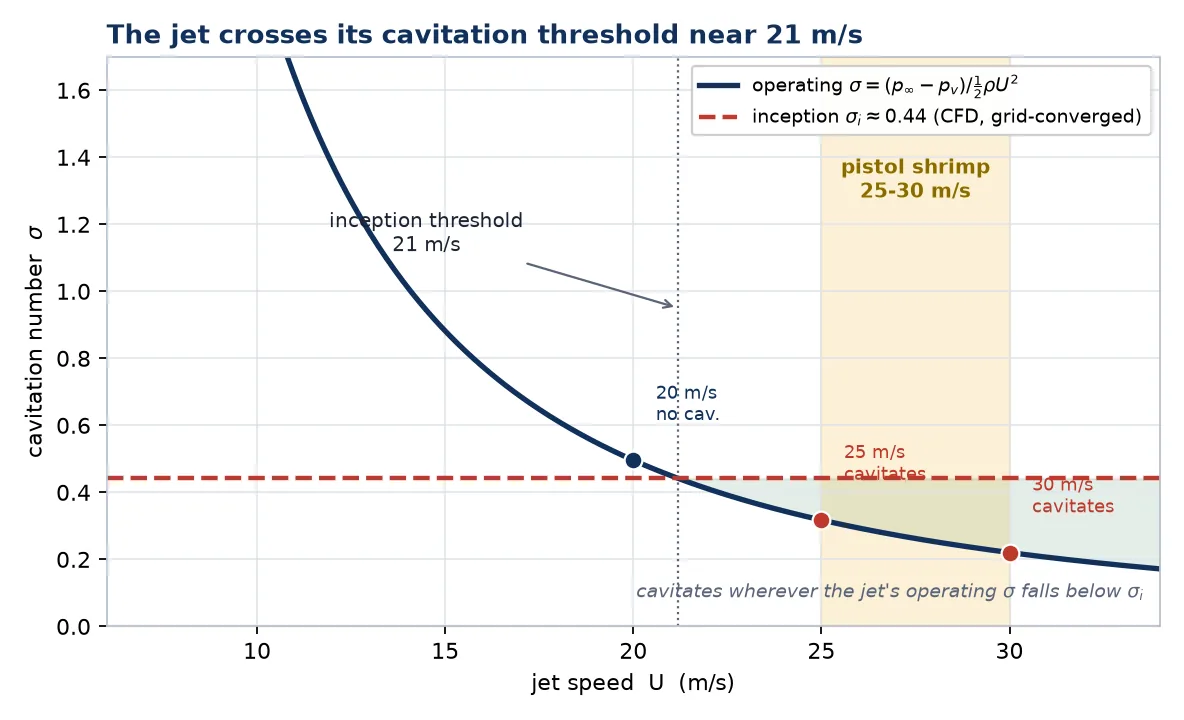
Whether a flow cavitates is captured by a single dimensionless number, the cavitation number σ = (p∞ − pv) / (½ρU²): the pressure margin you have above vapor pressure, divided by the dynamic pressure of the flow. Fast flow (big U) shrinks σ. When σ drops low enough that some corner of the flow reaches a local pressure below pv, a vapor cavity opens. For water at one atmosphere the margin p∞ − pv is about 99 kPa; a 25 m/s jet carries a dynamic pressure of 312 kPa, so σ is only about 0.32 — already well under one. The question our model answers is the precise one: does the jet actually produce a spot that low, and at what speed does it start?
Inside the model
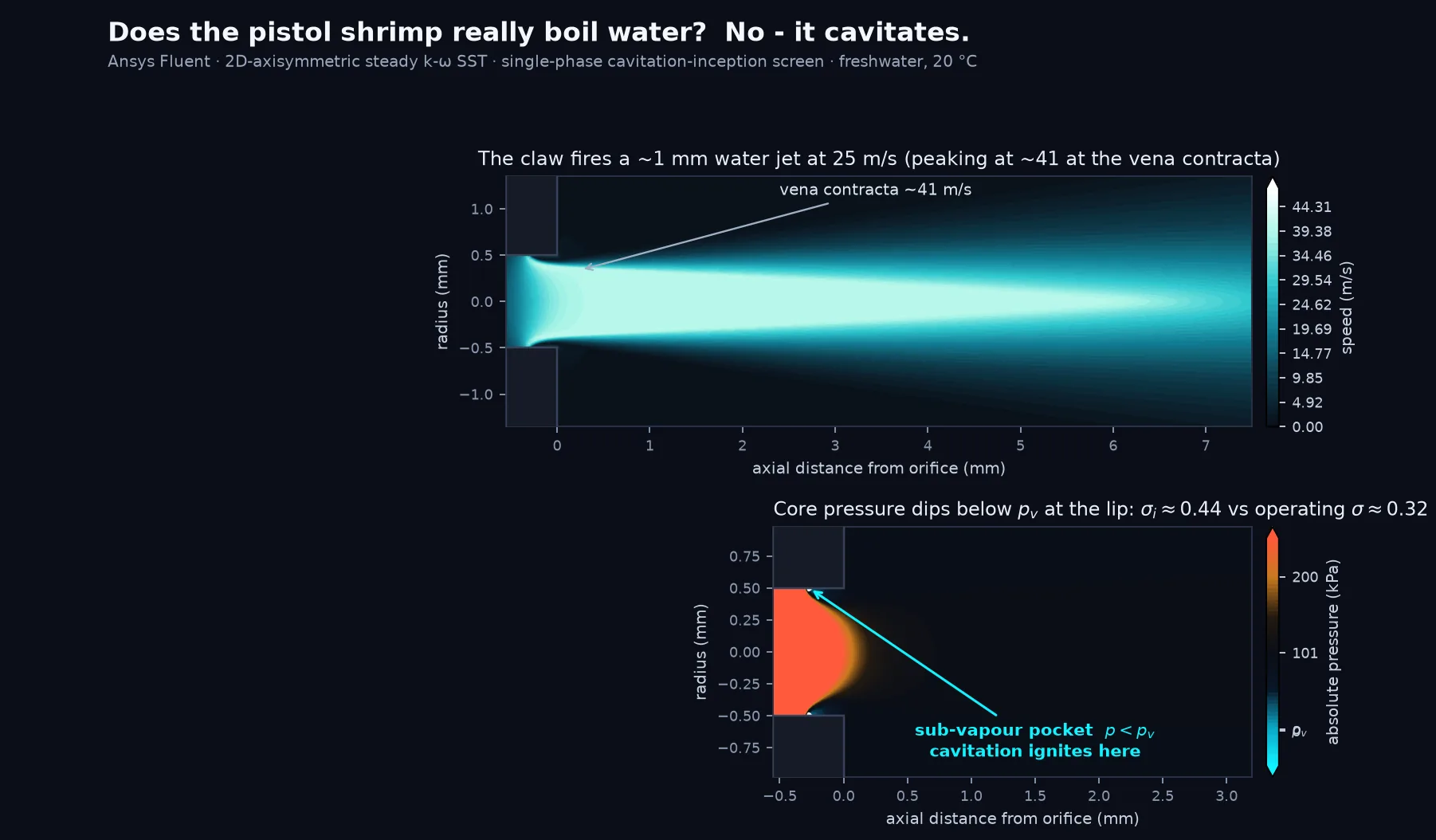
We idealized the claw as an axisymmetric sharp-edged orifice: a pressurized plenum driving water through a 1 mm aperture in a thin plate into a large pool — the textbook cavitating-orifice geometry, and the mechanism a steady solve can actually resolve. The mesh is a structured, graded quad grid of about 37,000 cells — the baseline density, one level inside the 14,000-to-84,000-cell grid-convergence study reported below — clustered hard at the orifice lip (first cells a few microns across) so the suction peak is captured, opening out into the pool. The working fluid is liquid water (ρ = 998 kg/m³, μ = 1.0 mPa·s) at an operating pressure of one atmosphere, with vapor pressure pv = 2.3 kPa. The solver is Ansys Fluent, 2D-axisymmetric, steady, k–ω SST turbulence (the jet Reynolds number is ~25,000, firmly turbulent), pressure-based coupled. We drove the throat at 20, 25 and 30 m/s and read the minimum pressure off each converged field.
This is deliberately a single-phase inception screen, not a two-phase bubble solve. We are not growing and collapsing vapor bubbles; we are asking a sharper, cheaper question — where, and by how much, does the pressure fall below pv? — and reading the threshold off it. A single-phase model has no mechanism to actually boil, so it lets the suction peak dip below vapor pressure (even, at the sharpest point, below a perfect vacuum); that unphysical-looking dip is precisely the cavitation tell, and we interpret it rather than “fixing” it.
Is it right? A curve, a control, and a grid check
Three things make us trust the threshold. First, the physics should collapse onto one curve, and it does: because the pressure field of a high-speed jet is fixed by geometry, the normalized pressure coefficient at 20 m/s and at 30 m/s are the same field to within 2% — so σi really is a property of the aperture, and the only thing that changes with speed is the operating σ sliding down its 1/U² curve to cross it.
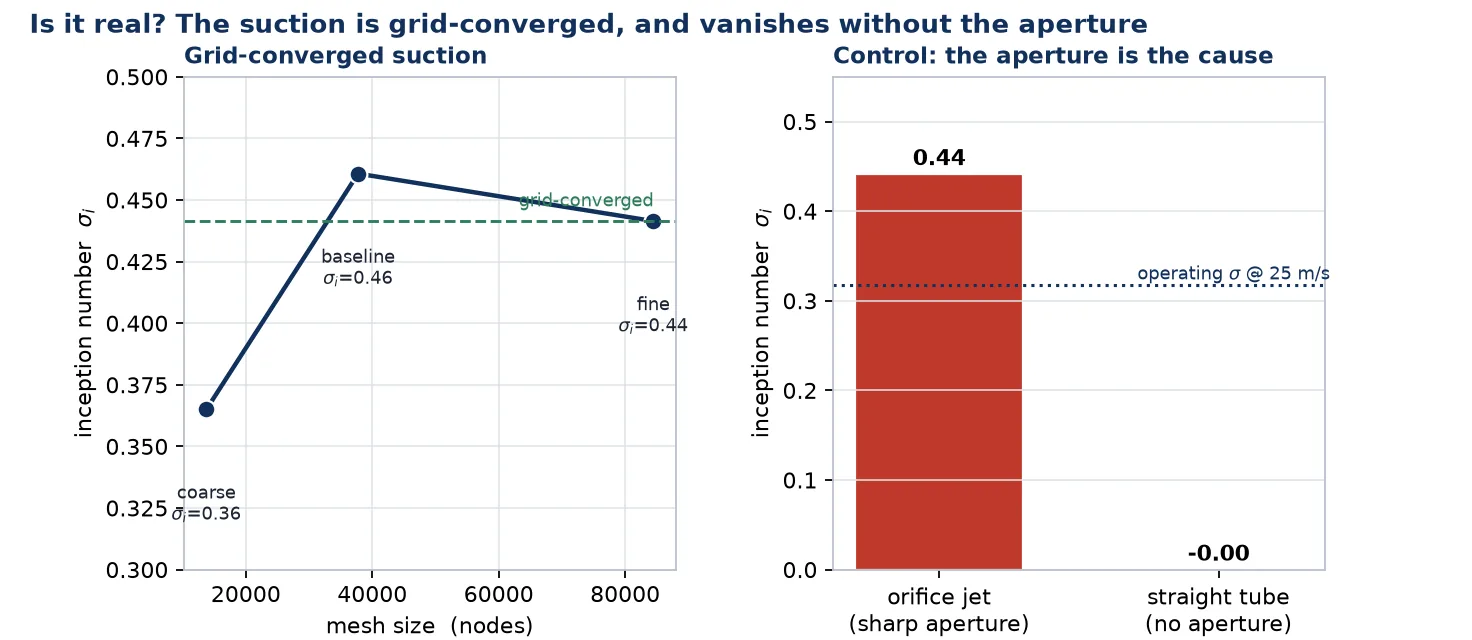
Second, the control. A skeptic could argue the low-pressure pocket is a numerical artifact of a sharp corner. So we ran the identical solver, fluid and speed through a straight tube of the same diameter — same flow, no aperture. Its pressure never once dips below ambient, let alone below vapor pressure (σi = 0). The suction is not the mesh and not the solver; it is the aperture, exactly as the vena-contracta picture predicts. Third, a grid check: refining from 14,000 to 84,000 cells moves σi from 0.37 to a settled 0.44, and the minimum stays pinned to the same physical spot on the lip — a converging separation pressure, not a runaway singularity.
One honest caveat sits on top of all of this, and it points the same way. A steady RANS solve smooths out the unsteady, rolled-up vortices in a real turbulent jet’s shear layer — and those vortex cores are themselves low-pressure and are a major site of real jet cavitation. So our steady σi = 0.44 is best read as a conservative floor: the true jet reaches vapor pressure at least this readily, probably more. The snapping shrimp’s claw jet was measured at roughly 25–30 m/s by Versluis and co-workers (M. Versluis et al., “How Snapping Shrimp Snap: Through Cavitating Bubbles,” Science 289, 2114–2117, 2000); at those speeds the operating cavitation number of the jet works out to σ ≈ 0.3 (comfortably below one, and consistent with our own σ ≈ 0.32 at 25 m/s above) — the same conclusion from the other direction.
So where does the “flash” come from? The collapse, not the jet
Opening a vapor pocket is only Act One, and on its own it is gentle. The violence — the crack, the light, the stun — comes when that pocket collapses. The moment the fast flow moves on, the surrounding water at one atmosphere finds a near-vacuum cavity and rushes in to fill it. There is nothing to hold it back until the tiny slug of gas and vapor left inside is compressed to a stop. All the inrushing water’s kinetic energy funnels into a volume the size of a speck, in under a hundred microseconds. This is the classic Rayleigh collapse, and it is worth doing as a hand calculation because it is where the energy actually is.
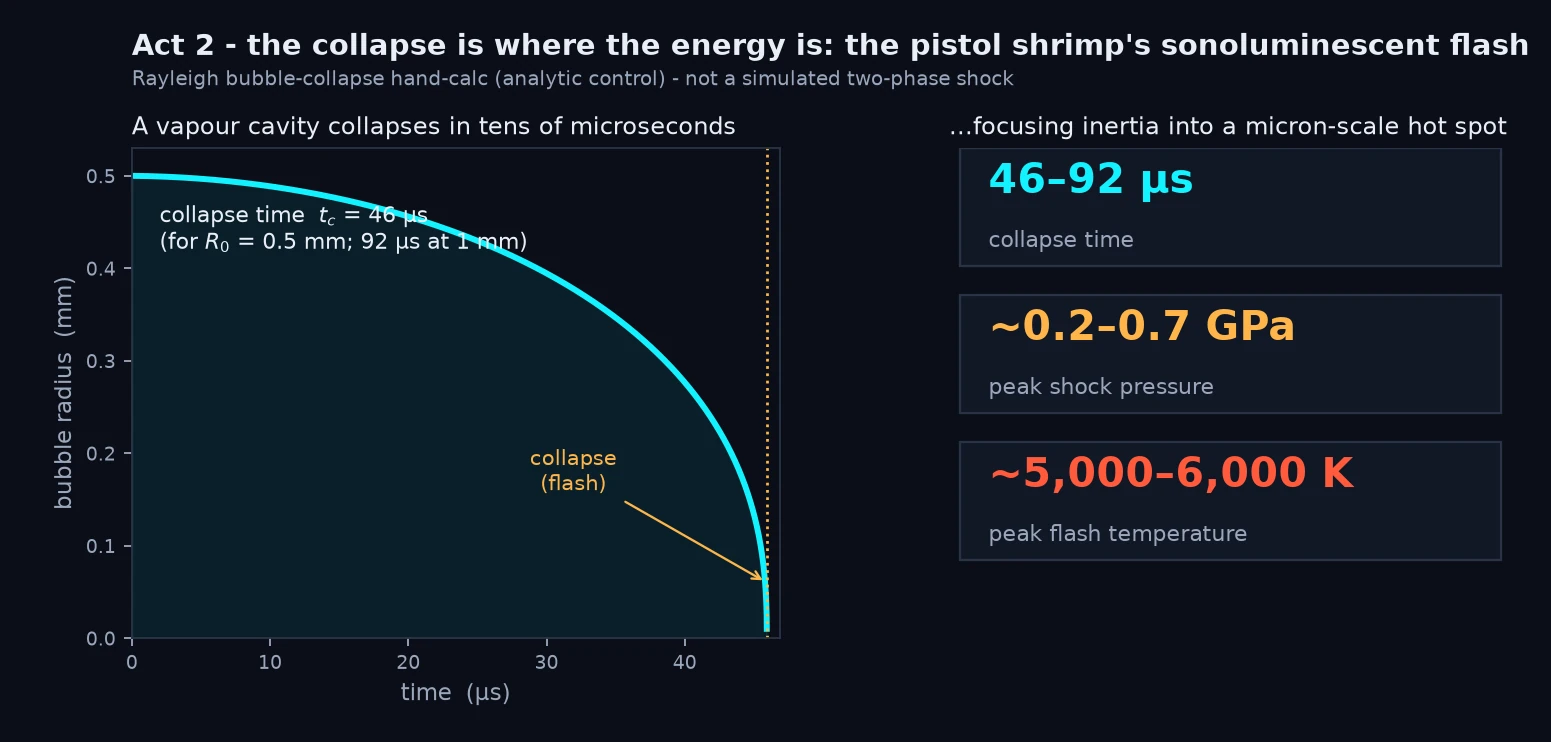
The numbers are blunt. A half-millimeter cavity collapses in about 46 microseconds (a one-millimeter one in ~92). Squeezing the trapped gas by a factor of twenty to thirty in radius drives the pressure to a few tenths of a gigapascal — the shock that makes the “bang” and does the stunning. And compressing that same gas adiabatically heats it to roughly 5,000–6,000 kelvin — hotter than the surface of the Sun, for a few billionths of a second, in a volume you would need a microscope to find. That flash of light has a name in the literature: shrimpoluminescence (D. Lohse, B. Schmitz & M. Versluis, “Snapping shrimp make flashing bubbles,” Nature 413, 477–478, 2001). So the myth-answer, stated properly: the water does not boil (that would need heat it never gets); it cavitates at room temperature because the pressure crosses a line, and the collapse of that cavity is what briefly reaches thousands of degrees. A flash, not a boil.
The real-world connection
This is not a party trick of biology — it is the same phenomenon that erodes ship propellers, pits pump impellers and hydro-turbine blades, and that engineers spend real money designing against. The shrimp’s claw evolved to aim it as a weapon; a pump designer’s job is to keep σ above σi so it never happens. Either way the governing quantity is the same cavitation number, and the same single-phase inception screen we ran here — minimum pressure versus vapor pressure, with a control and a grid check — is the first, cheapest question you ask of any pump, valve, or nozzle before committing to a full two-phase study.
Have a pump, valve, nozzle, or impeller where cavitation is the risk — and you need to know the margin, not the folklore? The same workflow we used here — a fast single-phase inception screen to find the threshold, a control to prove the mechanism, a grid check to trust the number, before any expensive two-phase run — is the kind of workflow that helps teams keep cavitation out of hardware that matters. Innovation through insight.