
Can a Penny Dropped From a Skyscraper Actually Hurt Someone?
It is the physics rumor that refuses to die: a penny dropped from the top of a skyscraper builds up so much speed on the way down that it punches through the sidewalk — or through the skull of whoever is standing below. Someone in the Ideas Lab asked us to settle it. So we did it in two parts: a CFD solve for how fast a falling penny can actually go, and an explicit-dynamics impact for what that speed could do when it lands.
The physics: a penny is a terrible skydiver
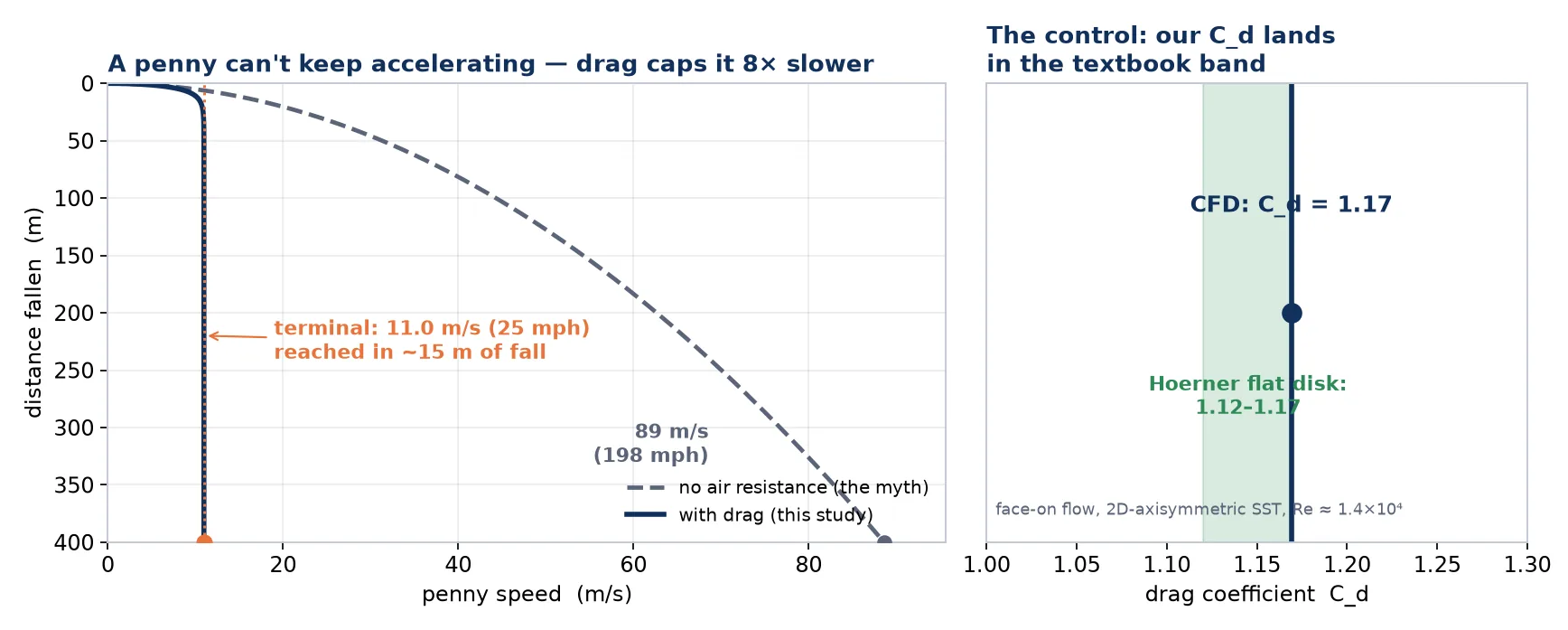
The myth assumes a penny keeps speeding up until it hits. It doesn’t. Everything falling through air feels drag that grows with the square of speed, and very quickly that drag rises to exactly cancel gravity. From then on the object stops accelerating and coasts at a constant terminal velocity. For a dense, streamlined dart that speed is high. For a light, flat, tumbling disc — which is precisely what a penny is — it is remarkably low.
A penny weighs only 2.5 grams but spans 19 mm, so it presents a lot of face to the wind for very little weight. Tumbling, it spends most of its fall broadside to the airflow, dragging a wide wake behind it. That wake is the whole story: it is what caps the speed.
Inside the model
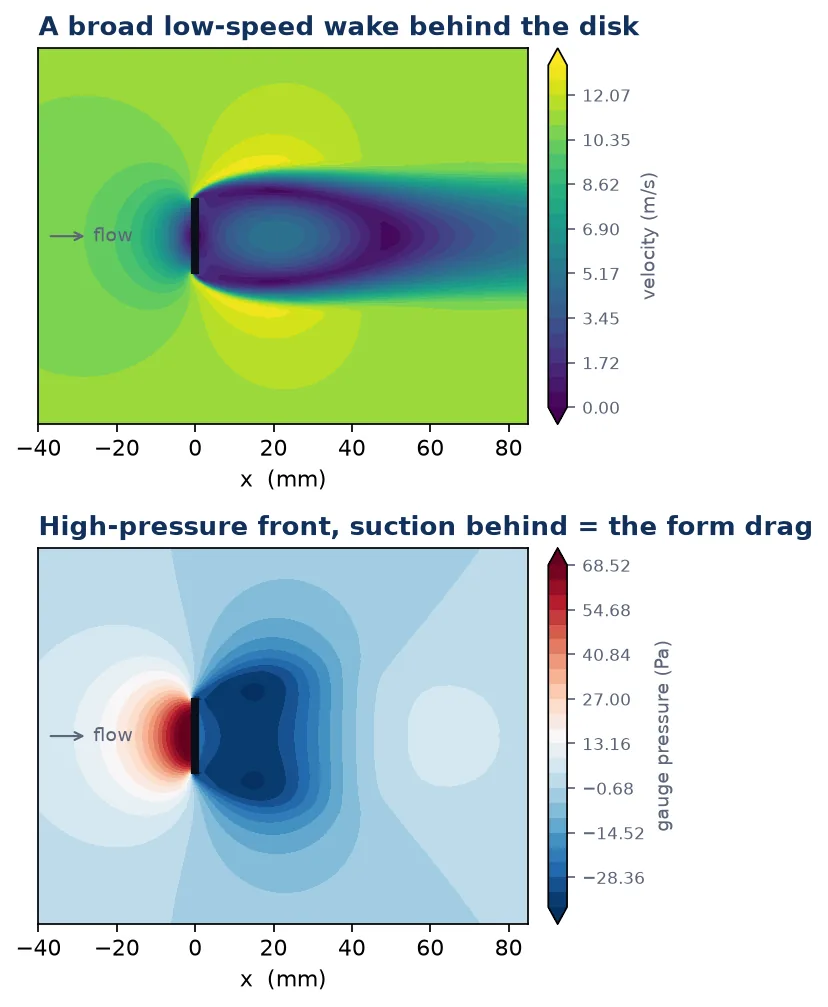
Two solvers, matched to two very different physics. For the fall we used Ansys Fluent: a 2D-axisymmetric external-flow model of air rushing past a face-on penny (the maximum-drag orientation), about 9,150 cells, steady k–ω SST turbulence, sea-level air, at the Reynolds number of the falling coin (~14,000). That solve returns the drag coefficient, and a simple force balance — drag equals weight — converts it to terminal velocity. For the landing we used Ansys LS-DYNA explicit dynamics: the penny as a 2,000-element solid of zinc (modern cents are >97% zinc under a thin copper skin), 96 GPa stiffness, 130 MPa yield, its true 2.5 g mass, struck against a rigid surface. A tumbling coin almost never lands perfectly flat, so we tilt it 20° and let it strike edge-first — the realistic case, which also spreads the impact out in time.
Is it right? Check the drag against the textbook
A CFD number is only worth as much as its validation, and this one has an unusually clean check. The drag of a flat disc held square to a flow is one of the most-measured quantities in aerodynamics — Hoerner’s classic data puts the drag coefficient at about 1.12–1.17, and it barely changes across a huge range of speeds. Our Fluent solve returns Cd = 1.17 — squarely on the textbook value (right-hand panel above). Because the disc drag is so nearly speed-independent, that agreement carries straight through to the terminal velocity: our ~11 m/s for a face-on penny is consistent with the widely quoted figure for a falling cent, and with what MythBusters measured when they put one in a wind tunnel.
One honest nuance: a tumbling penny isn’t always face-on, so it flickers through lower-drag angles and its real terminal velocity sits a bit above this face-on figure — the various estimates land in the 25–50 mph range. But even the top of that range carries under about one joule. The conclusion doesn’t depend on the last digit; it depends on the fact that drag wins by a landslide.
So what would it actually do?
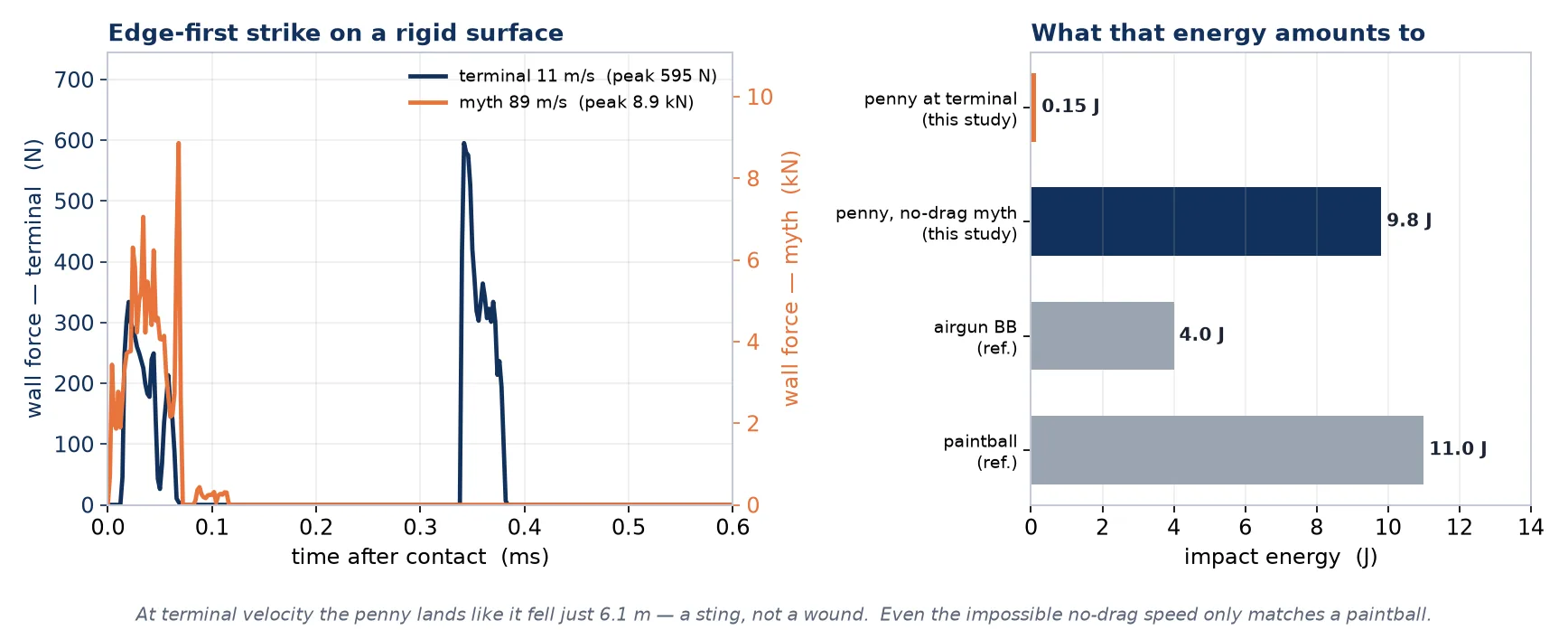
Here is the same LS-DYNA impact, run at the penny’s real arrival speed instead of the myth’s:
The numbers tell the same story from both ends of the scale. At terminal velocity the coin delivers 0.15 J; even the myth’s impossible 89 m/s version delivers 9.8 J — about the muzzle energy of a paintball. A paintball stings and can raise a welt; it does not break bone or bore through concrete. And in the fantasy case, all that energy is spent folding the soft coin, not punching a hole. Concrete shrugs off pressures thousands of times what a coin can muster, and skin, hair and skull sit far above 0.15 joules of blunt sting.
The verdict, and where it came from
MythBusters put this legend to a full-scale test years ago and called it busted; the physics classroom has used it as a terminal-velocity problem for decades. What Ansys adds is the why and the how much: the CFD shows the broad bluff-body wake that holds the coin to a gentle 25 mph, validated against the textbook disc; the explicit-dynamics impact shows that even the myth’s impossible speed only wrecks the penny. A dropped penny can startle you, sting you, and absolutely should not be thrown — but it is not going to punch through you or the pavement.
Need to know whether something survives the drop, the debris, or the gust — with the physics, not the folklore? The same pairing we used here — CFD for how the air actually behaves, explicit dynamics for the impact, each checked against a known number — is the kind of workflow that helps teams answer drop-test, wind-load, and impact questions on hardware that matters. Innovation through insight.