
Why an Induction Cooktop Won’t Heat Your Aluminum Pan
An induction cooktop looks like a magic trick. Water boils furiously in the pan, but you can lay your hand on the black glass an inch away and it is barely warm. Slide a paper towel under the pan and it does not scorch. Then you set your favorite aluminum saucepan on it — and nothing happens. The cooktop just beeps and gives up. The reason for all three is the same piece of physics, and you can watch it happen: we built the coil-and-pan system in Ansys Maxwell and solved for the invisible currents it drives into the metal.
The physics: the pan is its own heating element
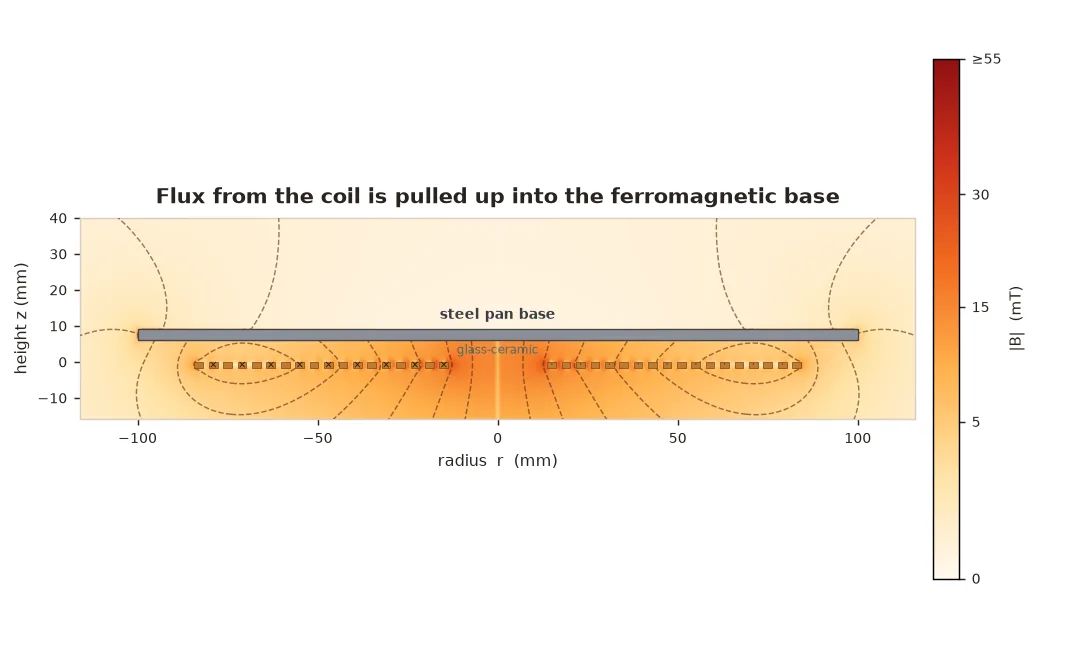
There is no flame and no glowing element under an induction cooktop — just a flat coil of wire beneath the glass, carrying an alternating current at tens of kilohertz. That current makes an alternating magnetic field, and the field passes straight through the (non-magnetic, non-conducting) glass as if it were not there. When it reaches a metal pan, a changing magnetic field through a conductor does what Faraday promised: it drives eddy currents — circulating loops of current — round and round in the metal. Those currents flow against the metal’s own electrical resistance, and resistance times current squared is heat. The pan cooks itself, from the inside of its own base. The cooktop never has to get hot; it only feels warm afterward because the pan warms it by contact.
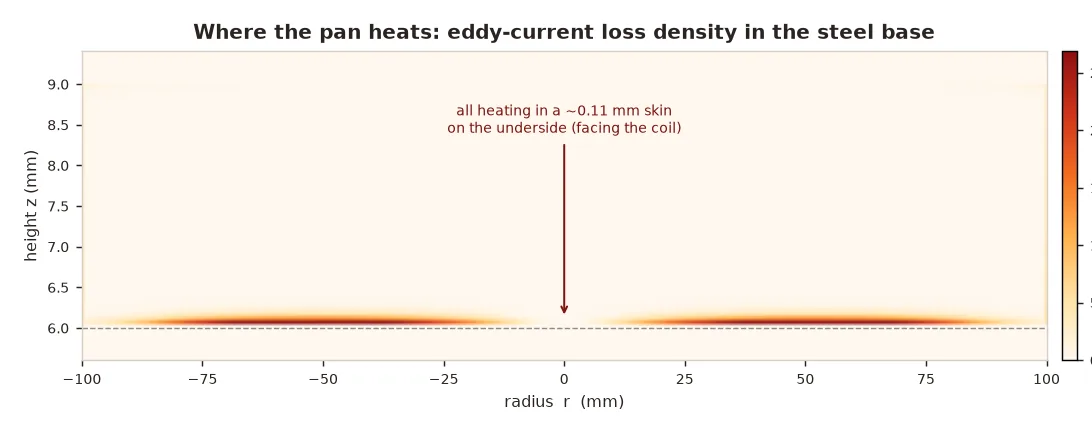
But the field does not soak evenly through the metal. An alternating field crowds the induced current into a thin layer at the surface facing the coil — the skin effect. The higher the frequency, the conductivity, and (crucially) the magnetic permeability of the metal, the thinner that layer. In a steel pan it is razor-thin, which packs the current into a tiny cross-section, drives the effective resistance up, and dumps the heat right where you want it.
Inside the model
The coil is an 18-turn copper pancake, its windings spanning radii from 15 to 83 mm, driven at 30 A RMS per turn at 24 kHz — a typical induction operating point. Six millimeters of glass-ceramic and clearance separate it from the pan. The pan base is a 200 mm-diameter, 3 mm-thick steel disc with the properties of the ferromagnetic (ferritic) stainless used in real induction cookware: resistivity 60 µΩ·cm and a relative permeability of 500. Because the coil and pan are both round, the whole problem is axisymmetric — a 2-D slice revolved about the centerline — which is what lets us resolve a 0.11 mm skin inside a 100 mm-wide pan without a supercomputer. Ansys Maxwell 2D solved it as an AC-magnetic (eddy-current) problem: one frequency, complex phasor fields, an adaptively refined mesh driven to a 1% energy-error target over 14 passes, with each copper turn a stranded (litz) current source and eddy currents allowed only in the pan. The power delivered was found by integrating the ohmic loss density over the pan volume.
Those two numbers hang together. Spread 541 W through the δ/2 ≈ 0.057 mm skin over the 200 mm pan face and the loss density averages about 305 MW/m³ — essentially the 310 MW/m³ peak, because the eddy currents spread over most of the face, so the ring maximum sits only just above the average.
Is it right? Two metals, one formula, both under 1%
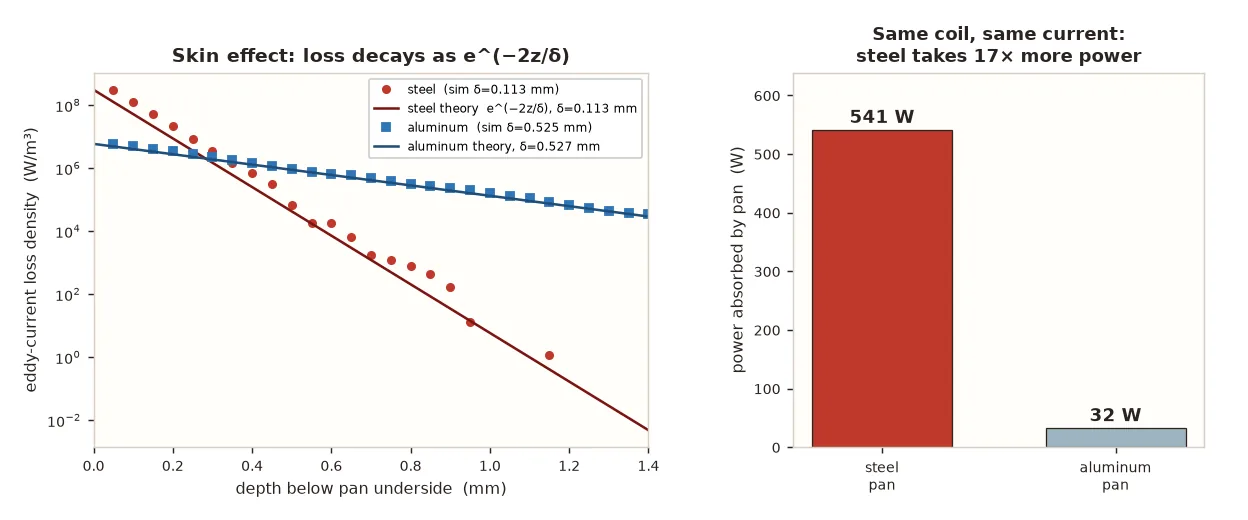
The believable part is not the wattage — it is that the skin the solver found matches a formula you can write on a napkin. The classical skin depth is δ = √(2ρ/ωμ): resistivity over frequency times permeability, square-rooted. Plug in the steel and it predicts a 0.1125 mm skin; Maxwell’s solved loss profile decays as e−2z/δ with a fitted depth of 0.1132 mm — a 0.6% agreement. Rerun the identical model with an aluminum base and the formula calls for a much fatter 0.527 mm skin (aluminum is non-magnetic and a far better conductor); the solver lands at 0.5254 mm, off by 0.3%. One equation, two metals with a 5× spread in skin depth, both nailed. That agreement — not the picture — is the reason to trust the wattage.
And the aluminum run is also the punchline. Under the exact same coil and current, the steel pan drank 541 W while the aluminum pan absorbed just about 32 W — roughly 17 times less. Aluminum’s problem is twofold: with no ferromagnetism (permeability of 1) it never concentrates the field, and its very low resistance means the eddy currents it does carry waste little energy. Its surface resistance to these currents is about a hundredth of steel’s. That is the whole story of induction cookware in one bar chart.
Why it matters: the magnet on the fridge knows
Every quirk of induction cooking falls out of this model. The magnet test — the one where a pan is “induction ready” only if a fridge magnet sticks to its base — is really a test for the ferromagnetism that gives you a thin, high-loss skin. Cast iron and magnetic stainless pass; plain aluminum and copper fail, exactly as our 17× gap predicts. It is also why “induction-compatible” aluminum pans exist at all: the manufacturer bonds a disc of magnetic stainless into the bottom so there is something for the field to grab.
The cool glass and the unscorched paper towel are the same physics read the other way: the field only dissipates power in a conductor it can couple to, so the glass-ceramic top and a sheet of paper sail through untouched, and the surface warms only by conduction from the pan sitting on it. And the reason induction is so efficient — roughly 85–90% of the electricity reaches the food, versus something like 40% for gas — is that the pan itself is the heating element, with no hot air or glowing coil throwing heat sideways. The field concentrating into the steel, in the animation above, is that efficiency.
Designing anything that moves power through a magnetic field — an induction heater, a motor or transformer, a wireless charger, a busbar, or the shielding around them? The same Ansys Maxwell workflow — geometry, an adaptive eddy-current solve, and losses and forces checked against the physics — is how simulation answers “how much power, how much heating, and where” before the first coil is wound. That’s innovation through insight.